Morgan Stanley Goes ‘Max Overweight’ Global Stocks, Calls 2027 the Year to Embrace Risk
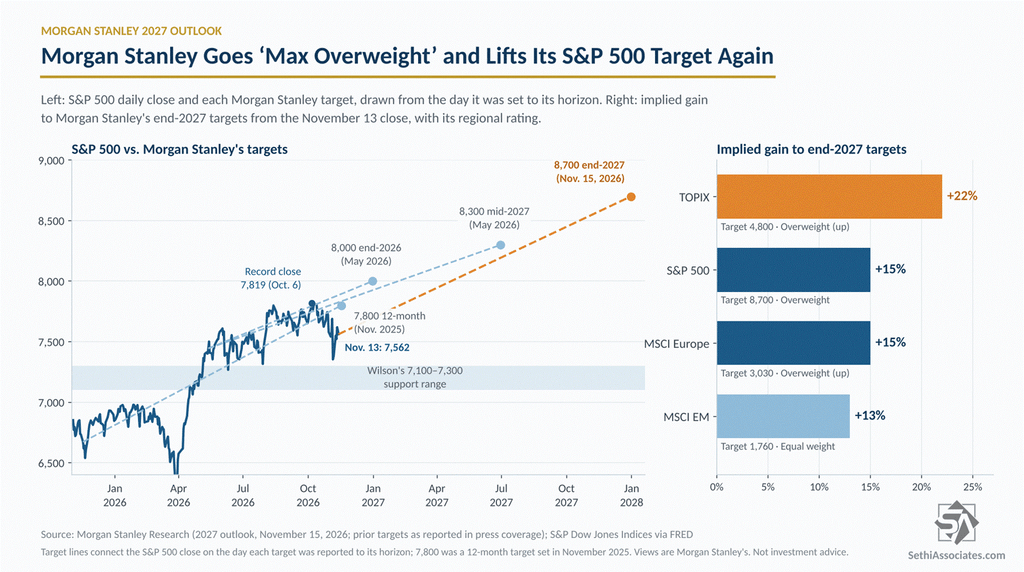
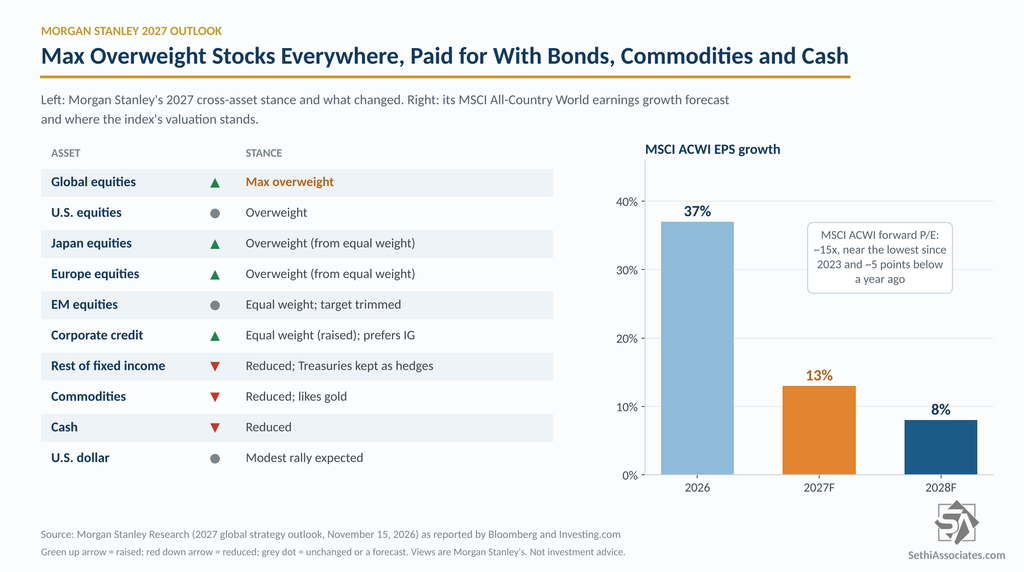
Morgan Stanley (MS) is telling clients to take their stock allocation as high as it will go. In its 2027 outlook, the strategy team led by Serena Tang moved to a maximum overweight in global equities, added to stocks in every region and raised Japan and Europe to overweight alongside the U.S. (Bloomberg). Chief U.S. equity strategist Mike Wilson lifted his 12-month S&P 500 target to 8,700 from 8,000, about 15% above Friday’s close of 7,561.67 (Investing.com).
The argument is that the selloff made stocks cheaper while the fundamentals held up. “With risk assets having cheapened, we embrace risk,” the strategists wrote. While the target is not out-of-step with peers (Goldman and Barclays have the same target as discussed below), MarketWatch “notes its language ‘unusually avoided caveats.'”
The Math Behind 8,700
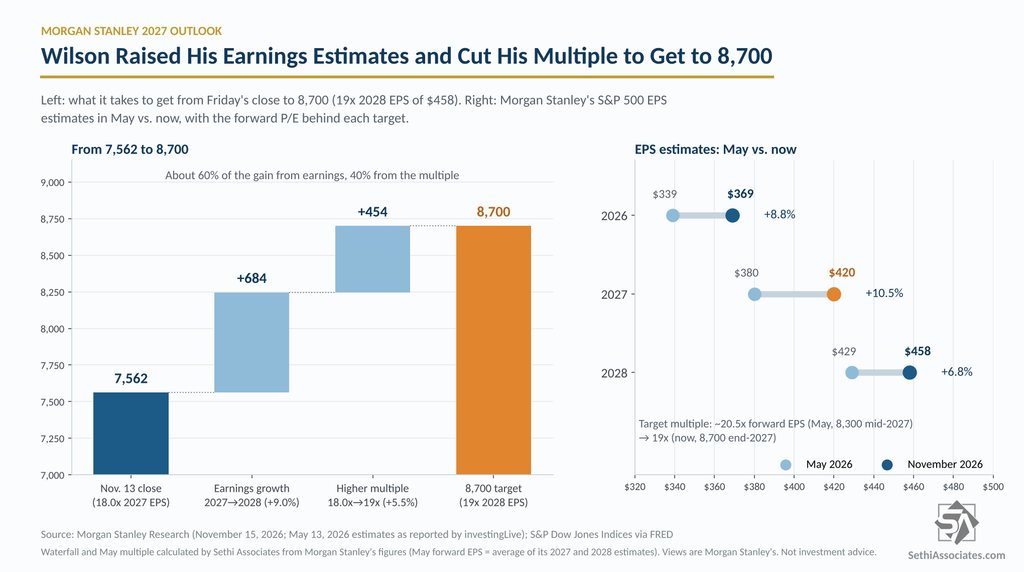
Wilson’s target is 19 times his 2028 earnings estimate of $458 a share. He sees S&P 500 earnings of $369 this year, $420 in 2027 and $458 in 2028, or growth of 34%, 14% and 9% (Investing.com). At Friday’s close, the index trades at 18 times his 2027 number, so reaching 8,700 takes about 9% from earnings and about 6% from a higher multiple.
So the higher target is all from earnings. In May, when Wilson set an 8,300 mid-2027 target, he had 2027 earnings at $380 and 2028 at $429 (investingLive). That target worked out to about 20.5 times forward earnings. He has since raised his 2027 estimate about 11% and lowered the multiple he’s willing to pay to 19.
And the earnings call is not particularly aggressive. His 14% growth for 2027 is a bit below the 16.2% analysts expect (FactSet).
A Global Call Funded by Bonds, Commodities and Cash
Outside the U.S., though, the case is mostly about valuation. MSCI ACWI trades at about 15 times forward earnings, near the lowest since 2023, after falling more than 4% from its August peak, while a benchmark chip index is down 23% since early October (Bloomberg). The team sees ACWI earnings growing 13% next year and expects the valuation drag to ease.
Its end-2027 targets are 4,800 for Japan’s TOPIX (22% upside), 3,030 for MSCI Europe (15%) and 1,760 for MSCI Emerging Markets (13%), which stays at equal weight on deflation in China (Investing.com). Japan gets the upgrade on reflation, governance reform and a capex cycle, Europe on AI adoption and its discount to the U.S. In Asia, the bank prefers South Korea over Taiwan.
To pay for the move, the team cut the rest of fixed income, commodities and cash, while raising corporate credit to equal weight with a preference for investment grade. It also likes gold and sees a modest dollar rally (Bloomberg).
On AI, the strategists expect $1.7 trillion of U.S. hyperscaler capex in 2027 and $1.8 trillion in 2028, and don’t expect the Democratic sweep to stall projects already under way (MarketWatch). They say the story is broadening beyond hyperscalers to AI adopters. In the U.S., Wilson favors quality cyclicals, with industrials his top sector and parts of financials and consumer discretionary also attractive, and the bank is overweight utilities on power demand.
The Potential Rate Problem
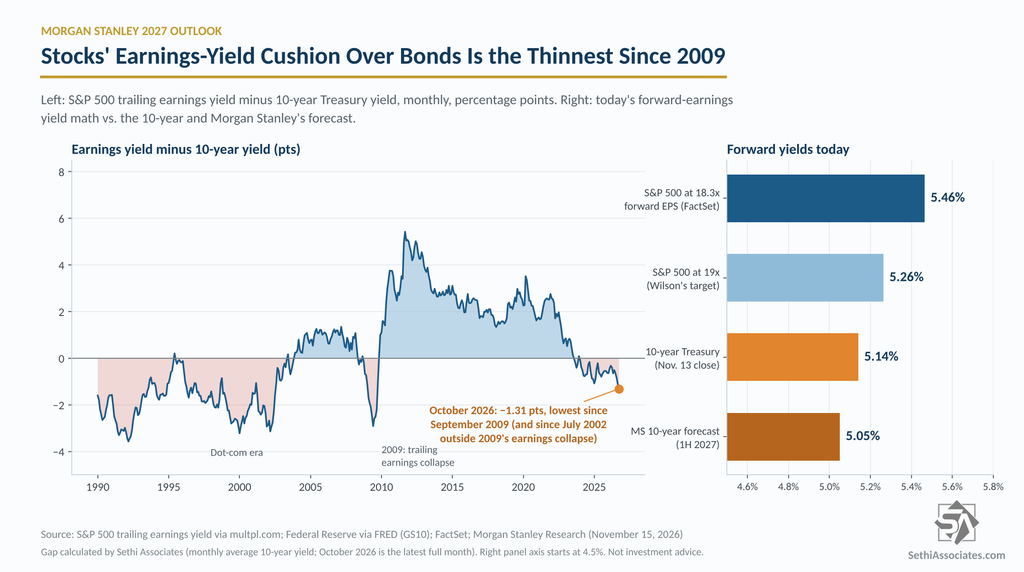
The bank expects a Fed hike in December and another in 2027 (MarketWatch), but its rates team sees the 10-year Treasury yield at 5.05% in the first half (Bloomberg). The 10-year already closed Friday at 5.14% (The Week Ahead).
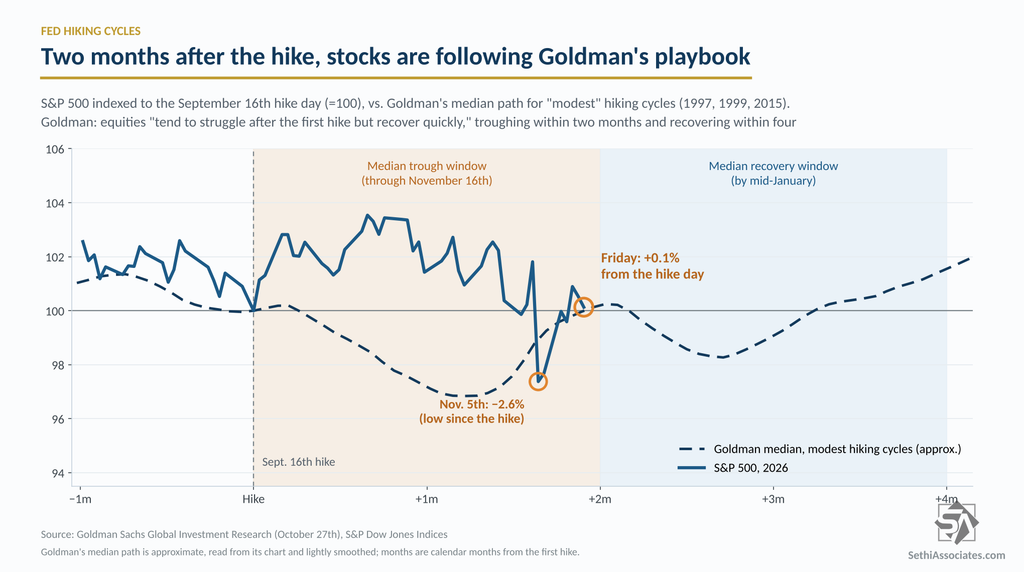
At 18.3 times forward earnings, the S&P 500’s earnings yield is about 5.5%, only about a third of a point above the 10-year. At Wilson’s 19 times, it would be about 5.3%. That leaves little cushion for a market being asked to re-rate higher while policy tightens, although stocks have so far held up after the Fed’s first hike.
The longer history makes the same point. On trailing earnings, the S&P 500’s earnings yield was 1.31 points below the 10-year’s in October, by our math using multpl.com and Federal Reserve data. That’s the widest shortfall since September 2009, and outside 2009’s earnings collapse, the widest since July 2002.
What to Do With It
Morgan Stanley isn’t alone at 8,700. Goldman Sachs (GS) has the same 12-month target but sees S&P 500 earnings growth slowing to 11% from 36% (Yahoo Finance). Barclays (BCS) trimmed its end-2027 target to 8,700 from 8,800 and called it a “potentially systemic risk” that chips and hardware are expected to deliver at least half of index earnings growth (Investing.com). With three big banks at the same number, the debate is less about the destination than whether the earnings show up.
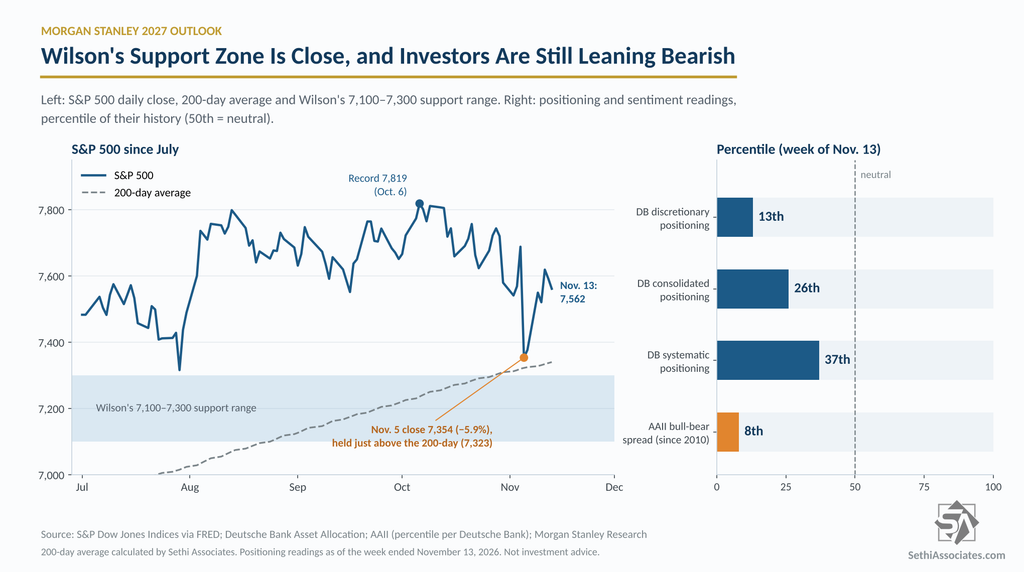
That comes at a time most investors are more cautious. Deutsche Bank’s discretionary positioning was at just the 13th percentile last week and AAII bears topped 50% (The Week Ahead), while active managers’ equity exposure fell to an eight-week low.
Wilson himself says a retest of his 7,100–7,300 support range “could still lie ahead.” The S&P 500’s closing low this month was 7,353.73 on November 5, about 6% below the October 6 record of 7,818.93 (FRED).
Conversation 0 Comments
One ongoing discussion across all days. Everyone can read; sign in to take part.
Your voice matters. Discussions are moderated for civility. Read our guidelines .
Log in to join the conversation