Market updates and conversation from TheStreet Pro team. Follow the latest and join the conversation below.
Stock Market Today: November 16, 2026
Newest first · All times Eastern · 6 updates
DATE:
By Neil Sethi
Is Europe Really the Anti-AI Trade?
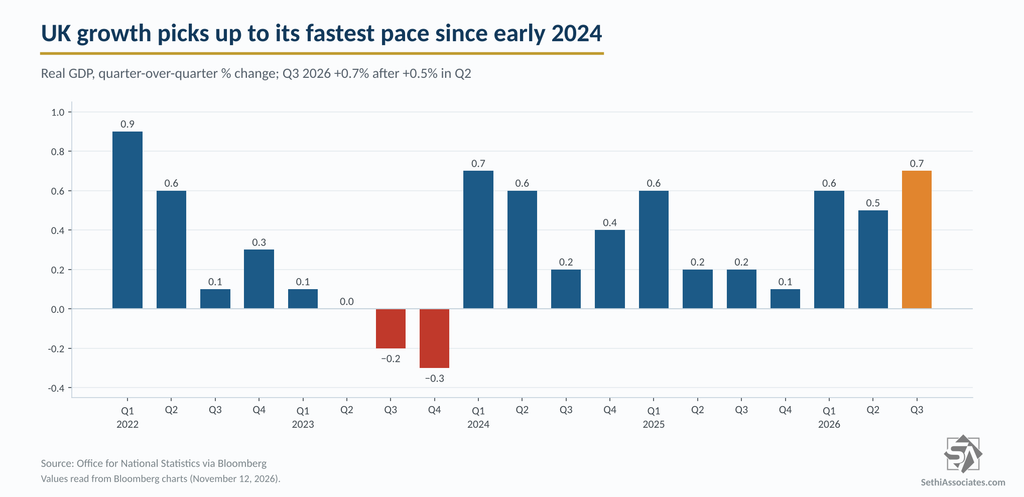
UK Growth Hits Fastest Pace Since Early 2024, and AI Gets the Credit
Europe is often treated as the “anti-AI” trade, the place to hide if the AI boom cools. Last Thursday morning’s U.K. GDP report says otherwise.
The U.K. economy grew 0.7% in the third quarter, according to the Office for National Statistics. That’s up from 0.5% in the second quarter and the fastest pace in two and a half years. It matched the median forecast in a Bloomberg survey. September on its own grew 0.2% when economists expected no growth, which suggests the momentum carried into the fourth quarter.
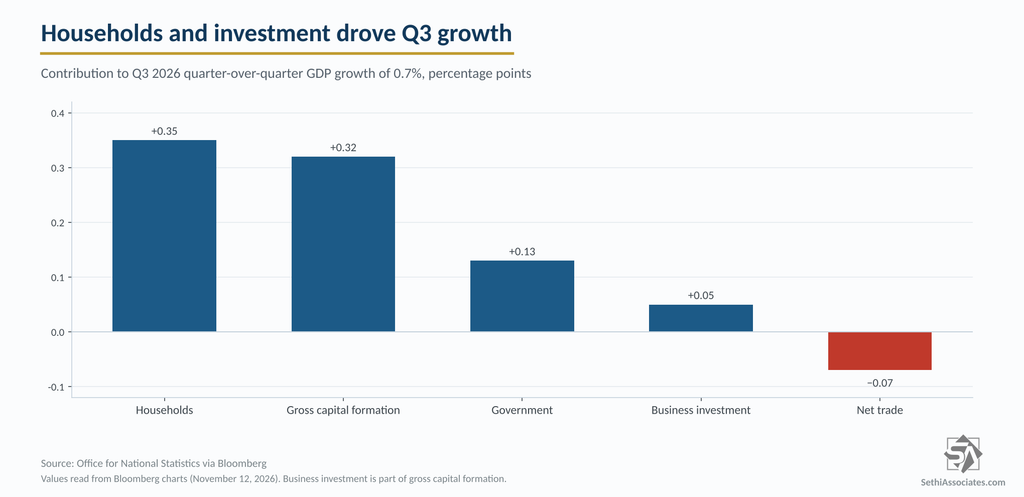
The ONS said the rollout of AI drove a 2.1% jump in information and communication output, Bloomberg reported. Professional, scientific and technical activities rose 1.6%. Manufacturing grew 0.9%, including a 4.6% jump in output of computers, electronics and optical products. Business investment was 3% higher than a year earlier.
Consumers held up as well. Household spending rose 0.6%, more than economists expected, even with elevated energy costs.
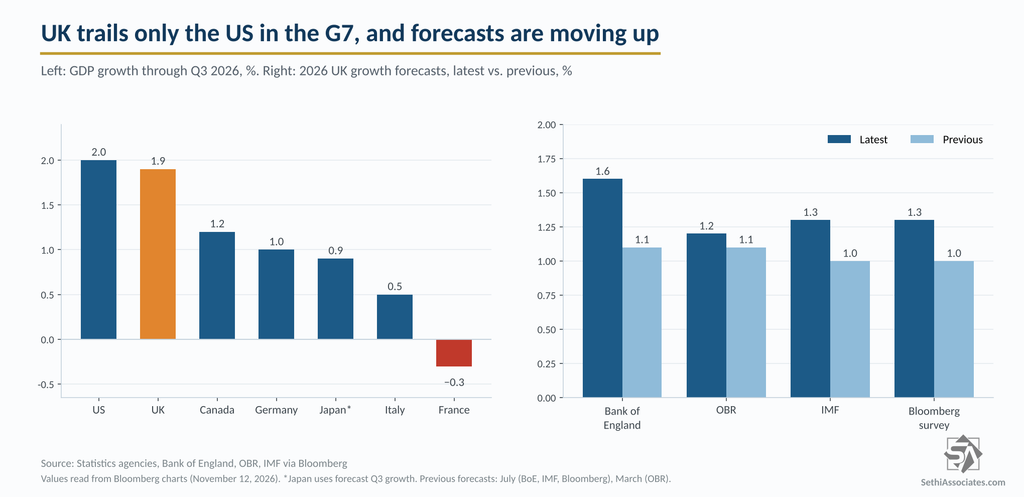
That leaves the U.K. as the second-fastest-growing G7 economy this year, behind only the U.S. France has shrunk over the same stretch. Forecasters have had to catch up: the Bank of England, the International Monetary Fund and the Bloomberg survey median have all raised their 2026 U.K. growth forecasts since July.
There are two catches.
The first is that the growth is narrow. “The main caveat is that growth remains concentrated in a relatively small number of industries linked to the AI build-out,” PwC senior economist Jake Finney told Bloomberg. That ties the UK to the same AI spending cycle investors are now questioning across the pond.
The second is the Bank of England. It raised rates last week for the first time in more than three years, and this report keeps the pressure on. After the data, investors still see a nearly 80% chance of another hike in December and three increases by next summer. The BoE expects inflation to approach 5% next year and growth to slow to 0.3% in the fourth quarter. Household energy bills are also set to jump about a quarter in January.
So the U.K. clearly isn’t a clean hedge against the AI trade. Its biggest growth engine right now is the AI build-out. If it slows, the U.K loses a major ballast that has helped carry it through the energy shock.
Morgan Stanley Goes ‘Max Overweight’ Global Stocks, Calls 2027 the Year to Embrace Risk
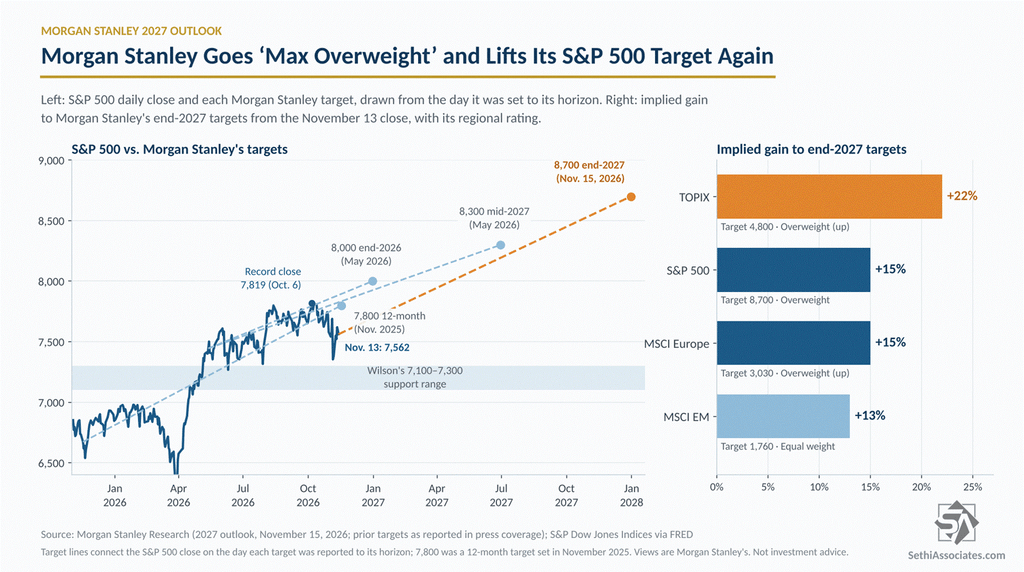
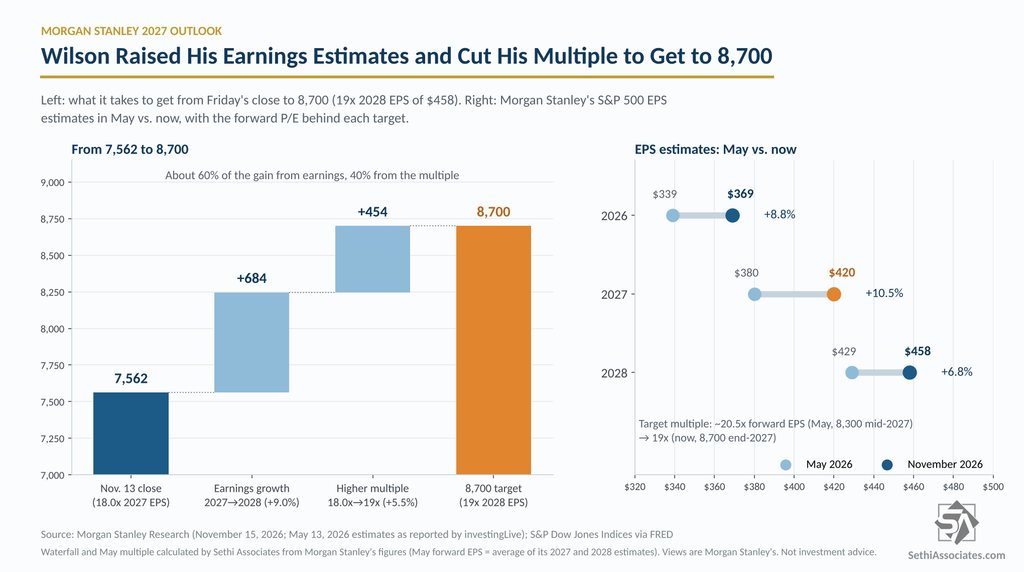
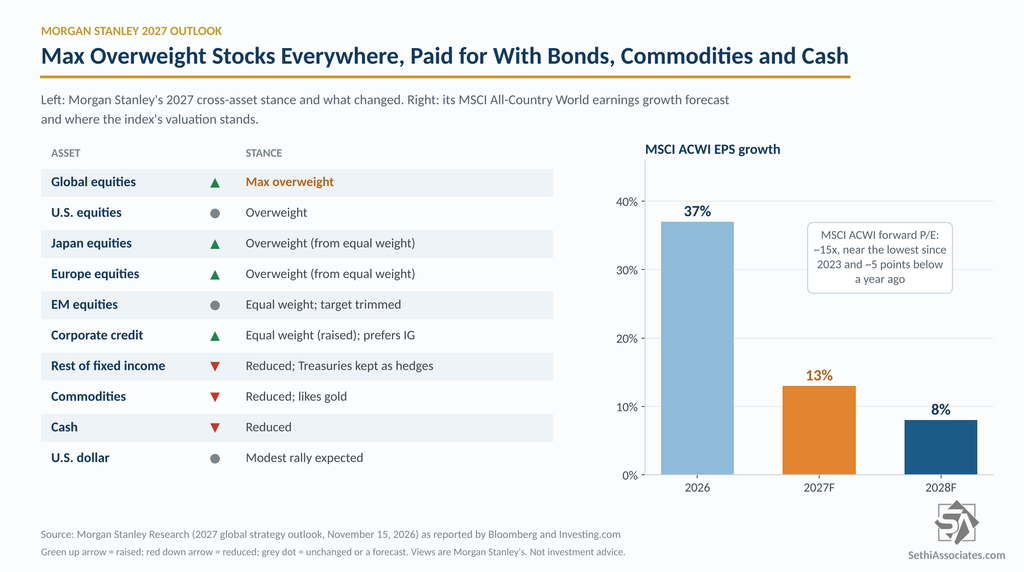
Morgan Stanley (MS) is telling clients to take their stock allocation as high as it will go. In its 2027 outlook, the strategy team led by Serena Tang moved to a maximum overweight in global equities, added to stocks in every region and raised Japan and Europe to overweight alongside the U.S. (Bloomberg). Chief U.S. equity strategist Mike Wilson lifted his 12-month S&P 500 target to 8,700 from 8,000, about 15% above Friday’s close of 7,561.67 (Investing.com).
The argument is that the selloff made stocks cheaper while the fundamentals held up. “With risk assets having cheapened, we embrace risk,” the strategists wrote. While the target is not out-of-step with peers (Goldman and Barclays have the same target as discussed below), MarketWatch “notes its language ‘unusually avoided caveats.'”
The Math Behind 8,700
Wilson’s target is 19 times his 2028 earnings estimate of $458 a share. He sees S&P 500 earnings of $369 this year, $420 in 2027 and $458 in 2028, or growth of 34%, 14% and 9% (Investing.com). At Friday’s close, the index trades at 18 times his 2027 number, so reaching 8,700 takes about 9% from earnings and about 6% from a higher multiple.
So the higher target is all from earnings. In May, when Wilson set an 8,300 mid-2027 target, he had 2027 earnings at $380 and 2028 at $429 (investingLive). That target worked out to about 20.5 times forward earnings. He has since raised his 2027 estimate about 11% and lowered the multiple he’s willing to pay to 19.
And the earnings call is not particularly aggressive. His 14% growth for 2027 is a bit below the 16.2% analysts expect (FactSet).
A Global Call Funded by Bonds, Commodities and Cash
Outside the U.S., though, the case is mostly about valuation. MSCI ACWI trades at about 15 times forward earnings, near the lowest since 2023, after falling more than 4% from its August peak, while a benchmark chip index is down 23% since early October (Bloomberg). The team sees ACWI earnings growing 13% next year and expects the valuation drag to ease.
Its end-2027 targets are 4,800 for Japan’s TOPIX (22% upside), 3,030 for MSCI Europe (15%) and 1,760 for MSCI Emerging Markets (13%), which stays at equal weight on deflation in China (Investing.com). Japan gets the upgrade on reflation, governance reform and a capex cycle, Europe on AI adoption and its discount to the U.S. In Asia, the bank prefers South Korea over Taiwan.
To pay for the move, the team cut the rest of fixed income, commodities and cash, while raising corporate credit to equal weight with a preference for investment grade. It also likes gold and sees a modest dollar rally (Bloomberg).
On AI, the strategists expect $1.7 trillion of U.S. hyperscaler capex in 2027 and $1.8 trillion in 2028, and don’t expect the Democratic sweep to stall projects already under way (MarketWatch). They say the story is broadening beyond hyperscalers to AI adopters. In the U.S., Wilson favors quality cyclicals, with industrials his top sector and parts of financials and consumer discretionary also attractive, and the bank is overweight utilities on power demand.
The Potential Rate Problem
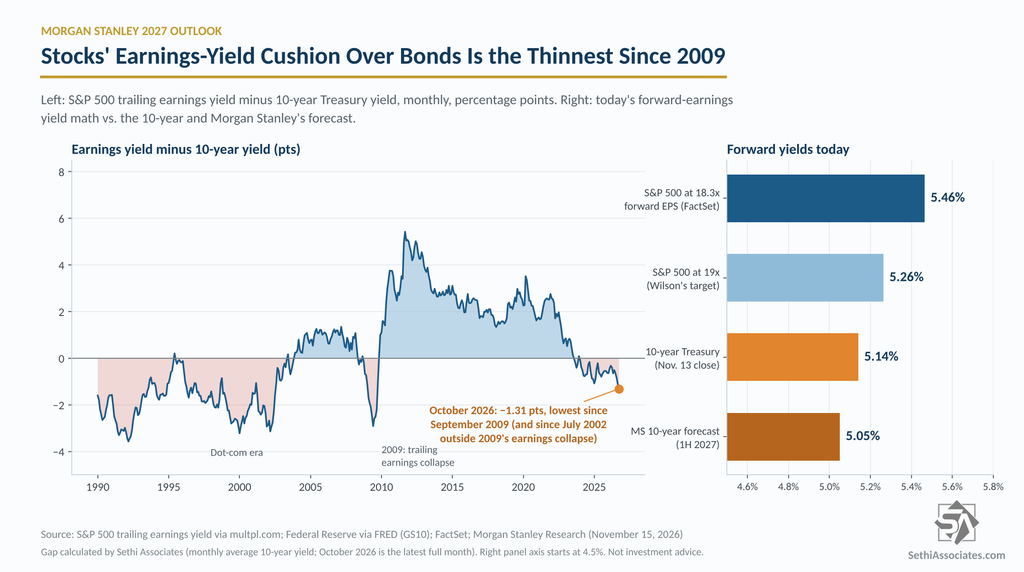
The bank expects a Fed hike in December and another in 2027 (MarketWatch), but its rates team sees the 10-year Treasury yield at 5.05% in the first half (Bloomberg). The 10-year already closed Friday at 5.14% (The Week Ahead).
At 18.3 times forward earnings, the S&P 500’s earnings yield is about 5.5%, only about a third of a point above the 10-year. At Wilson’s 19 times, it would be about 5.3%. That leaves little cushion for a market being asked to re-rate higher while policy tightens, although stocks have so far held up after the Fed’s first hike.
The longer history makes the same point. On trailing earnings, the S&P 500’s earnings yield was 1.31 points below the 10-year’s in October, by our math using multpl.com and Federal Reserve data. That’s the widest shortfall since September 2009, and outside 2009’s earnings collapse, the widest since July 2002.
What to Do With It
Morgan Stanley isn’t alone at 8,700. Goldman Sachs (GS) has the same 12-month target but sees S&P 500 earnings growth slowing to 11% from 36% (Yahoo Finance). Barclays (BCS) trimmed its end-2027 target to 8,700 from 8,800 and called it a “potentially systemic risk” that chips and hardware are expected to deliver at least half of index earnings growth (Investing.com). With three big banks at the same number, the debate is less about the destination than whether the earnings show up.
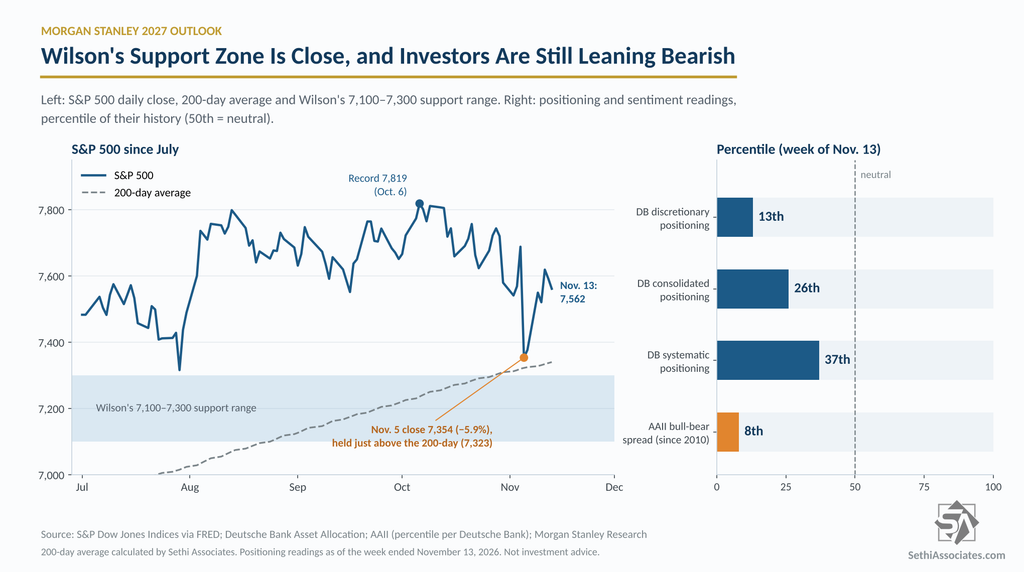
That comes at a time most investors are more cautious. Deutsche Bank’s discretionary positioning was at just the 13th percentile last week and AAII bears topped 50% (The Week Ahead), while active managers’ equity exposure fell to an eight-week low.
Wilson himself says a retest of his 7,100–7,300 support range “could still lie ahead.” The S&P 500’s closing low this month was 7,353.73 on November 5, about 6% below the October 6 record of 7,818.93 (FRED).
President Trump this morning says he “wouldn’t mind” seeing Jensen Huang reinstated as Nvidia (NVDA) CEO. He also commented that he “didn’t know” if Alice Huang was a spy.
Do you agree with Trump and believe that Jensen Huang should be reinstated? Or are you concerned that there could be more to this story?
Also, is this an issue of Jensen Huang’s personal life, or is it an issue of national security?
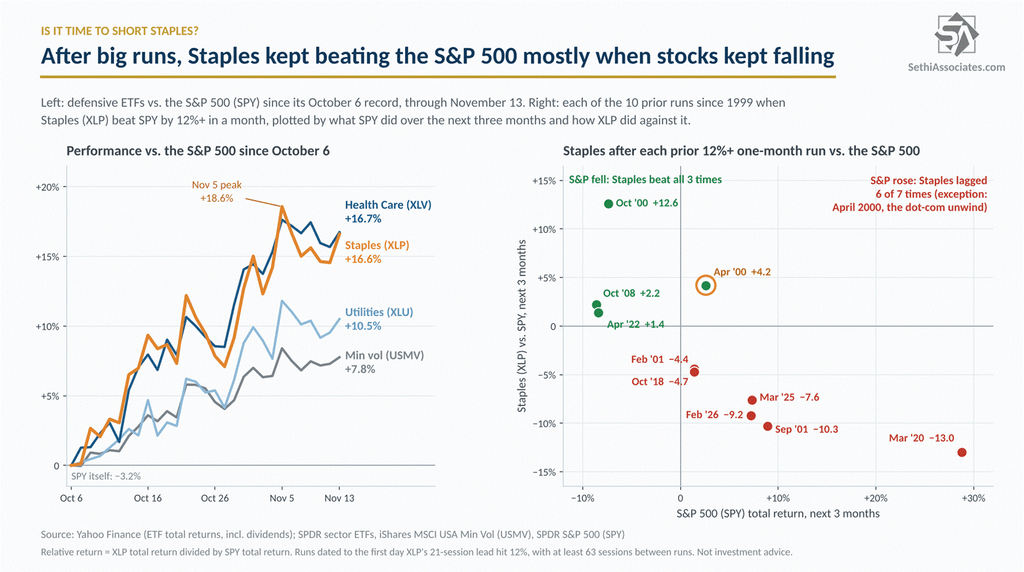
Consumer Staples just had their biggest one-month lead over the S&P 500 since March 2020, and they’re now priced like it’s 1999. History says shorting them after a run like this usually works, but only if the broader market goes on to rally. In the three times since 1999 that stocks kept falling, Staples kept winning.
Valuations Have Flipped Since 2000
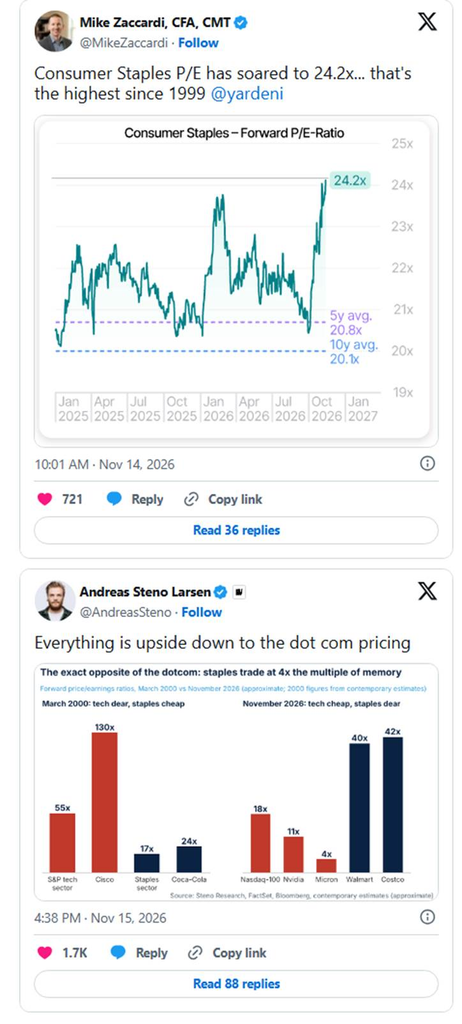
Christophe Barraud’s Monday Morning Brief (a nice, free daily collection of posts) had two charts comparing this market to the internet bubble. Andreas Steno says “everything is upside down to the dot com pricing.” In March 2000, S&P 500 tech traded at about 55 times forward earnings and Cisco (CSCO) at 130, while Staples sat at 17. Today the Nasdaq 100 trades at about 18, Nvidia (NVDA) at 11 and Micron (MU) at 4, while Walmart (WMT) and Costco (COST) trade at 40 and 42 (Steno’s figures are approximate).
Mike Zaccardi, citing Yardeni Research, shows the Staples sector’s forward P/E at 24.2, the highest since 1999 and well above its five-year (20.8) and 10-year (20.1) averages. As I noted in Sunday’s Week Ahead, the Nasdaq 100’s forward P/E hit 18 last week for the first time since the Covid crash.
Goldman Likes a Short
As I noted in last week’s Week Ahead, Goldman Sachs’ thematic desk said it likes shorting its Staples basket after the group beat the S&P 500 by nearly 20% in a month. Its case: the sector’s valuation premium to the index is the highest in more than 10 years, and the basket’s 2.84% dividend yield sits 2.05 percentage points below the 10-year Treasury yield, the 1st percentile of the last decade. Goldman adds that Staples have historically lagged over the next three months after similar runs, except in late 2021 and early 2022.
What the History Says
I looked at the Consumer Staples Select Sector SPDR Fund (XLP) against the SPDR S&P 500 ETF (SPY) using total returns back to 1999. On November 5, Staples’ lead over the prior month hit 18.4%, a level topped only in April and October 2000 and March 2020. There have been 10 earlier runs of 12% or more, and Staples lagged over the next three months in six of them, by a median of 4.5%.
Based on history, whether the short works comes down to what the S&P 500 does next. In all three cases where the S&P fell over the following three months (October 2000, October 2008 and April 2022, each down 7% to 9%), Staples beat it. In six of the seven cases where the S&P rose, though, Staples lagged, by as much as 13 percentage points after the March 2020 run.
The one exception to the rule was April 2000, a month after the Nasdaq peaked. The S&P rose 2.6% over the next three months and Staples still beat it by 4.2 points, rising 7% on their own. One difference is Staples went into that unwind at 17 times earnings. They’re going into this one at 24.
Positioning
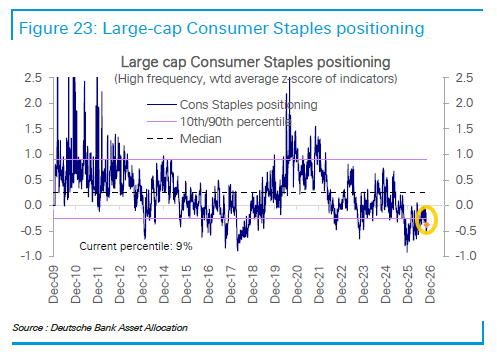
One thing working against the short is positioning. Deutsche Bank’s data, which I covered in Sunday’s Week Ahead, show investors are still underweight large-cap Staples (9th percentile, up from the 4th), which leaves less to unwind.
Bottom line: a Staples short has mostly been a bet that the selloff is over. If stocks keep sliding, history says Staples can keep working even from rich valuations. Nvidia’s earnings Tuesday are the near-term test
Two Months After the Fed’s First Hike, the Historical Playbook Is Holding
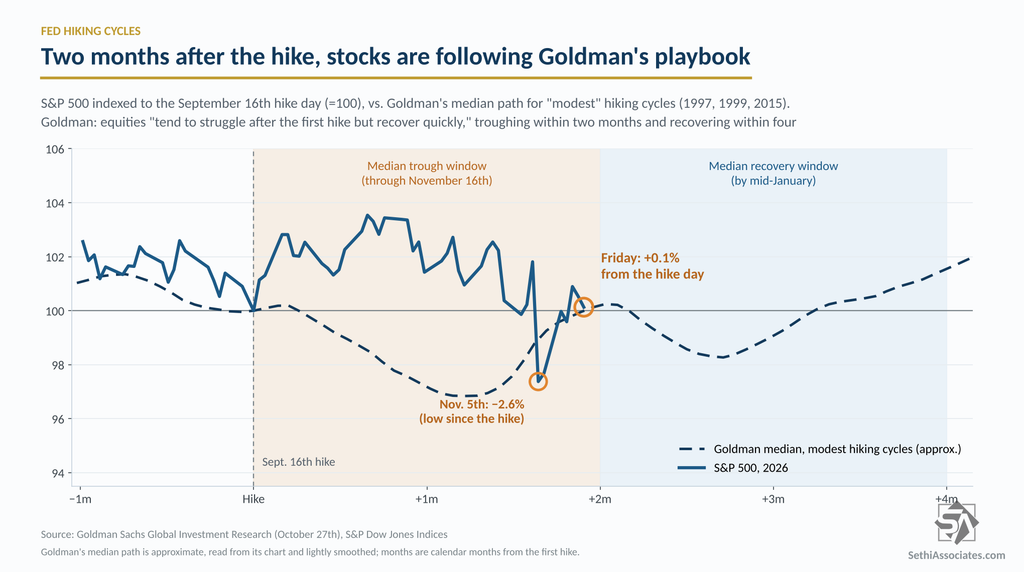
Today marks two months since the Fed’s September 16 hike, and so far stocks are following the pattern Goldman laid out for a first hike in a “modest” hiking cycle. Goldman found equities “tend to struggle after the first hike but recover quickly,” with the median trough coming within two months.
The S&P 500’s November 5 close (7,353.73), 2.6% below the hike-day close, remains its low since the hike and its Q4 low so far. Friday’s close left the index 2.8% above that low and 0.1% above the hike-day close.
Whether that low holds is the question I explored up in yesterday’s Week Ahead (The Week Ahead – Have We Seen the Q4 Bottom?), and I’ll be highlighting more from that through the week here.
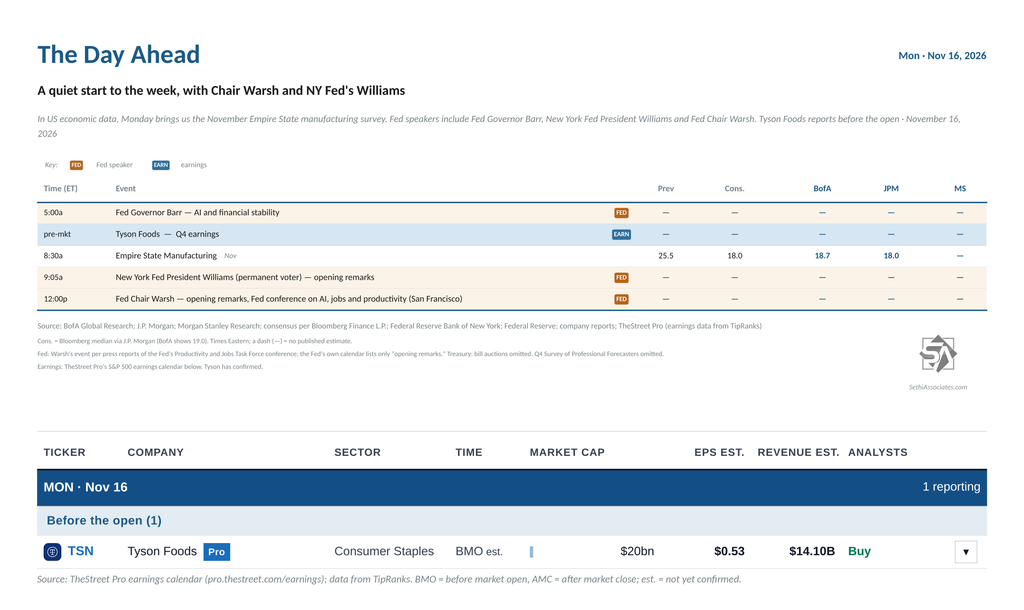
The Day Ahead – A Light Start Highlighted by Fedspeak
In US economic data, Monday brings us just the November Empire State manufacturing survey.
Fed speakers are the scheduled highlight with Chair Warsh making opening remarks at the Federal Reserve’s Productivity and Jobs Task Force Conference Monday at noon ET, his first public remarks since the October press conference, but we’re unlikely to get anything on his thoughts for policy given his dislike of forward guidance. We’ll also hear from Fed Governor Barr and New York Fed President Williams (permanent voter).
Conversation 0 Comments
One ongoing discussion across all days. Everyone can read; sign in to take part.
Your voice matters. Discussions are moderated for civility. Read our guidelines .
Log in to join the conversation