Tech Has Rarely Lagged the S&P 500 This Badly, History Says It Usually Catches Up
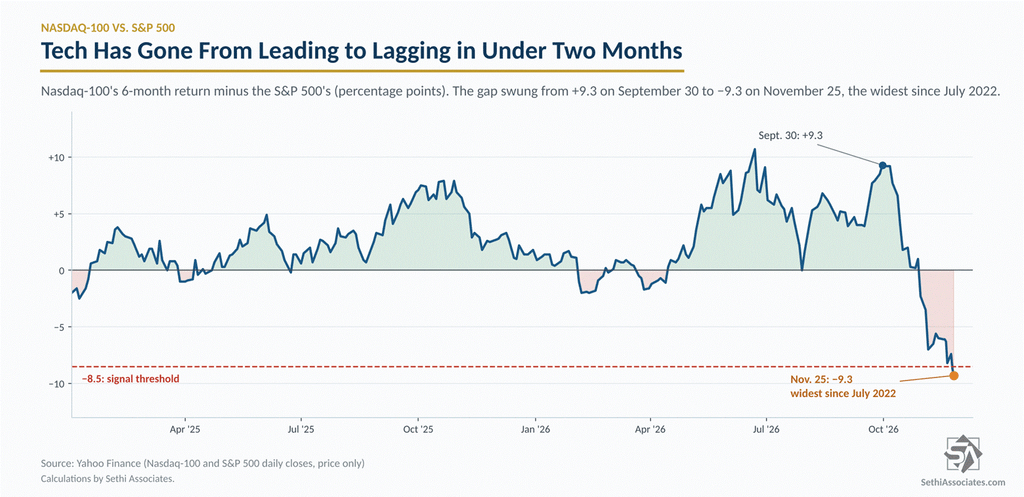
The Nasdaq-100’s 6-month return has fallen more than 8.5 percentage points behind the S&P 500’s. Since 1986, that kind of gap has more often marked a turning point for tech than the start of a longer slide: the Nasdaq-100 beat the S&P 500 over the following year in 11 of 13 cases. The two exceptions, 2000 and 2022, are why it’s worth watching how the gap behaves from here.
The swing has been fast. At the end of September, the Nasdaq-100’s 6-month return was 9.3 points ahead of the S&P 500’s. By Wednesday’s close it was 9.3 points behind, the widest gap since July 2022, as the AI trade has stumbled and chips logged their worst week since 2001. The Nasdaq-100 ended Wednesday 16.6% below its 52-week high, versus 8.1% for the S&P 500, and fund managers cut their tech overweight by the most since 2006 in BofA’s latest survey.
What history says
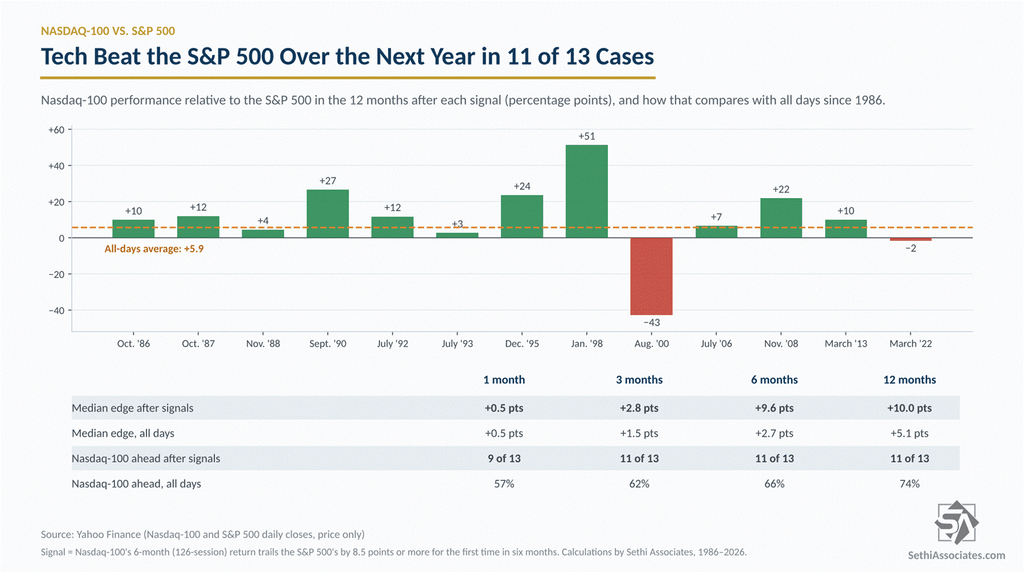
I looked at every time since 1986 that the Nasdaq-100’s 6-month return fell 8.5 points or more behind the S&P 500’s for the first time in six months. That happened 13 times before Tuesday’s reading, the 14th.
In 11 of the 13, the Nasdaq-100 outperformed the S&P 500 over the next six and 12 months. The median 12-month edge was 10 percentage points, about double the 5.1-point edge the Nasdaq-100 has had over a typical 12-month stretch since 1986.
The catch-up takes time, though
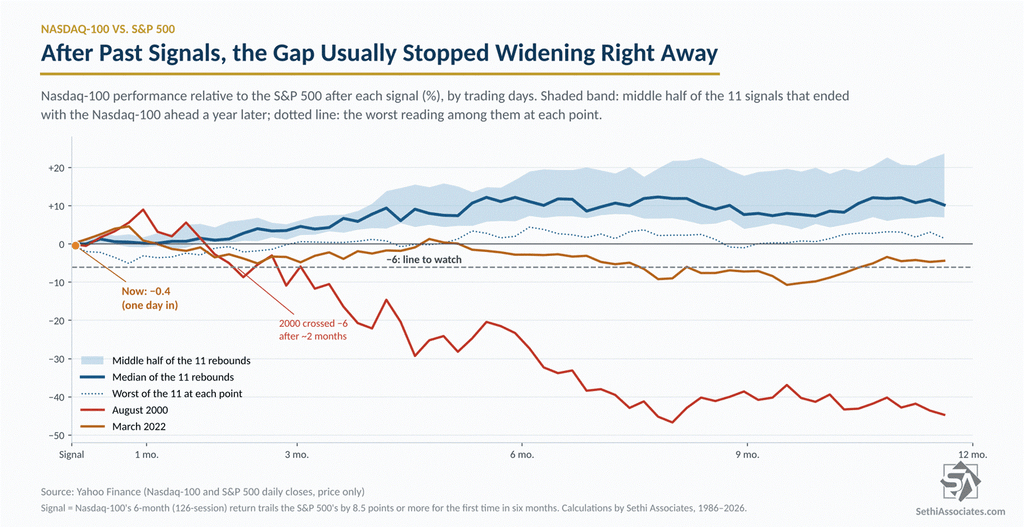
While the gap stop widening, the rebound wasn’t immediate. One month after a signal, the median edge was half a point, no better than normal, and most of the catch-up came in months two through six. The more useful finding is that in those 11 cases, the damage was largely done by the signal date. The Nasdaq-100 never fell more than about 5% further behind the S&P 500 before turning.
The two exceptions
August 2000 and March 2022 played out differently. After the August 2000 signal, the Nasdaq-100 trailed the S&P 500 by another 43 points over the following year as the dot-com bust unfolded. After March 2022, it finished the year just 2 points behind, but only after the gap widened by nearly 11% as the Fed began raising rates. In both cases, tech’s slide turned into a full tech bear market.
It’s also worth noting that in 2000, the Nasdaq-100 outperformed by as much as 9 points in the first month after the signal before the bottom fell out. So an early bounce isn’t an all-clear.
What to watch
History favors tech narrowing the gap from here. The line to watch is whether the Nasdaq-100 falls more than about 6% further behind the S&P 500 from Tuesday’s signal. If it does, it’s tracking 2000 and 2022 rather than the usual rebound. In 2000, that line was crossed about two months after the signal, well before most of the damage was done. As of Wednesday’s close, the Nasdaq-100 had slipped about 0.4% further behind. As for me, as mentioned in Friday’s Charts, I’ve got my stop on QQQ at 1% below Friday’s low.
Conversation 0 Comments
One ongoing discussion across all days. Everyone can read; sign in to take part.
Your voice matters. Discussions are moderated for civility. Read our guidelines .
Log in to join the conversation