Machines Behind Monday’s Rally
Monday’s surge gave the S&P 500 its best day since April 2025 (A Stretched Market and Huang’s Return Combine For Stocks’ Best Day Since April 2025), but a lot of that buying was from nondiscretionary systematic strategies, and their absence now appears to be at least partly behind the giveback we’ve seen (The AI Trade Stumbles Again, But This Time Investors Rotate).
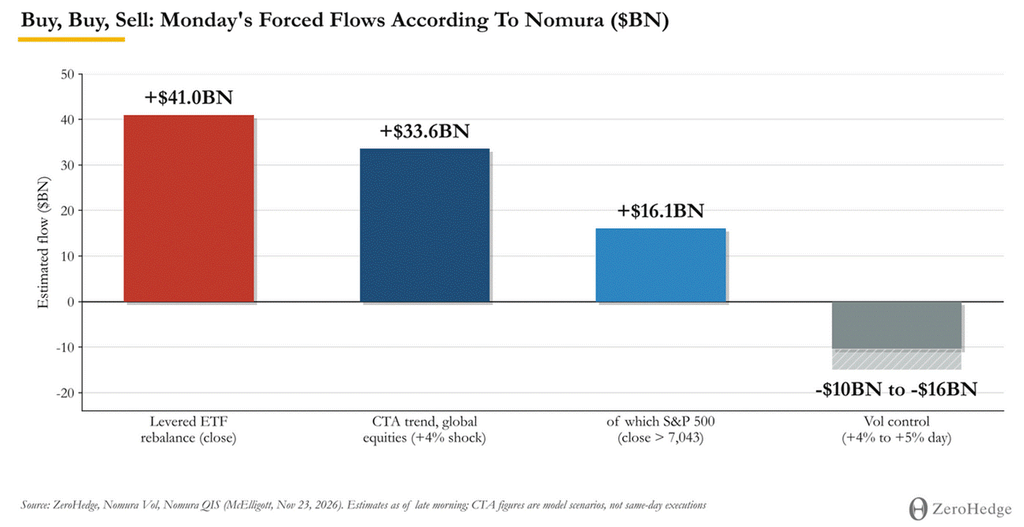
The machines bought Monday. Nomura’s Charlie McElligott walked through the groups whose buying is set by price and volatility rather than by a view on the market (per ZeroHedge).
- Leveraged ETFs, which have to rebalance into the close, were projected to buy $41 billion, the second-largest buy in more than 5,100 sessions going back to July 2006, behind only the $46.5 billion on April 9, 2025, the day of the tariff pause.
- Options dealers bought back the futures they had sold to hedge customers’ puts, as the VIX collapsed and those puts lost value.
- Trend-following CTAs, which Nomura had at maximum short, had to cover about $16.1 billion of S&P 500 futures once the index closed above 7,043, part of as much as $33.6 billion of global equity buying in a 4% rally.
- The one seller was volatility-control funds, which cut exposure after big moves in either direction, by an estimated $10 billion to $16 billion.
The result? The S&P 500 closed up 4.7% at 7,237, and Nvidia (NVDA ) jumped 31%, its biggest gain since May 2003, per Bloomberg.
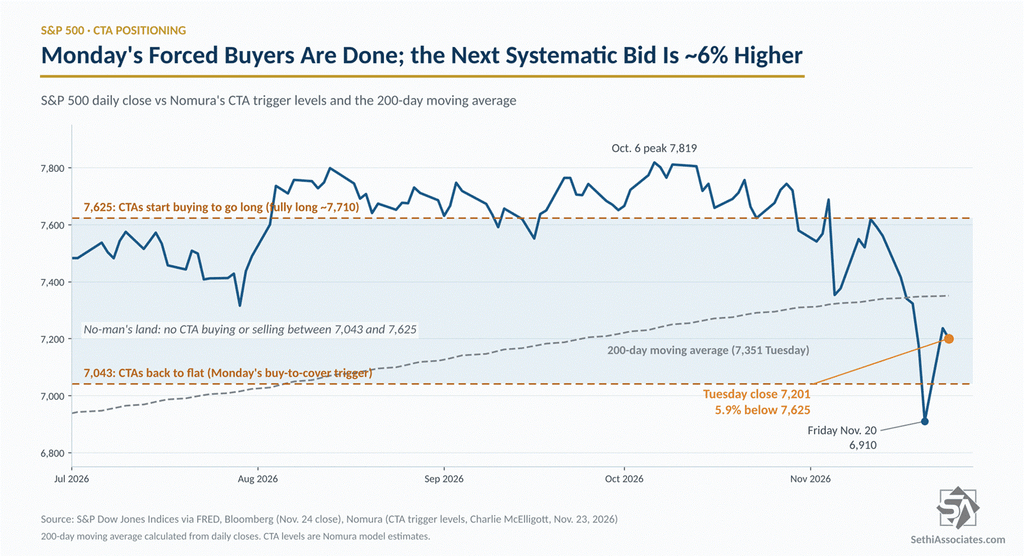
Here’s the catch. Covering took CTAs back to roughly flat, so the short covering is done, but Nomura’s model doesn’t have them starting to buy to go long until 7,625, 5.9% above Tuesday’s close of 7,201, or fully long until around 7,710. In between, CTAs do little. Worse, another major cohort of systematic traders, vol-control funds, sells big moves in either direction, while levered ETFs only go the way the market goes. And by the same math, a close back below 7,043, not far from premarket levels, would turn CTAs back into sellers.
That means discretionary investors have to pick up the baton, and so far they haven’t. Goldman Sachs tech specialist Peter Callahan said activity pointed to more “net exposure management” than “investing,” with ETFs running at a high-30s percent share of trading and single-stock desks quiet (per ZeroHedge). Technical buyers are also waiting for the S&P 500 to retake its 200-day moving average near 7,351 (Bloomberg).
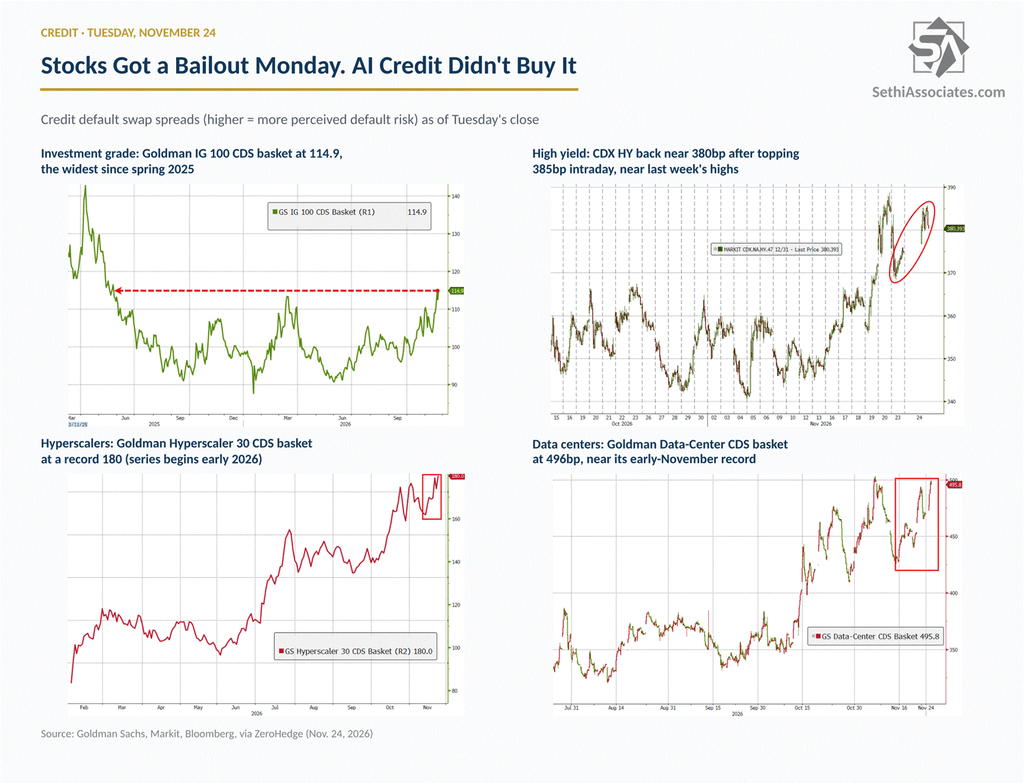
Credit hasn’t followed equities. On Monday, Goldman’s Rich Privorotsky offered a test: if Nvidia rallied but spreads on the neoclouds (the AI cloud providers that borrowed heavily to buy its chips) stayed under pressure, “we’re probably just covering shorts.” Tuesday morning, he said credit “didn’t quite have the beta of equities” on Monday (per ZeroHedge).
Tuesday it moved the wrong way (charts via ZeroHedge). Goldman’s investment-grade CDS basket hit its widest since spring 2025, high-yield CDX topped 385 basis points intraday, Goldman’s hyperscaler CDS basket hit a record (its data begin in early 2026) and its data-center basket was back near 496bp, close to its early-November high. CoreWeave (CRWV) bonds fell to record lows, with its 9% notes due 2031 down as much as 3.6 points to 76.6 cents on the dollar, the lowest since they were issued in July 2025 (Bloomberg), as the stock fell 11.9% after Monday’s 22% jump.
Semis gave back most of Monday. The Philadelphia Semiconductor Index (SOX) fell 7.9% Tuesday giving back nearly two-thirds of Monday’s 14% jump (Tuesday’s Charts – The Day After), and is indicated down more than 4% in Wednesday’s premarket. Its 5.9-point lag versus the Nasdaq-100 ranks among the worst since 1996, close to the 6.9-point record on October 17, 2000, in Bloomberg data shared by Callahan. Last night’s evening update has more on Analog Devices (ADI), Hewlett Packard Enterprise (HPE) and the rest of the selloff.
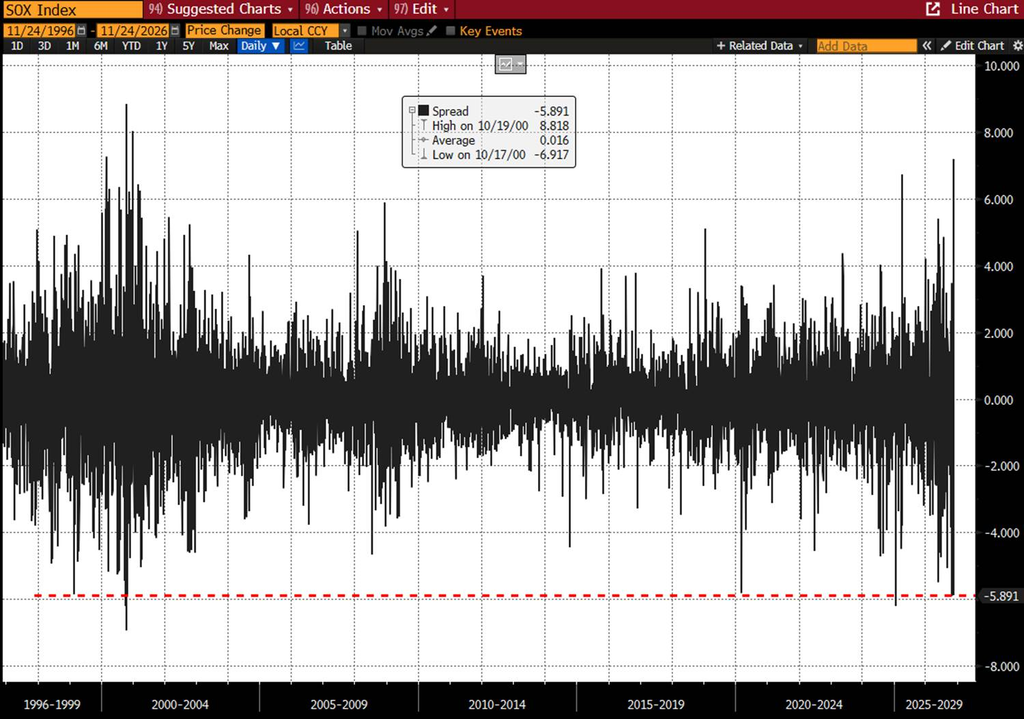
Daily SOX return minus Nasdaq-100 return, percentage points, since 1996. Chart source: Goldman Sachs, Bloomberg, via ZeroHedge.
What to do with it. None of this means Friday’s low can’t hold. Privorotsky said the best thing the market could do now is “sit still for a couple of days,” letting volatility bleed out so systematic funds can re-lever, which with year-end seasonals adds up to “a lot of potential demand.” And as I noted Tuesday, after VIX drops like Monday’s, stocks were higher 6 and 12 months later every time.
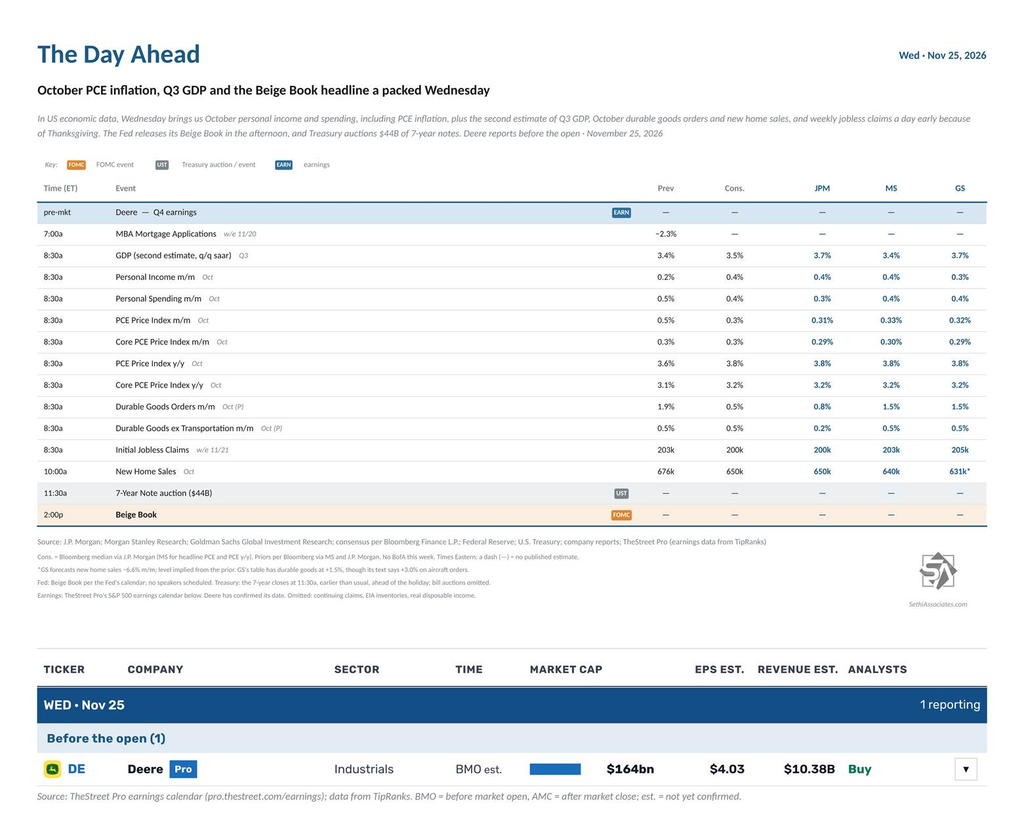
But near term, the mechanical bid is spent, and CTAs are now closer to selling than buying, while vol control will keep cutting its equity exposure as long as volatility stays elevated. Leveraged ETFs will also add to any downside moves. With markets lower Wednesday, keep an eye on 7,043 and Friday’s 6,910 close.
At the time of publication, in terms of securities mentioned, Sethi was long NVDA.
Conversation 0 Comments
One ongoing discussion across all days. Everyone can read; sign in to take part.
Your voice matters. Discussions are moderated for civility. Read our guidelines .
Log in to join the conversation