US Equity Markets Bend But Don’t Break
A toxic mix of a potential slowing in AI spending, rising oil prices, and increased Fed rate hike bets see markets fall, but they end well off the lows.
You've reached your free article limit
You've read 0 of 1 free Pro articles.
Quick Summary
- US equities started the Monday session solidly lower after leaders of the biggest artificial-intelligence firms proposed slowing the technology’s development and oil prices rebounded following Friday’s declines as discussed in the morning update.
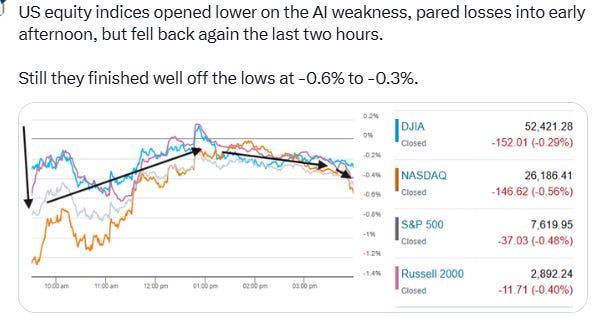
- Indices would pare those opening losses though getting back to around unchanged levels by early afternoon before leaking lower into the end of the session, but finishing well off the lows of the day — the Nasdaq -0.56%, S&P 500 -0.48%, Dow Jones Industrial Average -0.29%, and small-cap Russell 2000 -0.40%
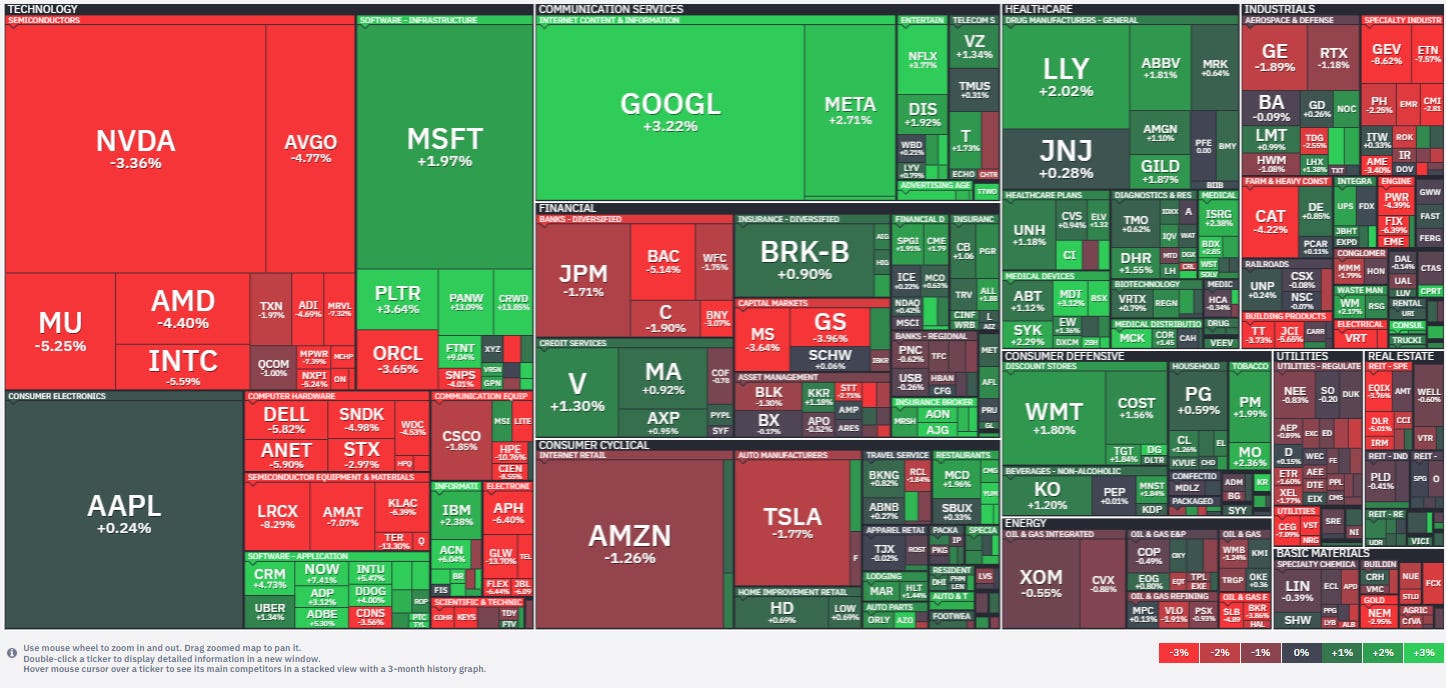
- The largest beneficiaries of the AI buildout saw the worst of the losses with the PHLX Semiconductor Index (SOX) sinking 5.9%, but other areas such as software and cybersecurity rallied hard as did some hyperscalers led by Alphabet (GOOG) and Meta (META). Oracle (ORCL) would again finish lower though.
- President Donald Trump, though, attacked a slowdown in AI development, intensifying his opposition to new guardrails. He blamed a “SICK conspiracy” for voter backlash on AI data centers and increased concern about frontier models, and added that “the only one that is happy about it is China…The only control or ‘guardrails’ that AI needs is a STRONG AND SMART (High IQ!) PRESIDENT, and the U.S.A. has that, in spades!” Trump wrote in a Truth Social post. “The Trump Administration has stopped AI ‘people’ from doing bad, or potentially bad, ‘things,’ like Dario (Anthropic!), who is now pretending to be a ‘perfect little angel’ – and we will continue to do so!” Trump wrote.
- Breadth remained weak though with just three sectors higher (Communications, Health Care, Staples, although all up over 1%) versus eight lower and four down at least 1%, led by superheavyweight Tech; Industrials, Utilities, and Materials extended recent weakness.
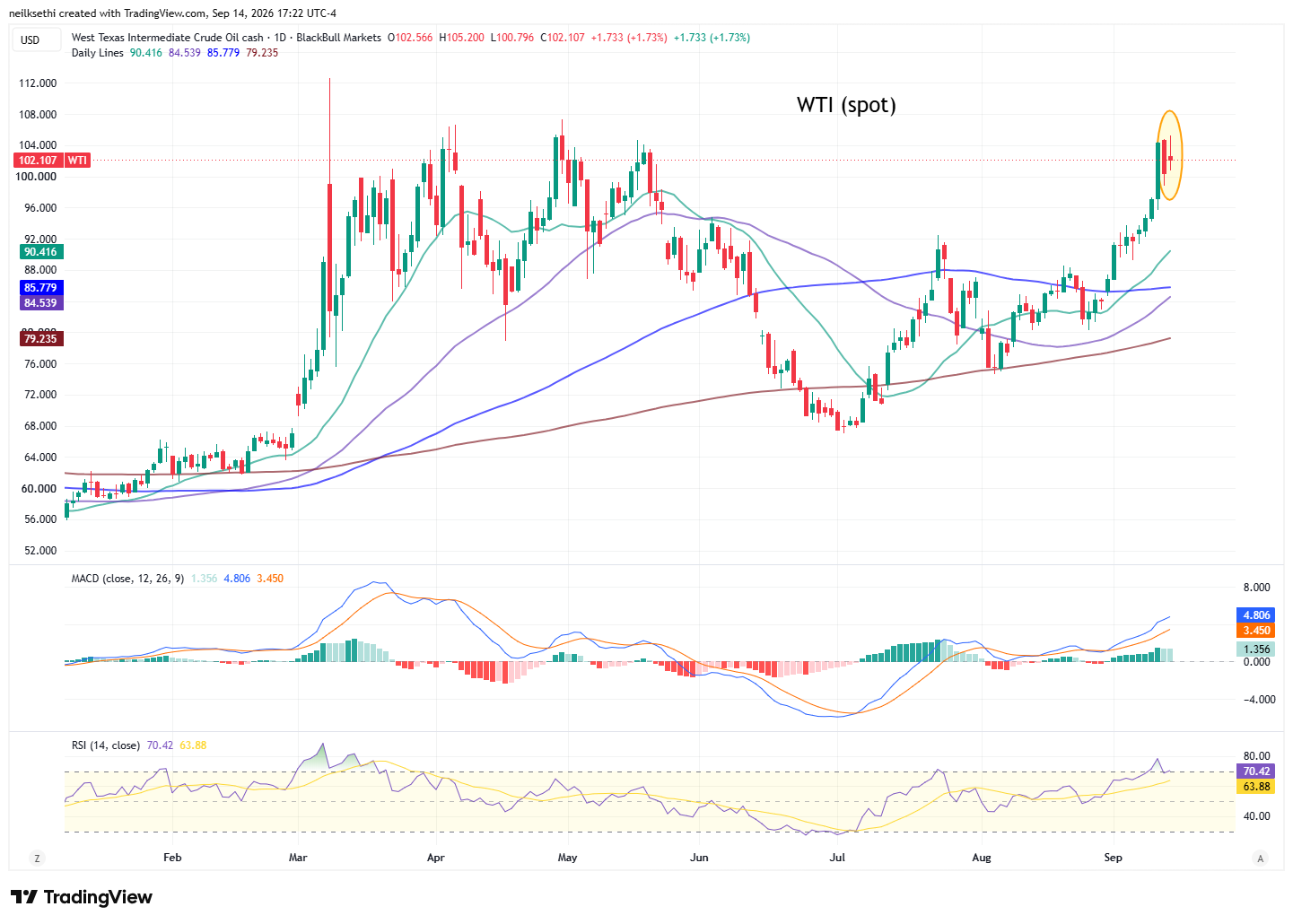
- Oil stayed elevated — WTI topped $104 intraday before easing back — while the 2-year and 10-year yields hit new multi-year closing highs with the 10-year yield at one point breaching the closely watched 5% level. Fed funds futures also rose now at an ~95% chance of a hike Wednesday with a second hike now fully priced in by December (CME FedWatch).
Market Commentary
Equities:
- “In the short term, these warnings could still weigh on AI and chip stocks,” said Charu Chanana, chief investment strategist at Saxo Bank in Singapore.“Their valuations assume both strong demand and a relentless pace of technological progress,” she said. “When expectations are this high, even a possible delay can trigger profit-taking.”
- “The key question is whether this is the first sign that the extraordinary AI investment cycle might eventually moderate. For now, that seems unlikely. The competitive race between companies and countries remains intense, and it’s difficult to imagine firms voluntarily stepping back while rivals continue to push ahead,” Deutsche Bank said in a note.
- “The debate is safety process, not an announced cut to training compute or offtake; however initially the market is still marking AI credit, GPU/HBM demand and IPO optionality as if pacing could slip capex calendars,” said Sean Johnstone, who is on Goldman’s TMT sales desk.
- “We believe concerns on AI deployment could be a sentiment negative for the AI value chain,” Justin Post and Nitin Bansal at Bank of America Corp wrote. “Despite potential concerns, we continue to believe AI capacity will have strong multi-year demand.”
- “Two unwelcome headwinds collide,” said Tim Waterer, chief market analyst for KCM Trade. “Warnings that AI development needs to slow down, combined with another leg higher in oil prices after the Saudi East-West pipeline closure, are a difficult mix for risk assets.”
- “There was a bit of irrational exuberance in the middle of the summer that’s been unwound,” said Chris Armstrong at Berenberg. “This is, I think, another leg bringing down expectations.”
- “The stock market is acting like a duck,” said Drew Pettit, chief investment strategist at Roundhill Investments. “It’s calm on the surface, but it’s just paddling like the dickens underneath.”
- “Alongside ongoing geopolitical uncertainty, we believe these developments could weigh on markets in the coming days or weeks as investors assess the potential implications for corporate profits,” Brock Weimer, investment strategy analyst at Edward Jones said. However, even though Weimer said the impact of those developments “remains uncertain,” he still believes the underlying macroeconomic backdrop is “supportive” for equities.
- “Having guardrails would help steer the direction of AI development, but we do not think it is going to slow it down,” noted Mohit Kumar at Jefferies. “The direction of travel, in our view, would still remain forward.”
- At HSBC, Max Kettner says calls for a slower AI buildout and resulting fears for the tech sector are “overblown.” This could actually help profitability of AI companies eventually, he said.
- “Mostly what’s going on is that [the frontier models] are pulling up the ladder. They have a big lead, and they don’t want anybody to catch up to them, so they’re trying to scare us and our politicians into creating so much regulation that would slow down their competition,” Gil Luria, head of technology research at DA Davidson, told CNBC Monday.
- “Obviously some high profile names stating that the acceleration of Frontier AI models needs to slow may be a sticker shock, but, in a way, this feels exactly what the markets want,” said David Wagner, head of equity at Aptus Capital Advisors. “If capex spend were to slow, so would earnings, but free cash flow would likely inflect higher, which could create multiple expansion back to levels witnessed in December 2025.”“Nonetheless, the market knows it’s entering a seasonally weak period. Coupled with a lot of mid-term rhetoric, this could create an environment where stocks continue to take a breather,” he added.
- “Whether calls to pace advanced model development will gain traction across the industry remains uncertain, but we believe they are more aimed at shaping a regulatory framework acceptable to leading AI labs,” said Ulrike Hoffmann-Burchardi at UBS Chief Investment Office. “We therefore expect AI investment to continue.”
- “Earnings have overwhelmed” the macroeconomic risks, said Keith Lerner, chief investment officer and chief investment strategist at Truist Advisory Services, adding that he expects to see further earnings growth in the next round of reports. “On the other side of this, the evidence in our work suggests the bull market is still intact.”
- “If you can make your way to the next earnings season, then all of a sudden you’re going to be hearing about what should be, I think, decent top- and bottom-line growth,” said Timothy Holland, chief investment officer at Orion. “I am not willing or ready to give up on the underlying strength of the economy, earnings growth, liquidity, despite what are some very meaningful and really concerning macro headwinds,” Holland said.
- “The greater risk is missing the last leg of a bull market where you generate these outsized returns,” said Michael Rosen, chief investment officer at Angeles Investment Advisors. “I’m not suggesting this is the end of a bull market, but if it were then missing out and then having to get back in is really an impossible task.”
- “Growth and tech can power through a tightening cycle,” said Chris Harvey, head of equity and portfolio strategy at CIBC Capital Markets, noting that the technology-heavy Nasdaq 100 Index climbed 59% from June 1999 through May 2000, when the Fed was raising rates. But financials and value stocks fell, posting “weak relative and absolute returns,” he said.
Fed:
- “The Fed is behind the curve, definitely,” said Tracy Chen, a portfolio manager with Brandywine Global Asset Management. “Yields are heading higher in the medium-term.” She said that’s because some of the factors pushing longer-term yields higher, like the inflationary impacts of the Iran war, aren’t in policymakers’ control. “How high I don’t know, but I think definitely beyond 5%.”
- “Inflation is still uncomfortably above target and the federal government is financing large deficits into an already heavy supply environment. If nominal activity stays around current levels while the Fed has tacitly accepted 3% inflation as 2%, long rates simply must go higher.” —Brendan Fagan, Macro Strategist, Markets Live.
- “The more that the Fed can show its inflation fighting credibility, the more likely it’ll compress the risk premium on the back end of the Treasury curve over the medium term,” said Daleep Singh, chief global economist at PGIM Credit.
- “The selloff in the long end, if the Fed does not hike, could potentially become much more disorderly,” said Ed Al-Hussainy, a portfolio manager at Columbia Threadneedle.
- Standard Chartered’s Steve Englander said the Federal Reserve should wait until noise from tariffs in the economic data dissipates, adding that core inflation is likely to be overestimated. “From a risk-management perspective, the FOMC should allow data to settle before determining whether a hike is necessary,” the global head of G10 FX research wrote in a note titled “Hiking is the wrong choice.” “It could open the door to a 50bps hike if subsequent data supports the hawkish case.”“By contrast, reversing a premature hike would damage credibility and be seen as a very unsteady hand on the tiller,” he added.
Stock and Sector Breakdown:
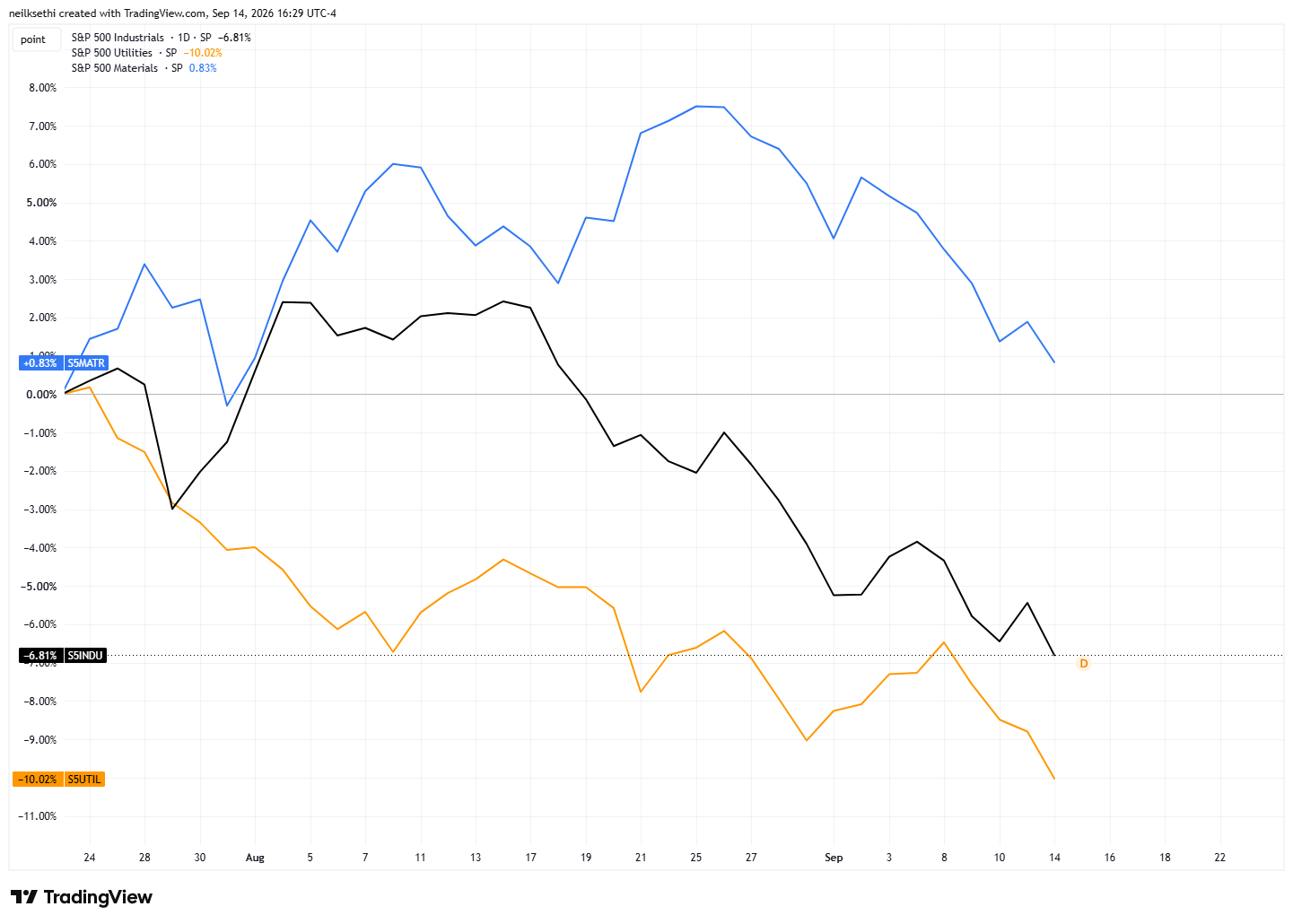
After Friday saw 9 of 11 sectors higher, just about the opposite Monday with just three in the green, although all up over 1% in Communications, Health Care, and Staples (the former up nearly 3%). Four sectors down at least 1%, though led by superheavyweight Tech (~40% of market cap) as AI beneficiaries sold off. Industrials continued their recent weakness (down over 9% the past month) as did Utilities and Materials (see chart below).
The PHLX Semiconductor Index (SOX) dropped 5.9%, while other beneficiaries of the AI infrastructure buildout such as Corning (GLW) -13.76%, Teradyne (TER) -13.30%, and Coherent (COHR) -12.73% saw double-digit losses and were the worst-performing S&P 500 components, with Corning facing the additional headwind of a potential $2 billion common stock offering.
The other side of the AI trade looked dramatically different. The First Trust NASDAQ Cybersecurity ETF (CIBR) jumped 6.0%, boosted both by reduced concerns over AI disruption as well as increased concerns of security threats from autonomous AI systems. CrowdStrike (CRWD) +13.85%, Palo Alto Networks (PANW) +13.09%, and Gartner (IT) +9.73% led S&P 500 components to the upside.
Other beneficiaries of potential reduced spending on AI were Alphabet (GOOG) +3.06%, Meta Platforms (META) +2.71%, and Microsoft (MSFT), apparently on hopes for a return to more robust cash flows.
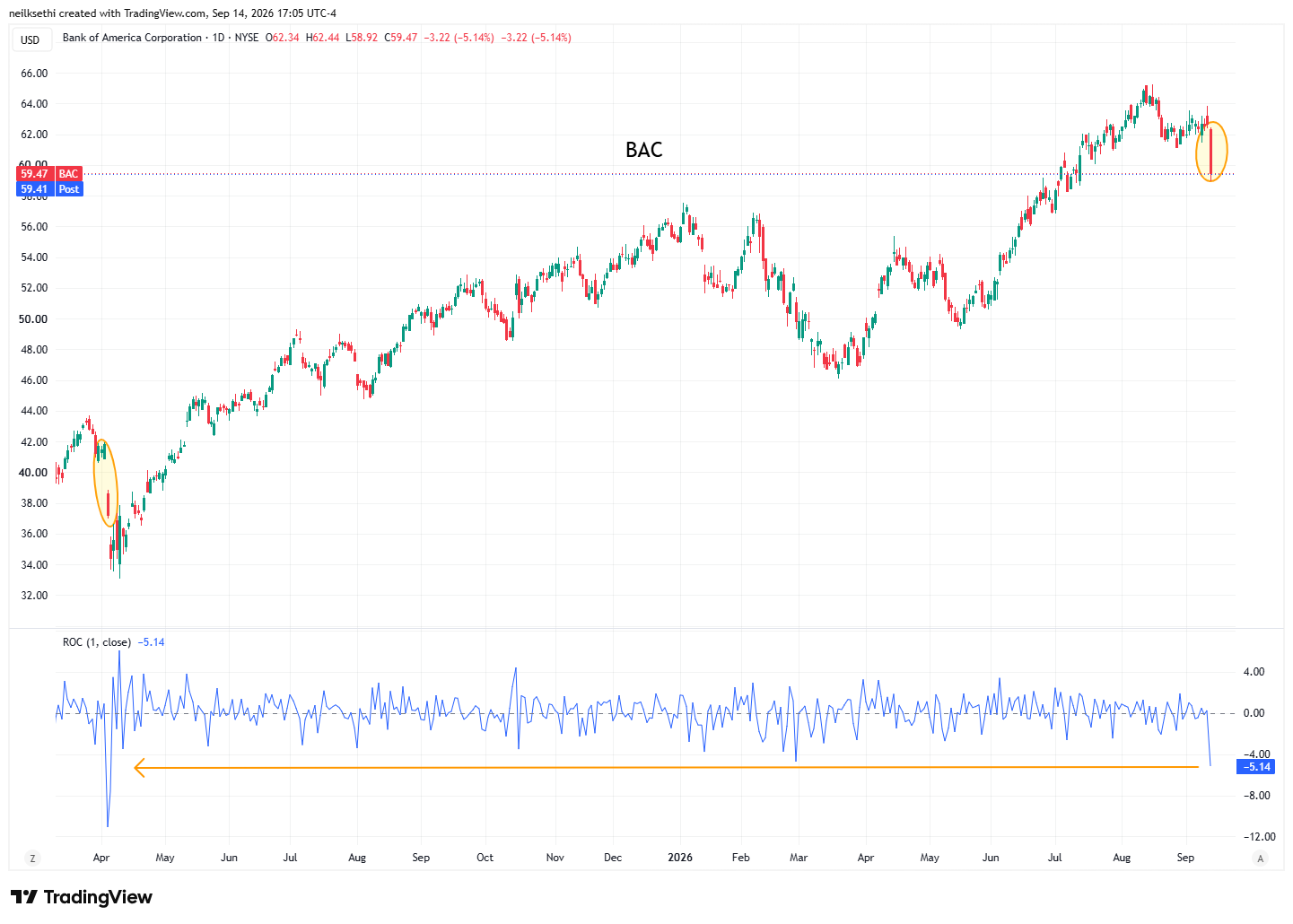
Away from AI, Bank of America (BAC) was a sore spot in the session, falling 5.1%, its worst day since liberation day, after CEO Brian Moynihan said that third-quarter investment banking fees will likely fall by more than 10% from a year ago, and trading revenue will come in around flat (chart below).
In other news, Elon Musk’s xAI and X Corp. said they resolved an antitrust lawsuit against Apple Inc. (AAPL) that accused the iPhone maker of favoring OpenAI’s ChatGPT over other chatbot makers, and SpaceX (SPCX) is set to get a larger weighting in the Nasdaq 100 later this month, a change that could trigger billions of dollars of buying by passive funds tied to the benchmark.
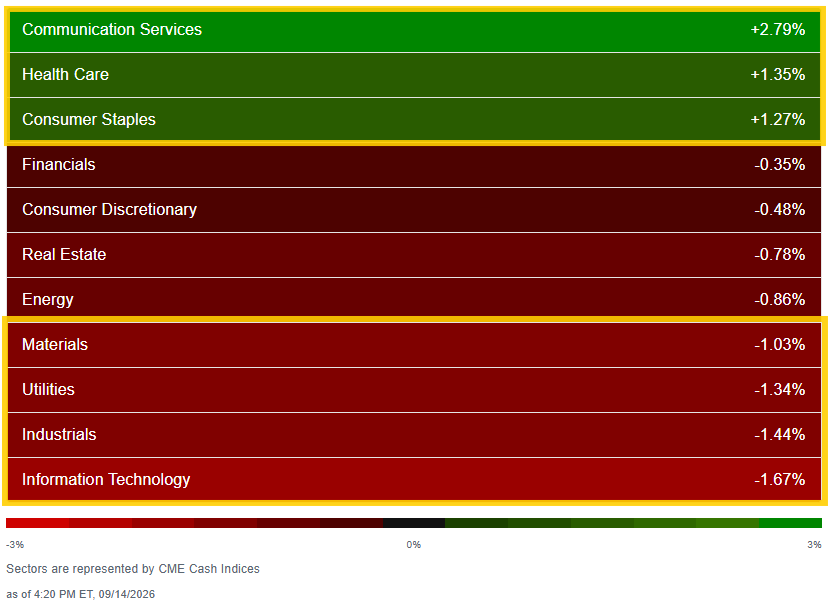
Despite the weaker sector breadth, the number of large SPX winners (up over 3%) improved to ~55 from ~45 Friday. Almost as many as the number of large losers (down over 3%), which increased to ~65 from just 3 Friday.
Some stock-specific commentary from TheStreet Pro today:
- Stephen Guilfoyle – Why I Bought Nvidia Into Monday’s AI Panic & Our Small-Cap Holding Makes $205 Million Acquisition
- Chris Versace – We’re Exiting This Position Amid OpenAI IPO and Market Concerns
- James “Rev Shark” DePorre – Messy Market Action Continues But 2 Big-Cap Names Stand Out
- Bob Lang – Chart of the Day: Arista Networks Is a Screaming Buy, This Pattern Says
- Bob Byrne – Can Anthropic’s IPO Survive Its Dystopian AI Warnings?
A Look At The Charts
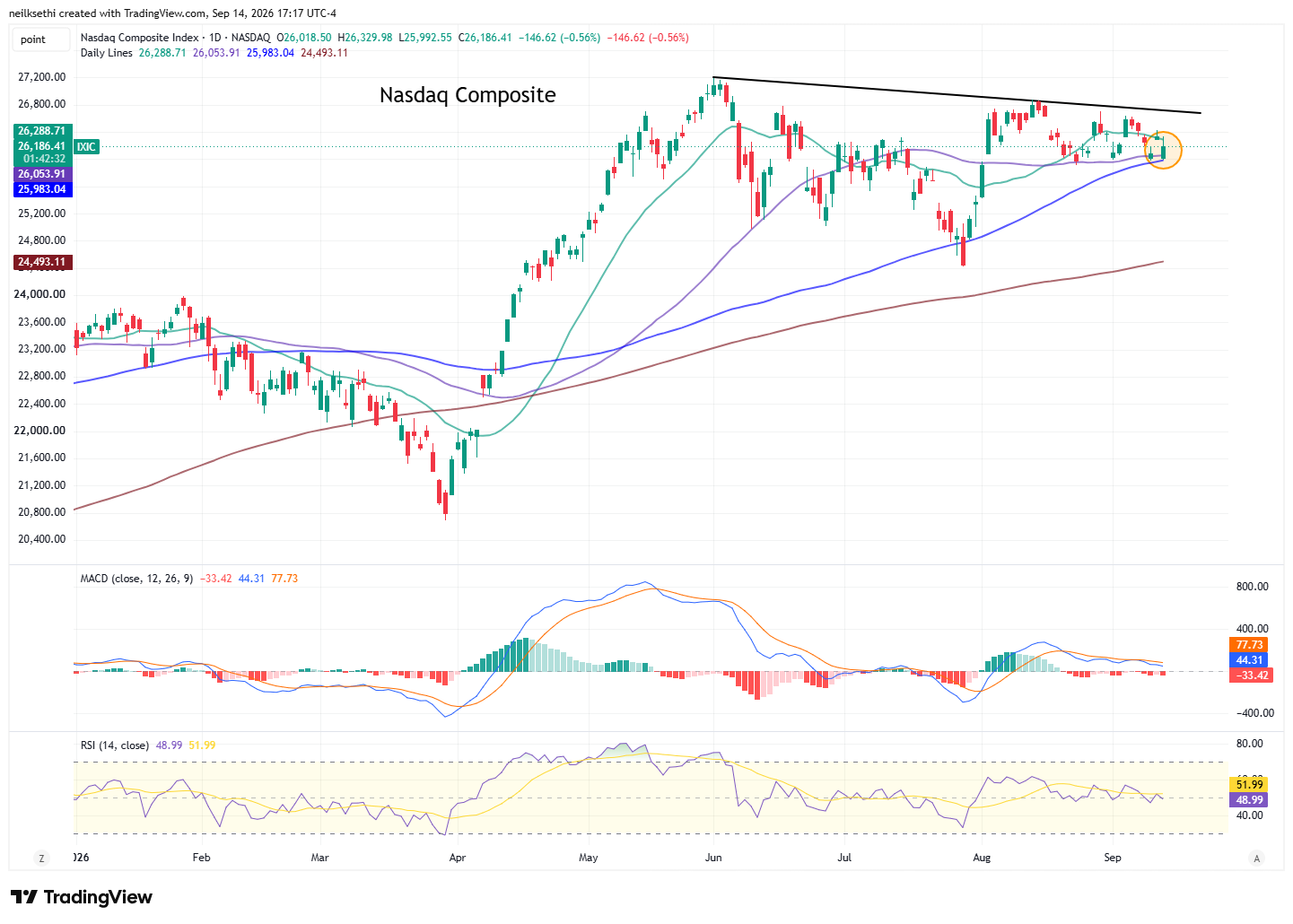
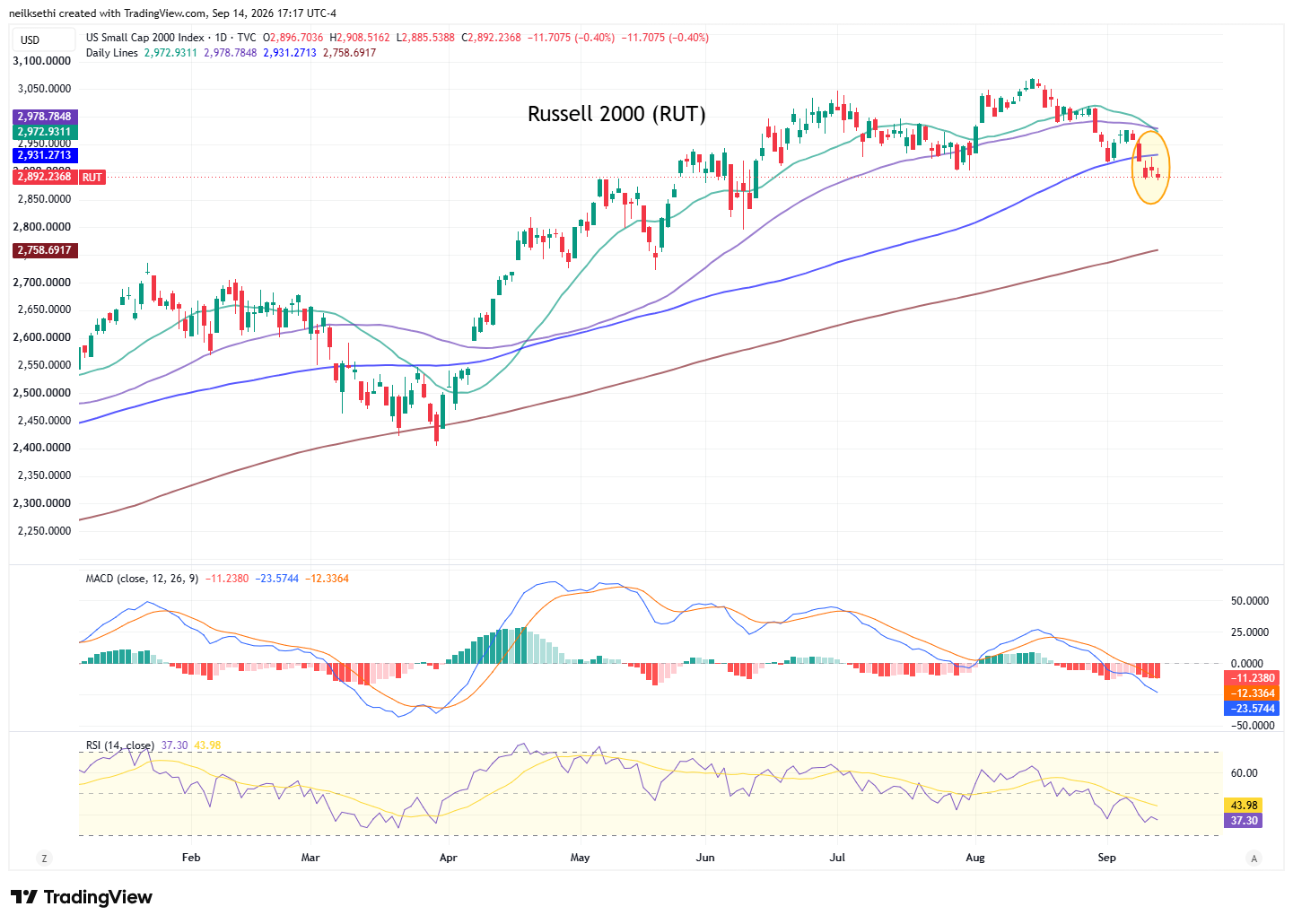
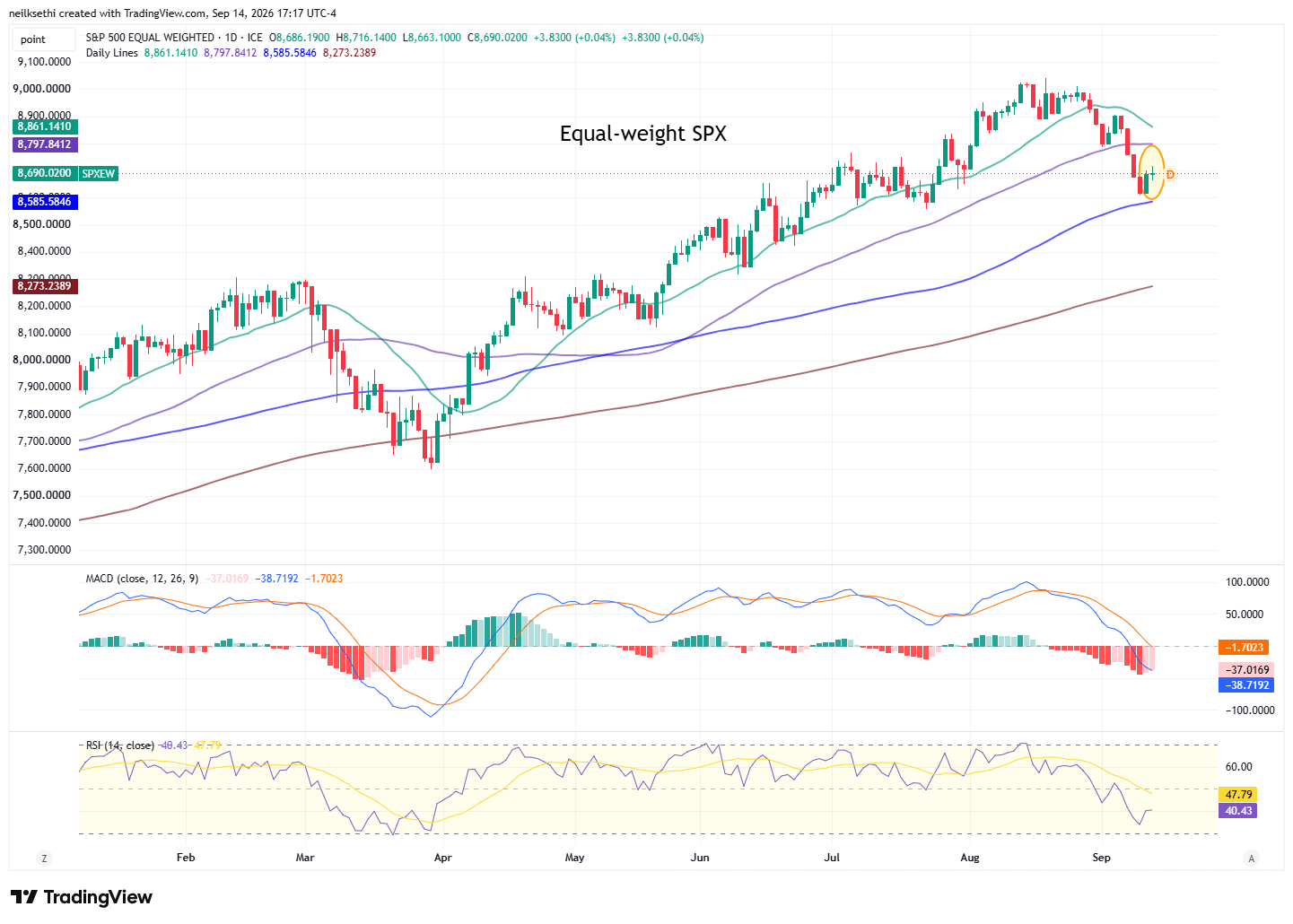
Note on all charts the colored lines are moving averages (the average price over the lookback period (days on the daily charts, weeks on the weekly charts)):
20 = green
50 = purple
100 = blue
200 = brownException is monthly charts where blue is 10-month moving average and brown is 20-month moving average.
MACD = Moving average convergence/divergence line, a measure of momentum that compares longer term and shorter term momentum to gauge if a move is strengthening or weakening. This is probably my favorite individual indicator (it’s also the favorite of Katie Stockton, a very fine technician).
RSI = Relative Strength Index (basically what it sounds like) = measures the strength of the move comparing gains to losses over the given lookback window (I use the standard 14 periods).
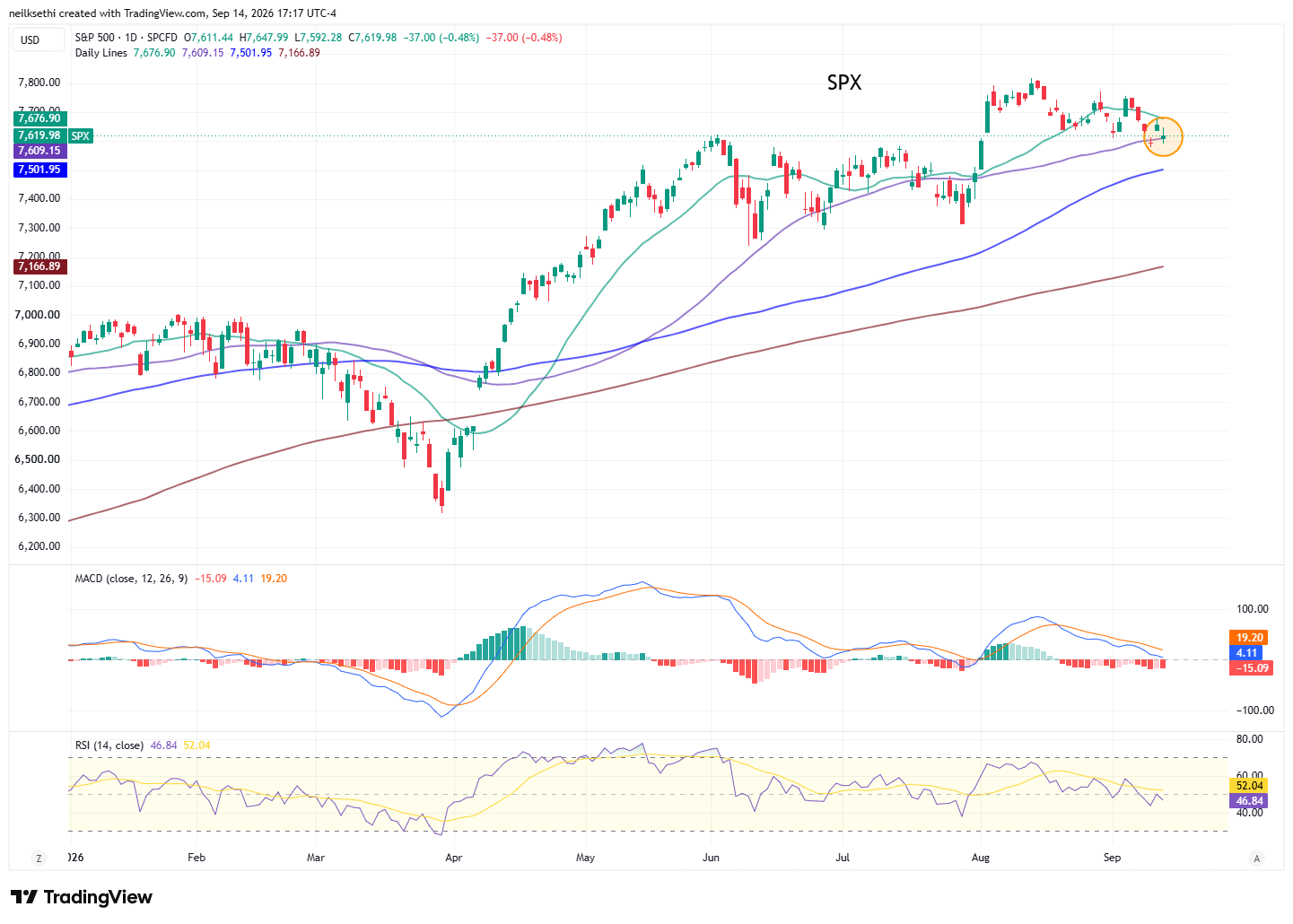
SPX ended right on its 50-DMA. Daily MACD remains in “sell longs” positioning though, and RSI is right around 50. So as I said Tuesday/Wednesday “just caution flags – nothing yet to turn bearish, but that probably changes short term if the 50-DMA doesn’t hold.” As I added Thursday, “For now I’m taking some comfort in the fact it doesn’t seem CTA selling thresholds have hit, and Tier1Alpha (see below) finds the 7575 level (which we closed above) good support. If we breach that I will exit my SPX index longs until we recover the 50-DMA.” So far it continues to hold.
Nasdaq Composite a similar story to the SPX with a slightly better chart. As I said Thursday “Holding here as well for now.”
The Russell 2000 (RUT) I said Wednesday was “much more problematic,” and that remains the case. As mentioned Tuesday its MACD is now in “go short” positioning, and its RSI is now below 40. As I said Wednesday “I am not long this index, but … I’d be out until it at least recovered the 100-DMA.”
The equal-weighted SPX I noted Friday was no longer the most concerning chart “as the RUT has taken that role, and I like the nice green candle meaning it closed near the highs of the session.” I mentioned Tuesday “I did take off most of my holdings in (RSP) for now. I’ll be looking for a tradeable bottom to form.” As I said Friday “I had thought the 100-DMA might offer some support, and this is a nice start, but we’ll need to see a lot more before adding.” Today was another step in the right direction.
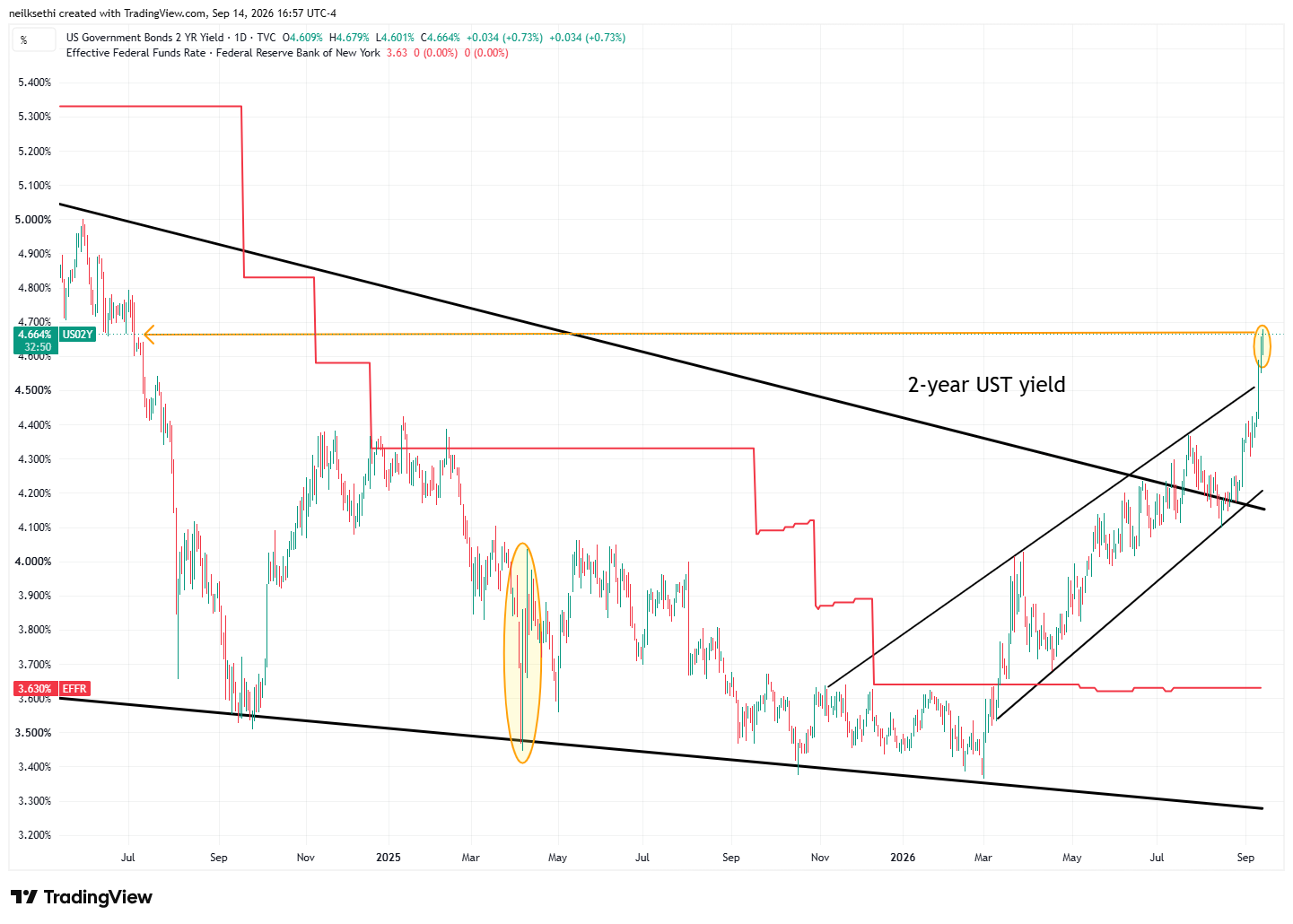
Treasury yields bear flattened again with the short end moving higher while the long end was little changed (bearish because it implies Fed rate hikes):
The two-year Treasury yield added another three basis points, now up 22 basis points the past three sessions, to 4.66%, the highest close since July 2024. It’s now well above its trend channel, which I had said Friday was “signaling either it’s breaking out or it’s become extended and is in need of a pullback.” So far seems like the former. Still, as I mentioned “we’ll likely not find out for sure which until Wednesday.”
It is over 100 basis points above the Effective Fed Funds rate (red line), screaming for rate hikes. That’s the furthest above the EFFR since November 2022 when the Fed was in the middle of a historic tightening campaign.
And again probably no surprise that FOMC rate hike expectations also pressed higher. The September meeting rose to a 95% chance up from 60% on Wednesday. Two rate hikes this year are now fully priced (actually 53 basis points) and through 2027 there’s nearly four hikes priced (98 basis points). As I said Friday, “don’t see how the Fed doesn’t hike next week absent some sort of media tip that they are planning on not going.”
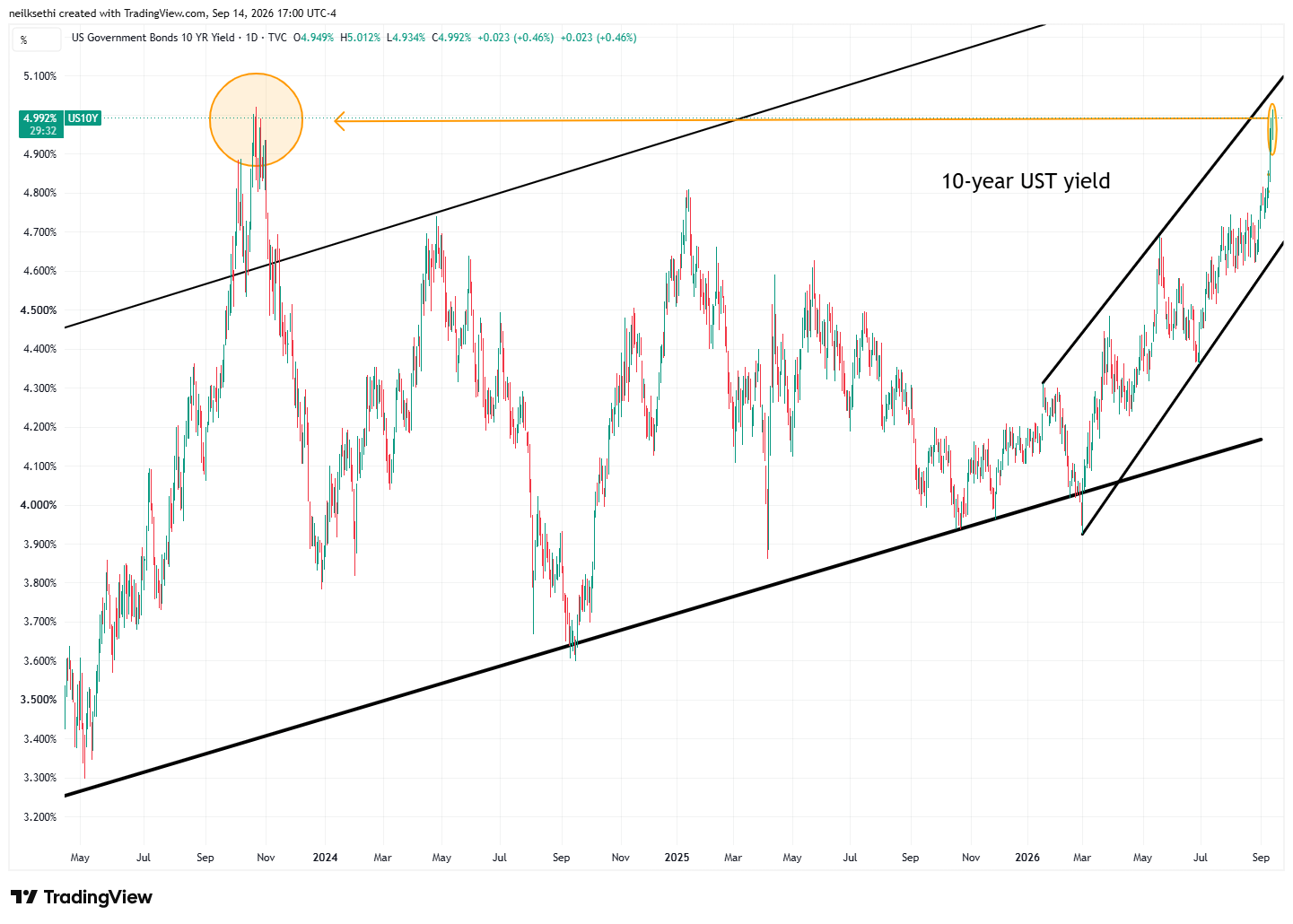
10-year yields at one point breached the 5% level before ending just under at 4.99%, the highest since October 2023.
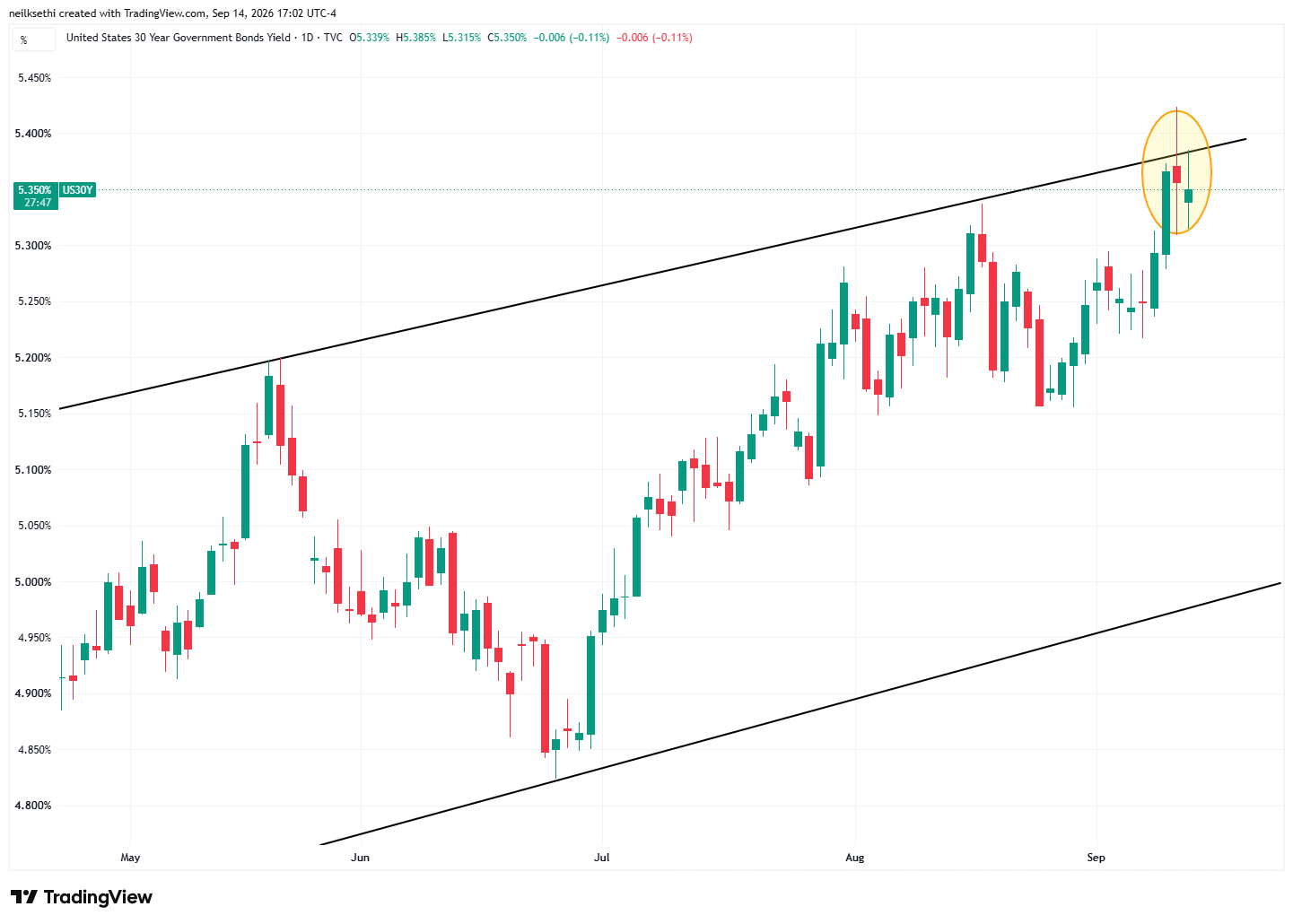
30-year yields though ended down a touch for a second session at 5.35%, two basis points off the highest close since 2007. It remains right at the top of its uptrend channel.
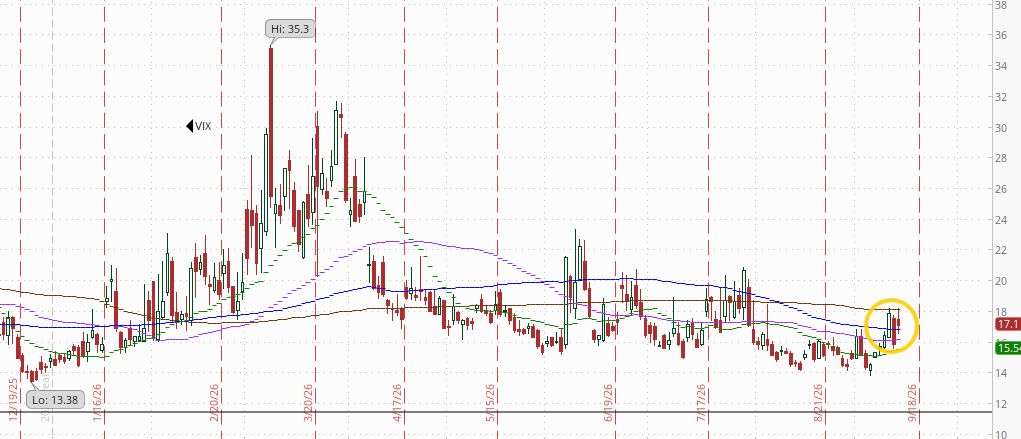
VIX interestingly failed at its 200-DMA for a second session but ended higher at 17.1. That’s consistent with ~1.07% average daily moves in the SPX over the next 30 days.
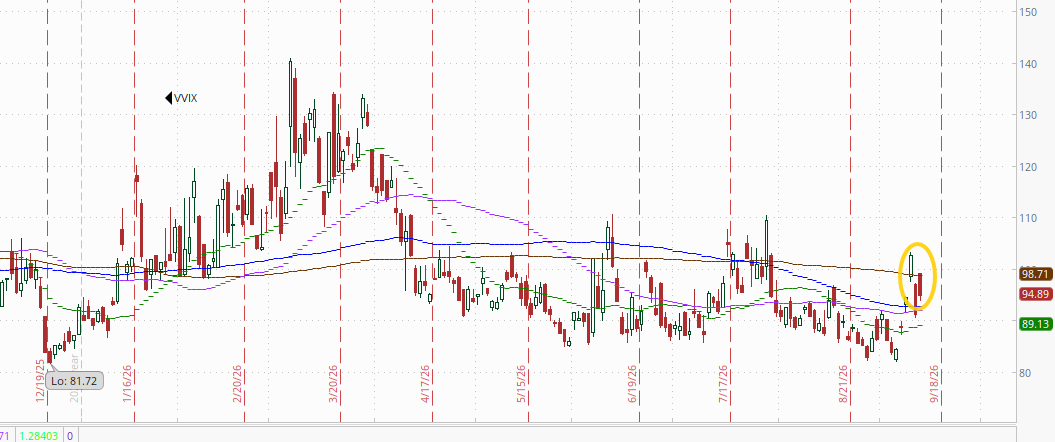
The VVIX (VIX of the VIX) a similar story rising to 94.9.
The current level is consistent with “moderate” daily moves in the VIX over the next 30 days (historically, normal is 80-100). Above 100 is the level flagged by Charlie McElligott as indicating higher stress.
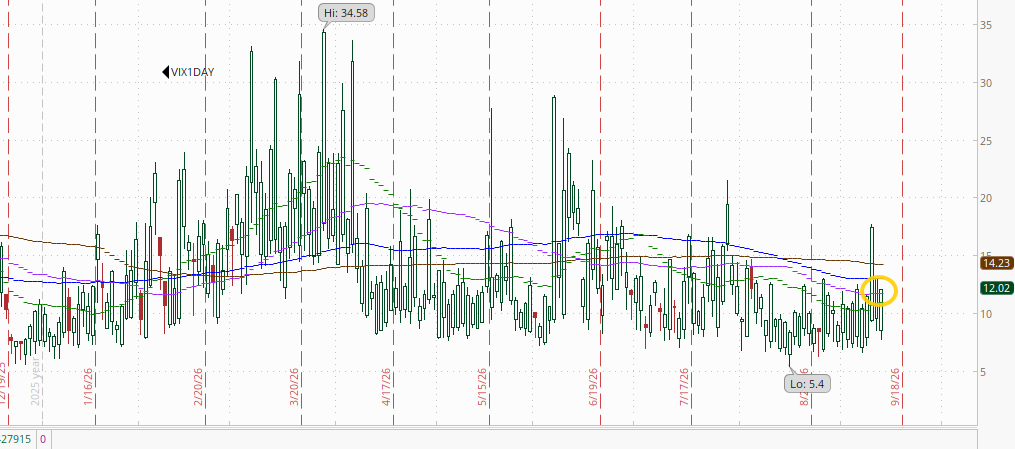
While the 1-day VIX eased back just a touch with the weekend rolling off to 12.0. The current reading isconsistent with a move of 0.76% in the SPX next session. This will likely shoot higher tomorrow as the FOMC comes into the picture.
WTI (cash) early on had recovered all of Friday’s drop but ended up around half of that gain at $102.11.
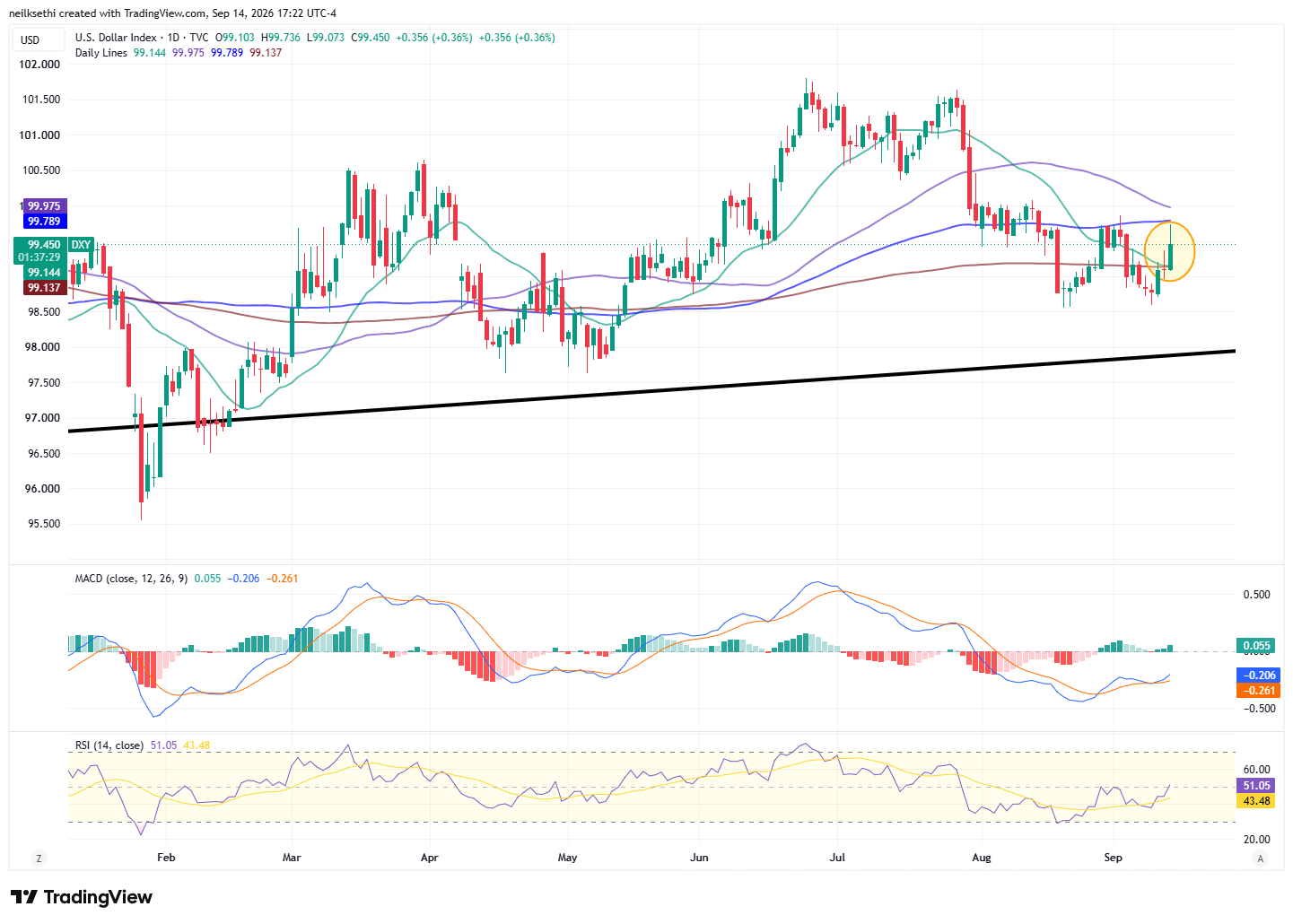
The DXY dollar index (which is fixed weighted with a heavy (57%) weighting vs the euro), had no problem with the 200-DMA today but did fail at the same resistance area as two weeks ago. It will need another catalyst to get through that.
The daily MACD remains tilted positive and the RSI is now just above 50. I said Thursday “If it can get through the 200-DMA it likely runs to the 100 (blue line).” It did just that, but now it’s got even stiffer resistance.
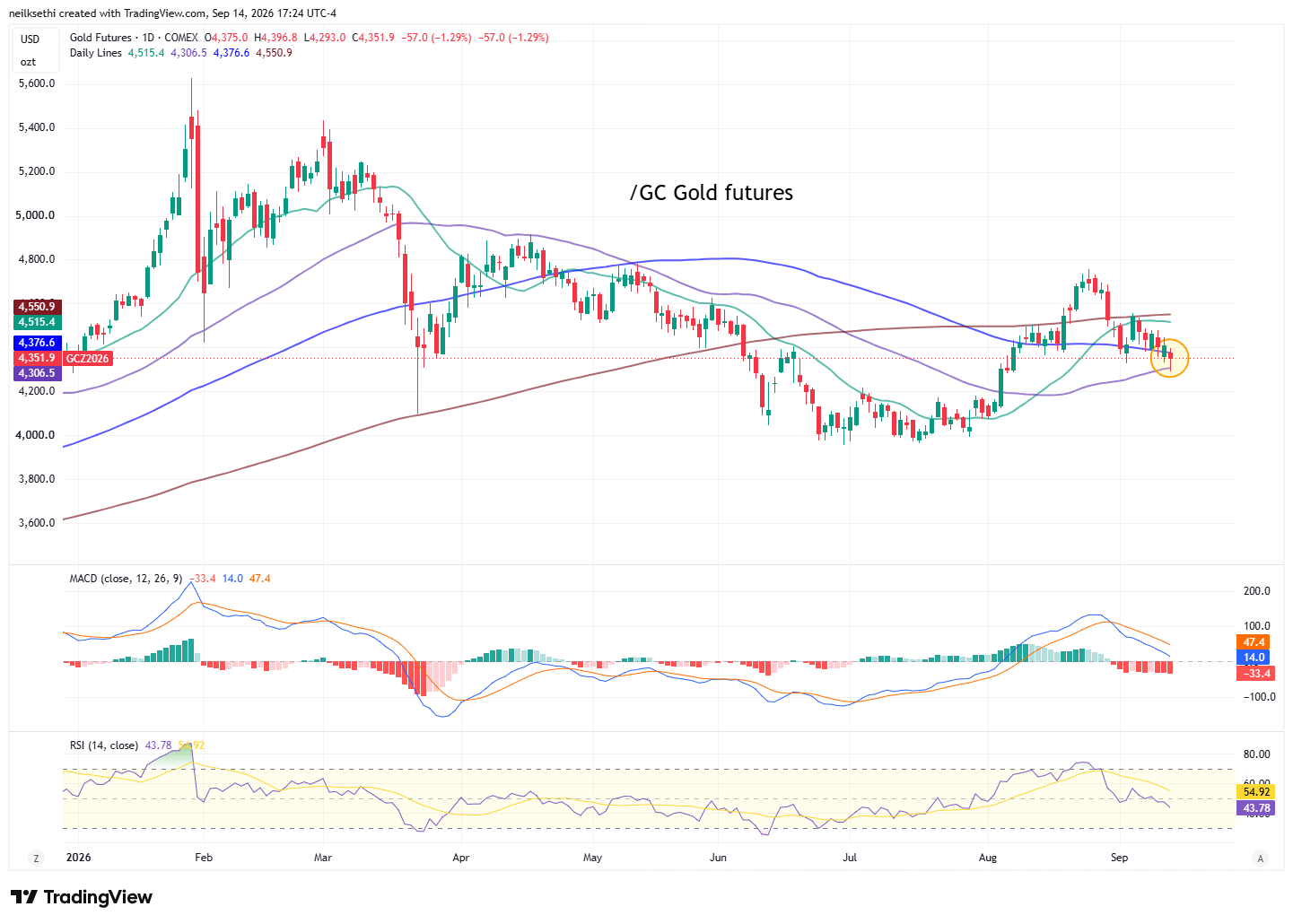
Gold futures (/GC) fell under the 100-DMA to the 50-DMA. The daily MACD remains negative and the RSI is under 50. As mentioned at the start of the month, “I will wait for it to get back over the 200-DMA to add back what I took off when it fell below.”
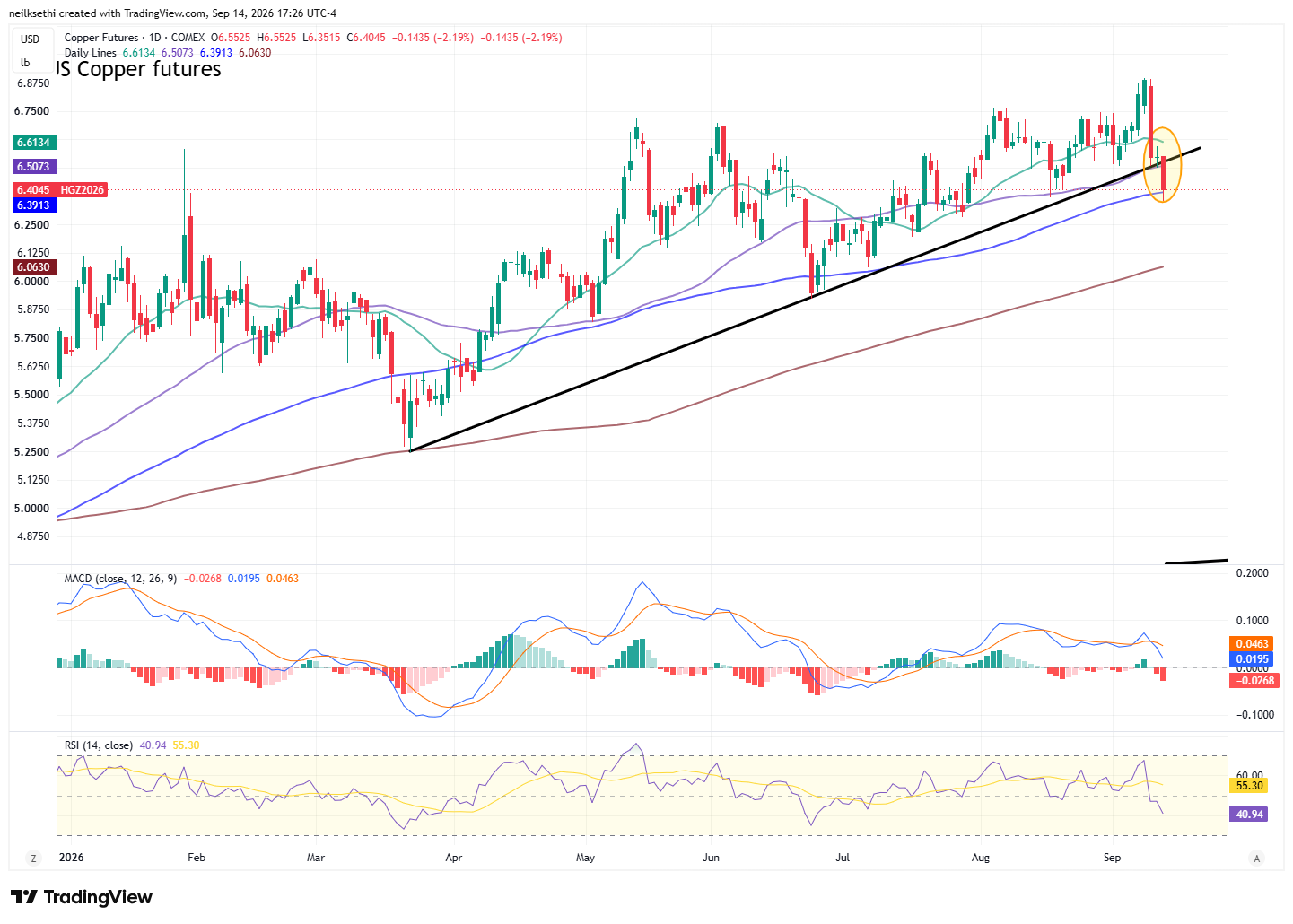
US copper futures (/HG) dropped with the AI trade slicing through their 50-DMA and the uptrend from March (they remain well above a longer term uptrend running to February 2020). Technicals turned much more bearish, so as promised I took off half until it reclaims the 50-DMA. If it breaks the 100-DMA I might take off more.
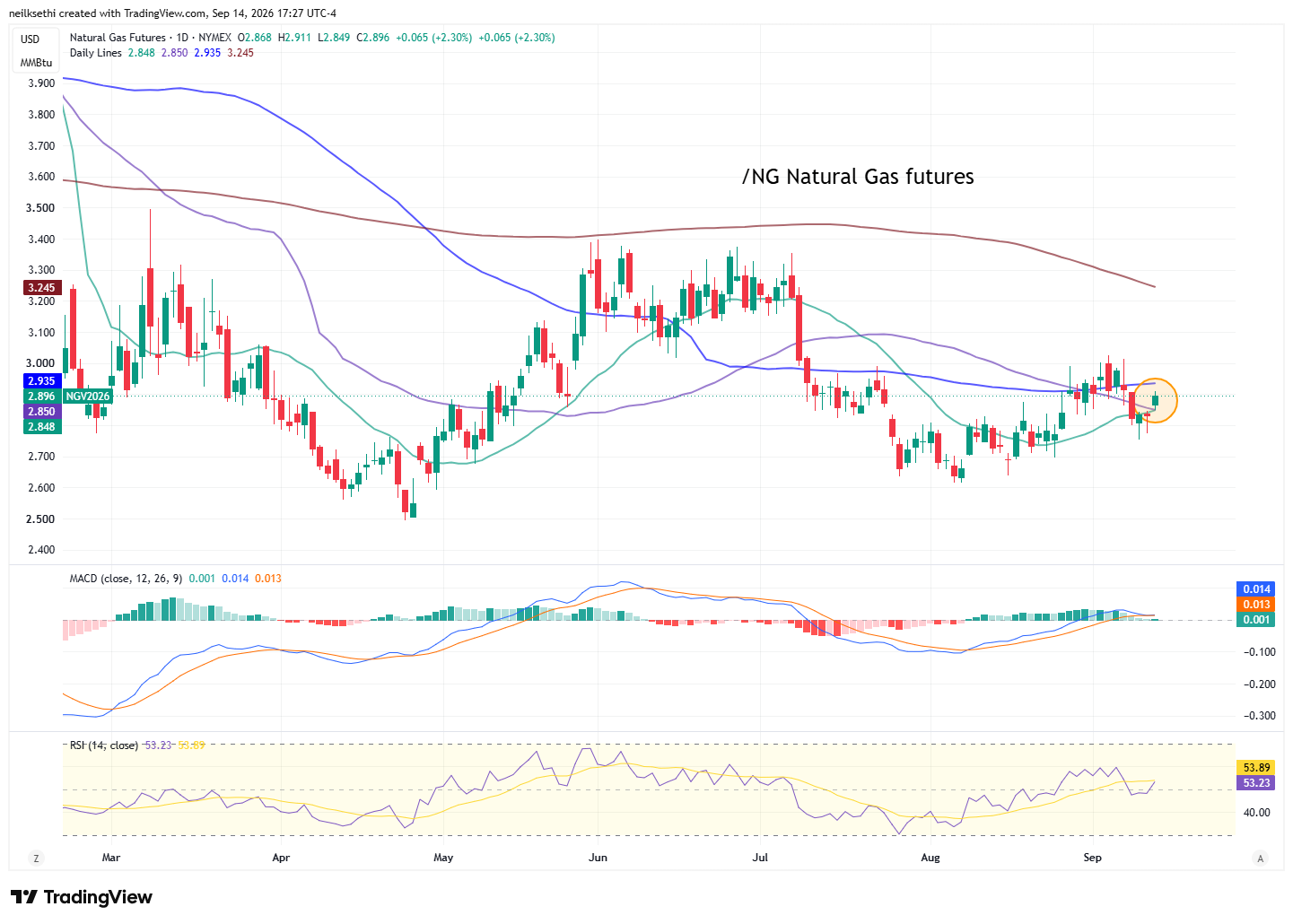
US natural gas futures (/NG) as noted last week “now back to trading in their range since the start of July.”
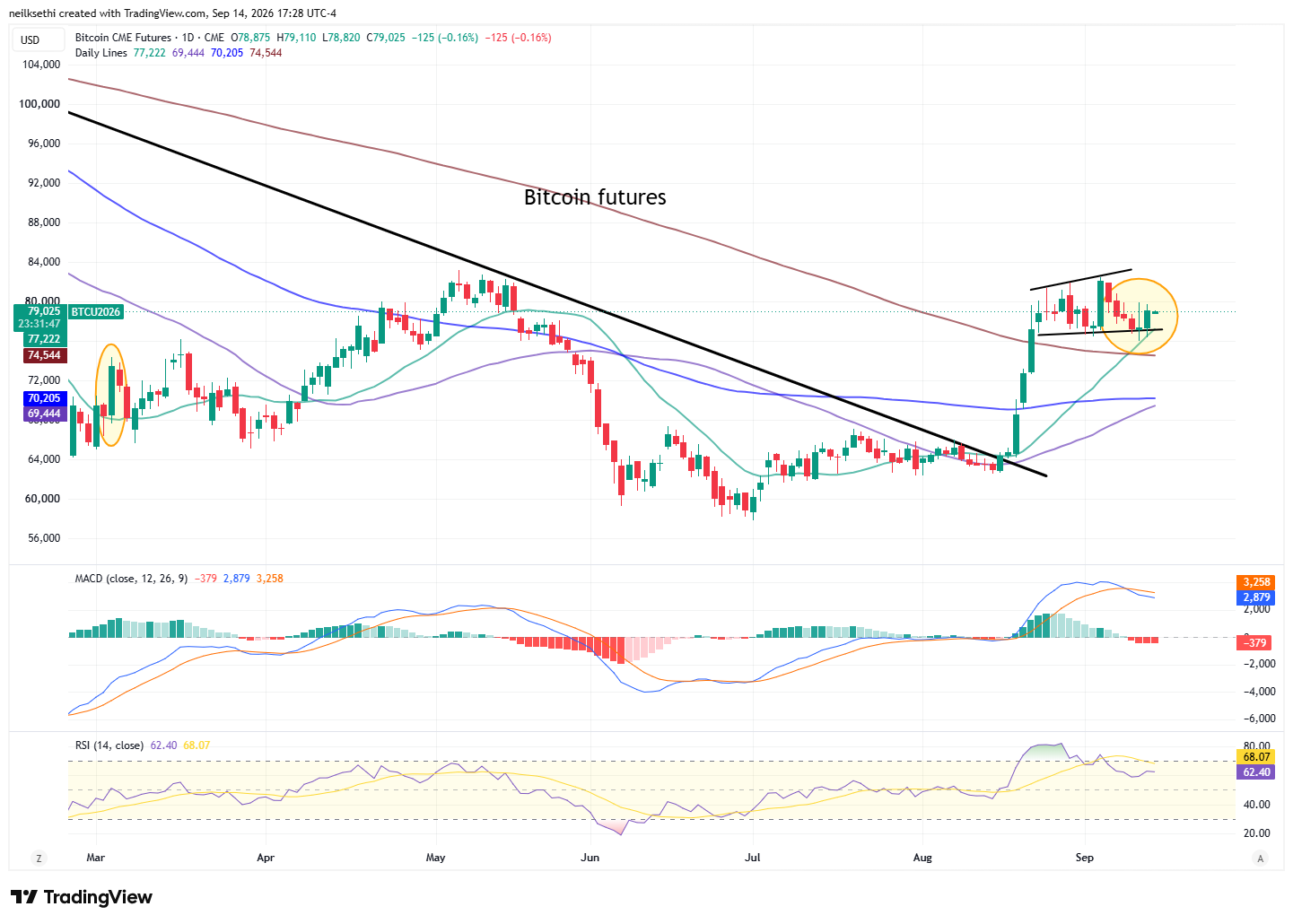
Bitcoin futures were down for a sixth session early but saw a bigger recovery today continuing to hold the bull flag formation I mentioned two weeks ago. Daily technicals remain mixed. As I said then, “I’ll stay long as long as it holds above the bottom of the flag (and will add if breaks above).”
More From TheStreet Pro:
- Chris Versace –Updating Our Table of Key Portfolio Metrics & VIDEO: How We’re Positioning the Portfolio for the Fed, AI and Rising Yields
- James “Rev Shark” DePorre – A Market Stuck on Hold Leaves Traders With Little to Do
- Bret Jensen – Markets Scream Caution With Rate Hike All But Guaranteed
- Peter Tchir – The AI Spend Grabs Headlines, But the Economy Really Hinges on This
Miscellaneous:
Wrap-Up – The “Fragile” Market Holds Its Ground
I wrote at length in the Week Ahead about the narrowing margin for error, and from all appearances this morning things were headed very much in the wrong direction, but as we’ve seen more often than not the past four years, markets proved more resilient than expected with investors simply taking the AI-selloff as an opportunity to buy into the rest of the market, particularly names which had been beaten down due to AI concerns (software, hyperscalers, etc.).
That does fit with the “oversold” breadth metrics I noted, so there does seem to be some scope for this to continue I suppose, especially with an almost empty calendar again tomorrow in the US.
We also might very well see a bounceback in AI names if investors rethink how much slowing there really might be.
And we are starting that pre-earnings positive period highlighted by DB, along with the other supportive factors identified.
So while the situation remains fragile, perhaps it’s not quite as much as it seemed coming into the week.
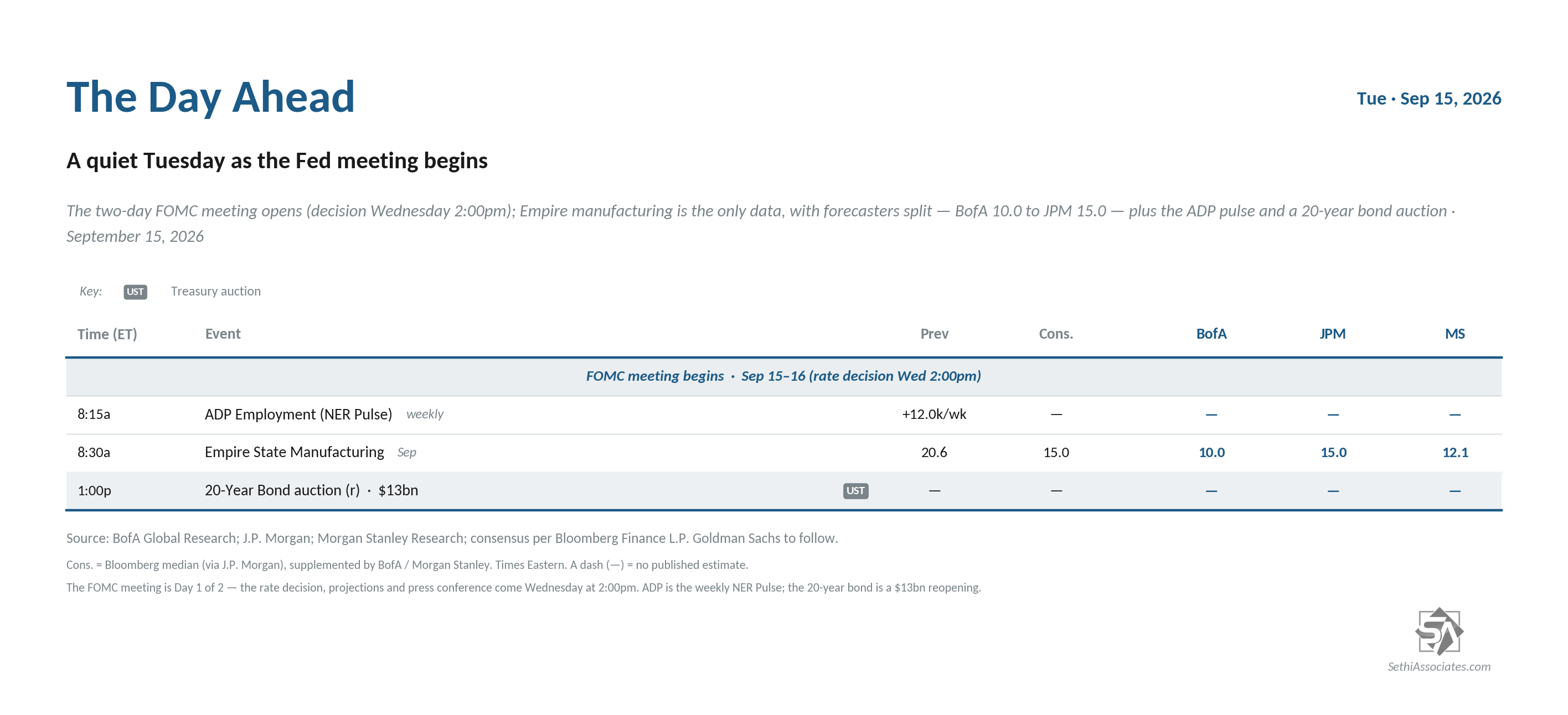
The Day Ahead – Calm Before the Storm
After Monday’s empty calendar Tuesday is also very light giving us just the ADP weekly job growth update and a regional Fed survey in terms of US economic data.
Non-Bill (>1yr in maturity) US Treasury auctions give us a 20-year bond (reopening).
No SPX components reporting.
Ex-US highlights are the monthly data dump from China including retail sales, industrial production, home prices, fixed investment, unemployment, etc., UK employment, Germany and EU Zew surveys, and EU trade balance.