The AI Spend Grabs Headlines, But the Economy Really Hinges on This
There is a lot of debate about compute spending, but investors should be more focused on these two developments.
You've reached your free article limit
You've read 0 of 1 free Pro articles.

There is a lot of debate on Monday morning about what is next in the compute space, as Anthropic’s and OpenAI’s CEOs opened the door to some questions. But I will focus on two things more tangible, that may see some clarity this week.
Warsh Has a Difficult Job
While it isn’t Fed Chair Kevin Warsh’s decision alone, he faces an incredibly difficult dilemma this week as he tries to steer the Fed into a hike or to a hold:
- The market is 90% pricing in a hike, so it is difficult to push for a hold
- A hike will likely help the longer end of the yield curve, which is good
- With $6 trillion of T-bills maturing in 2026, any hike will immediately increase the amount the country is spending on interest. At $15 billion annually, we really don’t benefit much from better in longer-term yields. The Federal Reserve balance sheet sits at $6.7 trillion, most funded overnight. That’s another $15 billion of cost to the country, with interest expense already an issue relative to defense or discretionary spending, a rate hike does not help on that front.
- I find it difficult to imagine President Trump liking the idea, even if it helps the longer end of the yield curve, or that stocks have priced it in
- While CPI disappointed, it is the years of being above trend that make a relatively benign number seem malignant. I continue to wish we could move to alternative data sources sooner rather than later. The conversation around inflation should be much broader based. While I agree that we missed inflation (especially in the aftermath of COVID), I’m not sure fighting old battles is the best way to manage the world’s largest economy.
- I don’t see how hiking rates helps the price of oil, gasoline or diesel, when the problem isn’t excess demand, it is supply disruption and a global system of refining that isn’t operating at optimal levels. If everyone was running around willy nilly, “splurging” on gasoline, electricity and diesel, it might help, but the cost is already impeding demand. How does raising rates help? Maybe it hurts as it makes some projects to generate more oil, gas and electricity less easy to justify economically.
- While we try to figure out whether AI will kill us all in 10 years or not, there is little to slow the “compute” spending. Well, there is an increasingly vocal, largely local, movement against data centers, but they will get built. The companies (which maybe should have been reading my reports when I first discussed the AI revolution) are finally starting to do some better outreach. I completely agreed with Scott Bessent when he gave them a poor grade on steps taken to persuade communities on why they should want, and even embrace, data centers in their areas. But there is a 0.00001% chance that 50 BPS of hikes slows the compute spend. The compute spend is built on “addressable market shares” that dwarf even current valuations in the compute space. The only way the compute spend slows down is if the perception of the addressable market decreases. That could happen through too much AI slop, cheap Chinese compute, etc., but it won’t slow due to rate hikes. Until something changes in the value perception, we are going to see higher memory prices, etc., permeate consumer electronics. So, why hike to slow this if it won’t slow it? We need AI for many reasons, including national security, but it needs to be “sold” (or better explained to the people than it currently has been).
Warsh has a tough job. I would fight tooth and nail to stay on hold! Not because it would make the president happy (it would), not because it would help the long end of the yield curve (it won’t), but because hiking won’t help fight the current drivers of inflation, and inflation isn’t high enough to have what I think is a “preemptive/fighting past wrongs” hike.
The Gulf States and Iran
There is reporting that the pipeline the Saudis have been using to bypass the Strait of Hormuz has been hit and is currently shut down. Not only has this pipeline been used for oil, it apparently has helped with the supply of gasoline and diesel (via Saudi refiners). While the U.S. has been blocking shipments of Iranian oil and aiding some ships through the Strait, this attack could derail progress that has been made.
We have repeatedly argued that any “new” pipelines (or Middle East data centers) are going to be expensive and slow to build because they will need to be “hardened.” Hundreds of miles of exposed pipe is an easy target for drones and rockets and almost impossible to defend. There will be a higher cost (and longer timeframe) than optimists believe in terms of reducing the need for the strait.
The Houthis, after a series of offensives, are in even stronger position to disrupt trade through the Red Sea. That’s all problematic.
The president is asking/telling/ordering Ukraine to stop attacking Russian refineries. That is having some impact on the price of diesel, but it is unclear how much Ukraine will do in this respect (they finally seem to be “bringing” the war to Moscow and St. Petersburg, which Vladimir Putin had done a good job of isolating from the impact of the war, until recently).
While the president seems to be indicating that there will be no resolution until after the midterms (consistent with our earliest expectations of when the increased economic pressure on Iran could bring results), he (and the country) faces a couple of realities. Let’s start with diesel.
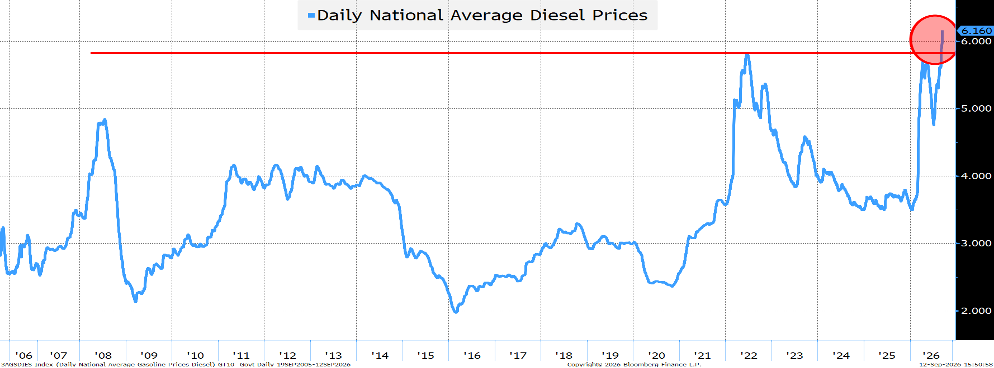
Diesel permeates the economy. It is incredibly important in shipping and agriculture and therefore the entire economy. It is the highest ever. The 2007 “China Commodity Boom” was higher when adjusted for inflation, but that was part of an economic boom. My understanding is that U.S. refineries are operating at close to maximum capacity and that some “normal” maintenance shutdowns have been pushed off. Can this continue? Are there risks even to the domestic system, let alone the global system?
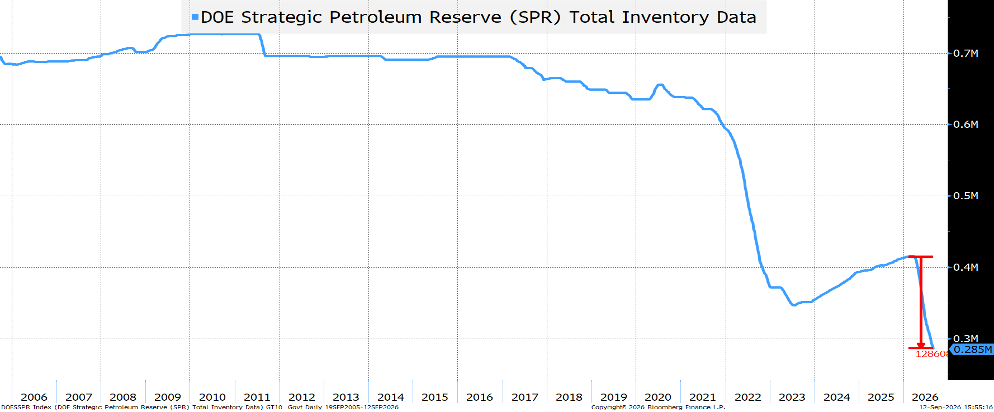
It is far too late to wonder why no one bothered refilling the reserve when we could have.
About 125 million barrels have been extracted from the reserve since the start of the war. We are sitting at 285 million barrels as of last week, but the big question is: what is the practical limit to how much can be withdrawn? Without a doubt it cannot be drained to zero and retain structural integrity. How close are we to risking structural integrity? How much more can be released?
During the first phase of the war, globally, reserves played a key role in containing oil prices and ensuring the refining systems were working relatively efficiently.
Without that, this could get much worse, and more quickly than markets have been pricing in.
Bottom Line
Oil and rates seem as important or more important than compute spend to markets and the economy. It is kind of refreshing, but unfortunately the risk/reward in both of those assets is geared towards more pain (higher bond yields and higher oil prices).