The 3 Options After Jensen Huang’s Exit From Nvidia
The market faces three options with different levels of risk as the beleaguered CEO departs.
You've reached your free article limit
You've read 0 of 1 free Pro articles.
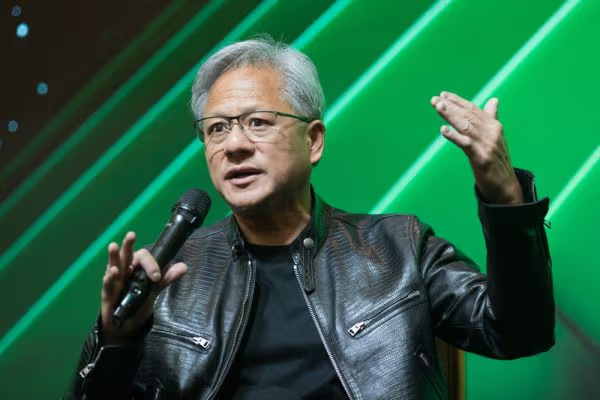
I wound up discussing Jensen Huang on Monday on CNBC and on Thursday on Bloomberg TV.
I continue to express concerns about cheap Chinese compute and the lengths China will go in order to close the gap with U.S. compute. Even after allegations of spying this week, I don’t think we fully appreciate the risk to the economy and valuations due to China’s focus on compute. We’ve seen how China came to dominate manufacturing, processing and refining rare earths and critical minerals, and more recently EV production, so I’m not sure why this isn’t getting as much attention from market participants (it is getting a lot of attention at the national security level).
Markets have not yet settled on the “outcome” of Huang’s departure. Three options seem to be:
- The company and the entire industry lost a powerful force for now. When you think chips, Huang is the first name that comes to mind. When you think AI, some other CEOs pop up, but ultimately, I think Huang did the best under both parties and in terms of overall impact for the industry. Is the business mature enough that his leadership isn’t required the way it was a couple of years ago? Will he wind up in a position to still deliver that leadership? That’s largely priced in at current valuations.
- Will the company or industry do as well without Huang’s push for overseas sales of chips and aggressive financing? Almost certainly, there will be renewed focus on which chips are being sent where. That could help affordability for those building domestic computer, but would not help the chip industry. If the new CEO backs off some of the more aggressive financing and cross ownership policies, we could see compute build get more difficult (at a time credit markets are already pushing back on financing) and fewer chips. That’s not yet priced in and this is a risk that seems possible, if not probable.
- Something worse will be uncovered. Are there more things that we will discover as scrutiny is focused on the company? I think it is highly unlikely as the management team there is full of exceptional people. While Huang was a force, this company was built by many highly skilled, professionals in all fields. I think it’s very low risk.
Away from these headlines, we are still digesting the outcome of the midterms. On that front, I’m confident the compute build will continue post midterms. Some areas will embrace the opportunity to welcome compute while other areas fight it. Even the areas that voted against it are likely to sit down at the table and decide what compute will be built, where it will be built and the burden sharing (water, electricity, etc.) will likely shift toward the compute side rather than the populace, but I don’t see the elections changing the overall trajectory of the compute build.
I remain wary about the pace of development of cheap Chinese compute and think that is the biggest threat to current valuations, though after so much selling pressure in the AI and chip sectors, there is, once again, lots of upside potential. Not sure we are out of the woods yet, but the SOX index finishing up on the week was good, and the Nasdaq 100 is hovering right around the 200-day moving average; if it can get above and stay above, that would be a signal I’d want to follow (again, we are stuck talking about technicals as a guide more than usual, but c’est la vie in chaotic markets). For the first time in awhile, I am looking to put money into the “AI”/“compute” trade.
Opportunities Are Available Across the Globe
U.S. stocks were up this week (though not without some indigestion), but European stock markets outperformed. Looking at a broad set of European indices versus U.S. indices, Europe has now outperformed the U.S. over a week, a month, three-month and six-month time horizons. I pulled up (EPOL) (an ETF that invests in Poland). I continue to think Poland will be one of the most important countries and economies in all of Europe in the coming years. Comparing this ETF to the Nasdaq 100 is a bit unfair as the market cap is quite small and you could not move huge amounts of money into the market without impacting price, but I found it surprising that EPOL outperformed (QQQ) (Nasdaq 100) over the one-year, three-year and five-year time horizons.
To me, as the entire world starts rebuilding industry and infrastructure, there are still opportunities to invest overseas, with what I think is a better risk/reward profile.
Rates
The Federal Reserve will hike 25 BPS in December unless there is a deal with Iran. While it seemed “civilized” on the surface, many longtime Fed watchers thought the statements last week were more along the lines of something we’d see on the “Kardashians” (wow, it has been a long time since I mentioned them) than typical Fed speeches. It is clear that some want to provide forward guidance (despite the chair not wishing to do so) and that maybe the discussions at the last meeting, where the decision was made not to hike, were more contentious than we were led to believe. With 10-year treasury yields back above 5%, I’d be getting longer duration again. The “Big Beautiful Bill” did many things, one of which was to front load some of the benefits to boost the economy this year, so we should see some easing on inflation (and the deficit) as we start 2027.
Credit spreads seem almost “boring” again. I guess that is a good thing.