Services Keep Expanding, but Prices Climb to Highest Since 2022
ISM’s services index slipped but stayed solidly in expansion in September as hiring returned to growth and backlogs rose.
You've reached your free article limit
You've read 0 of 1 free Pro articles.

US ISM Services Index Sep: 54.9 (est 55.0; prev 55.4)
- Prices Paid: 74.0 (est 73.3; prev 72.6)
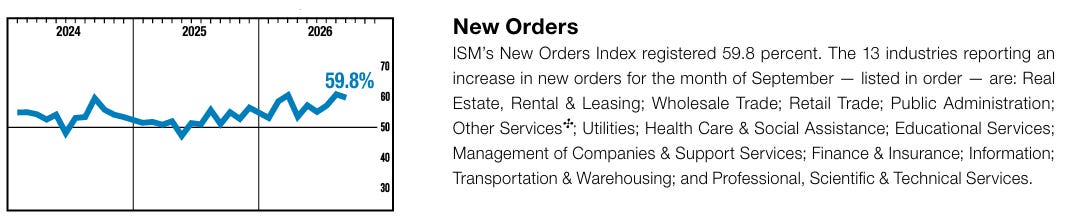
- New Orders: 59.8 (est 60.3; prev 60.9)
- Employment: 50.1 (est 48.8; prev 47.8)
Executive Summary
- The Institute for Supply Management (ISM) services index eased 0.5 point to 54.9. That was just shy of expectations but marks a 27th straight month of expansion, and the 12-month average rose for a ninth straight month.
- Business activity and new orders cooled from multiyear highs but also remained solidly in expansion. Employment returned to expansion for the first time in three months, and backlogs hit the highest since July 2022.
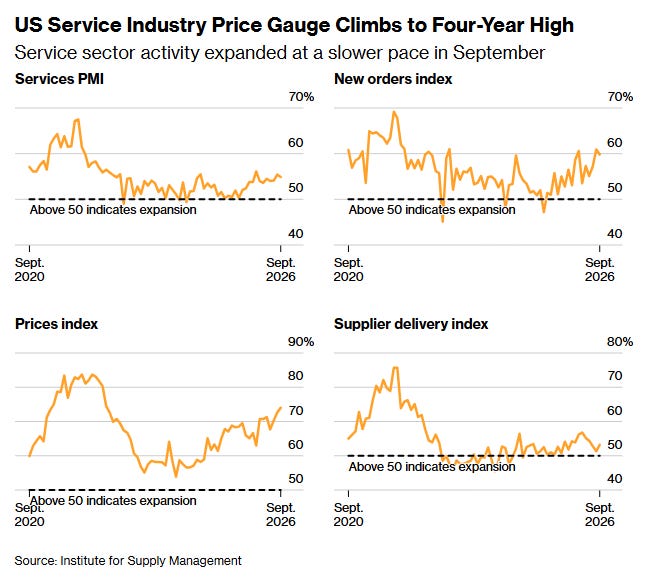
- Prices paid though rose to 74.0, also the highest since July 2022. ISM said fuel costs were cited twice as often as any other issue.
September ISM Services
The ISM services index fell 0.5 point to 54.9 in September, a hair below expectations of 55.0, but still the 27th consecutive month of expansion. It has now expanded in 65 of the last 67 months. The only contraction in that span was in May 2025, and September 2024 sat right at the 50.0 dividing line. The reading is 0.8 point above the 12-month average of 54.1. That average has now risen for nine straight months and is up 2.4 points from 51.7 in December.
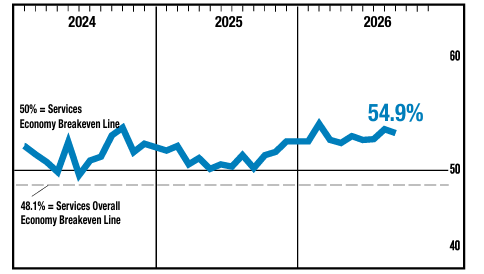
According to the report, the reading corresponds to 2.1% annualized growth in real gross domestic product (GDP), down from 2.3% in August, marking the 76th straight month of overall economic expansion.
S&P Global’s survey, which covers generally smaller and more domestically focused companies, told a stronger story. Its services index rose to 58.8 from 56.5, the strongest since July 2021. S&P Global Chief Business Economist Chris Williamson said the services and manufacturing surveys together point “to economic growth of around 4% in the third quarter and 5% in September alone.”
The Components
Three of the four components behind the headline remained in expansion, and employment moved back above 50.
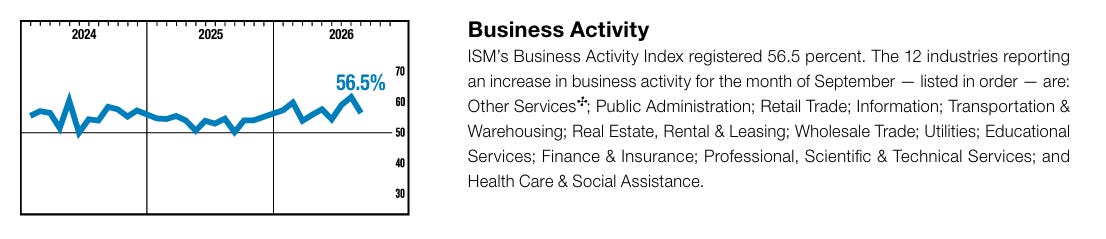
- Business Activity fell 5.2 points to 56.5, the lowest since June (55.4), decelerating from August’s 61.7, which was the highest since November 2022 (62.7). Still the index has now expanded for 27 straight months. It sits 0.2 point below its 12-month average of 56.7, though that average rose 0.5 point. Twelve industries reported growth (down from 13) and three reported declines (down from four).
- New Orders slipped 1.1 points to 59.8, a 16th consecutive month of expansion. That’s also down from August’s 60.9, the highest since February 2023 (61.0), though Bloomberg called it “still one of the highest of the past few years.” Thirteen industries reported growth (down from 14). For the second month in a row, Construction was the only industry reporting a decline. S&P Global showed new orders rising at the fastest pace in four and a half years.
- Employment rose 2.3 points to 50.1, moving back into expansion for the first time since June. It’s now 1.1 points above its 12-month average of 49.0. That follows a stretch in which the index was below 50 for 13 of the 18 months through August, including a drop to 45.2 in March, the lowest since December 2023. Seven industries reported higher employment and eight reported decreases, both unchanged from August. The share of respondents reporting lower employment eased to 16.2% from 17.1%. Steve Miller, chair of ISM’s Services Business Survey Committee, said the move “seems to have resulted from increasing backlogs, as well as high levels of business activity and new orders.” Respondent comments ranged from “filling positions that have been vacated due to promotions or retirements” to “restructuring due to efficiencies gained using AI tools.” S&P Global showed hiring at the fastest pace since June 2022.

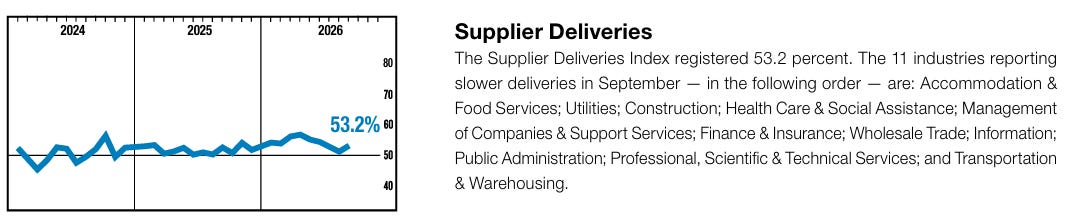
- Supplier Deliveries rose 1.9 points to 53.2, the highest since June. A reading above 50 means deliveries are taking longer, and they have now slowed for 22 straight months. The rise reversed a four-month decline, though the index is still below its 12-month average of 53.7. Eleven industries reported slower deliveries (up from 10) and only Retail Trade reported faster (down from two). Comments included “experienced more back orders” and “supplier lead times are extending due to tariff related delays.”
Prices
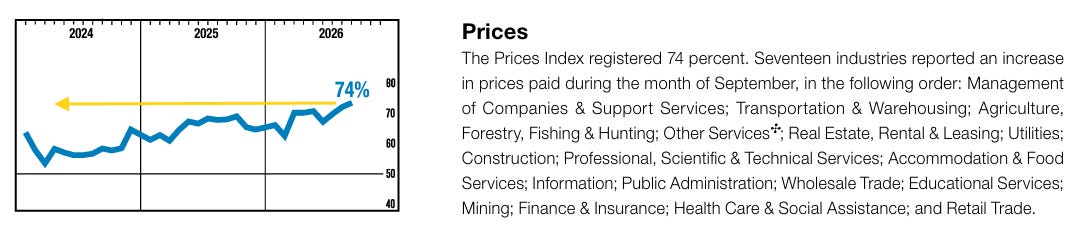
Prices paid rose 1.4 points to 74.0, the highest since July 2022 (74.5). Bloomberg noted the gauge had hit “a nearly one-year low in February, just before the Iran war sent fuel costs higher.”
Prices have now risen for 112 consecutive months, and the index has been above 70 for six of the past seven months and above 60 for 22 straight months. Its 12-month average rose 0.5 point to 69.0, the highest since March 2023. The share of respondents paying higher prices rose to 50.3% from 44.8%. Seventeen of 18 industries reported paying more (up from 15) and none paid less. Lumber and pork products were the only commodities reported down in price. Fuel was reported up in price for an eighth straight month and memory products for a ninth.
S&P Global showed input cost inflation reaccelerating to the steepest since November 2022 on “higher gas prices and an associated rise in transportation costs.” Its measure of output prices rose at the second-fastest pace in just over a year.
Other Indexes
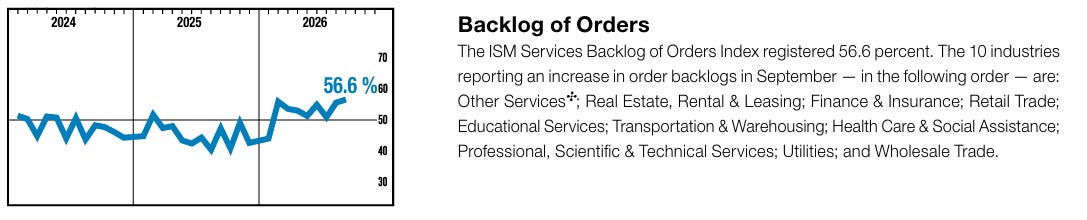
- Backlogs rose 1.0 point to 56.6, the highest since July 2022 (58.3). Backlogs have now expanded for eight straight months, the longest run since a 26-month string that ended in February 2023. That’s after the index fell to 40.2 in August 2024, the lowest since 2009. Ten industries reported growth and four reported declines, both unchanged from August. Comments included “workload has exceeded manpower.”
- New Export Orders, reported by 61% of respondents, plunged 9.4 points to 46.9. That’s the first reading below 50 in eight months; the last was January’s 45.0, the lowest since March 2023. Three industries reported growth (down from seven) and six reported declines (up from three). One respondent cited “uncertainties due to delayed shipments and rising surcharges.” S&P Global, by contrast, showed export orders rising for a second straight month.

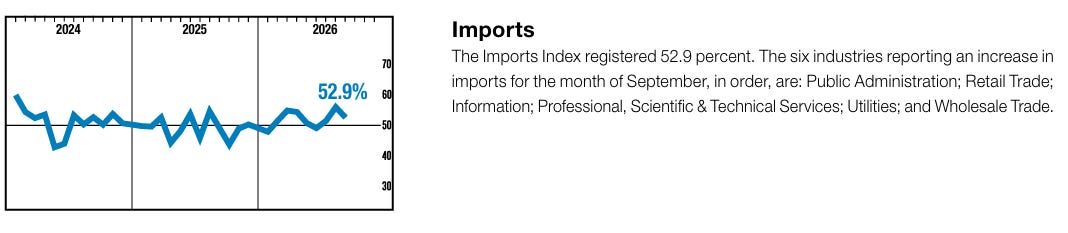
- Imports, reported by 63% of respondents, fell 3.4 points to 52.9. Imports have now expanded for three straight months and in six of the last seven, after peaking at 55.2 in March, the highest in over two years. Six industries reported higher imports (down from seven) and three reported decreases (up from two). Two comments flagged Canada: “Canola meal from Canada is no longer competitive” and “U.S.-Canada duties change impacting imports/exports.”
- Inventories rose 1.1 points to 57.8, the highest since May (62.5) and an eighth straight month of expansion. Nine industries reported increases (down from 11) and two reported decreases (down from five). One respondent “purchased [additional inventory] — hedging against price increases.”

- Inventory Sentiment fell 2.4 points to 51.7, the lowest this year, though it has now been in ‘too high’ territory for 41 consecutive months.” Nine industries reported inventories as too high (up from seven).

Breadth
Thirteen of 18 industries reported growth, up from 12 in August but down from 17 in May. Growth was led by Wholesale Trade; Real Estate, Rental & Leasing; and Other Services.
Four industries contracted, down from five in August: Agriculture, Forestry, Fishing & Hunting; Mining; Construction; and Management of Companies & Support Services.
The number of commodities in short supply rose to seven from six, with switchgear and computers added and memory components on the list for a ninth month.
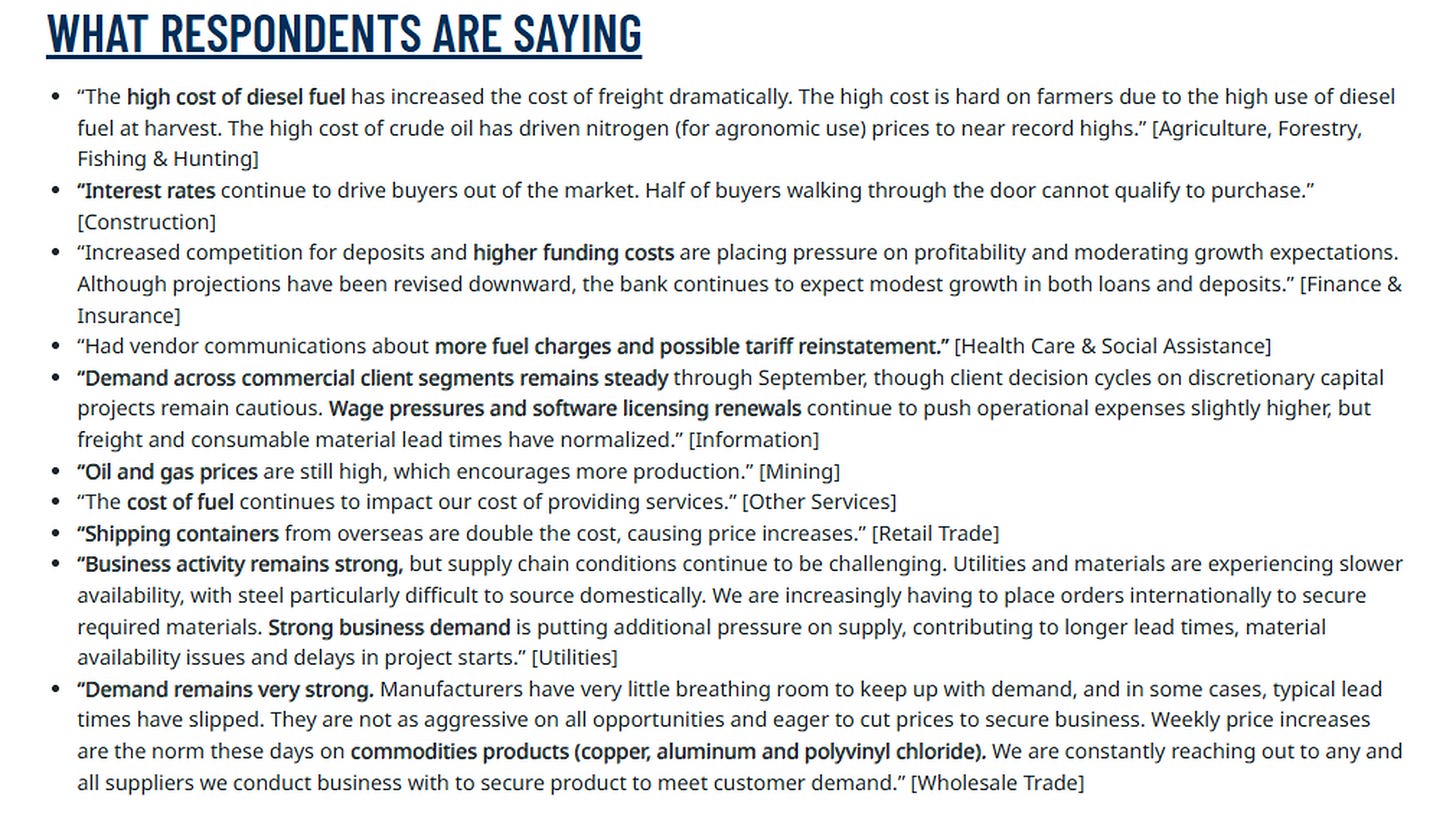
What Respondents Are Saying
Miller said “tariffs and fuel cost impacts were the most cited issues impacting respondents’ supply chains; in fact, fuel costs were mentioned twice as often as any other single issue impacting performance.” He added that “supply chain constraints were also a top concern of respondents and were impacting both lead times and costs.”
Similarly, costs dominated the list of selected comments, especially fuel. Eight of the 10 published comments mentioned higher prices or expenses.
- Agriculture said “the high cost of diesel fuel has increased the cost of freight dramatically,” and that crude oil “has driven nitrogen (for agronomic use) prices to near record highs.”
- Other Services said “the cost of fuel continues to impact our cost of providing services.”
- Health Care reported “vendor communications about more fuel charges and possible tariff reinstatement.”
- Retail Trade said “shipping containers from overseas are double the cost, causing price increases.”
- Wholesale Trade said “weekly price increases are the norm these days on commodities products (copper, aluminum and polyvinyl chloride).”
- Information pointed to “wage pressures and software licensing renewals,” and Finance & Insurance to “higher funding costs.”
- Mining though was a beneficiary: “oil and gas prices are still high, which encourages more production.”
Supply chains were the other pressure point, with steel again a leading complaint.
- Utilities said steel is “particularly difficult to source domestically. We are increasingly having to place orders internationally to secure required materials.” It added that “strong business demand is putting additional pressure on supply, contributing to longer lead times, material availability issues and delays in project starts.”
- Wholesale Trade said “manufacturers have very little breathing room to keep up with demand, and in some cases, typical lead times have slipped.”
- Not everyone is struggling, though. Information said “freight and consumable material lead times have normalized.”
Demand itself held up outside of rate-sensitive areas.
- Wholesale Trade said “demand remains very strong.”
- Utilities said “business activity remains strong.”
- Information said demand “remains steady through September, though client decision cycles on discretionary capital projects remain cautious.”
The soft spots were housing and banking.
- Construction said “interest rates continue to drive buyers out of the market. Half of buyers walking through the door cannot qualify to purchase.”
- Finance & Insurance said the higher funding costs noted above are “moderating growth expectations,” though the bank “continues to expect modest growth in both loans and deposits.”