Rapid Change in Euro Credit Risk Hints at Deeper Problems
Whatever just happened between German bond yields and French and Italian bond yields was not on my radar.
You've reached your free article limit
You've read 0 of 1 free Pro articles.

We’ve discussed many issues facing treasuries and on Friday we suggested fading the move after the jobs data came out — and fade it did.
I’m more or less neutral here on treasuries, which scares me a bit, because consensus and fund flows (like (TLT)) all seem to indicate traders still buying bonds and being bullish rather than bearish.
But let’s look at two other markets, as Europe has just started to show signs of stress and, while credit is fine, it too bears watching right now, given how quickly first U.S. treasuries moved and more recently, how quickly the EU bond market has moved.
European Sovereign Debt
Rising global bond yields was on my radar. But whatever just happened between German bond yields and French and Italian bond yields was not.
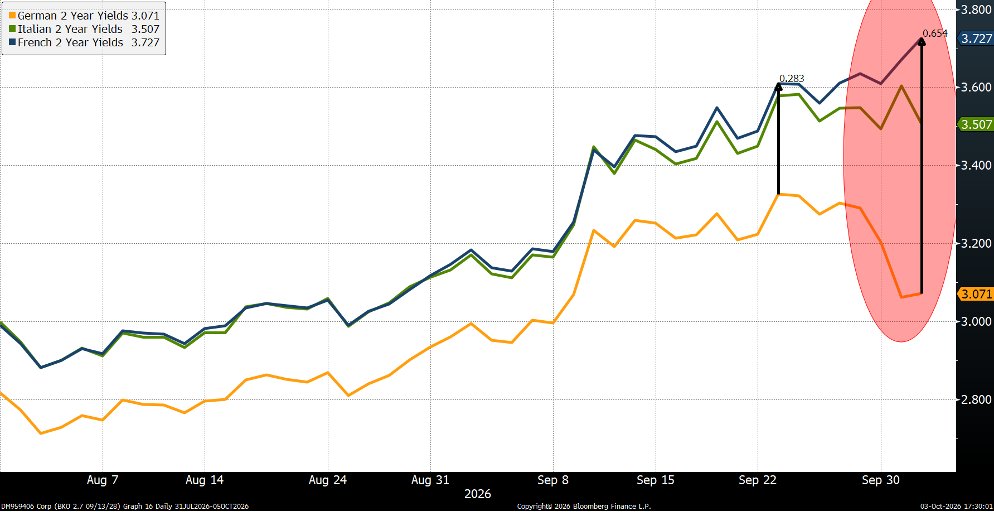
European bond yields rising as spending on defense and infrastructure increases made perfect sense. What is harder to figure out is this move in French and Italian yields relative to German yields.
The French deficit is going to go above the EU “targets.” Looks like 5% instead of 3%. That helps explain the move higher in French (and Italian) yields. But the move in German yields? Are we really having a “flight to quality” in Europe? And Germany, losing its industrial base, having a major shift in politics, is the “go to” place for safety? I guess, but it all seems odd.
Maybe investors were being “lazy” and were picking up the “extra” yield in France and Italy for the same “risk” as Germany, only to realize the risk might not be the same, and they were forced to unwind.
That seems plausible.
I don’t know what is going on here, but it does not seem good. This fairly rapid “repricing” of relative credit risk in Europe could be nothing, but I suspect it is hinting at a deeper problems.
Credit Spreads
There is an entire cottage industry dedicated to calling for the “next” GFC. It often starts with worrying about BBB spreads, or sometimes structured/opaque credit, because those seem to be areas big enough to scare people, and difficult enough for the average person to understand, that it is easy to scare them.
My background is in credit, but I rarely write about it lately, because it has been so boring! I’m not going to go all doom and gloom, but for the first time in ages, I better dust off some of my tools to look at credit. We will look into this more closely next week, but again, just like the European bond market, something is going on that deserves some attention.
There was a record sized HY bond deal priced this week, and it did not do well. The (PSKY) 8.875% second lien bonds due 2034 (BB composite rating), that were issues at par, traded below 95% on Thursday and 96% on Friday, to close the week at 96.5%. A 3.5% loss on $4 billion of bonds will leave a mark ($140 million to be exact) on bond buyers, especially the “fast money” crowd, but even long only won’t be happy with that.
One thing that greatly re-assured me, and let’s me believe I can wait until Monday or Tuesday to do a deeper dive into credit (this weekend is too nice in the metro area to be stuck inside typing), was that both (HYG) and (JNK) (two large HY ETFS) were trading at NAV. I watch for deviations in how the fixed income ETFs are trading relative to the “market value” of the portfolio. Right now, all looks good and orderly.
The CDX index has widened from 50 to 60 in a two weeks.
CDX traded up to almost 70 in March at the start of the war, so that is “good” that we are only at 60.
One thing I don’t like is that, while the S&P 500 traded marginally higher on Thursday and had a strong day on Friday, the CDX index — which is often correlated with the S&P 500 — was wider on Thursday and basically unchanged on Friday. If you told me what the S&P 500 had done, I’d have guess wrong on what the CDX index had done. While “decoupling” is a bit strong, when you are looking for early signs of something “bigger” like we’ve already seen in treasuries, and just saw in European sovereign debt relative value, it is not nothing.
Bottom Line
We often hear from equity market participants that they want to pay attention to fixed income, but for some reason they often ignore it when it is sending a message that they don’t like.
VIX is barely above 15 (well below it’s average of 18 for the year). The MOVE index, the bond market equivalent of VIX (not quite, but close enough for now), is at 107. Just below its peak of 115 in March. Well above its one-year average of 74.
I’ll start the week neutral on rates, since “fade the move” worked so well on Friday, but I’m nervous.
Whatever just happened in European sovereign makes me nervous. Credit doesn’t make me nervous, but for the first time in years I’m paying some serious attention to spreads.
A deal with Iran and more news on the compute front can help, but away from all of that, equities seem to be ignoring some fixed income market moves (and not just the headlines on long bond yields) that equities might wish they’d pay more attention to.
Call me nervous, not scared.
Fixed income is sending some sketchy signals, and to the extent that positioning is wrong, those signals risk turning into something bigger!