One Thing Republicans and Democrats Agree On: The Economic Outlook Has Declined
Final September UMich read shows consumer sentiment sinking to a four-month low as inflation expectations rise.
You've reached your free article limit
You've read 0 of 1 free Pro articles.

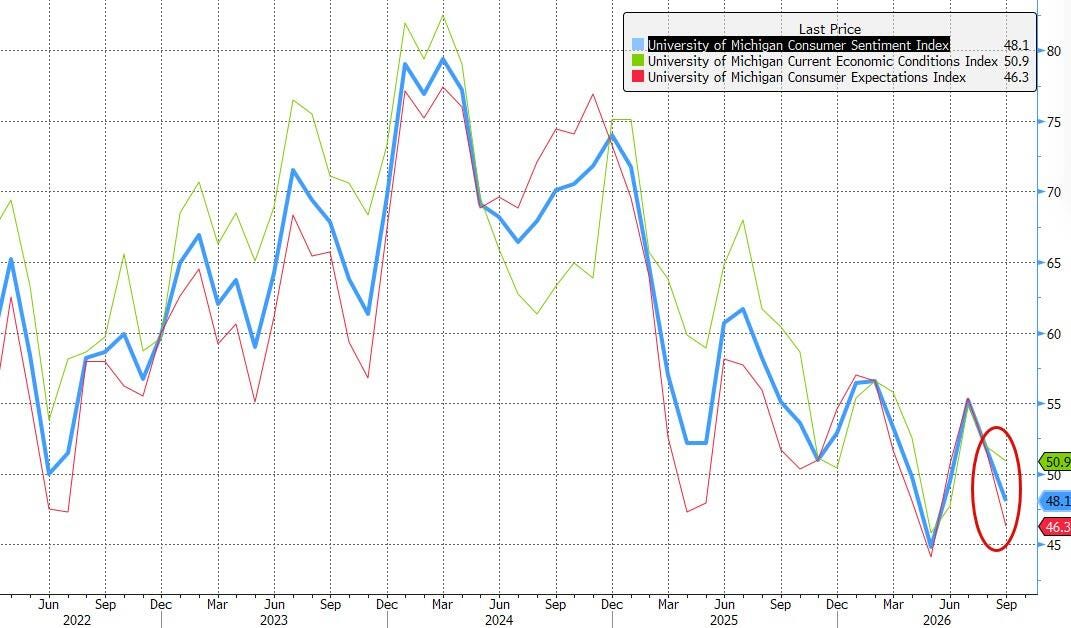
Sentiment: 48.1 (preliminary 47.8; August 51.7)
Current Conditions: 50.9 (preliminary 50.9; August 51.9)
Expectations: 46.3 (preliminary 45.8; August 51.5)
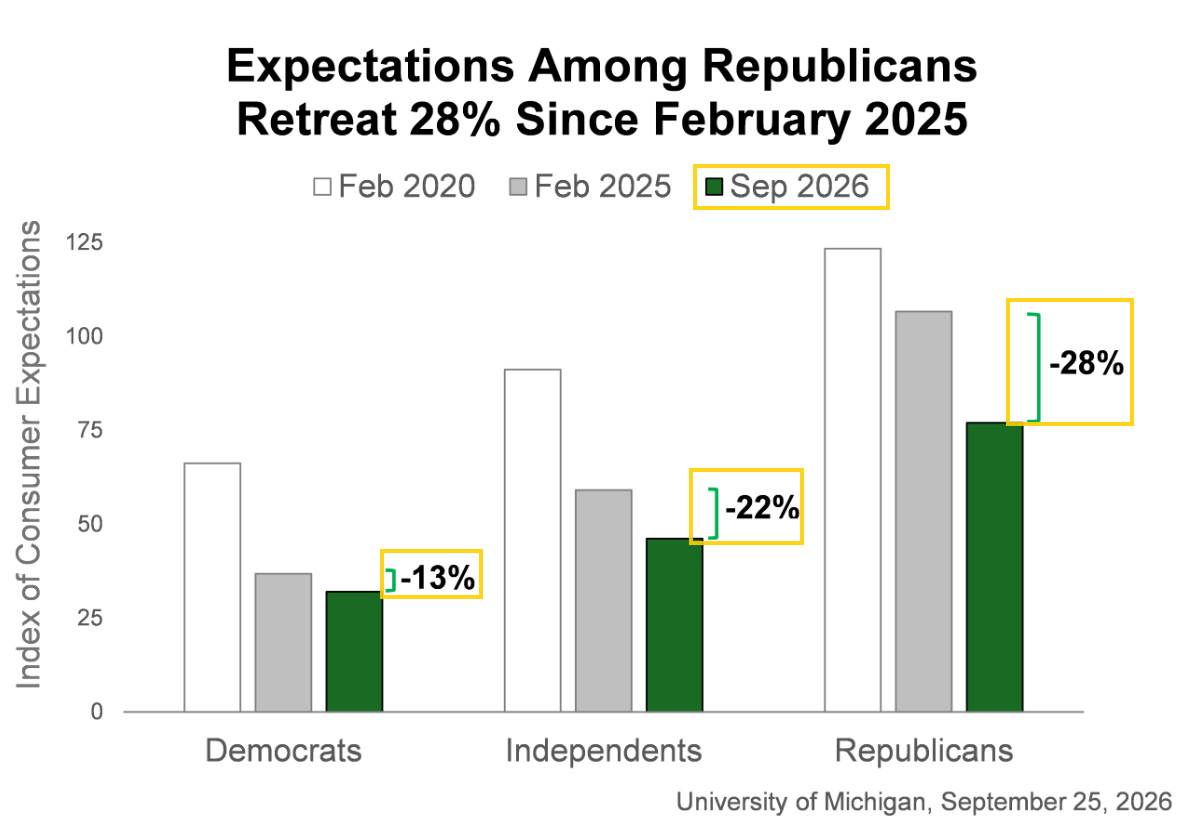
1-Year Inflation: 4.6% (preliminary 4.6%; August 4.0%)
5-10 Year Inflation: 3.4% (preliminary 3.4%; August 3.3%)
Executive Summary
● The final read of University of Michigan consumer sentiment for September was revised up modestly from the preliminary read to 48.1 but was still down 7.0% from August to the lowest reading in four months, 15% below January 2026.
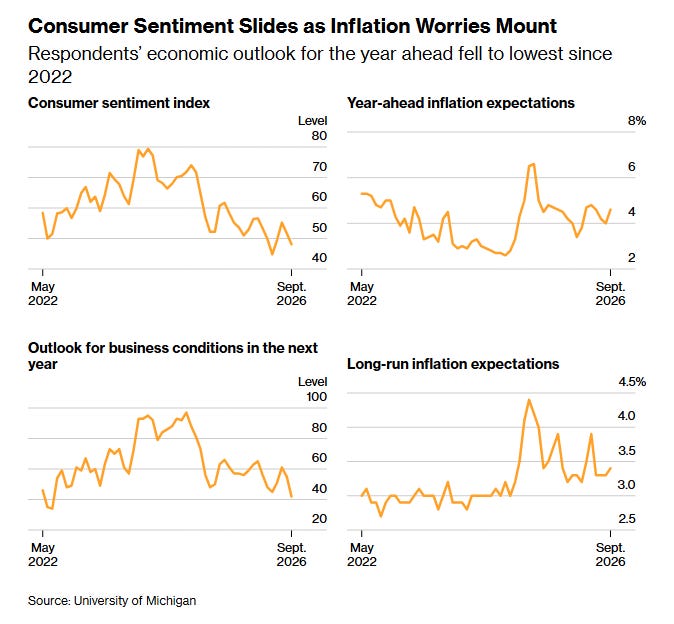
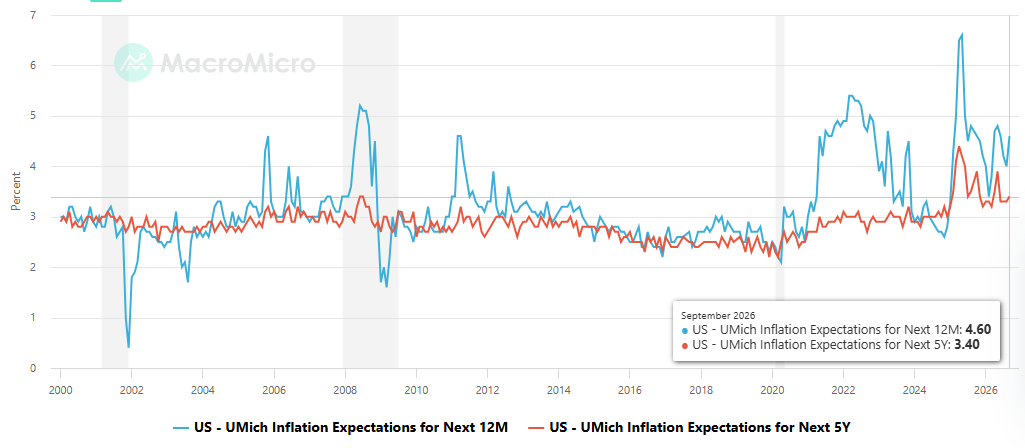
● The decline since the start of the year has been broad-based but led by Republicans: since the start of the year, sentiment has fallen for all groups by age, education, geography, political party, and income, with Republican sentiment now 20% below January versus Democrats down 13%. The year-ahead outlook for the economy slumped to the lowest since 2022.
● Year-ahead inflation expectations rose six tenths from August to 4.6%, the highest since June, while long-run expectations ticked up a tenth to 3.4%, the highest since May — both well above pre-war and 2024 levels.
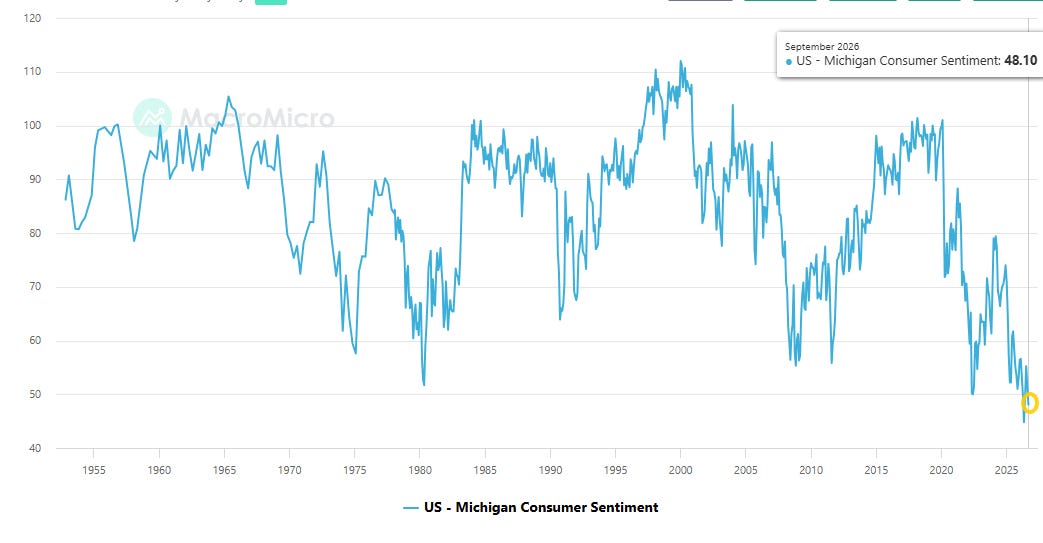
The final read of University of Michigan consumer sentiment for September came in at 48.1, a four-month low, down 7.0% from August’s 51.7 and now just over 3 points above the all-time low set in May (44.8). The one silver lining is that it revised up modestly from the preliminary’s 47.8, so sentiment actually firmed a touch intra-month even as the month-over-month picture deteriorated. The full survey period ran August 25 to September 21.
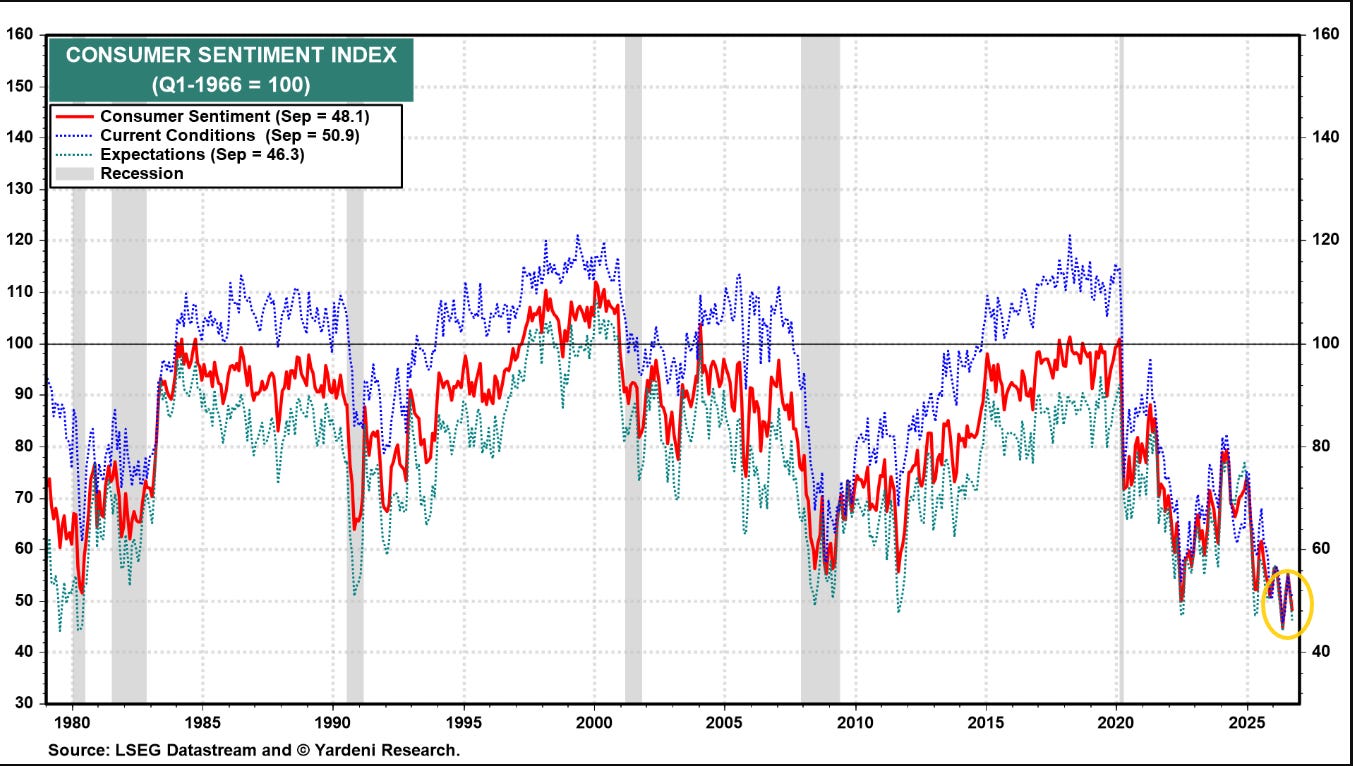
As with the flash, the damage was concentrated in the forward-looking piece: the expectations index (green line) which fell 10.1% to 46.3, while current conditions (blue line) held up better, easing just 1.9% to 50.9.
The Pocketbook Remains the Epicenter
Per Hsu, “views of current and year-ahead expected personal finances both weakened about 10% this month, with concerns over high prices continuing to climb,” while “the short-run outlook for business conditions plunged amid renewed worries that elevated fuel prices and re-escalating trade disputes could pass through to the economy as a whole.” Per Bloomberg, the gauge of the outlook for the economy in the year ahead slumped to its lowest since 2022.
One quirk: buying conditions for durables actually improved slightly, but Hsu attributed that partly to “a perception that completing such purchases now would help consumers avoid higher prices in the future” — defensive buying rather than genuine confidence.
A Broad-Based, Bipartisan Decline
Per Hsu, via the University of Michigan release, “interviews reveal broad agreement across the political spectrum that the outlook for the economy has weakened since the beginning of the year.” The partisan detail is the striking part: “after particularly large declines in sentiment this month, Republican sentiment is now 20% lower than January 2026; Democrats are down 13% over the same period,” and Independents 22%. Hsu summed it up bluntly — “despite political differences, consumers unanimously believe that the outlook for the economy has diminished.” Since the start of the year, she noted that sentiment has declined for all groups by age, education, geography, political party, and income.
Inflation Expectations Climb
On inflation, per Hsu: “Year-ahead inflation expectations [blue line] jumped from 4.0% last month to 4.6% this month, the highest reading since June. The current reading substantially exceeds the 3.4% seen in February before the Iran conflict began, along with all 2024 readings.”
Long-run five-to-10-year expectations (red line) ticked up a tenth to 3.4%, ending three consecutive months at 3.3% and the highest since May. They remain above the 2.8% to 3.2% range seen in 2024 and the sub-2.8% readings in 2019 and 2020; the prior peak was 4.4% in April 2023.
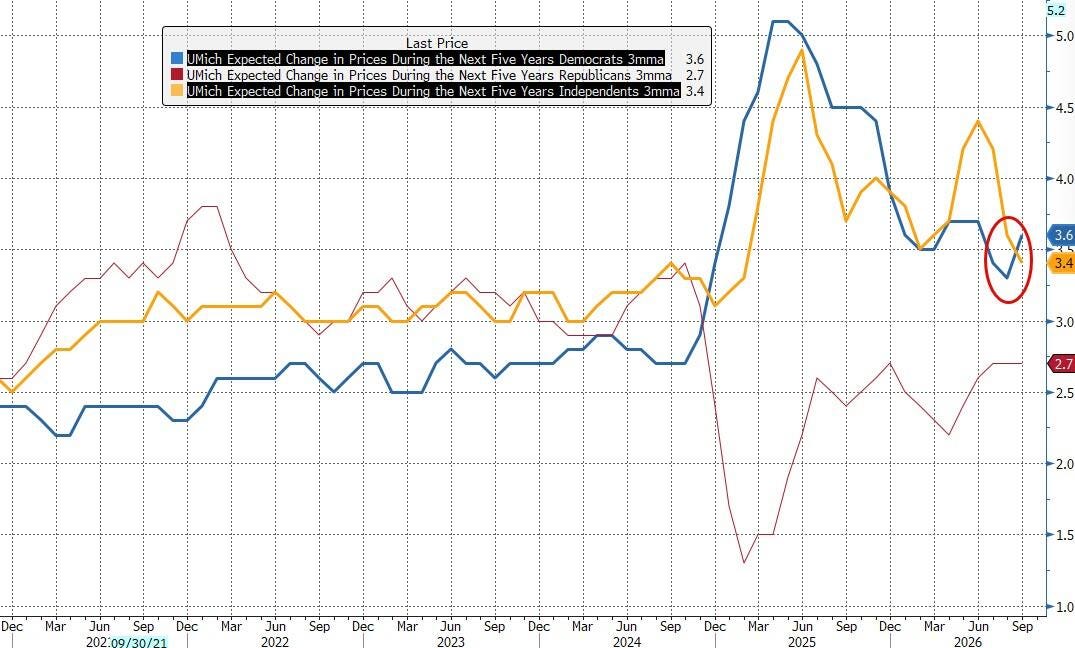
ZeroHedge notes that inflation concerns are most prevalent for Democrats and Independents.