Of All Post-Earnings Worries, This One Keeps Me Up at Night
Fighting with Iran and threats the conflict could spread concern me. Another worry is Japan’s bond yields. But neither bother me as much as this.
You've reached your free article limit
You've read 0 of 1 free Pro articles.

Approximately 90% of the S&P 500 companies have now reported second-quarter results, meaning the current earnings season is largely over. And what a quarter from an earnings growth perspective. S&P 500 profits have risen 50% on a year-over-year basis. More than impressive given the tepid gross domestic product growth in recent quarters: Q4 (.5%), Q1 (1.6%) Q2 (1.5%). The semiconductor sector was the primary driver of earnings growth once again during the quarter.
While equities are trading at or near all-time highs, I still have several key concerns around the markets as second-quarter results are largely behind us. The first is the continued conflict in the Middle East. While hostilities have subsided recently, traffic through the Strait of Hormuz remains a trickle of its pre-war levels. There seems no path to a permanent resolution to restore these flows.
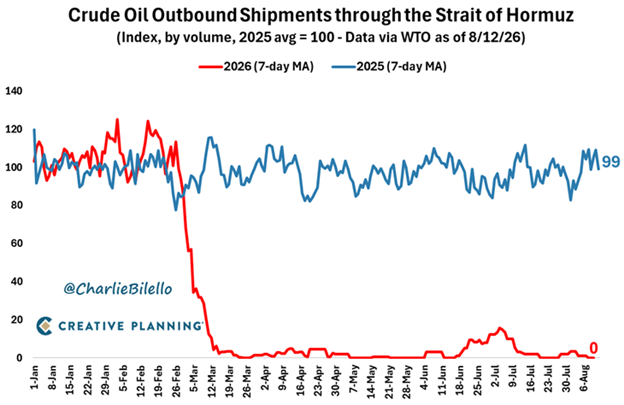
The war could potentially expand to other transitways like the Red Sea. And every week the status quo remains in place drains petroleum reserves and will remain a headwind to global growth and is unhelpful on the inflation front. Particularly concerning are the impacts on diesel fuel supplies, which have also been impacted by Russian refineries being hit by Ukrainian drones. Diesel crack spreads are at all-time highs. While that is beneficial to refiners like PBF Energy (PBF), it adds costs to any good that needs to be transported by ship, rail or truck. Diesel fuel is up around 55% year to date.
My second concern involves what is happening in Japan where bond yields are at multi-decade highs in a country with a debt of gross domestic product ratio significantly north of 200%. Japan is also the largest foreign holder of U.S. treasuries, which is one reason our treasury department recently intervened in the Japanese yen for the first time since 2011. This appears to be triggering an unwind of the yen carry trade that has been in place for decades. And I cannot find any reliable estimate on how big that trade is to assess potential impacts.
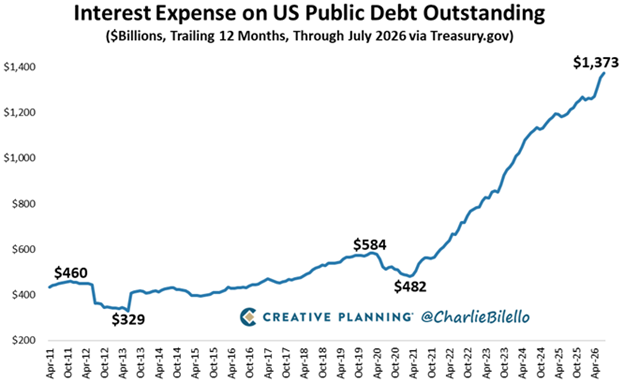
But my main worry is about the debt/credit markets. The 30-year treasury just hit its highest yield since 2001 during its auction last week. This is happening as debt servicing costs are spiraling out of control. Private credit also continues to deteriorate with the default rate in private credit hitting all-time highs in Q2 according to Fitch Ratings. Ironically, some of the same companies like Apollo Global Management (APO) and Blackstone (BX) that have “gated” quarterly redemption requests in their large private credit funds in recent quarters just signed memorandums of understanding with Nvidia Corporation (NVDA) to potentially provide up to $500 billion in funding for AI infrastructure.
According to a recent analysis by Nikkei, the five largest hyperscalers now have a combined $3 trillion in debt including off-balance-sheet obligations. Nikkei reports, for example, that while Meta (META) reports about $140 billion in AI debt, it has about $420 billion in hidden “off-balance-sheet” debt. For Oracle (ORCL), it’s about $100 billion vs. $273 billion; and for Alphabet it’s $30 billion vs. an estimated $250 billion.
And this happening as credit default swaps on Oracle’s (ORCL) debt just have hit all-time highs. And that debt is likely to continue to grow as capex budgets rise ever higher. In 2022, capital expenditures amounted to roughly 30% of the operational cash flow at these hyperscalers. This year it should account for roughly 100% of operational cash flow. This is the primary reason there has been such a large increase in debt and equity issuance from AI-related firms here in 2026 and why stock repurchases have all but ceased.
So, while Q2 quarterly results should rightly be celebrated, prudent investors still have several major issues that will need to be navigated successfully in the months ahead.
At the time of publication, Jensen was long PBF.