S&P Manufacturing PMI Eases From Flash Read, but Still Best Since May 2022
Final September PMI was revised down to 55.9 from 57.0 flash, but it’s still the 14th month of expansion as new orders were second strongest since 2022 and employment jumped to a 5-year high.
You've reached your free article limit
You've read 0 of 1 free Pro articles.

US S&P Global Manufacturing PMI Sep F: 55.9 (est 57.0; flash 57.0, Aug 53.9)
Executive Summary
- The S&P final September manufacturing PMI rose to 55.9, the highest since May 2022, from 53.9 in August — revised down from the 57.0 flash read but still a notable acceleration marking 14 straight months of expansion. All five PMI components supported the uplift.
- Production extended its run of growth to 16 months while new orders registered the best rise in sales since April and the second-strongest since May 2022, both on a “broad-based uplift in demand” tied to government and tech-related industries, though exports fell for a 15th straight month on tariffs.
- Employment jumped to the highest in over five years as firms scrambled for capacity, driving backlogs higher for a 7th consecutive month to the greatest degree since April. Supply chain delays also lengthened the most since August 2022.
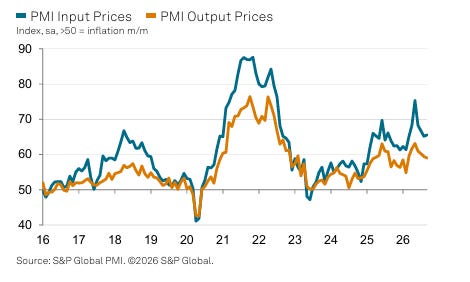
- Input prices accelerated on shortages, tariffs and the war in Iran, though selling price growth was the weakest since February.
- Per Williamson: “The combination of accelerating growth, increased hiring and elevated price gauges will add to speculation of a further imminent rate hike from the FOMC.”
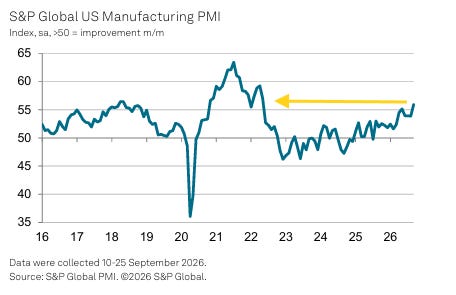
The S&P final September manufacturing PMI came in at 55.9, the highest since May 2022, up from 53.9 in August, although revised down from the 57.0 preliminary reading. Growth has now been registered every month since August 2025.
All five PMI components supported the uplift. Production and new orders both accelerated sharply on a “broad-based uplift in demand” with government and tech-related industries called out as sources of strength, while exports fell for a 15th straight month. Employment jumped to the highest in over five years as firms scrambled to add capacity, backlogs rose for a 7th consecutive month to the greatest degree since April, and supply chain delays lengthened to the worst since August 2022.
Looking more specifically at the components:
Production extended its run of growth to 16 months, with firms responding sharply to a surge in orders.
New Orders registered the strongest rise in sales since April and the second-strongest since May 2022, driven by “a broad-based uplift in demand,” though exports fell for a 15th straight month — “government and tech-related industries mentioned as sources of higher sales…Panelists reported that tariffs and elevated shipping costs had dampened international sales.”
Employment jumped to the highest in over five years “as firms scrambled for capacity and deal with the influx of new work and existing workloads,” though with reports of labor shortages — “there were several reports of difficulties in securing suitable labor, and this was a factor that led to another rise in work outstanding.”
In that regard, Backlogs rose for a 7th consecutive month “to the greatest degree since April.”
Supply Chains/Purchasing/Inventories — delivery times lengthened the most since August 2022, with “reports of widespread stock shortages at suppliers,” while purchasing activity rose at the fastest since June and raw material inventories grew for a 6th straight month — “Manufacturers … reported that input delivery delays had contributed to backlog growth … with a swathe of products reportedly hard to source, especially steel and electronics-related items. Shipping challenges across global maritime routes, plus customs delays (especially at the Canadian border) added to supply-side pressure…Purchasing activity rose markedly, expanding at an above-trend pace that was the fastest since June. Despite supply-side delays, and a strong uplift in production needs, the rise in purchasing activity helped to drive stocks of purchases higher for the sixth successive month.”
Input Prices rose at a faster rate than August on shortages, tariffs and the war in Iran, while Selling Prices rose “steeply” but at the weakest rate since February — “The short supply of inputs, tariffs and the war in Iran all served to push up manufacturing input costs at a faster rate…. Alongside metals and electronics, firms widely reported increased energy and fuel prices. In response, manufacturers raised their own charges steeply albeit to the weakest degree since February.”
Sentiment remained positive though slightly below historical trend — “confidence in the outlook remained positive (albeit a little below its historical trend), with firms linking their optimism to positive order book pipelines, and expectations for market, product and commercial expansion. Some firms also hope for greater stability in the business environment and a drop in energy prices.”
Comments from Chris Williamson, Chief Business Economist, who notes the combination of accelerating growth, rising hiring and elevated prices will add to speculation of a further imminent Fed rate hike:
“September has seen the pace of US manufacturing growth pick up a gear again, the PMI lifting to its highest since May 2022 as a surge in new orders encouraged factories to lift output sharply higher and take on workers in increasing numbers.
“Order book backlogs are rising and suppliers are increasingly busy, pointing to stretched capacity as companies struggle to meet demand across both consumer-facing and business sectors. This is most notable in the investment and production of machinery and equipment, linked in many cases to rising AI-related spend. Safety stock building amid price and supply chain worries also continues to support demand, though the ongoing loss of export orders remains a disappointment.
“While sending an encouraging signal for further growth of manufacturing capacity in the coming months, the indication that demand is outstripping supply also means inflationary pressures remain a key area of concern, especially amid high oil prices.
“The combination of accelerating growth, increased hiring and elevated price gauges will add to speculation of a further imminent rate hike from the FOMC.”