ISM Sees Manufacturing Remaining Robust, Pushing Up Input Prices
ISM Manufacturing Index indicates expansion for ninth month — longest since 2022 — but prices paid jump 6.8 points to the highest since May.
You've reached your free article limit
You've read 0 of 1 free Pro articles.
- US ISM Manufacturing Sep: 54.5 (est 55.0; prev 54.6)
- Prices Paid: 77.9 (est 73.0; prev 71.1)
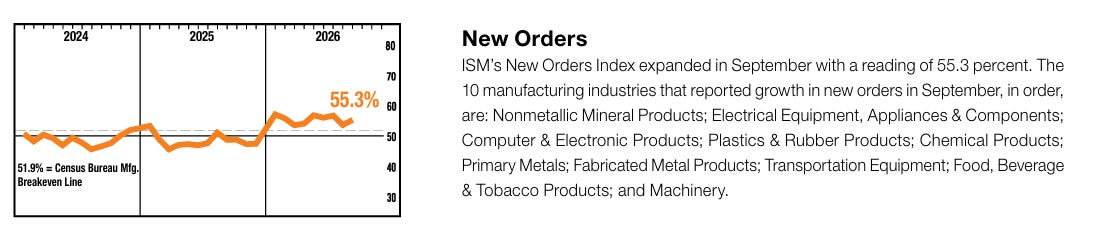
- New Orders: 55.3 (est 54.7; prev 53.7)
- Employment: 52.7 (est 52.0; prev 51.2)
Executive Summary
- The Institute for Supply Management (ISM) manufacturing index slipped 0.1 point to 54.5, still the ninth straight month of growth, the longest run since 2022.
- New orders, backlogs and hiring all picked up while production expanded for an 11th straight month. Employment has now expanded for three months in a row.
- Prices paid jumped 6.8 points to 77.9, almost back to levels at the start of the Iran war.
- Just 2% of manufacturing GDP was in contraction, down from 22% in August and matching May as the lowest this year.
- Respondents noted solid demand, particularly in semiconductor and government work but also high costs and supply shortages.
September ISM Manufacturing
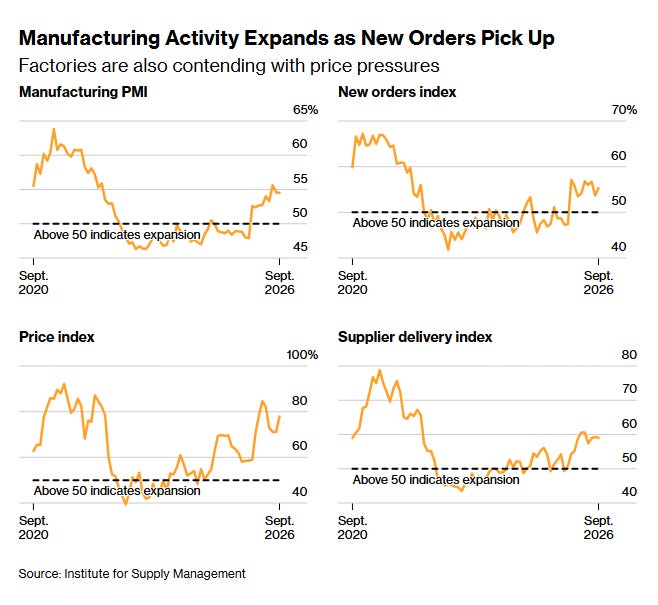
The ISM manufacturing index eased 0.1 point to 54.5 in September, a slight miss against expectations of 55.0, but still the ninth month in a row of expansion, the longest stretch since 2022, according to Bloomberg. The reading is above the 12-month average of 52.3. According to the report, it corresponds to 2.4% annualized growth in real gross domestic product (GDP) and marks the 23rd straight month of overall economic expansion.
It’s also roughly consistent with S&P Global’s survey, covering generally smaller and more domestically focused companies, which rose to 55.9, the highest since May 2022.
The Components
Four of the five components behind the headline were in expansion, and new orders and employment both accelerated.
- New Orders rose 1.6 points to 55.3, a ninth straight month of expansion. Five of the six largest industries reported more orders. Ten industries reported growth (down from 11 in August) and four reported declines (up from three). Demand sentiment kept cooling, though, with “1.7 positive comments for every negative comment; that ratio was 2-to-1 in August and 3.5-to-1 in July,” said Susan Spence, chair of ISM’s Manufacturing Business Survey Committee. S&P Global showed the strongest rise in new orders since April, driven by “a broad-based uplift in demand,” with government and tech-related industries named as sources of strength.
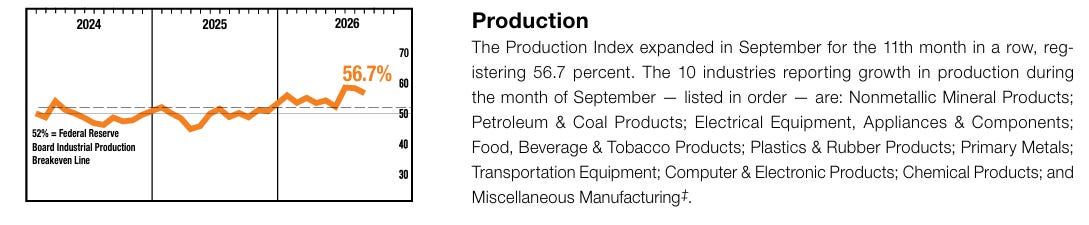
- Production fell 1.6 points to 56.7 but has now expanded for 11 straight months. Ten industries reported growth (down from 12) and three reported declines (up from two). The ratio of positive to negative comments on output fell to 1.6-to-1, from “a 2.2-to-1 ratio in August and 3.3-to-1 in July.”
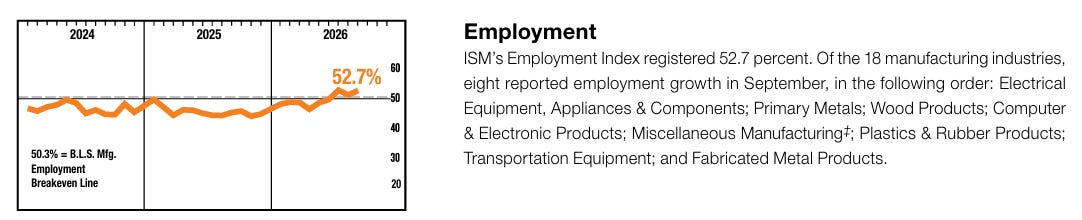
- Employment rose 1.5 points to 52.7. That’s a third straight month of expansion and the longest run of factory job gains since 2022, per Bloomberg. Eight industries added workers (up from seven) and six cut (up from three). Comments on hiring outnumbered comments on cutting by 1.5-to-1, up from 1.3-to-1. S&P Global’s employment measure jumped to its highest in more than five years “as firms scrambled for capacity,” though there were “several reports of difficulties in securing suitable labor.”
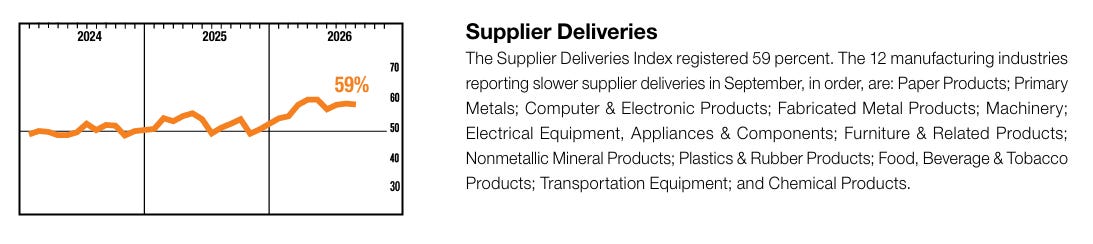
- Supplier Deliveries eased 0.3 point to 59.0. A reading above 50 means deliveries are taking longer, and they have now slowed for 10 straight months. Two industries reported faster deliveries though, after none did in August. S&P Global said delivery times lengthened the most since August 2022, with “reports of widespread stock shortages at suppliers,” especially steel and electronics.
- Inventories fell 2.0 points to 48.6, dropping back into contraction after three months of expansion.

Prices
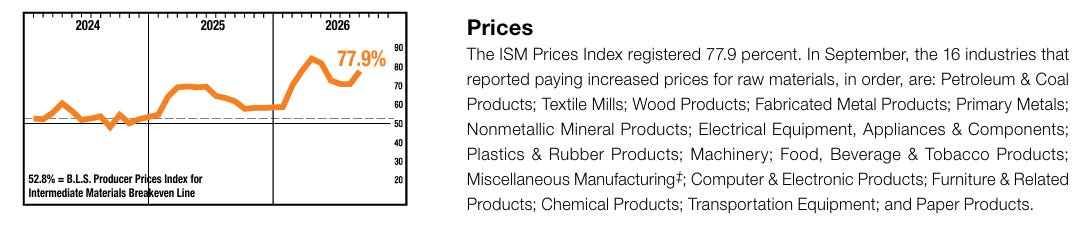
Prices paid jumped 6.8 points to 77.9, the highest since May, “close to its level (78.3 percent in March) at the beginning of the Iran war.”
Prices have now risen for 24 straight months, and the index has been above 70 for eight months in a row. The share of respondents reporting higher prices was 58.6%, up 12.4 percentage points from 46.2% in August. All six of the largest industries reported paying more. Overall, 16 of 18 industries paid more (up from 15) and none paid less, and no commodities were reported down in price.
S&P Global also showed input costs rising faster than in August, blaming “the short supply of inputs, tariffs and the war in Iran.” Manufacturers there raised their own prices “steeply albeit to the weakest degree since February.”
Other Indexes
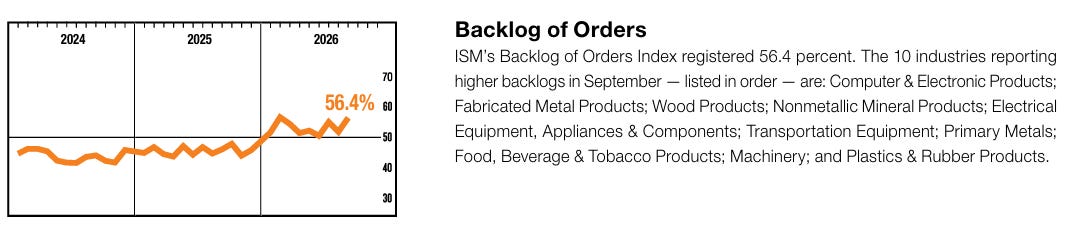
- Backlogs rose 4.6 points to 56.4, the highest since February, and up for a ninth straight month. Four of the six largest industries reported higher backlogs (up from three). S&P Global also showed backlogs rising for a seventh month, “to the greatest degree since April.”
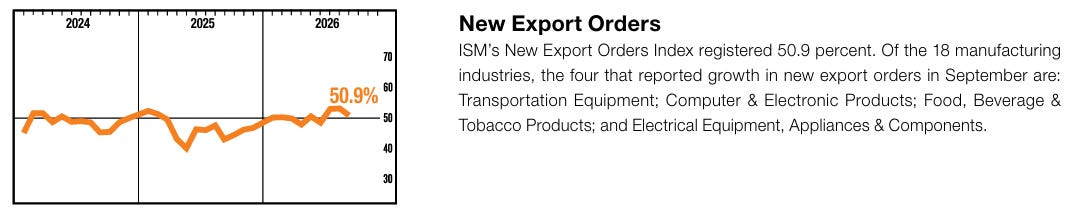
- New Export Orders fell 2.3 points to 50.9. Exports have expanded for three months but are fading. Four industries reported growth (down from nine) and eight reported declines (up from seven). S&P Global showed export orders falling for a 15th straight month, saying “tariffs and elevated shipping costs had dampened international sales.”
- Imports fell 1.5 points to 51.0 and have now expanded for eight months. Four industries reported higher imports (down from seven) and seven reported lower (up from three).

- Customers’ Inventories fell 1.2 points to 41.6. Customers have now been carrying “too low” stock for 24 straight months, which ISM notes “is usually considered positive for future production.”

Breadth
Just 2% of manufacturing GDP was in contraction in September, down from 22% in August. That matches May as the lowest reading this year. For comparison, the share was 85% last December, the highest since July 2024.
ISM defines strong contraction as a composite reading of 45 or lower and calls it “a good metric to gauge overall manufacturing weakness.” The share of manufacturing GDP in strong contraction held also at 2%, the same as August. That’s up from 0% in July, the low for the year, but well below 43% in December and 39% in November.
Twelve of 18 industries expanded, led by electrical equipment, nonmetallic minerals and primary metals. That’s down from 15 in August and July and 16 in May. Two contracted, printing and textile mills, the same number as August. That’s a far cry from December, when 15 industries contracted, the most since 2022. Five of the six largest industries expanded, the same as August, with Petroleum & Coal Products the only one that didn’t.
What Respondents Are Saying
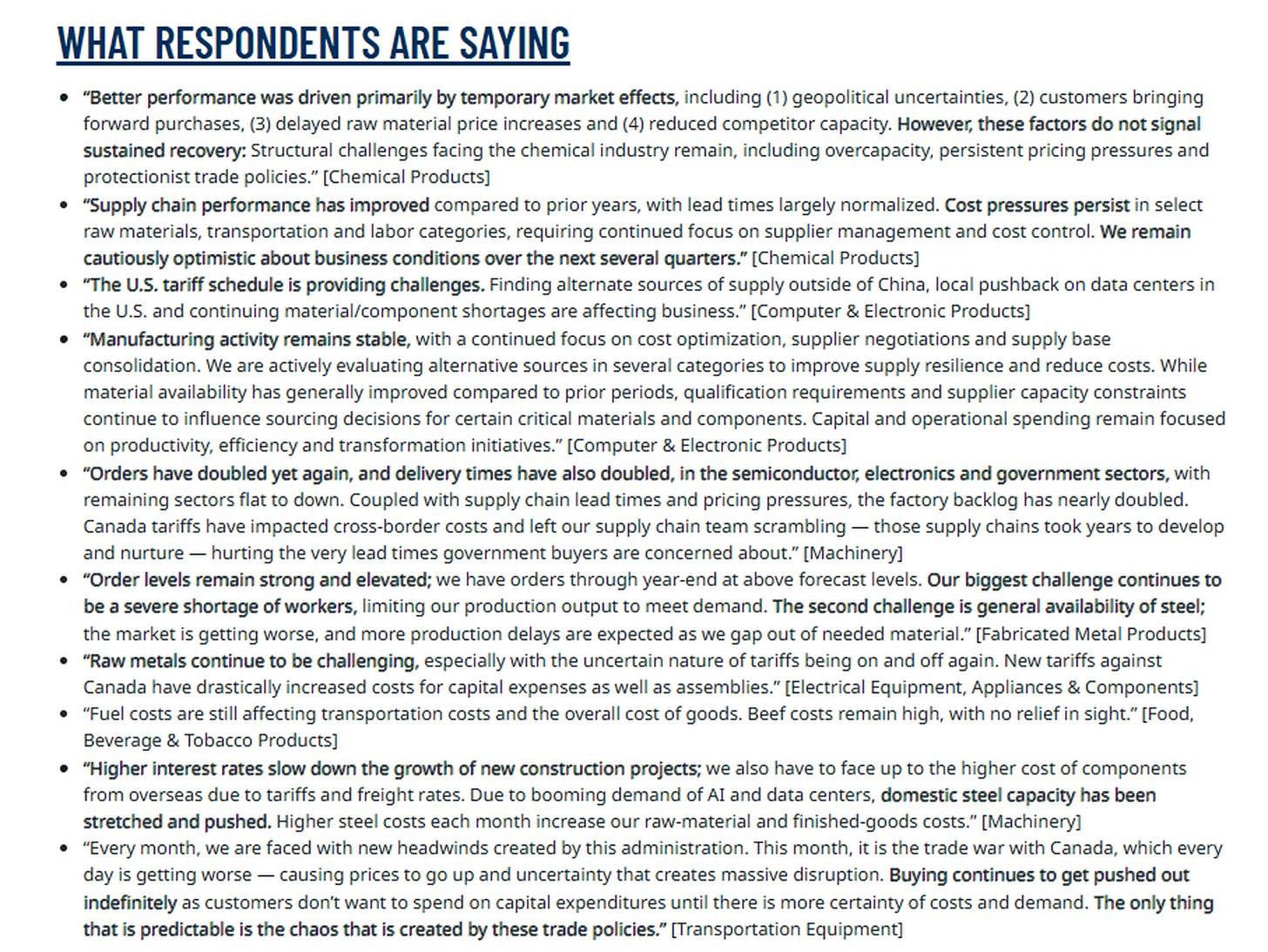
Sentiment held at 40% positive and 60% negative, the same 1-to-1.6 ratio as August. Among negative comments, pricing volatility was cited in 46% (down from 57%), tariffs in 34% (up from 29%), the Iran war in 30% (unchanged) and longer lead times in 21% (down from 46%).
Demand comments skewed positive, with several citing stronger demand led by semiconductor, electronics and government-linked work (consistent with the S&P report which flagged those same areas), though a couple flagged softness tied to rates and trade uncertainty. One Machinery respondent said “orders have doubled yet again,” while Fabricated Metal Products said “order levels remain strong and elevated,” with “orders through year-end at above forecast levels.”
But that demand and trade issues (war and tariffs) are straining materials and supply chains. The Machinery comment above also noted that “delivery times have also doubled,” while another Machinery respondent said “due to booming demand of AI and data centers, domestic steel capacity has been stretched and pushed. Higher steel costs each month increase our raw-material and finished-goods costs.” Fabricated Metal Products said “our biggest challenge continues to be a severe shortage of workers” and “the second challenge is general availability of steel; the market is getting worse, and more production delays are expected as we gap out of needed material.” Electrical Equipment said “raw metals continue to be challenging,” and Chemical Products said “cost pressures persist” in select raw materials, transportation and labor.
Canada was a new flashpoint, cited by three respondents. A Machinery respondent said “Canada tariffs have impacted cross-border costs and left our supply chain team scrambling — those supply chains took years to develop and nurture — hurting the very lead times government buyers are concerned about.” Electrical Equipment said “new tariffs against Canada have drastically increased costs for capital expenses as well as assemblies.” S&P Global separately flagged customs delays “especially at the Canadian border.” Computer & Electronic Products said “the U.S. tariff schedule is providing challenges,” citing the hunt for suppliers outside China, local pushback on data centers and component shortages. Transportation Equipment was the most pointed: “Buying continues to get pushed out indefinitely as customers don’t want to spend on capital expenditures until there is more certainty of costs and demand. The only thing that is predictable is the chaos that is created by these trade policies.” Not everyone is struggling, though. One Chemical Products respondent said “supply chain performance has improved compared to prior years, with lead times largely normalized.”
Analyst Takeaways
- “The most recent surge in price growth has renewed my concern of price volatility choking off demand in some of these sectors, underlining the impact of the ongoing war and renewed tariff threats,” Susan Spence, chair of ISM’s Manufacturing Business Survey Committee, said during a call with reporters (via Bloomberg).
- “US manufacturing activity remained solid in September, with the ISM Manufacturing composite index little changed and underlying details generally firmer than the top line.” — Bloomberg’s Andrew Sacher.