Goldman’s Amazon Move Adds Conviction to My Trade
Amazon is developing the way I hoped it would. Here’s my strategy as we begin the fourth quarter.
You've reached your free article limit
You've read 0 of 1 free Pro articles.

The indexes aren’t moving much Thursday morning, but we have the Magnificent Seven up and small-caps down again as interest rates continue to run sharply higher. The iShares 20+ Year Treasury Bond ETF (TLT) is ex-dividend, so it isn’t as bad as it looks, but it is still sitting at new multi-year lows.
Breadth is anemic again at under 37%, and new lows are dominating new highs by a score of 300 to 30. In other words, nothing has changed on the first day of the fourth quarter.
This is tiresome, but it also makes it the perfect time to prepare for what happens next. I’m constantly reviewing my shopping lists and planning my positioning. Amazon.com (AMZN) is one of the names on my shopping list that I’m watching closely right now. I like the way it is developing, and I want to provide some details on how I approach a stock like this.
I rebalance like the big funds do, but I do it differently. I rebalance based on the price action and technical considerations rather than on the calendar.
Many of the smaller names I trade have much more complicated game plans, so I want to use Amazon as an example of how I build a position while I wait for the market to give me better action.
I don’t try to predict an exact turn. I start with a small core position, trade around it with incremental buys and sells, and let the price action tell me when it is time to make the position bigger. So far Amazon is developing exactly the way I was looking for.
On Thursday morning Goldman Sachs added Amazon to its U.S. Conviction List as part of its monthly update. Analyst Eric Sheridan has a Buy rating and a $375 price target. He sees Amazon compounding revenue growth and expanding operating margins over a multi-year horizon. He points to demand for computing power from artificial intelligence, improving profitability in the retail business and a growing advertising business.
None of that will surprise anyone who follows the stock, and Goldman has been at $375 for a while. The Conviction List is an indication of greater confidence, and it puts a major firm’s name behind the idea at a time when the stock has been out of favor. It gives institutions that have been waiting to buy ahead of the earnings report one more reason to accumulate.
What the Chart Has Done
When I first wrote about Amazon in early September, it had pulled back to its 50-day moving average around $255. I said there was a good chance it would trade lower, especially if the broader market softened, and that there wasn’t much support until the low $240s. That is about how it played out.
The stock slipped under the 50-day, worked down toward $245 and found buyers there. That level goes back to the July lows, it has held through a choppy market, and the stock was trading back near $250 Thursday morning.
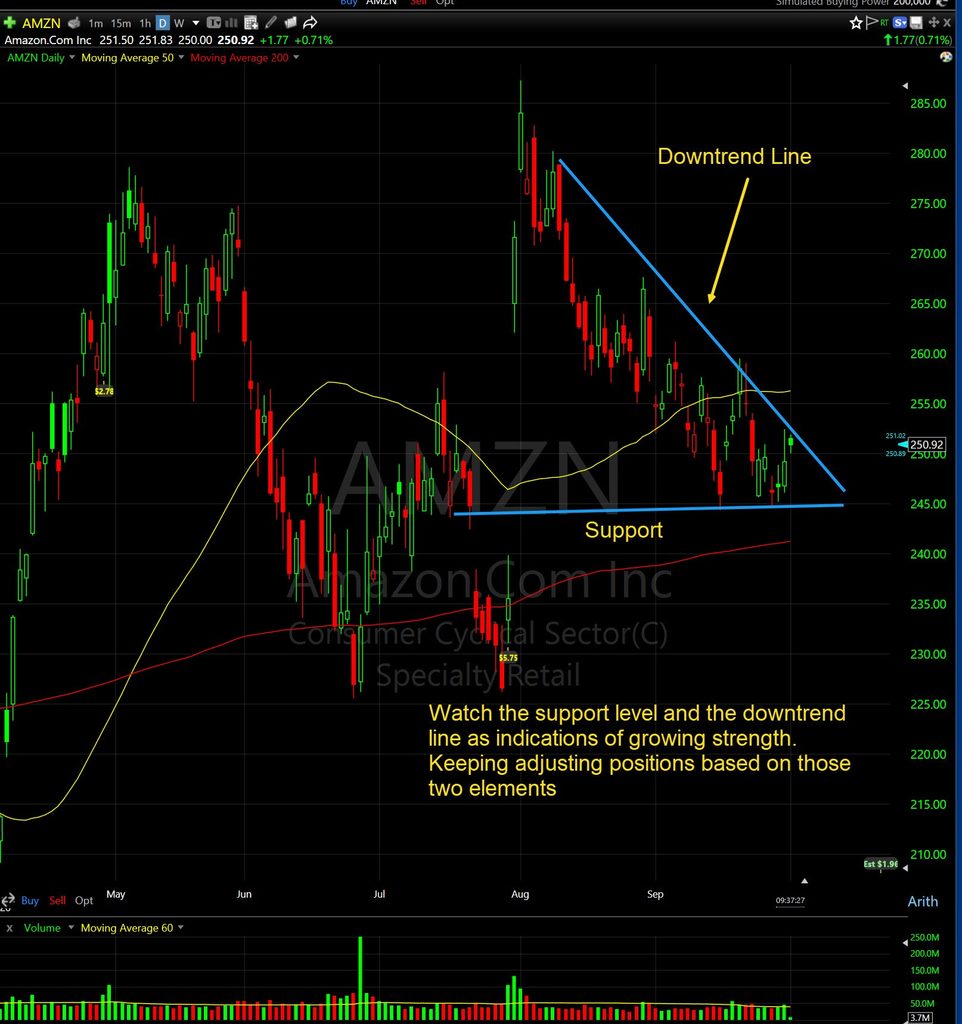
I don’t use charts to predict where a stock is going. I use them to tell me where I am wrong, and right now $245 is giving me a clear line of support. That support level makes me believe there is less risk in additional buys, and I’m willing to increase my position at this point.
The stock is also pushing against the downtrend line that runs from the August high. A move through it would be the second signal I’m looking for, and that is where I would become more aggressive.
How I’ve Managed the Position
I kept the core small through September so that weakness would be an opportunity rather than a problem. When the stock dipped toward $245 I added a little, and when it bounced I sold a little. Each roundtrip helped my cost basis, but the bigger benefit is that it kept me from building a full position before the stock showed me it had found support.
That is the part many investors skip. They like the company, they buy all at once, and then they spend six weeks watching it drift lower and wondering if they were wrong.
When I am building a position, I always want to feel that a lower price is an opportunity. When you are holding too much, those pullbacks are discouraging and painful. If your position is smaller, those pullbacks feel completely different. You have to maintain your objectivity about a stock, and that is much easier to do when you aren’t nervous about how much you already own.
What Changes From Here
With support holding and Goldman now adding its weight to the bullish thesis, I’m shifting the balance. I will continue to trade around the core, but I’ll be quicker to add on dips and slower to sell into strength. My goal is to carry a larger position as anticipation builds into the third-quarter earnings report, which is expected around the end of October. Last year the stock bottomed about 10 days before a strong report, and I suspect we will see a similar run of anticipation this time.
I still don’t plan on carrying a full position into the report itself. Management guided third-quarter revenue a bit below where Wall Street was, so the number carries more risk than the run-up into it. I’d rather let the anticipation do its job and then decide how much to hold through the results.
If $245 breaks on heavy volume, I’ll go back to keeping the position small and wait for new support to develop. That is the advantage of building incrementally. Being wrong costs little, and being right lets me get bigger.
This approach takes more attention than buying and holding, but it keeps me in a stock I like without having to guess the bottom. The patient part is mostly behind us. Now the market is starting to give me reasons to add, and I intend to use them.
At the time of publication Rev Shark was long AMZN.