My Worst Case for the AI-Fueled Economy
Here’s what I’m most concerned about the future of our economy. Also, let’s check on Warsh’s latest speech, the market rebound and the charts.
You've reached your free article limit
You've read 0 of 1 free Pro articles.
Nice rebound? Sort of. U.S. equity markets rebounded off of steep intraday losses on Thursday. The S&P 500 ended up gaining 0.33% for the regular session, while the tech-heavy Nasdaq Composite closed up 0.08%. That minute gain came after that particular index had been down as much as 1.4% midday on top of a 1.9% loss on Wednesday. While that felt like a rebound and it technically was, the Nasdaq Composite still stands 3.6% lower than it stood a rough 10 days ago.
The recent carnage has been inspired largely by doubts over debt-fueled funding for the AI space coupled by hotter-than-expected consumer price index and producer price index reports for September. Will this recent resurgence in both producer- and consumer-level inflation continue? It could, if the war in Iran continues to drag on without the obvious emergence of an off-ramp. Will higher interest rates or tighter monetary policy do anything to slow down that kind of inflation? I think the obvious answer is “of course” not. Some of our central bankers disagree.
Does the AI trade recover from this selloff and regain its past momentum? I think parts of that trade will. The gains may come slower. Revenue growth across the space will remain robust, but maybe more of an “old-school” kind of robust and less of a parabolic, “panic-stricken” robust. There will be more of a focus on balance sheet health going forward and rightfully so in my opinion. Less than profitable businesses should not be valued with highly profitable ones. Equity in businesses bearing positive cash flows that manage debt loads well should be more highly valued than is any equity in businesses that cannot. We’ll adjust. We’ll adapt. We’ll be OK, Wink. Wink.
Warsh Speaks
Fed Chair Kevin Warsh spoke overnight from Bangkok at the IMF-World Bank annual meetings. (Talk about a freak show, gee wiz.) Readers know that I generally like Kevin Warsh as an economist. We have some core similarities in our economic beliefs. That said, of late, I have been moderately critical. Readers know that I do not see the tightening of monetary policy as an appropriate response to rising inflation when that inflation is caused by a supply shock.
Warsh does see the artificial tamping down of broad demand as an effective tool in the attempt to arrest this inflationary surge. I see such rate hikes as more than likely to slow economic activity and ultimately damage the national employment picture than they are to corral inflation. Warsh is more confident in the U.S. economy than I am and that, my friends, is the very foundation of our difference of opinion.
In Bangkok, Warsh did not offer up any guidance on the trajectory of U.S. interest rates. In fact, he said, “I don’t prejudge meetings. I don’t believe in saying now what I might do at the meetings that we have in the balance of this year.”
Warsh added, “It’s a new chapter at the Fed. We’re not in that business anymore, but we can go in any direction you’d like.”
In short, he’s playing his cards close to the vest and for that, we can be grateful. I did not think that the past few Fed Chairs were especially good at managing policy or in running the Federal Open Market Committee, so this kind of discipline is more than welcome.
My Worst-Case Scenario
The difference of opinion between Warsh’s views and my views really comes down to the very AI trade that is at the center of recent market activity. Warsh sees the U.S. economy as rather hot right now due to the AI-focused up-spend and statistically, and he would be correct. Warsh commented that technology is hitting the demand side of the economy before it reaches the supply side, in the form of improved productivity. On AI, he said, “If you believe like I believe, which is it will make economies and countries that put it to good use more productive, that it’s going to make it so that we will have more wealth, then that has to be a very good thing, but the path from where we are to there is likely to be a very bumpy one.”
It’s those bumps that I am concerned about. While AI-improved efficiency and productivity will result in an increased (perhaps significantly so) gross domestic product, the economy will have less use for those at the middle and lower rungs of our income curve. In fact, high-paying jobs will likely be impacted much more so than the public or economists think as white collar workers will find no lateral move to make after either losing their positions or being forced to take a cut in compensation.
We currently have a “K” shaped economy where there is a bifurcation in standard of living between those who are able to invest or hold assets and those who rely solely upon wages to support their respective households. The threat from AI is that this capital “K” becomes a lower-case “k,” where those who suffer still suffer and those who do well, do less well.
My fear (hurts just to write) is that higher interest rates will not slow inflation directly, but that consumer-level inflation will ultimately slow as the cost to borrow damages small businesses and accelerates a shift toward permanently higher unemployment rates. Worst case? The U.S. and global economies become even more bifurcated and that upper-case “K” becomes a lower-case “k” and that lower-case ultimately becomes a lower-case “i”. That’s right. Those who do well will be represented by nothing more than a dot atop a short line that represents everyone else. How nice.
Charts
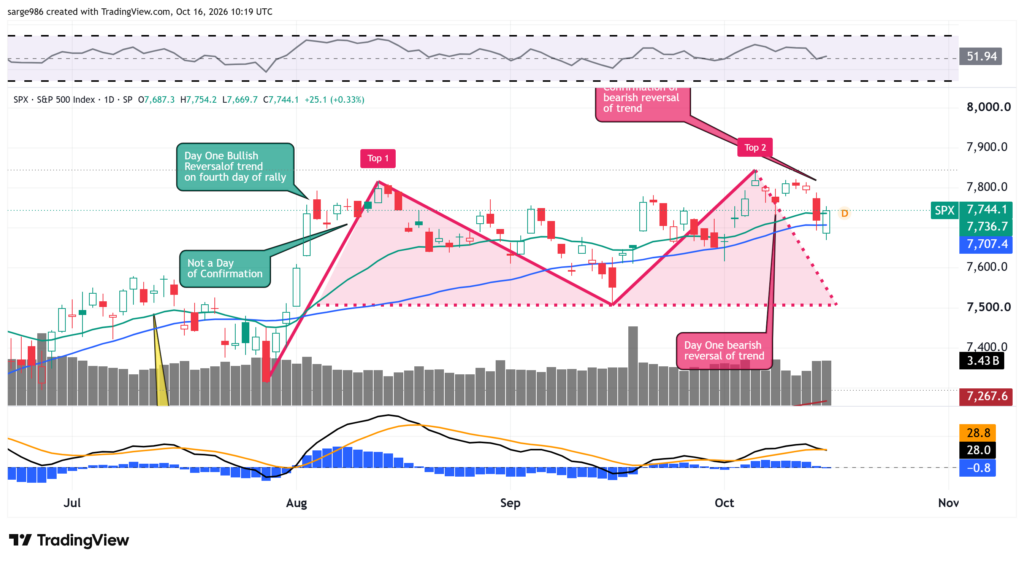
We mentioned in our charts section on Thursday morning that there was a chance that in the face of a plethora of negative turning indicators, that portfolio managers might defend the S&P 500’s 50-day simple moving average (the blue line) and that is exactly what happened as that line was pierced.
The same stand was made by those managers more focused upon the Nasdaq Composite.
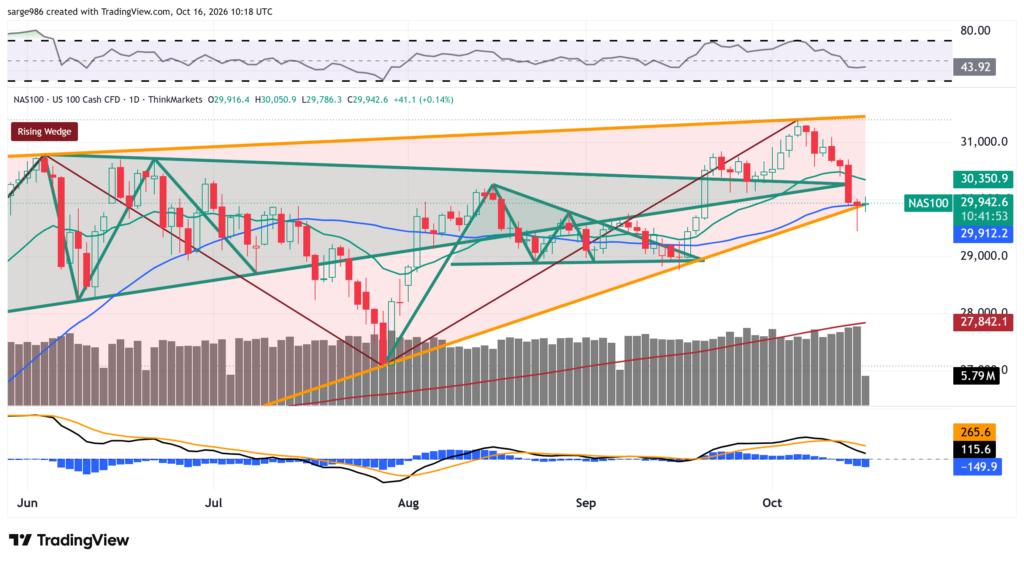
That said, the daily moving average convergence is in a tougher spot on this chart. Interesting. Markets may try to cement Thursday’s rebound on Friday. We’ll skate on that ice, but beware, the temperature is rising and the ice is thin.
Economics (All Times Eastern)
08:30 – Export Prices (Sept): Expecting 1.0% m/m, Last 0.6% m/m.
08:30 – Import Prices (Sept): Expecting 0.8% m/m, Last 0.7% m/m.
09:15 – Industrial Production (Sept): Expecting 0.4% m/m, Last 0.0% m/m.
09:15 – Capacity Utilization (Sept): Expecting 76.5%, Last 76.3%.
1:00 p.m. – Baker Hughes Total Rig Count (Weekly): Last 603.
1:00 – Baker Hughes Oil Rig Count (Weekly): Last 462.
4:00 p.m. – Net Long-Term TIC Flows (Aug): Last $-27.9B.
The Fed (All Times Eastern)
No public appearances scheduled.
Today’s Earnings Highlights (Consensus EPS Expectations)
Before the Open: MTB, TRV, TFC
At the time of publication, Guilfoyle had no position in any security mentioned.