Iran Escalation and AI Spend Leave Me Bearish Despite All-Time Highs
There can’t be much upside left.
You've reached your free article limit
You've read 0 of 1 free Pro articles.
Last week we discussed being cautious. I don’t know how bearish other TheStreet Pro contributors were, but I was pretty bearish. I remain bearish.
Iran
The escalation in Iran is real and is increasing. With more U.S. lives lost, it will be difficult for the President to not respond with a degree of escalation.
The Iran problem is twofold:
- Iran, even with a chain of command that is broken, is not crazy (probably not crazy), so it has chosen to escalate their attacks, knowing that the U.S. is likely to respond. I (along with many of the people I work with in my “day job” at Academy Securities) are trying to figure out what its endgame is. Why is it so anxious/willing to escalate? It could be that “splinter” groups have done something, but whenever an opponent “seems to make a mistake” it is worth considering why they don’t think it was a mistake. Maybe they think they can push the Gulf countries to push the U.S. to a deal?
- The Strategic Petroleum Reserve is near the lowest it can go:
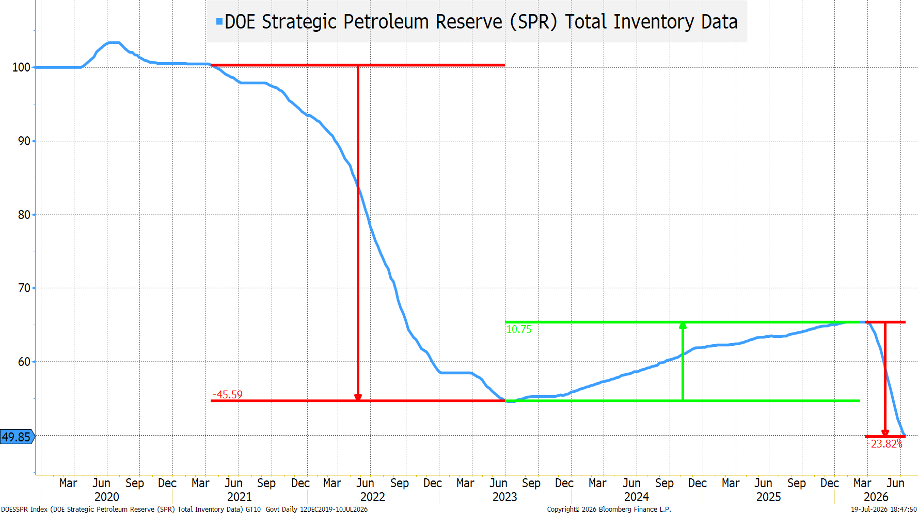
I am not an expert in our Strategic Petroleum Reserve, but I’m told there are levels (around here) where it is difficult to drain more. The color I get is primarily that “below a certain threshold, the integrity of the caverns holding the oil comes into question.” I’ve also heard that sediment occurs, meaning the stuff at the bottom of the caves isn’t that pure. I don’t know, but we drained a lot of reserves to protect the price of oil, and I’m not sure that can continue!
AI Spend
I’m nervous about the AI spend for several reasons. Some of which I’ve mentioned in the past, some of which are evolving rapidly.
Cheap Compute From China
In many respects (we can use (BYD) as an example) China relies on higher quality products, cheaper (at the margin and then some) versus competing offerings. That is a shift from when it used to deliver “mediocre” (at best) products at a very steep discount. I’m really worried it is launching cheap compute on the U.S. I don’t care about how it does on benchmarks, I only care that it is delivering the “dinky car” equivalent that worked for it in 2005 in compute form.
Electricity production and distribution (the grid) are crucial and the U.S. is behind — we need to catch up, and in some ways are, but we are currently at a disadvantage.
Also, I am quite sure the concept of NIMBY does not exist in China, certainly not for anything that has national security or economic benefits at stake. Parts of the U.S. are heading the other direction.
Parabolic SOXX
Since (SOXX) went parabolic, only a crazy person would talk about the AI spend dropping.
With companies announcing multi-year deals, only a crazy person in media would be crazy enough to let a crazy bear speak. I think that is changing rapidly! You may wake up this week to all sorts of analysts questioning the AI spend. People will point to the debt being raised and recent spread widening in the sector. Maybe some “brave” (formerly crazy CEO) will say that they’ve been trying hard to use AI, but they aren’t getting a cost/benefit win? This may be far fetched, but that is my sense of the news flow, and I’m pretty plugged in, doing CNBC, Bloomberg and Wolf of All Streets on Monday.
If just one company announces it is reining in their spending and their stock goes up, what happens next?
I Like Europe
I would like the U.S. too, excluding AI, except that the equal-weight S&P 500 has done well enough recently (all-time highs) that I’m not sure how much upside there is.
Also, AI is the main source of inflation and job growth (building the AI capabilities requires a lot of bodies) so inflation and jobs may both decline (though renewed Middle East fighting won’t help inflation).