This Mid-Cap Biotech’s Pullback Just Created a Trade I Can’t Ignore
The stock has fallen about 15% from its October highs. My strategy offers both double-digit upside potential and downside protection.
You've reached your free article limit
You've read 0 of 1 free Pro articles.
Friday was option expiration day for October and marked the end of a volatile week in the markets. Surging energy prices were the core driver of higher-than-expected September CPI and PPI readings. Another rate hike from the Federal Reserve may not happen at the FOMC meeting later this month, but unless some resolution is reached in the Middle East, one looks to be in the cards at some point.
Meanwhile, stocks in semiconductors and neocloud provider have taken the gas in recent trading sessions. It is unknown whether this action is a notable sector rotation or a sign the AI bubble is finally deflating.
I am heading back to the biotech sector for my next covered call trade idea, a name that currently trades around $80 and sports a market capitalization of $7.5 billion.
Shares of Spyre Therapeutics (SYRE) have dropped some 15% from their highs earlier this month. Management used a big rally in the stock this year to go back to the capital markets last week and raise around $350 million via a secondary offering. That leaves the company with some $1.4 billion in cash — more than enough to advance its pipeline until at least the end of the decade.
Management has solid plans for that cash. Spyre is advancing three antibodies (SPY001, SPY002, and SPY003) in clinical development to treat ulcerative colitis or UC and IBD, and one antibody (SPY072) against three other indications. I will focus on the efforts around UC and IBD. These subcutaneously injected extended half-life monoclonal antibodies are being evaluated both as monotherapies and as part of combination therapies.
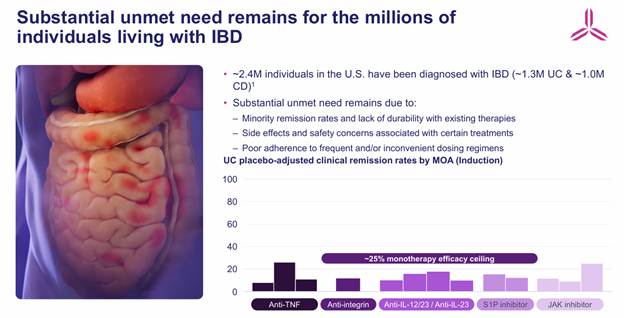
UC afflicts ~1.3 million Americans and CD impacts another ~1.1 million with ~70,000 new cases of IBD diagnosed annually. Between the two IBD indications, the total addressable global market is expected to reach $40 billion by 2030. Given the size of the market, it is not surprising there are several products on the market, including from drug giants AbbVie (ABBV) and Johnson & Johnson (JNJ).
SPY001 scored a 9.2-point mean reduction from baseline in the 33-point Robart’s Histopathology Index (RHI) (p<0.0001), a measure of histological disease activity at week 12 with 40% of the 43 patients achieving clinical remission (17/43) while 51% demonstrated improvement as assessed by endoscopic examination. The clinical remission and endoscopic results were superior to Takeda’s (TAK) anti-α4β7 integrin therapy Entyvio (vedolizumab), which produced a 27% remission rate and 41% endoscopic improvement at week 14 in its pivotal trial (VARSITY). Also approved for CD, Entyvio generated sales of ~$6 billion in the 12 months ending March 31, 2026.
SPY002 scored a 10.7-point mean reduction from baseline in RHI (p<0.0001), a 33% clinical remission rate, and a 42% endoscopic improvement rate across 48 patients at week 12. The remission and endoscopic rates were superior to Merck’s (MRK) anti-TL1A candidate tulisokibart (26% and 37% at week 12, respectively), which were produced in a Phase 3 trial (ARTEMIS). They also bettered Roche’s (RHHBY) TL1A inhibitor afimkibart (32% and 40% at week 14, respectively) in its Phase 2b study (TUSCANY2).
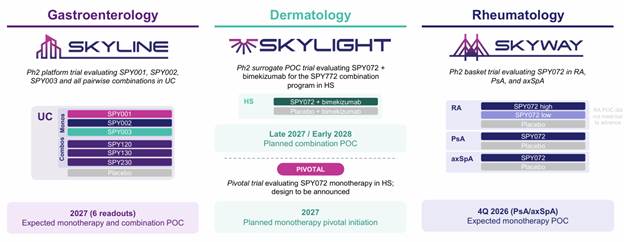
Now it needs to be known that SYRE probably will not see commercialized sales until 2030, but it has several key trial readouts that are scheduled to hit in 2027 as part of its SKYWAY studies as well as from other efforts I have not touched on in this analysis in the name of brevity.
The current analyst firm consensus is revenues will broach $5 billion in 2034, though any forecast that far out has to be taken with a large grain of salt. However, the potential probably puts a floor under the stock pending further readouts. Given its pipeline and size of the market, SYRE could attract the interest of a larger player that wants to expand its footprint in this area.
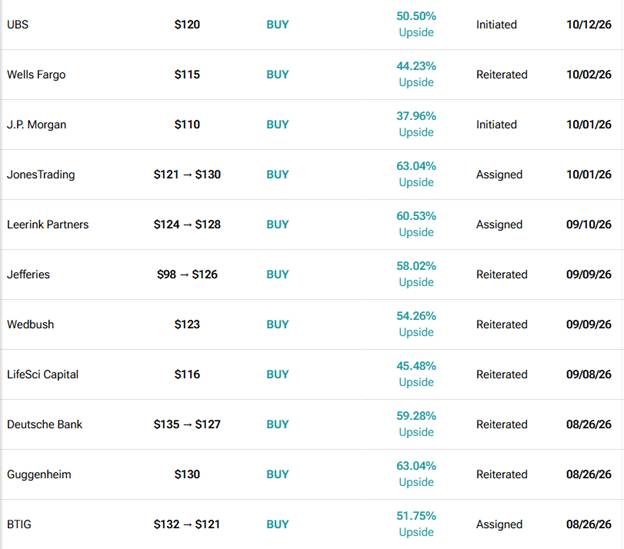
The stock is significantly below most analyst firms’ price targets. And I can lower my potential entry point in this name substantially via the highlighted covered call trade.
Option Strategy
This is how one can initiate a holding in SYRE with a covered call order. As a reminder, covered call orders involve buying an equity and simultaneously selling just out of the money call strikes against the new position.
Using the March $70 call strikes, fashion a covered call order with a net debit in the $61.00 to $62.00 a share range (net stock price – option premium).
At the top of the range, this strategy provides downside protection of 23% with upside potential of approximately 14% even if this equity trades down roughly 12% over the option duration.
At the time of publication, Jensen was long SYRE.