Expect Housing Sector to Sink Further in Coming Quarters
Here’s why I’m expecting the housing market won’t recover any time soon.
You've reached your free article limit
You've read 0 of 1 free Pro articles.

Spending on AI infrastructure continues to be the primary driver of the U.S. economy. Unfortunately, most of the other traditional economic engines are sputtering. Basically, 8% of the economy is growing at 14% while the other 92% is growing at 1%.
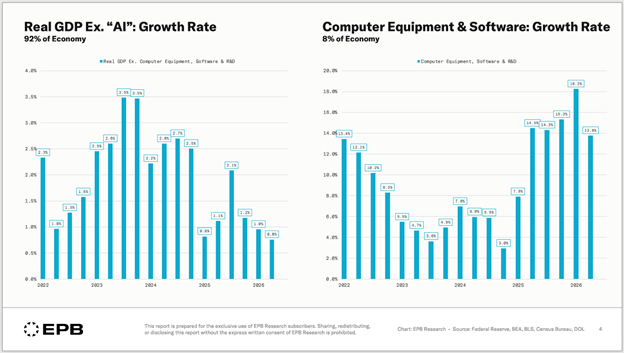
This was affirmed Friday by the July jobs report that saw a negative print of 23,000. This missed the consensus by more than 100,000 positions. Jobs estimates for May and June were also slashed. The markets rallied on this dismal labor reading as the probabilities of a rate hike at the September FOMC meeting fell on the poor jobs picture.
Housing has been a headwind to the U.S. economy for several years now compared to its historical contribution. Existing home sales since 2023 have run at the lowest levels since 1995, when the U.S. population was 20% smaller. In today’s column, I take a look at the current state of the U.S. residential real estate market, one of the largest asset classes on the globe.
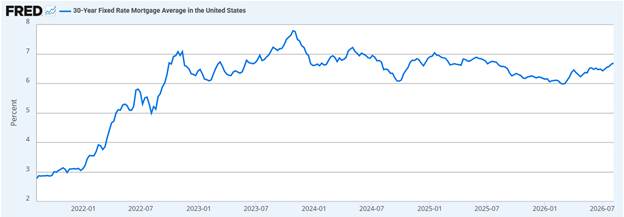
Unfortunately, I see no improvement on the horizon for the housing sector in the cards. Given the voracious debt issuance by both the federal government and the hyperscalers, this is little hope for any significant reduction in average mortgage rates. Even as the Federal Reserve has reduced its key interest rate by 175 basis points cumulatively since September 2024, average mortgage rates have risen over that time and currently stand around 6.7%.
While home price appreciation has slowed dramatically from the go-go years of 2020 to 2022 following the Covid pandemic, housing affordability remains historically low. The debt-to-income ratio for new mortgage originations is back at 2008 levels. The income needed to qualify for the median currently is around $110,000, far above the average median household income of under $88,000. There is little hope of significantly lower mortgage rates on the horizon. Average wage growth is currently around 3.5%. Therefore, that is likely to remain the case for the foreseeable future.
Outside a major economic contraction, I don’t see home prices crashing like during the Housing Bust during the Great Financial Crisis. The most likely outcome is that average home prices rise at less at the pace of inflation for a considerable time. This will allow average wage growth to eventually close the housing affordability gap. A “lost decade” if you will.
Home sellers outnumber home buyers by the largest percentage since Redfin started to survey this metric back in 2013. Recent legislation passed to boost the housing sector is likely to have a marginal benefit at best. Foreclosure rates are at seven-year highs, but not in the same vicinity of the same ballpark of where they were during the implosion in the housing sector nearly two decades ago. That said, they are likely to go significantly higher due to changes to Federal Housing Authority mortgage mitigation efforts that largely ended on Sept. 30. Those higher foreclosures should become more apparent in Q4 and 1Q2027.
In addition, the Silent Generation and Baby Boomer generations own roughly half of all housing stock. And they are passing in increasing numbers. Roughly 70% of these homes will be sold upon this event to settle inheritance. There was also a surge of apartment completions from 2023-2025. This is starting to force rents down in many regions of the country as national apartment vacancy rates currently are at all-time highs. Immigration flows have reversed under the current administration, taking away a key source of demand for rentals. This tilts the buy vs. rent decision to the latter. Dramatically so in myriad regions of the country.
In summary, the moribund housing sector is likely to remain moribund in the second half of 2026 and likely beyond. This will continue to act as an economic drag and will be a negative for consumer sentiment. In Wednesday’s column, I will take a look on the impacts of a struggling housing market on new home builders and associated industries.
At the time of publication, Jensen had no position in any security mentioned.