Asia’s Response to ‘Nvidia Effect’ May Surprise You
It has been a scary summer of moves in either direction for Asia’s chip sector and the reaction to Nvidia’s guidance may come as a shock.
You've reached your free article limit
You've read 0 of 1 free Pro articles.
The Nvidia (NVDA) industrial complex is on the march again on Thursday. Slowly. And that’s a good thing.
Asia’s artificial intelligence (AI) and semiconductor sector plays are advancing on the back of strong guidance by Nvidia after the bell on Wednesday. But it’s a sensible move forward. Encouragingly, the buying isn’t at the frenzied levels we have seen during prior run ups.
I read that as a good sign. The likelihood that semiconductor stocks are blowing up into a bubble is haunting these markets. So to see a measured response from Asia’s chip-sector players — many of which supply or derive other business from Nvidia — is surprising and positive.
Money Talk Talk
I was on the “Money Talk” show on Thursday morning alongside host Peter Lewis. We dug into Nvidia’s impact, the big talking point of the day even on the other side of the Pacific. You can find the episode on Spotify here if you fancy a listen.
The first thing I noted is that you could have told me Nvidia’s entire results before they came out, and I still wouldn’t have been able to predict the magnitude of Thursday’s stock move, or even the direction.
It seems I wasn’t alone. Shares in Nvidia have sunk the last four quarters in a row after its results, even though it is posting blowout numbers every time it releases earnings. And the knee-jerk response after the bell was again to sell on the news.
The change in direction only came with the conference call. Nvidia is guiding that it expects sales for the year running through January 2028 to rise 70%. The company hasn’t normally given that kind of guidance, so it cheered investors. I see NVDA share are up 7.6% in early U.S. going.
Good News for Asian Suppliers
Nvidia also said it had more than doubled its supply and capacity commitments, to $279 billion in this just-reported quarter, up from $119 billion three months back. That indicates strong future demand for Nvidia suppliers such as South Korea-based Samsung Electronics (KR:005930) and SK Hynix (SKHY) (KR:000660).
Yet Thursday’s gains are generally modest, with Hynix up 3.6% in South Korean trade, alongside rival Samsung’s 2.5% gain.
One of the largest tech-sector gains comes in Japan. Memory maker Kioxia Holdings (KXIAY) (T:285A), the former chip business spun out from Toshiba, is up 5.0%. The company provides Nvidia with flash memory and solid-state drives.
Kioxia has experienced wild swings of its own. Its shares are up almost five-fold this year — but are down by half since peaking on June 22.
There’s a company-specific reason for today’s rise beyond the Nvidia numbers. The Nikkei business daily on Thursday reported that Kioxia plans to invest ¥1 trillion ($6.3 billion) to build a third production plant at its chip facility in Iwate Prefecture, at the northern tip of Japan’s main island, Honshu.
Summer Semi Shakeout
This has been a summer of shakeouts for chip stocks after the sector peaked in June. Apple (AAPL) even briefly reclaimed its crown as the biggest company in the world by market capitalization, supplanting Nvidia on July 17.
Nvidia has actually been a chip-sector underperformer so far this year. Prior to these earnings, it was up “just” 11.0% year to date, a strong showing but a fraction of the 63.6% advance for the Philadelphia Semiconductor Index.
On Thursday, Nvidia is playing a little catchup. But these are far from the massive moves we have recently seen.
Hynix shares raced up 30.0% in a single day’s trade on July 31, with Samsung up 28.0%. That jump came after hyperscalers Amazon.com (AMZN) and Microsoft (MSFT) reported encouraging earnings that showed strong and profitable growth for their AI services.
Crazy Swings in Hynix Shares
But that sword has two edges. Hynix shares suffered a “flash crash” of 30.0% a week later. Those sorts of moves make me exceedingly nervous. They would be surprising for a small-cap stock. But they’re occurring for some of the world’s most-valuable companies. Hynix today sits at No. 17 worldwide, just behind the world’s most-valuable bank, JP Morgan Chase (JPM), and just ahead of the world’s largest retailer, Walmart (WMT).
These huge moves indicate that over-leveraged investors are crowding into a “sure thing” in terms of semiconductor stocks. Moves in either direction are also amplified by forced selling on the way down, and forced buying among the bears.
Leverage and “fear of missing out” are to blame. As of May 27, 16 leveraged single-stock exchange-traded funds (ETFs) are trading in South Korea, based off the shares of Hynix and Samsung. The ETFs provide leveraged 2x exposure, 14 of them on the long side and two on the short side, and at times now account for as much as half of the daily trading in Seoul for Hynix and Samsung. There are now also eight leveraged ETFs listed in the United States trading U.S. Hynix shares, six on the long side and two for the bears.
Has the Hot Air Come Out of the Bubble?
So, if this summer selldown has a positive, it is that speculative investors aren’t so sure about the semiconductor “sure thing” anymore. They might even be paying attention to the earnings these companies are putting out. Who would have thought?
Coincidentally, Apple shares fell 6.3% on July 31, with investors disappointed about its sales forecast of 9% to 11% growth, below the 12% analyst forecast. That pushed Nvidia back into top spot in terms of market value.
There is once again considerable distance between the two. Nvidia’s tally on Thursday is $5.5 trillion, while Apple’s market cap is $4.6 trillion, still good for second place but almost $1 trillion behind.
Asia’s most-valuable company, chip foundry Taiwan Semiconductor Manufacturing Co. (TSM) (TW:2330), is up only slightly in Taiwan, adding 0.8% at the close. At No. 6 globally, it ranks behind only NVDA, AAPL and then Alphabet (GOOG), Microsoft and Amazon.
‘Chip-Agnostic’ TSMC
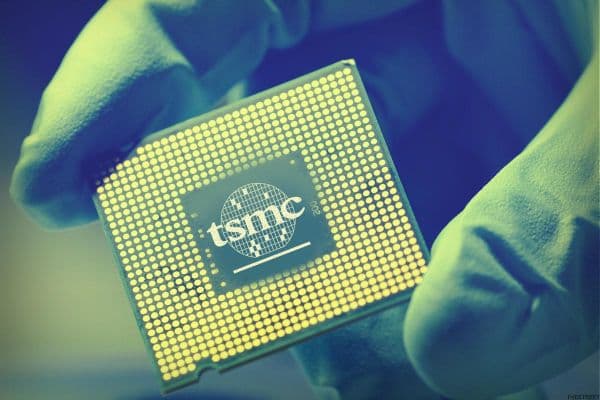
TSMC (TSM) fabricates the vast majority of Nvidia’s advanced graphics and AI processors. So, good news for Nvidia is inevitably good news for TSMC. In fact, TSMC is pretty agnostic about which companies are designing the chips that it physically produces, so long as they continue to place strong orders.
Besides Hynix and Samsung, Micron Technology (MU) is the other chief memory provider to Nvidia. Its shares are even down on Thursday, off 2.5% as I write. They opened higher but are being buffeted by geopolitical winds.
Politico reported that the President Trump administration is considering a new round of tariffs on the chip sector. The proposal would seek to extend the range of goods affected by the chip tariffs beyond microchips to include products that include them such as laptops, data-center servers and gaming consoles.
Micron to Suffer From Rules That Protect it?
These moves are designed to encourage U.S. chip production. But ironically, they could be bad for U.S. producer Micron if markets like China respond with tariffs of their own. What’s more, the Trump administration is reportedly considering allowing tech designers such as Apple to source chips from Chinese memory producers such as CXMT (SH:688825) for use in devices sold outside the United States.
Nvidia gets 8.2% of its business in China, as of these latest numbers. The company had been getting some 20% to 25% of sales in the Middle Kingdom before U.S. restrictions on its top-flight chips came into place. Its latest earnings indicate how tight supply for its chip designs has become — it has found willing buyers beyond China, and is still putting up highly impressive numbers.
At the time of publication, McMillan was long TSM and DRAM.