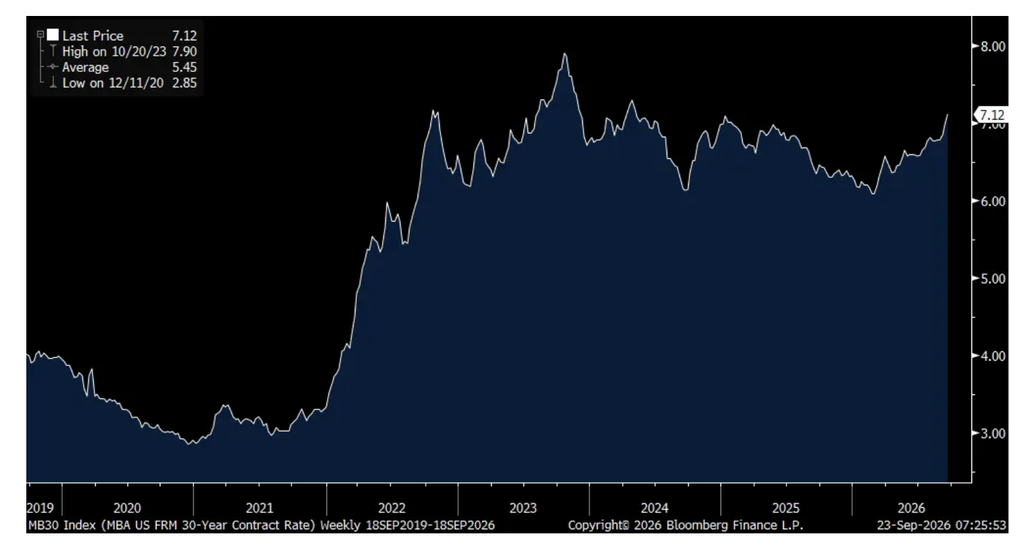
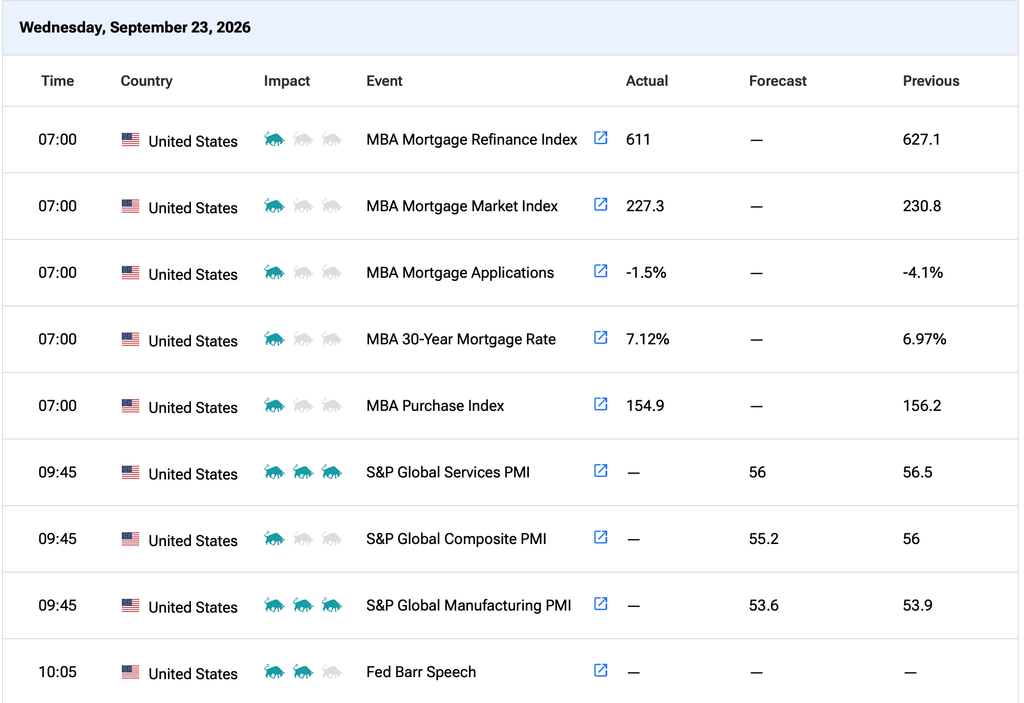
The contract rate on a 30-year fixed mortgage rose 15 basis points to 7.12% in the week ended Sept. 18, according to Mortgage Bankers Association data released Wednesday. That was the highest since May 2024. The five-year adjustable-rate mortgage, however, fell 13 basis points to 6.1%.
I am glad I don’t drive a diesel pickup nor do I need to buy a house…..
“Governments defending prices against fundamentals always lose”/Fed talk/Housing, RVs, auto repair/Overseas
I fully get the desire to lower diesel prices and certainly the politics of very high prices ahead of the midterms but the economics of an export ban is terrible. The US makes more diesel than its refineries use and thus exports the balance which is about 20% of global diesel trade. A ban would cause global diesel prices to skyrocket and would result in US diesel prices plunging, temporarily. US refineries would then see its margins drop sharply, which would then slow refinery runs and then the drop in US prices would end and if the ban continues, the upward trend would resume.
I’ll steal another line from the Stan Druckenmiller op-ed on the Treasury market, “Governments defending prices against fundamentals always lose. The only variable is how much they spend before conceding.” This instance of course would be slightly different in that it would be a policy intervention rather than a direct government financial one but the point is still the same, over time it is a losing strategy when messing with the markets.
While Fed Chair Kevin Warsh will stick with is ‘no forward guidance’ policy, it continues to be just his own as we hear from other Fed members who are giving their own personal ‘forward guidance’ beliefs, but to differing degrees.
From Richmond President Tom Barkin, a non-voter, who is hawkish but not tipping his cap just yet on the next meeting:
With regards to the supply disruptions being seen, “These may pass in time, but I do expect it will take time. In the interim, there is a risk that current elevated levels of inflation could affect future inflation.”
“Where do we go from here? We are committed to returning inflation sustainably to our 2% target. Last week’s hike will help. Will additional hikes be required, and how many? We’ll see.” I guess he’s more non-committal.
From non-voting member Boston President Susan Collins:
“Given all the available information, I now see an increased likelihood of future scenarios in which inflation remains notably above 2%.”
“A somewhat more restrictive federal funds rate will help ensure that inflation durably returns to target.”
From Alberto Musalem, speaking Monday, the St. Louis President:
“Both persistent demand and recurring supply forces are continuing to contribute to keeping inflation risks elevated, and I judge that without further policy restraint on inflation it is more likely to be substantially above our 2% target in 18 months than at target.”
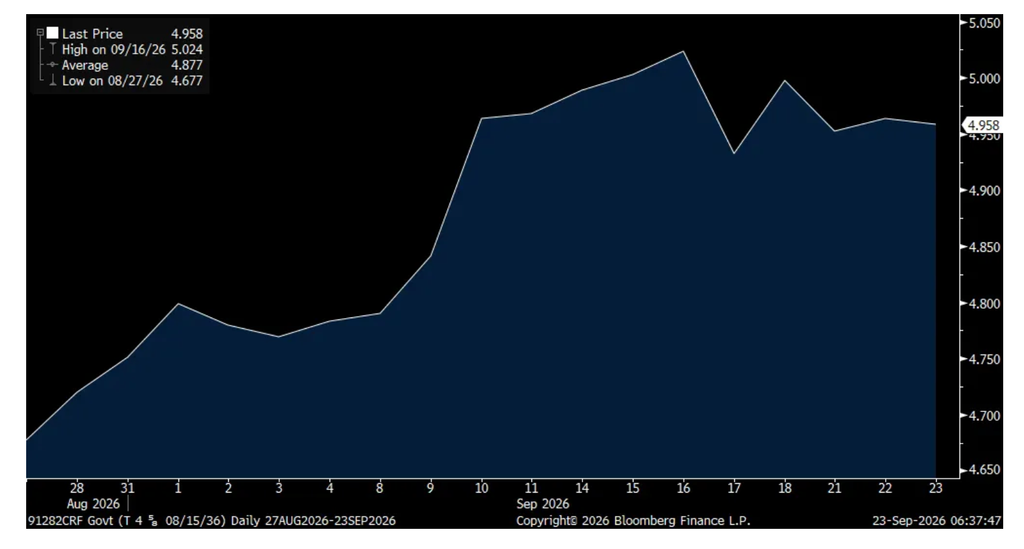
As for hopes that a rate hike or two would help to tame long rates, that ain’t working right now. On August 27th, the day before the Kevin Warsh Jackson Hole speech in which he sounded more hawkish than not and rate hike odds started to inflect higher, the 10 yr yield stood at 4.68% vs 4.96% as of this writing. The 2 yr yield is higher by 56 bps to 4.77% during that time frame, of course reflecting the rate hike and greater odds of more.
10 yr US Yield since August 27th
Shifting to housing, and the most interest rate sensitive part of the US economy. The average 30 yr mortgage rate for the week ended 9/18 jumped to 7.12% from 6.97% and sent refi’s lower for a 5th straight week and by 2.6% and down 62% y/o/y. Purchases fell for a 3rd week but by a modest .8% w/o/w and lower by 11.2% y/o/y.
Average 30 yr Mortgage Rate
Let’s hear from KB Homes on the state of the market and their business:
“The housing market remains challenging with conditions having weakened since our last earnings call in June. Affordability is under further pressure due to rising mortgage rates. Inflation remains persistently high, driven in part by fuel prices, which prompted the Federal Reserve to raise interest rates last week. These factors, as well as geopolitical uncertainty, and broader economic headwinds have resulted in consumers becoming more cautious about buying a home.”
“In addition, resale inventory, which is our largest competitor has increased to its highest levels in a decade, and we’re seeing pricing starting to decline in more of our markets, adding to the tension in this environment.”
“During the quarter, buyers continued to demonstrate both the desire for homeownership and the ability to qualify. However, declining consumer confidence and lower affordability in most of our markets weighed on traffic in our communities, which still solid, went down y/o/y. We saw more caution among prospective buyers, with many moving to the sidelines. As a result, while sales in June were resilient and slightly ahead of May, sales softened sequentially in July and August, resulting in a y/o/y decline in net orders.”
Finally from KB, “softer market conditions and greater affordability pressures have contributed to increased pricing pressures across many of our markets, and together with slightly higher costs as stated earlier, they are creating an additional headwind to margins.”
I’ll add my 2 cents on what the housing market needs in order to jump start more activity and greater affordability. For perspective, in 1980, the median home price relative to the median income was 3.5. Today it’s at 5.0. So, we need a period of time where home prices either flat line, or go down, at the same time wage gains continue in order to lower that ratio. That would mitigate the impact of a 7% mortgage rate. At the same time, it’s good to hear that more supply is coming to the market but broadly, we need the baby boomers to downsize into a smaller new home, a town house or apartment and release even more existing home inventory to the market.
Thor Industries is in the RV business which is tough right now but whose stock rallied 5.5% yesterday off a 52 week low. They said this on their higher ticket business, reliant on borrowing by their customers:
“Our fiscal 2026 proved to be more challenging than we anticipated at the outset of the year due to the headwinds impacting the RV industry. The retail market never reached the inflection point many in the industry expected, as stubborn interest rates, elevated fuel costs and ever-present inflationary pressures have strained household budgets and kept retail soft throughout the critical selling season.”
“Our earnings performance did not keep pace with our top-line performance. As the fiscal year progressed, heightened affordability concerns and increasing material costs resulted in significant pressure on our gross margins.”
From AutoZone, up 3.3% yesterday:
Domestic comps grew 1.6% y/o/y with “Our domestic DIY same store sales declined .6%, while our domestic commercial sales grew plus 8.6%.”
“We saw our sales bottom in June and then begin to improve as the quarter moved along…The impact of higher inflation from higher oil and gas prices likely dampened our traffic and sales results for most of the quarter. At the tail-end of the quarter, our results were buoyed by stronger results in our hot weather categories.”
“We saw mid-single digit like-for-like same SKU inflation for the quarter, which contributed to our DIY average ticket being up roughly 5%, which was offset by traffic declines.”
I’ll add this, as cars on the road continue to get older (nearing 13 years), and now with affordability being a real issue, the after-market and repair business should be good. We own a real laggard but that was up 11% yesterday after the AutoZone news, Monro, where half of their business is changing tires. I continue to like the name.
I’ll finish by reviewing some of the September manufacturing PMIs out today. Australia’s manufacturing PMI fell back under 50 at 49.3 from 52 while services slipped to 51.4 from 53.2.
India’s manufacturing component lifted to 55.7 from 52.8 and services rose to 55.8 from 54.1.
In the Eurozone, its manufacturing PMI held at 52.7 while services improved to 53 from 51.6. S&P Global said “Manufacturing, spearheaded by Germany, is enjoying its best growth spell for over four years, spurred by rising AI and defense spending, but service sector growth is also perking up to signal a broad-based improvement in the economic growth story.”
The problem though is the broad-based cost pressures. “Inflationary pressures intensified in September, with both input costs and output prices increasing at the sharpest rates in four months. The latest rise in input costs was faster than the average for the year-to-date, but remained softer than the recent peak seen in May. Accelerated cost inflation was registered across both the manufacturing and services sectors.”
In the UK, manufacturing was up a touch to 52 from 51.7 while services fell slightly to 51.7 from 52.5. The commentary on the UK economy from S&P Global sounded stagflationary, still. “September is seeing a worrying combination of disappointingly sluggish economic growth and intensifying inflationary pressure, with subdued business confidence and high costs meanwhile continuing to discourage hiring.”
And then this on the inflation side, “The latest survey indicated a steep and accelerated increase in average cost burdens at private sector companies, with the rate of inflation hitting a three-month high. Stronger input cost pressures were seen in both the manufacturing and service sectors in September, with fuel prices the most commonly cited factor. Many survey respondents also noted rising prices paid for energy, labor and raw materials (especially copper and steel). As a result, prices charged by private sector firms increased at a robust and accelerated pace, with the overall pace of inflation the highest since June.”
10:05 a.m.: Fed Board Governor Barr (Voter) speaks on “Housing” before “Housing Affordability 2026: A Community Development Summit” at the Federal Reserve Bank of Chicago, Chicago, IL (Text available. Q&A from moderator and audience. Webcast at https://www.chicagofed.org/);
12:00 p.m.: Federal Reserve Bank of Chicago President Austan Goolsbee (Non-Voter) appears on “Economics, Applied” podcast
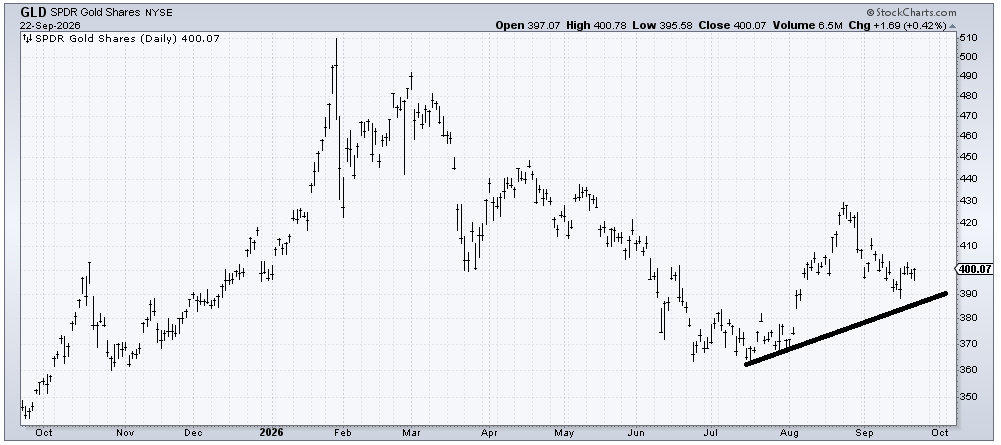
I agree $390 (or so) is an important level and might be a buy.
I still think this pullback in GLD is shaping up. My propensity to prefer a few touches at support means I would love to see another trip down to that line that also tests last week’s low around 390, because that makes the risk/reward better, but put GLD back on your radar
More Tales From Nvidia: I’m Not Trying to Call the Stocks But Consider That Muse Was Offered for Free! (Issue #253)
“Musepersonal AI agent is free to use with a generous weekly usage limit (such as up to 100 million tokens per week), though paid subscription tiers are available if you need higher usage capacity.”
– From AI
Does Anyone Do Their Homework Anymore?
Not that I am or have been trying to call the stocks, because that is a fool’s errand these days, especially in these types of mania-driven markets. But it is fun to occasionally comment on the markets relative to the underlying fundamentals and business issues.
Monday and Tuesday were a combination of a gamma squeeze aided and abetted by Facebook’s Muse announcement.
For those that don’t know, Muse is Facebook’s personal assistant app, a theoretical AI agent, that made it to the top of the app stores download list, helping to inspire the gamma squeeze rip of the last two days.
Why did it make it to the top of the list?Because it is both new and FREE! (I don’t recall a single person in the business media saying this!)
Hundreds of billions of investment, and this is what they have to show for it? A free, largely non-differentiated personal assistant app that Amazon (AMZN) has already cut off from shopping its site? And an app, that after the novelty factor wears off, will probably not be used all that much and likely never generate any economics, because it is free and of limited real utility and effectiveness. Guess what, people actually like shopping themselves, that is why they do it!
Heck, even Angry Birds costs money (and generates economics).
My guess, this thing goes the way of the Metaverse and Threads.
If any thing speaks volumes about AI, not sure if it is this, or it is OpenAI spending $22.5 million of compute to win a $1 million prize and needing to cheat along the way to even do that!
Coincidentally per prior on Muse, I just saw these.
The reference to Amazon is their theoretical no human convenience stores where AI was supposed to figure out everything you put in your basket. Turns out they had humans in India watching people on cameras. End of day, none of it ended up working, it lost too much money, and they shut all the stores anyway. Same for McDonald’s (MCD) automated AI ordering system, where “no onions” seemed problematic for the AI to get right. I guess I was too optimistic, hundreds of billions of investment, and Meta (META) still needs the humans too, because the AI still does not work.
Trillions of dollars of market cap added across the board due to this? And PS, Meta already paid for the junk they have in place to do this. They would have been better off buying offshore call centers for pennies on the dollar. Incidentally, that is one more thing AI was supposed to replace, but the opposite is happening, because it turns out Gen AI is multiples more expensive than cheap offshore labor.
🦔404 Media reports that Meta's AI agent Muse, which executives promoted last week as able to make phone calls to businesses on your behalf, is routing some of those calls to human beings in call centers. Internal communications show Meta told employees it "added a human agent…
But machines and algos know everything about price and nothing about value:
In the U.S. and Japan, the equity risk premium has been squeezed so hard that stocks barely compensate investors for taking on additional risk relative to bonds. Historically, such periods have eventually reverted not to the benefit of those chasing equities. h/t @ISABELNET_SApic.twitter.com/hs1Ez3br8w
@joesquawk Listen to what your guest from John Hanock is saying, nearly 20% of the Russell Index (IWM) is technology. In light of the strength in tech and weakness in IWM – it speaks volumes how weak the non tech IWM is today. Rather than read your cue cards and go thru your…
Regional Banks KRE have now fallen to their lowest prices since June, and are less than 1% away from entering a technical correction 📉 📉 pic.twitter.com/iABN2OkZxt
@joesquawk Listen to what your guest from John Hanock is saying, nearly 20% of the Russell Index ($IWM) is technology. In light of the strength in tech and weakness in IWM - it speaks volumes how weak the non tech
In the U.S. and Japan, the equity risk premium has been squeezed so hard that stocks barely compensate investors for taking on additional risk relative to bonds. Historically, such periods have eventually reverted not to the benefit of those chasing equities.
h/t @ISABELNET_SA
🦔404 Media reports that Meta's AI agent Muse, which executives promoted last week as able to make phone calls to businesses on your behalf, is routing some of those calls to human beings in call centers. Internal communications show Meta told employees it "added a human agentShow more