More Macke Truck
Position: None
BY Doug Kass · Oct 1, 2026, 4:50 PM EDT
 Doug KassDoug Kass
Position: None
BY Doug Kass · Oct 1, 2026, 4:50 PM EDT
Position: None
BY Doug Kass · Oct 1, 2026, 4:40 PM EDT
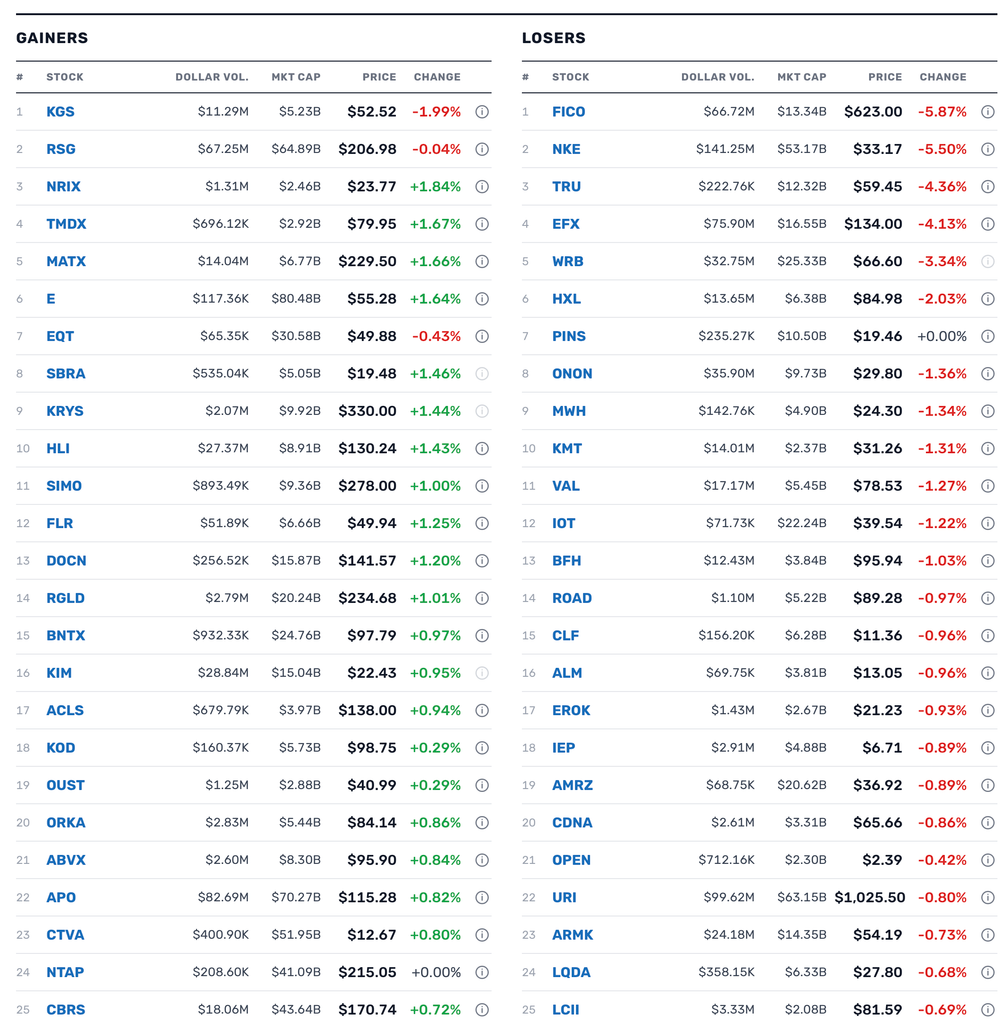
Closing Volume
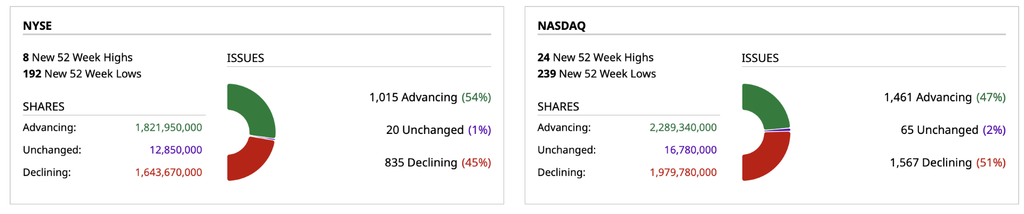
– NYSE volume 24% above its one-month average; Advancers lead decliners by 1.3:1
– NASDAQ volume 9% below its one-month average; Advancers flat to decliners
– VIX index: up 0.49% to 16.42
Breadth
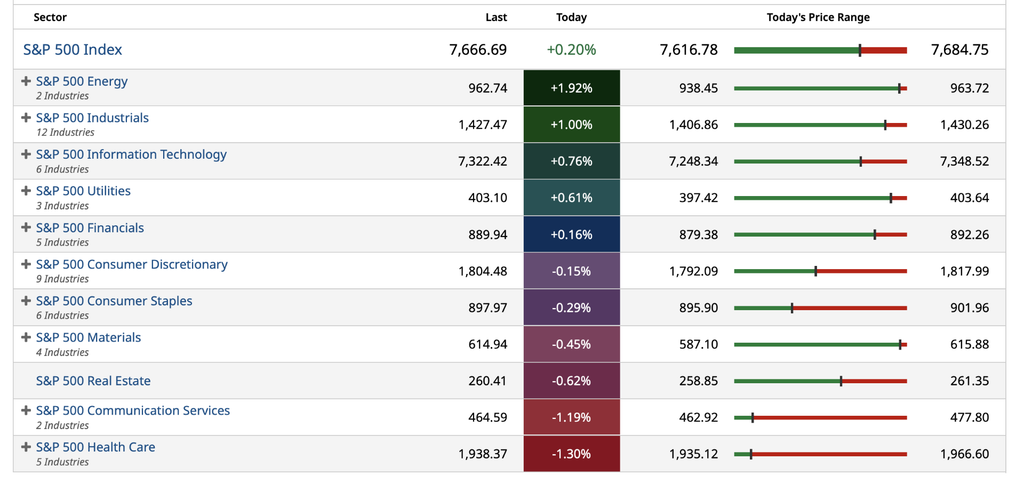
S&P 500 Sectors
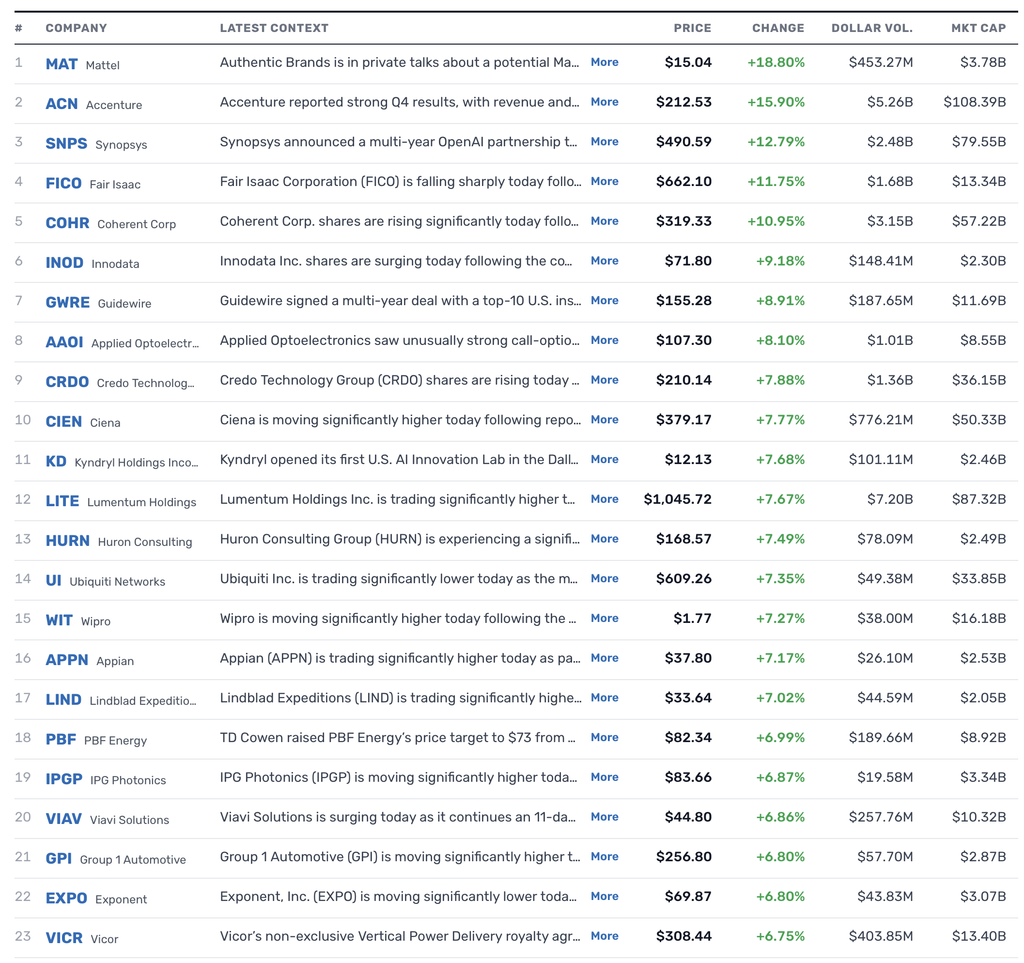
% Movers
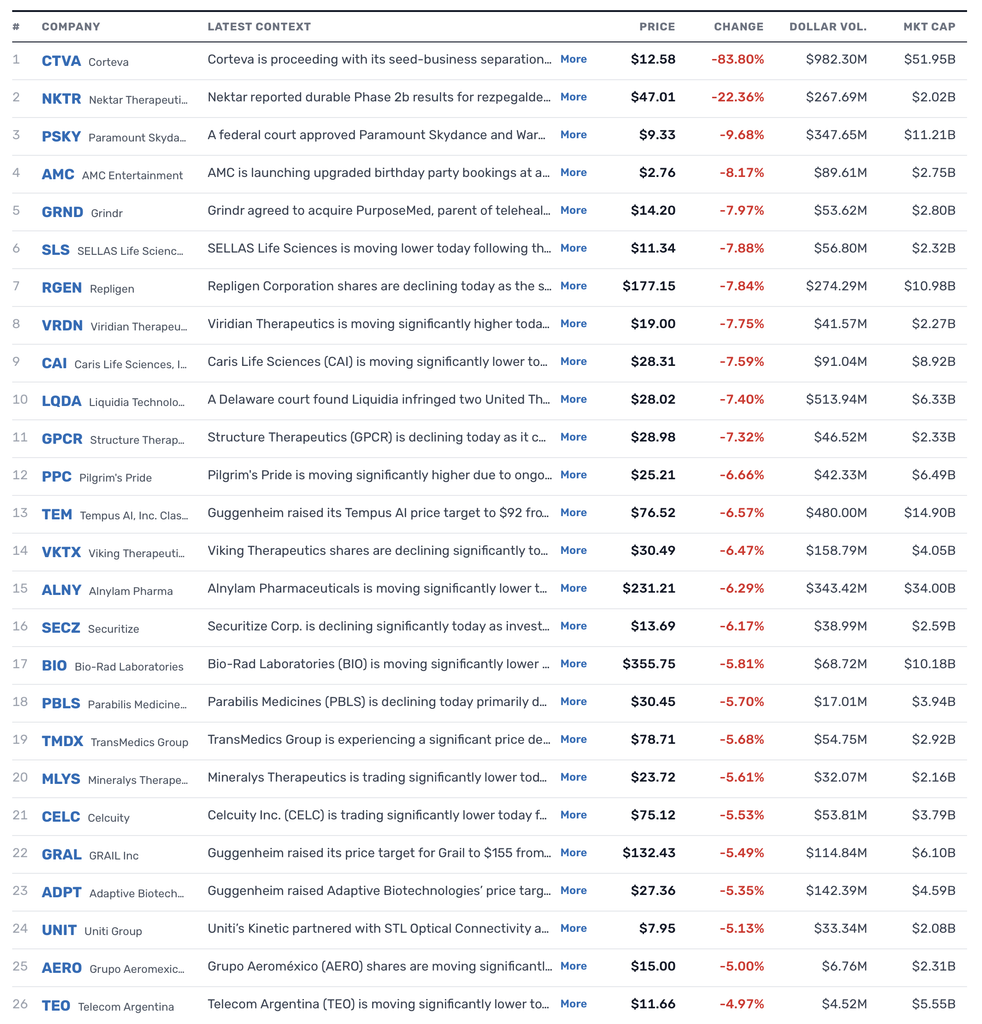
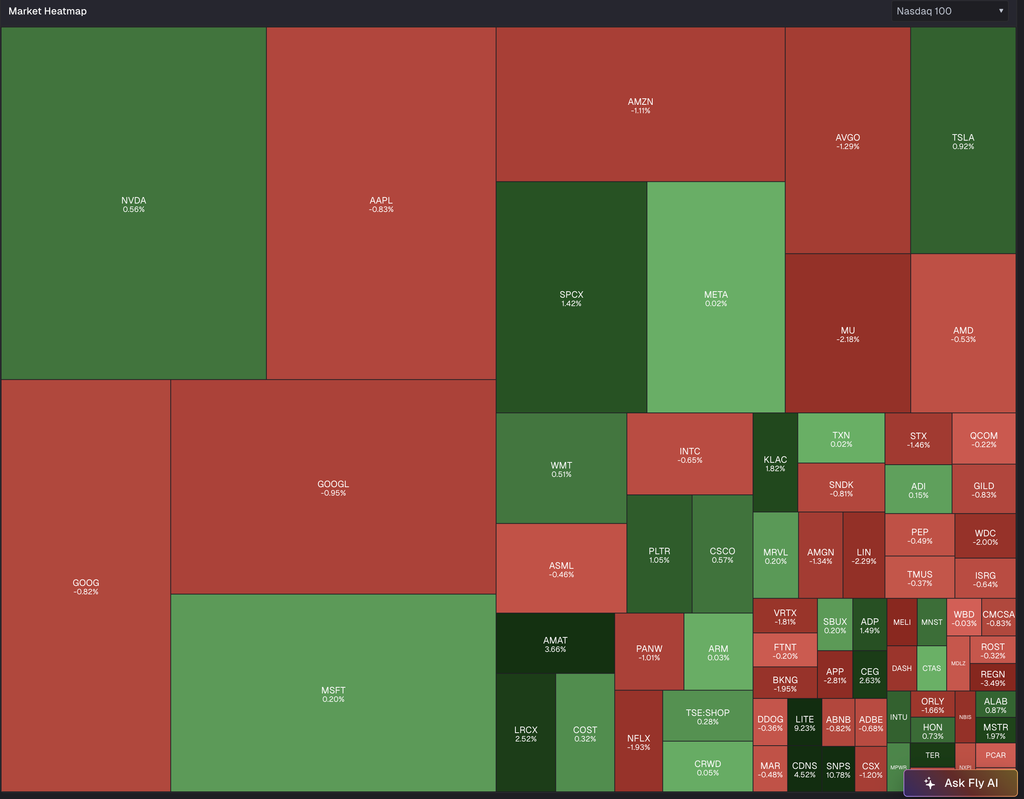
Heat Maps
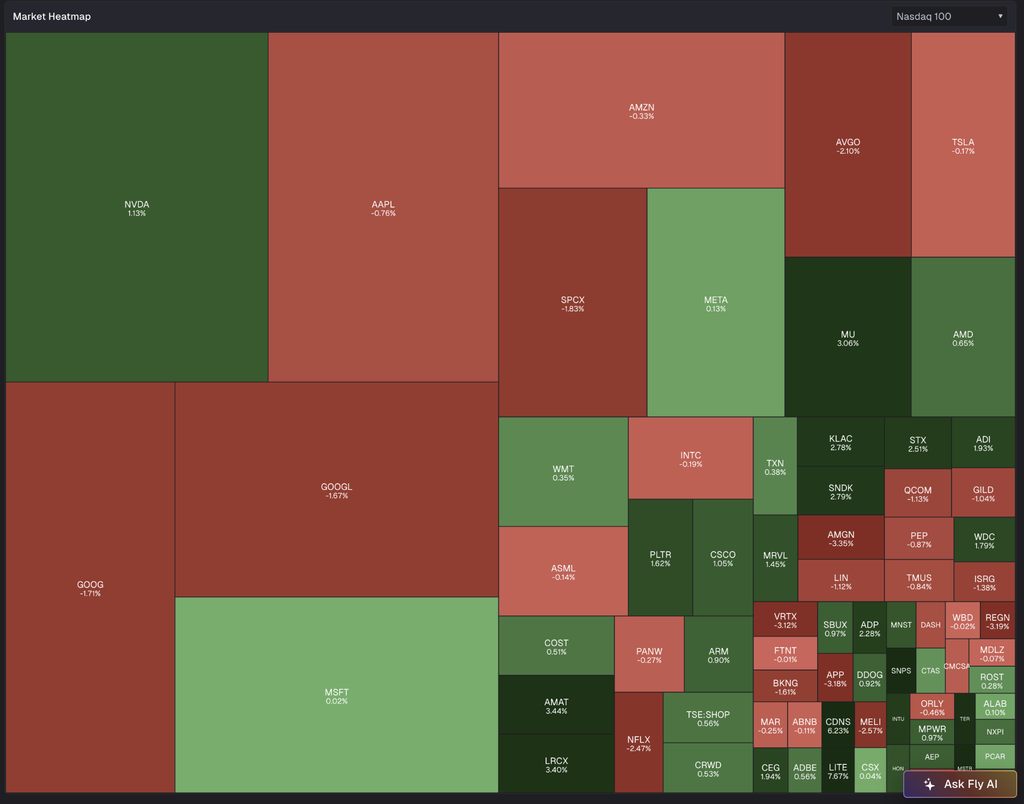
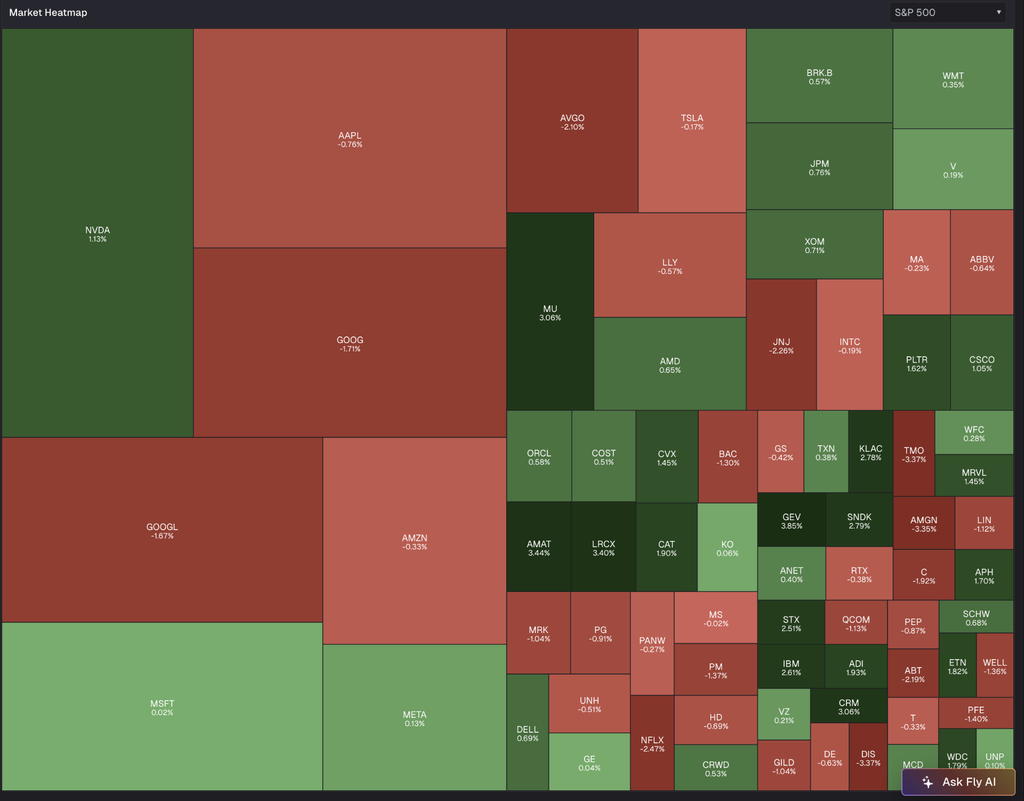
Position: None
BY Doug Kass · Oct 1, 2026, 4:30 PM EDT
Position: None
BY Doug Kass · Oct 1, 2026, 3:51 PM EDT
Position: None
BY Doug Kass · Oct 1, 2026, 3:45 PM EDT
Five years ago today I lost a friend and the investment community lost a legend.
Tobias was a righteous man who walked the walk and is sorely missed.
In markets like this, I/we sorely miss his commentary.
I wanted to remember Tuvia today by reposting a column I wrote about him in 2021:
Oct 04, 2021 ‘ 07:15 AM EDT DOUG KASS
“And it’s just a box of rain
I don’t know who put it there
Believe it if you need it
Or leave it if you dare
And it’s just a box of rain
Or a ribbon for your hair
Such a long long time to be gone
And a short time to be there…”
– Grateful Dead, Box of Rain
On Saturday morning I learned that Tobias Levkovich, Citigroup’s (C) Chief US Equity Strategist, my friend and my investment confidante over the last three decades passed away.
Tobias was walking to his synagogue when he was hit by an automobile on the morning of September 1 as he crossed a street in his hometown of Hewlett, Long Island. He had been hospitalized for a month before he passed away at the age of 60 years-old on Friday.
The investment community knew him as Tobias but his family, friends and Jewish community knew him as Tuvia, which in Hebrew means “god is good.”
To me, Tuvia combined the wisdom of a Byron Wien with the work ethic of a 25 year-old.
Tuvia was a special man.
Kind, humble and even tempered.
He had a sense of justice.
He sought out the good in people – and people like me sought out his advice.
He was fiercely committed and developed a personal connection with his friends, his fellow workers at Citigroup, his clients and to the many outside of the investment world.
He loved his family and community.
He was righteous, charitable and deeply religious.
He befriended everyone, the successful and the unsuccessful – it didn’t matter, and developed thousands of sincere personal connections within and outside of the investment community.
He realized we live in this world not for ourselves but for others.
To be with Tuvia was a delight.
He was smart – but more importantly, he had the wisdom of the Jewish patriarchs – Abraham, Isaac and Jacob.
He was so real in a world that can be very fake.
On numerous occasions Tobias invited me to play the role of the “bear” at fancy lunches in Citigroup’s executive dining room with his largest institutional clients, one of whom at every lunch would be the “bull”. It was the most fun, especially with Tobias moderating.
The last time I saw Tuvia in person was before COVID at lunch in Palm Beach two years ago. Here is a picture of that lunch with Tuvia, Lee Cooperman, Jeff Greene, Jack Ablin and Jerry Jordan.
And the last thing that Tobias did for me was, not surprisingly, a favor. I was doing work on AT&T (T) and, at my request he retrieved a newly minted AT&T purchase recommendation from his research department.
As an investment professional he was always prepared. His body of work was hard hitting, logical and thorough. He was not afraid, if justified analytically, to stand out in the crowd in terms of his market view.
The day of his accident, Tobias published his last equity note – maintaining a bearish stance on the market, with a 4000 S&P year-end price target. He wrote on that day:
“Caution that proves to be wrong can cost one a career… Nevertheless, we feel compelled to stand by our analytical process.”
The S&P Index had closed that day, on the month of August at 4524 and was to fall to 4307 during the month of September.
It was another one of what were hundreds of Tobias’ great calls over his career.
At the funeral on Sunday the Rabbi recalled Tuvia’s uniqueness in an anecdote about his last appearance on CNBC (you can watch it here) – which was the day before his car accident. In that CNBC interview Tobias appeared in his home office and behind him was a shofar. A shofar is made out of a ram’s horn and is used in Jewish religious festivities and services.
I was brought to tears because I spoke to Tobias right after that interview and I had noticed the shofar. In that phone call he told me, and the Rabbi passed on his similar discussion with him, that the placement was intentional. The shofar’s placement was a subliminal message – Tobias wanted it to inspire all the young Jewish professionals who had recently entered Wall Street.
I was brought to tears again when the Rabbi, at the end of the service quoted something that my Rabbi Martin Zion had previously quoted to me and his dear friends in a letter right before he died (See my column, “Keys To A Life Well Lived“):
“Who is wise? One who learns from every man … Who is strong? One who overpowers his inclinations … Who is rich? One who is satisfied with his lot … Who is honorable? One who honors his fellows.”
– Ben Zoma, Ethics of the Fathers
Both Tobias and Tuvia will be missed by anyone that has entered his sphere during a beautiful life of meaning and commitment.
Citigroup executive Levkovich dies a month after being hit by car | Reuters
Position: None
BY Doug Kass · Oct 1, 2026, 2:38 PM EDT
I am a big fan of Macke Truck (have been so for over two decades!):
Position: None
BY Doug Kass · Oct 1, 2026, 1:40 PM EDT
It’s been a slow day trading/investing as I have little conviction in here over the near term.
I added to GTBIF at $6.68.
Position: Long GTBIF (S)
BY Doug Kass · Oct 1, 2026, 1:29 PM EDT
* We have previously sold all four of these consumer-based stocks at much higher levels
* What to do now?
Walt Disney (DIS) continues to disappoint (-$3 today) — fundamentally and in the stock market. For the numerous reasons I have mentioned in the past, I would not own the stock until the low $90s.
Procter & Gamble (PG), Kimberly-Clark (KMB) and PepsiCo (PEP) are also stinking up the joint as suites of high-priced branded consumer products suffer from weakness in the low and middle classes.
Look for, as noted previously, PEP to likely miss this quarter. It will be interesting to see the market’s response.
It is probably the same for KMB and PG.
But all three of these companies (PEP, KMB, PG) may have discounted upcoming disappointments relative to consensus expectations.
I am ready to buy all three at some point…
Position: Long PEP (VS), PG (VS), KMB (VS)
BY Doug Kass · Oct 1, 2026, 12:10 PM EDT
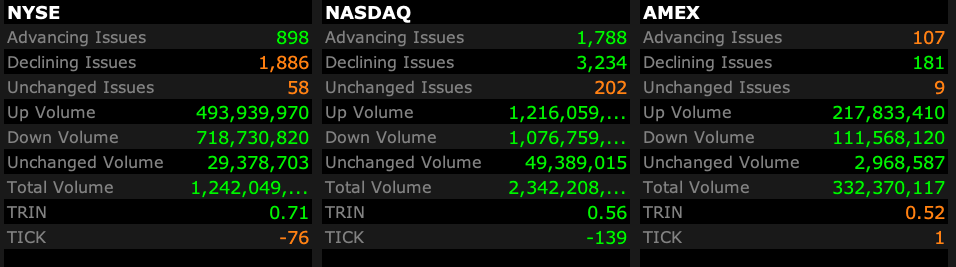
– NYSE volume 10% above its one-month average;
– Nasdaq volume 22% below its one-month average;
– VIX index: up 4.83% to 17.13
SOURCE: Interactive Brokers
S&P500 Indices
SOURCE: Barchart
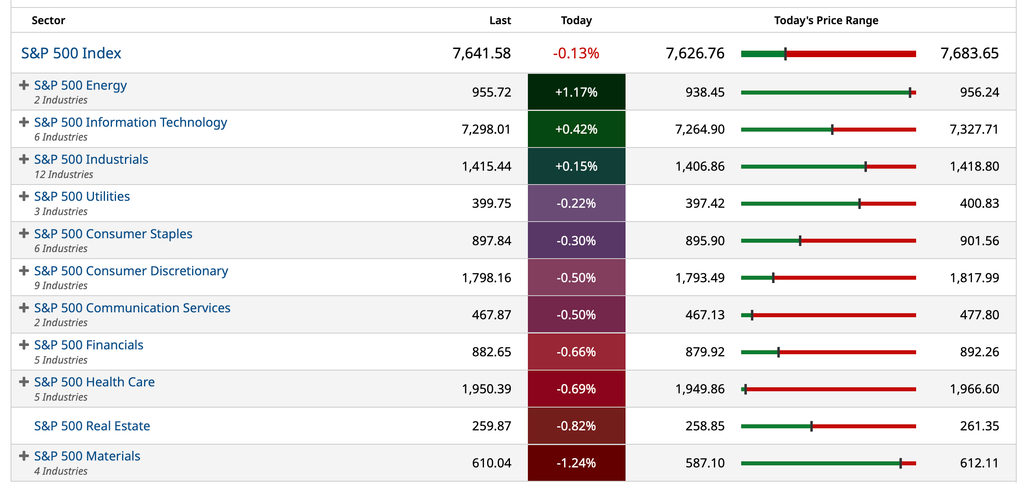
% GAINERS, DECLINERS
SOURCE: TheStreet Pro
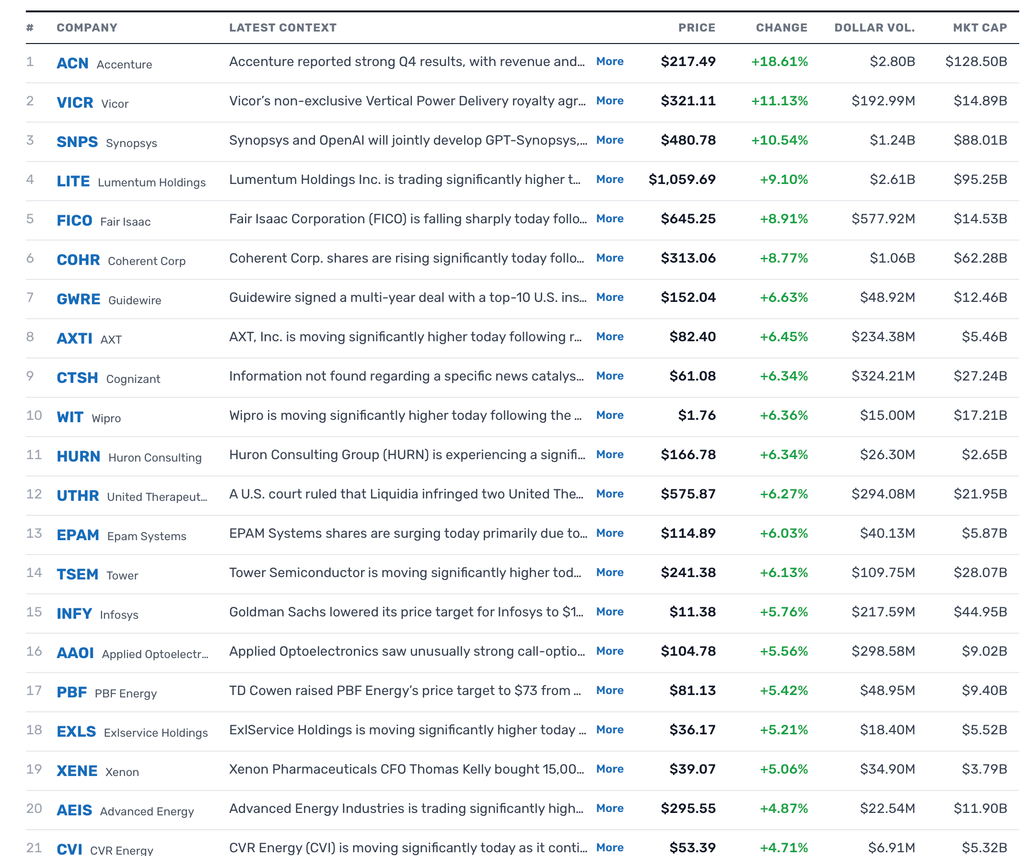
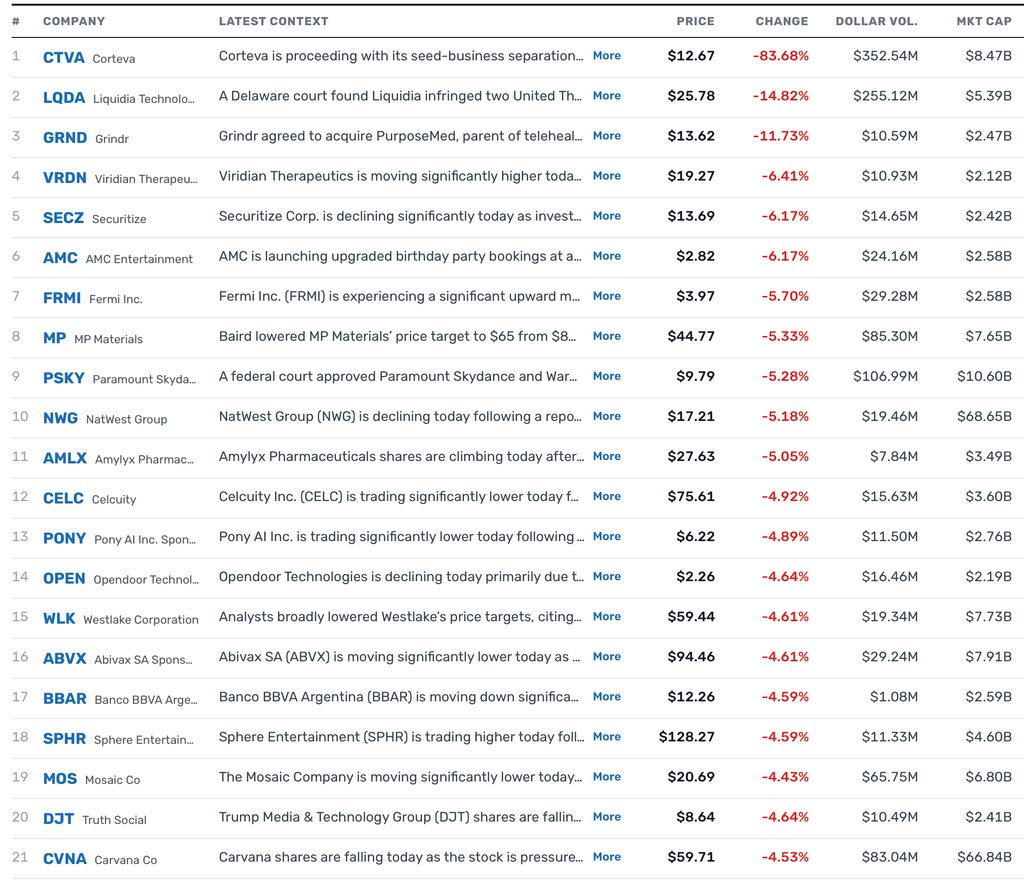
Nasdaq 100 and
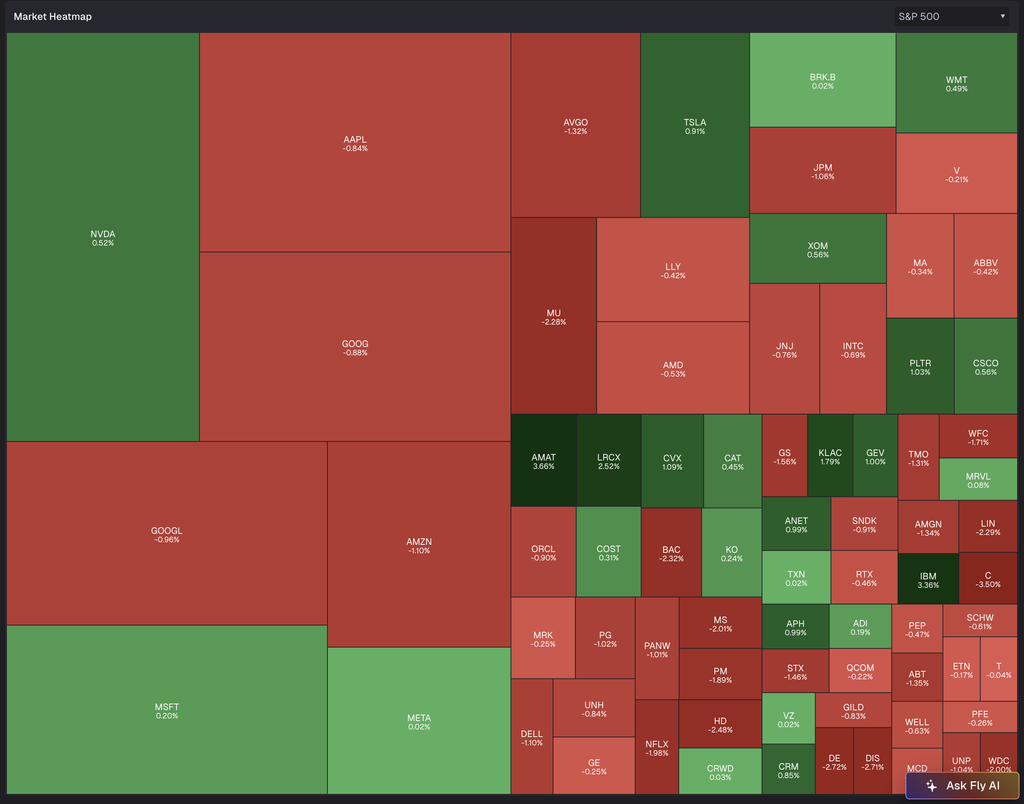
S&P500 Heat Maps
SOURCE TheFly
BY Doug Kass · Oct 1, 2026, 11:45 AM EDT
BY Doug Kass · Oct 1, 2026, 11:32 AM EDT
The following is from Peter Boockvar:
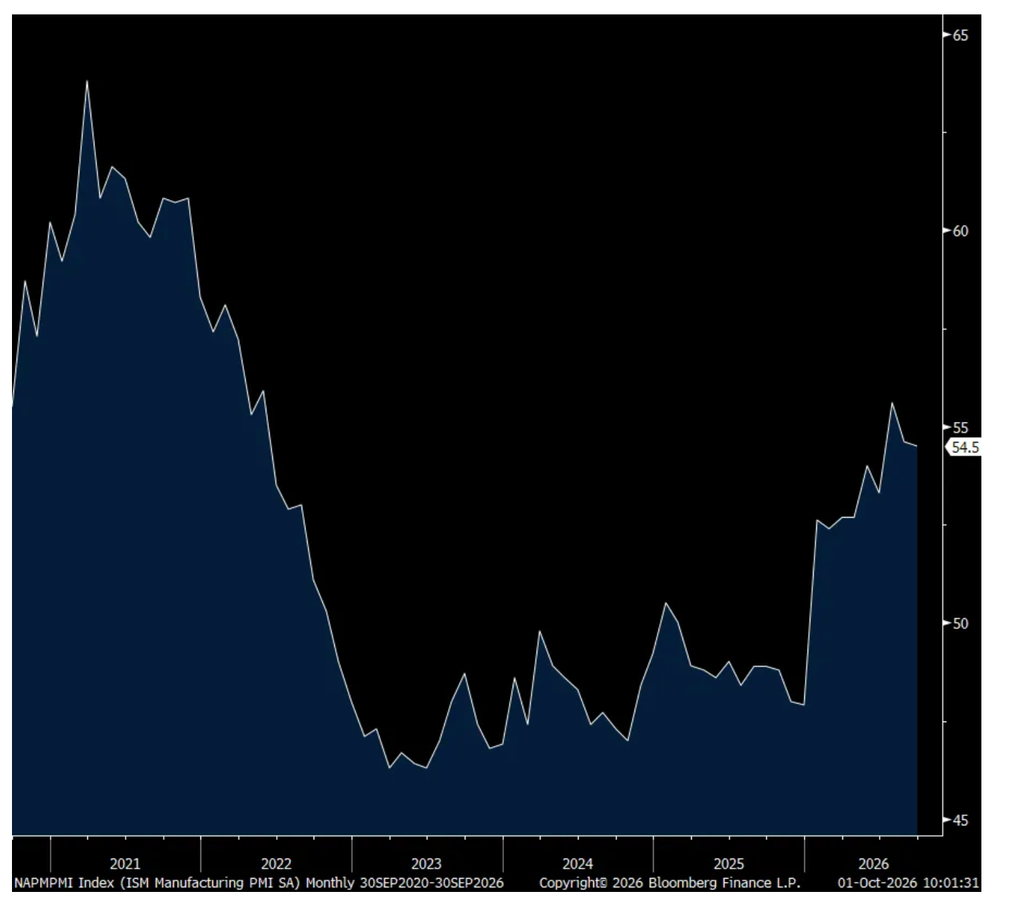
The September ISM manufacturing index was little changed at 54.5 vs 54.6 in August but holding well above 50 and reflecting the manufacturing recovery we’re witnessing after a tough previous three years.
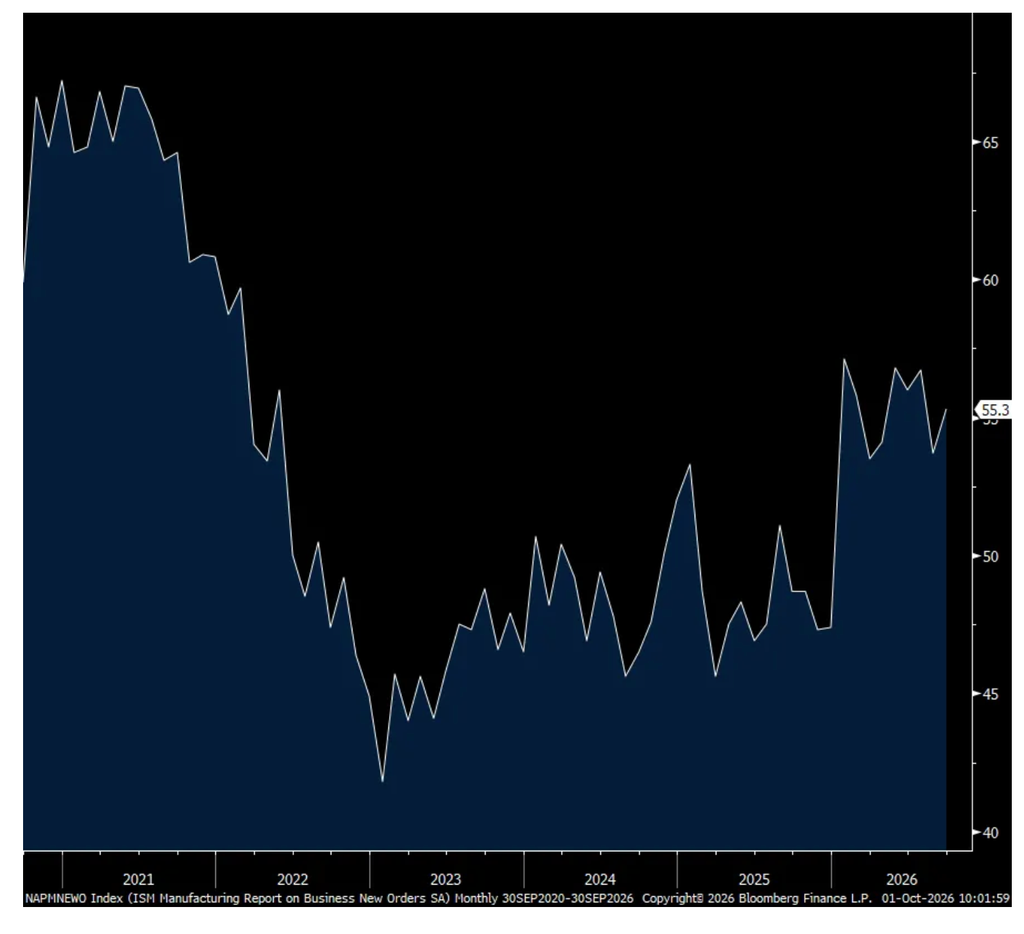
New orders rose 1.6 pts to 55.3 while backlogs were up by 4.6 pts to 56.4. Inventories dipped back below 50 at 48.6, lower by 2 pts as maybe some of the pull forward of orders we’ve seen beginning in March is beginning to moderate. Customer inventories remained lean at 41.6.
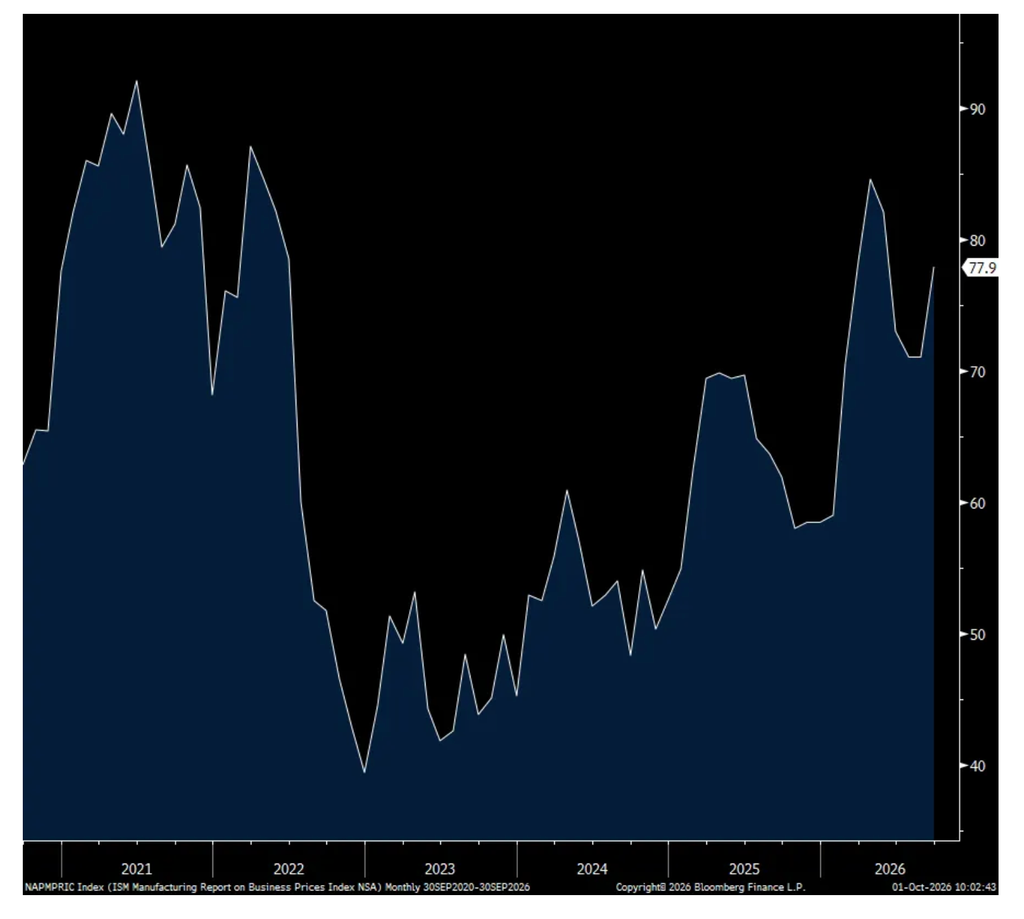
Supplier deliveries remain an issue with lengthening lead times as this figure sits at 59, well above 50. Part of this and also due to other things like higher energy prices, prices paid bounced by almost 7 pts to 77.9, a 4 month high. Of the 18 industries asked, 16 paid more.
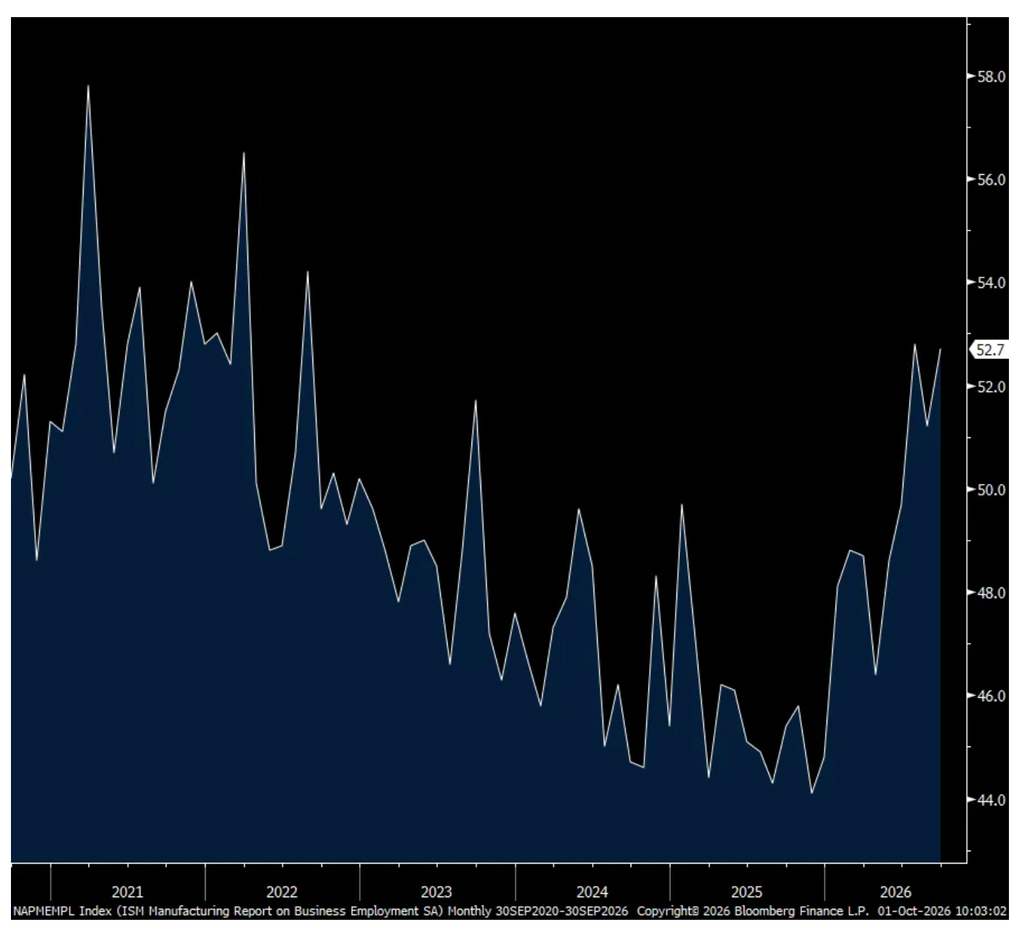
Employment was above 50 for a 3rd straight month at 52.7, 2.5 pts above the 6 month average but just 8 of the 18 industries surveyed added to payrolls with 6 seeing a decline.
Export orders slid by 2.3 pts to just above 50 at 50.9.
Notwithstanding the little change in the headline, industry breadth weakened a touch with 12 industries reporting growth vs 15 in August. Those seeing a contraction totaled two, the same last month with the balance seeing no growth.
Treasury yields are at the highs of the day, maybe in response to the prices paid component but also look at what’s going on now with 10 yr yields in France and Italy, up 7 bps and 9 bps respectively.
I’ll leave the bottom line to the respondent comments which reflect a wide range of opinions with where business is good and not so good and how some are dealing with supply chain disruptions, tariffs, and cost pressures.
· “Better performance was driven primarily by temporary market effects, including (1) geopolitical uncertainties, (2) customers bringing forward purchases, (3) delayed raw material price increases and (4) reduced competitor capacity. However, these factors do not signal sustained recovery: Structural challenges facing the chemical industry remain, including overcapacity, persistent pricing pressures and protectionist trade policies.” [Chemical Products]
· “Supply chain performance has improved compared to prior years, with lead times largely normalized. Cost pressures persist in select raw materials, transportation and labor categories, requiring continued focus on supplier management and cost control. We remain cautiously optimistic about business conditions over the next several quarters.” [Chemical Products]
· “The U.S. tariff schedule is providing challenges. Finding alternate sources of supply outside of China, local pushback on data centers in the U.S. and continuing material/component shortages are affecting business.” [Computer & Electronic Products]
· “Manufacturing activity remains stable, with a continued focus on cost optimization, supplier negotiations and supply base consolidation. We are actively evaluating alternative sources in several categories to improve supply resilience and reduce costs. While material availability has generally improved compared to prior periods, qualification requirements and supplier capacity constraints continue to influence sourcing decisions for certain critical materials and components. Capital and operational spending remain focused on productivity, efficiency and transformation initiatives.” [Computer & Electronic Products]
· “Orders have doubled yet again, and delivery times have also doubled, in the semiconductor, electronics and government sectors, with remaining sectors flat to down. Coupled with supply chain lead times and pricing pressures, the factory backlog has nearly doubled. Canada tariffs have impacted cross-border costs and left our supply chain team scrambling — those supply chains took years to develop and nurture — hurting the very lead times government buyers are concerned about.” [Machinery]
· “Order levels remain strong and elevated; we have orders through year-end at above forecast levels. Our biggest challenge continues to be a severe shortage of workers, limiting our production output to meet demand. The second challenge is general availability of steel; the market is getting worse, and more production delays are expected as we gap out of needed material.” [Fabricated Metal Products]
· “Raw metals continue to be challenging, especially with the uncertain nature of tariffs being on and off again. New tariffs against Canada have drastically increased costs for capital expenses as well as assemblies.” [Electrical Equipment, Appliances & Components]
· “Fuel costs are still affecting transportation costs and the overall cost of goods. Beef costs remain high, with no relief in sight.” [Food, Beverage & Tobacco Products]
· “Higher interest rates slow down the growth of new construction projects; we also have to face up to the higher cost of components from overseas due to tariffs and freight rates. Due to booming demand of AI and data centers, domestic steel capacity has been stretched and pushed. Higher steel costs each month increase our raw-material and finished-goods costs.” [Machinery]
· “Every month, we are faced with new headwinds created by this administration. This month, it is the trade war with Canada, which every day is getting worse — causing prices to go up and uncertainty that creates massive disruption. Buying continues to get pushed out indefinitely as customers don’t want to spend on capital expenditures until there is more certainty of costs and demand. The only thing that is predictable is the chaos that is created by these trade policies.” [Transportation Equipment]
ISM Mfr’g
New Orders
Prices Paid
Employment
BY Doug Kass · Oct 1, 2026, 11:15 AM EDT
The following is from Peter Boockvar:
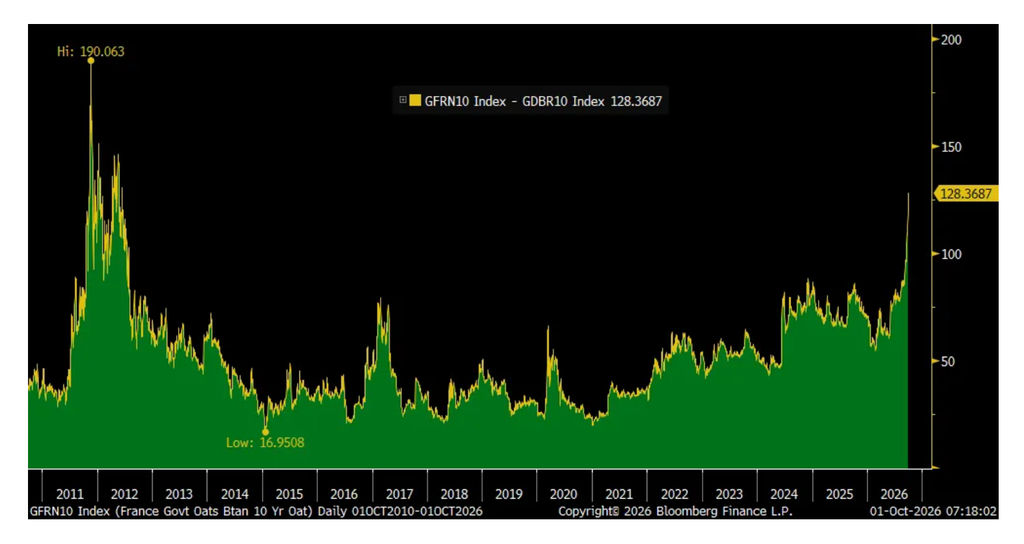
Yesterday was another example of why analyzing only US inflation and growth stats is not the only factor impacting US long term interest rates and a reminder AGAIN of how global this rate move is with a variety of influences. The French 10 yr yield yesterday closed at a 24 year high and is now nearing 5% at 4.85%. Its spread to German bund yields is at a 12 year high at 128 bps and you can be sure it is worries about French debts and deficits and not robust growth there.
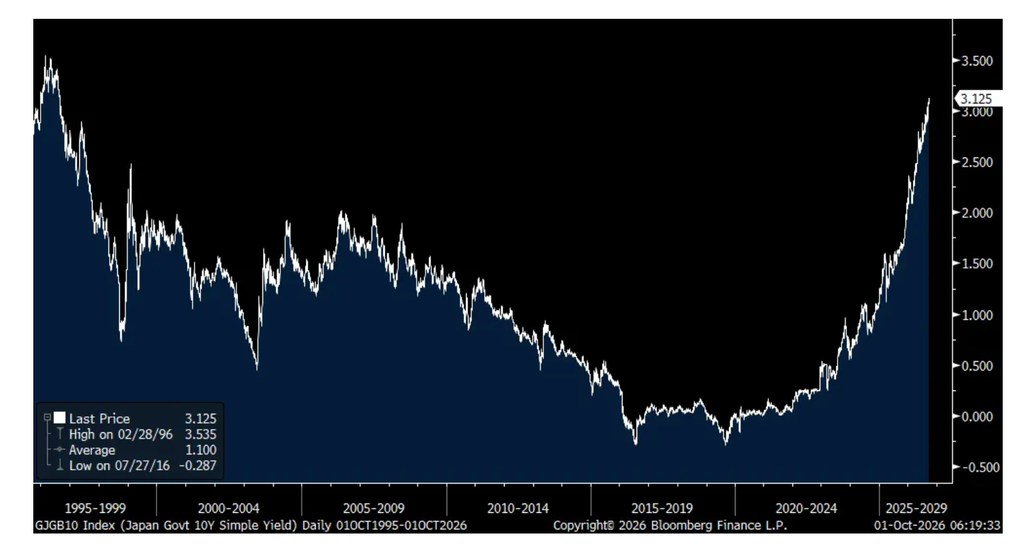
Also, the 10 yr JGB yield jumped another 6 bps to 3.13%, a fresh 30 yr high and it dragged yields across Asia higher. About ten years ago, on July 27th, 2016, that 10 yr JGB yield was -.29%, its ultimate bottom. I wonder who bought it on that day.
German Bund/French Oat 10 yr yield spread
10 yr JGB Yield
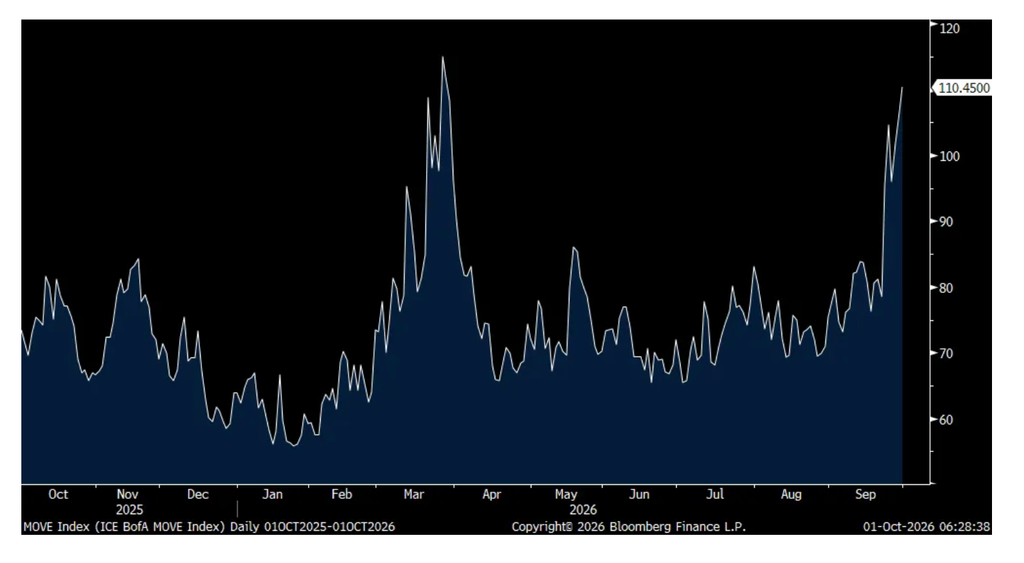
The MOVE index by the way, the VIX of Treasury bonds, closed yesterday at the highest since March.
MOVE index
At least from the perspective of ‘professional investors’, they got all giddy again over the past week on the stock market. II said Bulls jumped to 57.7 from 51.9 and that is back to being more than 40 pts above the Bears which sit at just 15.4, unchanged on the week. I’ve said many times that anything above 40 should be viewed as extreme. I do think the reason why is many of these newsletter writers are focused mostly on tech and the big indices while the individual investor is voting how they feel everyday, and for some, not that good. The AAII said bulls rose 1.9 pts w/o/w to 34.6, remaining well below Bears which stand at 46.5, down 1.6 pts w/o/w. The CNN Fear/Greed is still on the ‘fear’ side.
We know that the main drivers of US economic growth continues to be the data center buildout, upper income spend, and healthcare use. While Q2 GDP is old news with Q3 now over, I just wanted to highlight the contribution of each to that top line 2.2% growth rate. In that updated Q2 figure seen yesterday, spending on ‘software/R&D’ added 50 bps and almost a like amount from ‘info processing/industrial equipment.’ So, let’s call it about 100 bps from mostly data centers.
With the heavy influence of upper income spend (of course the GDP data doesn’t segment by income cohort), spending on vehicles, furniture and recreation (both durable goods and services) added about 95 bps of growth.
Lastly with healthcare, spending on its services contributed 79 bps to Q2 GDP growth. By the way, when Q2 data was first released on July 30th, the initial print was just 14 bps and highlighting how important healthcare spending is, with much via Medicare and Medicaid, to US GDP growth. We know too that this sector has been the leading contributor to job growth as well, again seen yesterday in the ADP data.
The Dallas Fed released its Q3 Oil and Gas survey and I just wanted to highlight a few things of note.
1)”Both oil and natural gas production rose in the third quarter, according to E&P executives. The oil production index increased from 15.0 in the second quarter to 20.7 in the third. Meanwhile, the natural gas production index climbed from 3.7 to 14.8.”
2)”Cost pressures remained elevated across the sector…All cost indexes were above their series averages, suggesting costs are growing at a faster-than-average pace.”
3)”Labor market indicators improved modestly in the third quarter. The aggregate employment index rose from 4.7 to 15.2, and the aggregate employee hours index increased from 11.8 to 20.0, both pointing to modest job growth and longer hours worked.”
4)”Supplier delivery times continued to lengthen.”
This one was interesting in response to the question, “Where do you primarily expect your firm to allocate this additional cash flow in the coming quarters?”
The answer, “Among large E&P firms, the majority of executives—50 percent—expect their firm to allocate additional cash flow (largely accumulated earlier in 2026) as capital return to shareholders and/or owners. Capital expenditures ranked second, selected by 21 percent of executives. By comparison, for small E&P firms, the top choice was capital expenditures, selected by 31 percent of executives, followed by debt reduction, cited by 23 percent of executives.”
So, at least for now, the large companies aren’t mainly interested in drilling more, reflecting continued financial discipline while the smaller ones want to take advantage of higher prices.
The main reason why it seems that the crude oil rig count overall is still well where it was a few years ago, I’ll take a quote from one of the respondents:
“Pricing volatility is near an all-time high given the backdrop of Iran. Swings of $5, $10 and $20 up or down are common. It is very challenging to select a planning price or budgeting price. Companies must look at the steep backwardation and budget off of a $65 per barrel or $70 per barrel price while operating expenses per barrel and finding and development pricing is increasing quickly.”
We remain positive and long the space.
To a few earnings calls of note.
From Conagra, a battered though very cheap stock we own:
“Consumers continue to be thoughtful about where they spend their dollars, and we’re managing through a volatile input cost environment.”
“Convenience store is an example that’s been a bit more pressured in recent months because of the gas prices. But overall, I would say the consumer has been relatively stable and resilient.”
“Price/mix contributed 130 bps to margin, with inflation-justified pricing actions more than offsetting incremental merchandising investments.”
“Inflation, inclusive of both core inflation and our tariff wrap, came in at roughly 5% in Q1. While still elevated, we saw favorability relative to our expectations primarily in proteins. However, we also saw an acceleration in fuel and logistics costs throughout the quarter, which we expect to further impact Q2 and the remainder of the year.”
Good but not good enough was the case for Jabil, the original equipment manufacturer for a variety of tech products as its stock fell 10% yesterday.
Their ‘Intelligent Infrastructure’ group saw revenue up 56% y/o/y and driven by “First, AI related demand remained very strong and continue to accelerate, exceeding the significant growth we had already incorporated in our June outlook. Second, capacity came online sooner than planned and customer ramps progressed better than anticipated, allowing us to support that higher level of demand.”
Industry wise outside of AI demand, “Automotive is benefiting from a more balanced technology mix. Defense and aerospace is gaining momentum as new programs move into production. Healthcare is expected to return to growth, while renewable and energy infrastructure is benefiting from improving market conditions and overall demand.”
With respect to memory and semi’s, “We’re seeing real constraints today. Memory in particular is being reallocated towards AI and hyperscale demand, tightening supply across many of the diversified end markets that we serve.”
Speaking of memory and earnings not good enough was Micron, up only slight pre-market on the heels of a big beat and raise.
“As strong as fiscal 2026 was, we expect fiscal 2027 to be even better. Industry demand has strengthened since our last earnings call, and we expect memory and storage supply-demand conditions to be much tighter in fiscal 2027 and 2028 than they were in 2026.”
“AI is becoming Super Intelligence, and memory enhances this intelligence and the competitiveness of our customers’ platforms. AI applications across end markets, whether using open-source or closed-source models, are run on a variety of competing customer platforms. These platforms all share one important characteristic: Their value proposition is enhanced by the performance and capacity of memory and storage. Running an AI application on a platform with greater memory capability enables more scalable growth in usage, improves the end-user experience and increases the value users get from AI applications.”
Regardless of all the great news for Micron, its stock peaked in June and I’d argue one reason is that shortly after, the Chinese competitor CXMT went public and questions arose about whether Micron can sustainably sustain its 87% gross margin.
These were the overseas manufacturing PMI’s out today ahead of the US ISM with most above 50:
Taiwan 56.7 vs 54.7
South Korea 53.9 vs 52.3
Vietnam 51.9 vs 53.3
India 55.1 vs 52.8
Japan 54.1 vs 54.9
Australia 49.6 vs 52
Thailand 54.3 vs 53.8
Malaysia 49.9 vs 50.2
Philippines 49.6 vs 54.9
Indonesia 52.4 vs 49.8
Eurozone 52.9 vs 52.7
UK 51.9 vs 51.7
BY Doug Kass · Oct 1, 2026, 10:30 AM EDT
My only trade today has been buying (speculative) cannabis GLAS at $5.14.
Positions: Long GLAS S
BY Doug Kass · Oct 1, 2026, 10:29 AM EDT
“Be greedy when others are fearful and be fearful when others are greedy.”
– Warren Buffett
* The cannabis industry has never been closer to rescheduling and resolving custodian and uplisting issues
* Perhaps the most positive and unnoticed variable has been the industry’s rescheduling of its debt (on excellent rate and duration terms) a few months ago
* Yesterday’s procedural court ruling (of a stay) caused a near panic in cannabis equities yesterday – nonetheless, a rescheduling is not likely to be materially impacted
* The confluence of the above (and positive) factors are creating an excellent entry point to invest in the space
* The retail investor cannabis base has been decimated by a series of regulatory disappointments over the last 5+ years – as without the prospects of institutional support a sustained rally has been problematic – however, for the reasons mentioned below (rescehduling, et al) I see institutional investors beginning to enter and support cannabis stocks over the balance of the year
I covered the mechanics of the stay decision on Tuesday and Wednesday:
* Spatafora on Cannabis Doug’s Daily Diary — Monday, September 21, 2026 | TheStreet Pro
* Claude on Cannabis Doug’s Daily Diary — Wednesday, September 30, 2026 | TheStreet Pro
* Cannabis News Doug’s Daily Diary — Tuesday, September 29, 2026 | TheStreet Pro
* Cannabis Thoughts Doug’s Daily Diary — Monday, September 21, 2026 | TheStreet ProHere is an excellent legal review of the stay from yesterday afternoon’s The Dales Report:
https://twitter.com/i/broadcasts/1MJgNbvMbjlGL
Here is an abridged version of Shadd and Anthony’s podcast:
And here is more from this morning:
I view yesterday’s news and market disruption as strictly procedural.
The severe share price reaction was a not an unexpected Pavlovian reaction — likely based on a history of news and share price disappointments (discussed below) and partially a function of the lack of liquidity in individual cannabis equities.
So, while rescheduling might be delayed somewhat, a unique opportunity to accumulate cannabis equities is emerging, which is exactly what I did yesterday.
After two false starts about 5-7 years ago in which I lost money, I had positioned my portfolio long cannabis stocks (on more, seven or eight, occasions) — buying on bad news and routinely selling on good news. This (short term and trading-like) positioning approach has yielded seven or eight consecutive wins.
The reason I consistently sold on strength (despite the vitriol on Twitter and criticism elsewhere) and not have elected to hold over the last five years or so is that I felt the retail investor base was not strong enough to sustain a rally in the cannabis sector.
All those sell decisions proved correct.
This was especially true about a year ago when the President issued Executive Order 14370 directing the Attorney General to expedite cannabis rescheduling on December 18,2025. (See: Federal Register: Increasing Medical Marijuana and Cannabidiol Research.) That day the stocks rallied (we immediately sold) and were hit hard, with most cannabis investors and traders stunned. Many still feel the pain, so skepticism and a Pavlovian reaction to the stay announcement was not surprising. (See: Federal Marijuana Rescheduling: Process and Impact | Moritz College of Law.)
This pattern of very brief strength in the cannabis space on good news – has left the retail investor base in cannabis with sizeable losses, little confidence and recency bias – so the durability of any advance (regardless of news) has become suspect and fragile.
But we think the industry conditions have improved markedly and the regulatory process of rescheduling of cannabis (despite yesterday’s sharp decline in cannabis shares) will be intact.
It remains my view that the decision yesterday was procedural and rescheduling (though slightly delayed) is my baseline expectation.
I am optimistic on the cannabis space because:
* I am extremely confident that rescheduling of both medical and adult use (recreational) will pass in the next few months.
* I am confident that uplistings will soon follow.
* More relaxed custodian rules allowing for institutional purchases of the group.
* The recent debt refinancings have eliminated the frightening debt maturity cliff that some feared.
* Industry fundamentals (volumes and pricing) have stabilized.
* Expectations are very low.
* Massive absolute and relative underperformance over the last five years has created a long runway for appreciation.
* Upside reward is probably more than 5x downside risk.
The announcement of the stay has created an exceptional entry point in cannabis as the industry and shareholders are better positioned than at any time in history.
Positions: Long MSOS common VL calls S TRLV S GTBIF S TSNDF VS CURLF VS VRNOF VS GLAS S
BY Doug Kass · Oct 1, 2026, 9:35 AM EDT
– MEDS +36% (preliminary September pharmacy revenue exceeded $1M, rising more than 66% from July)
– ACN +17% (Q4 beat with $22.2B of bookings and stronger operating margins)
– ABAT +13% (receives federal approval to export up to $100M of recycled black-mass material)
– QSI +13% (no clear fresh catalyst identified; unusually large move on heavy premarket volume)
– VICR +12% (raises Q3 sequential revenue-growth outlook to more than 30% from more than 20% on higher royalties)
– GLOB +11%, CTSH +7.5%, INFY +8.1%, EPAM +6.6% (IT-services names rise in read-through from ACN’s Q4 beat, strong bookings and margin performance)
– INSG +9.6% (completes fixed-wireless-access acquisition expected to roughly double revenue and expand its global footprint)
– IBM +5.7% (unveils a self-hosted enterprise AI model)
– NU +5.6% (rebounds after clarifying it is not pursuing the reported UK digital-bank acquisition)
– GLUE +4.8% (Phase 1 GFORCE-1 results showed normalization of key pathogenic drivers of cardiovascular disease)
– RKLB +4.3% (signs its largest commercial launch agreement, covering 20 missions and lifting total backlog above 100 launches)
– MKC +3.7% (Q3 profit and sales beat expectations as pricing offset softer volumes)
– SNPS +3.7% (signs a multiyear silicon-IP and engineering-software agreement valued above $1B)
– CEG +3.4% (signs a 20-year, 690-megawatt nuclear power agreement supporting more than $3B of infrastructure investment)
– TARA +3.3% (updated 12-month Phase 2 ADVANCED-2 data showed durable responses in BCG-naïve bladder-cancer patients)
– FHTX -43% (Phase 1 review leads to discontinuation of FHD-909 expansion and a related degrader program; workforce cut about 40%)
– ANGO -16% (no clear fresh catalyst identified; unusually large, high-volume premarket decline)
– LQDA -12% (federal court rules YUTREPIA infringed two pulmonary-hypertension patent claims)
– ZELA -12% (Phase 3 obesity trial met its endpoints, but weight-loss efficacy fell short of investor expectations)
– BGIN -10% (slides following first-half results)
– IVA -10% (extends weakness following unaudited first-half results and corporate update)
– FLOC -8.5% (no clear fresh catalyst identified; unusually large, liquid premarket decline)
– ENTX -6.4% (no clear fresh catalyst identified after healthcare and company-news checks)
BY Doug Kass · Oct 1, 2026, 9:15 AM EDT
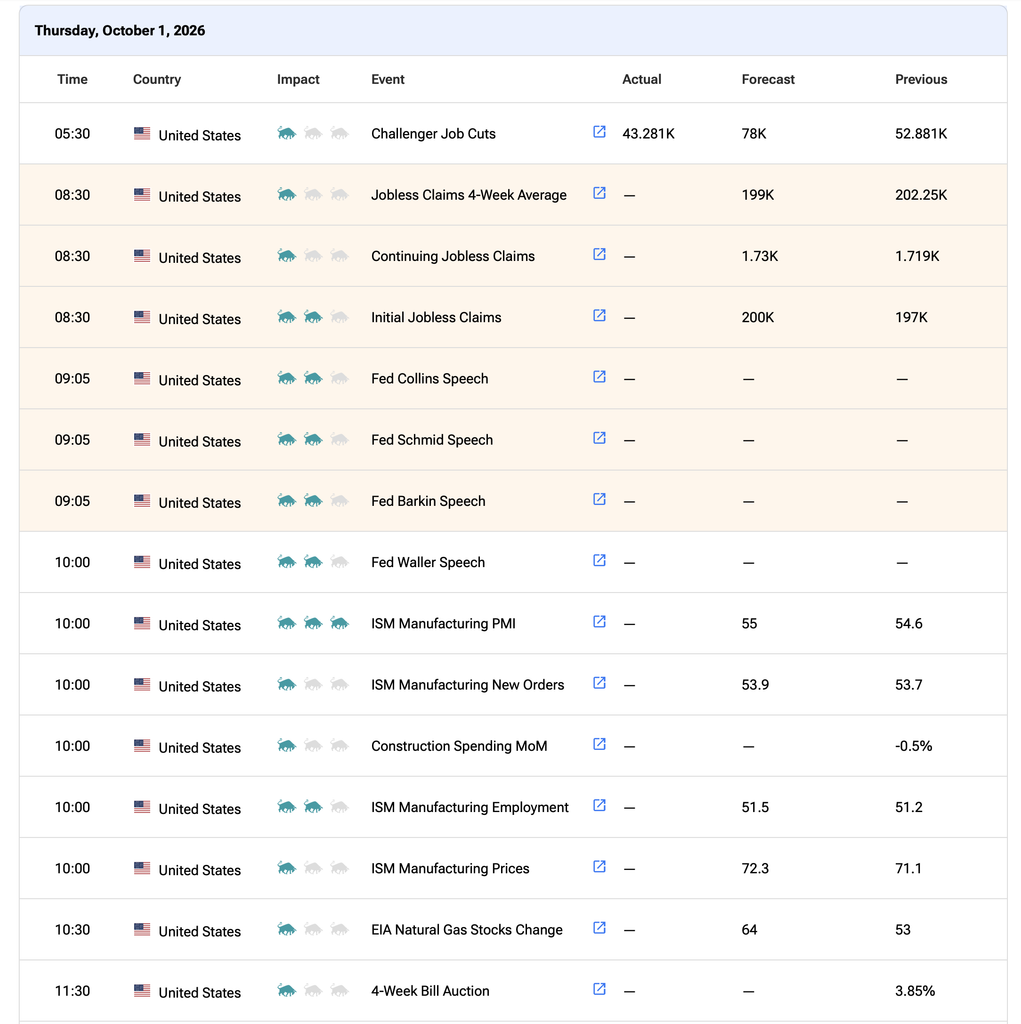
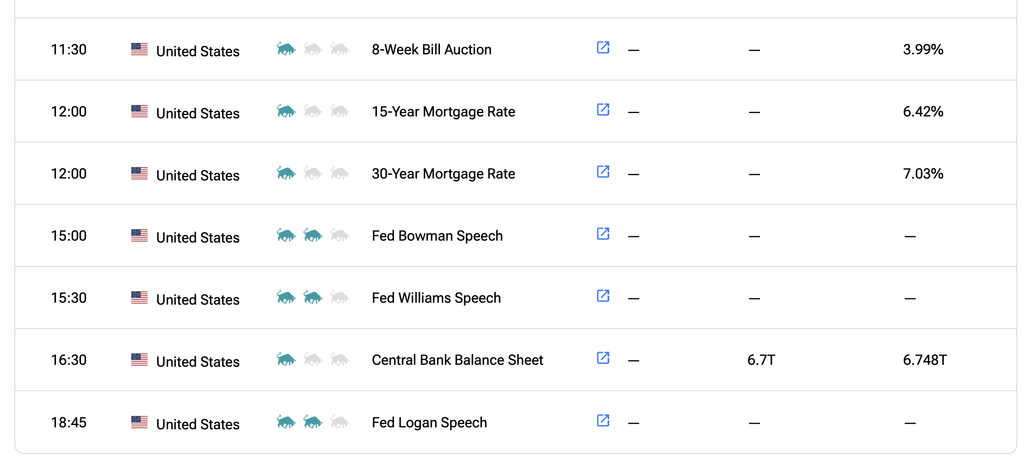
9:05 a.m.: Fed Bank of Richmond President Barkin (Non-Voter), Fed Bank of Kansas City President Schmid (Non-Voter) and Fed Bank of Boston President Collins (Non-Voter) participate in “Federal Reserve Perspectives: Regional Insights on Rural Economic Conditions” session before the “2026 Investing in Rural America Conference: The Strength of Rural Places,” hosted by the Federal Reserve Bank of Richmond in partnership with the Federal Reserve System and Rural LISC (Local Initiatives Support Corporation), Asheville, NC (Other details TBA).
10:00 a.m.: Fed Board Governor Waller (Voter) speaks on “Federal Reserve Economic Data”before event, “FRED Con: Navigating Trust, AI & Storytelling in a World of Data,” St. Louis, MO (Text available. Q&A from moderator. Livestream at https://www.youtube.com/live/1fK5omRbOvM?si=9mToIa7-cn6iDC9F);
1:30 p.m.: Fed Vice Chair Jefferson (Voter) speaks on the U.S. economy and monetary policy at the University of Virginia, Charlottesville, VA (Text available. Q&A from moderator. Livestream at https://darden-virginia.zoom.us/j/92232791521);
3:00 p.m.: Fed Vice Chair for Supervision Bowman (Voter) speaks on “Modernizing Financial Regulation: Initial Observations from eSLR” before the Atlantic Council, Washington, DC (Text available. Q&A from moderator and audience. Livestream at https://www.youtube.com/watch?v=UosIN7C-ZCE);
3:30 p.m.: Fed Bank of New York President Williams (Voter) moderates a discussion before a Central Banking Seminar organized by the Federal Reserve Bank of New York, NYC (Open to media via livestream);
6:45 p.m.: Fed Bank of Dallas President Logan (Voter) participates in moderated question-and-answer session before a Voice of the Eleventh District appreciation event, Dallas, TX (No text. No livestream. No Q&A)
BY Doug Kass · Oct 1, 2026, 8:54 AM EDT
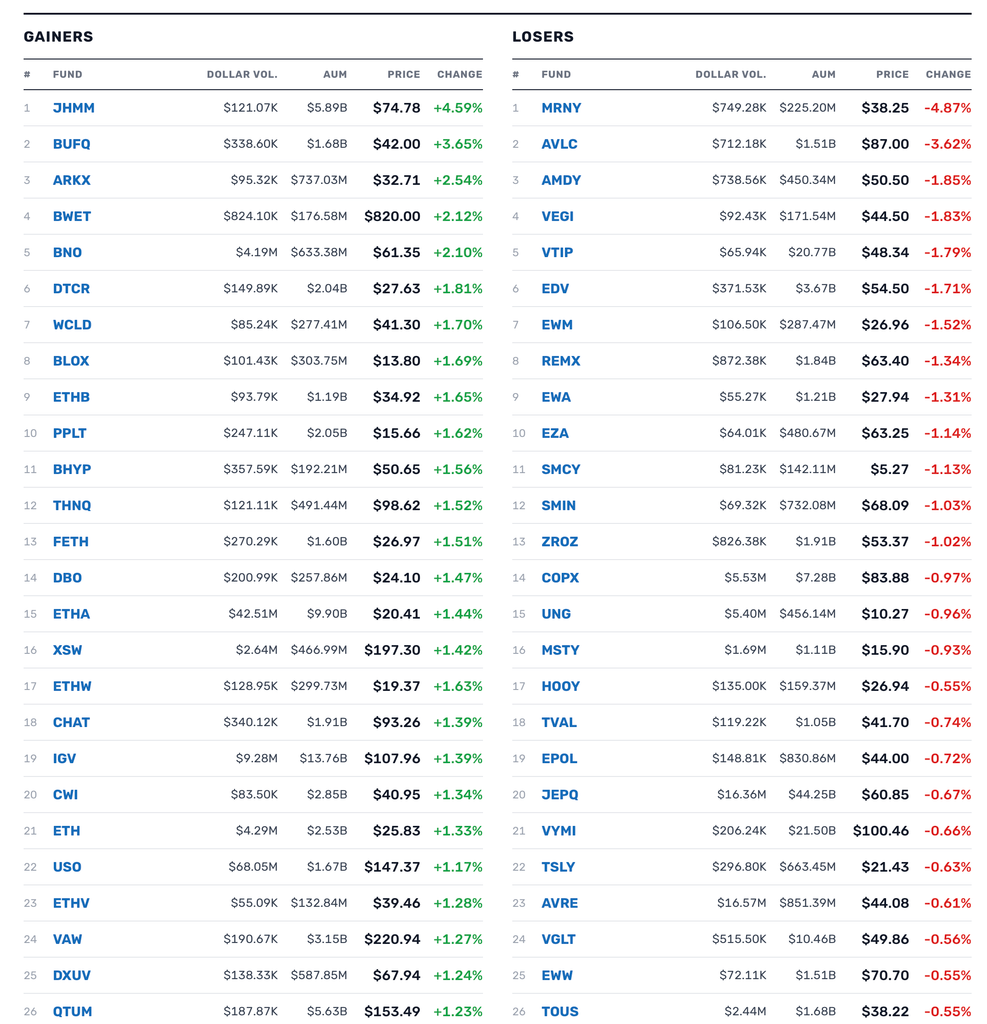
Source: TheStreet Pro
BY Doug Kass · Oct 1, 2026, 8:47 AM EDT
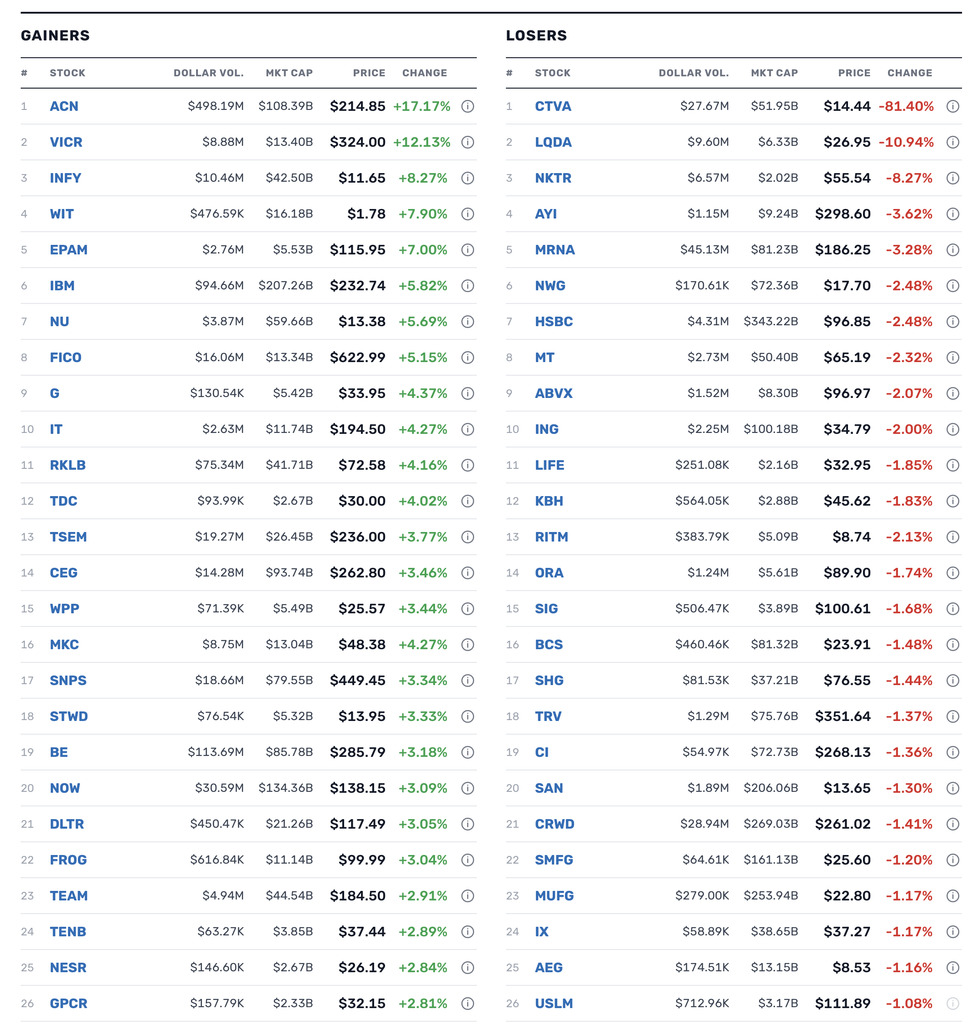
Source: TheStreet Pro
BY Doug Kass · Oct 1, 2026, 8:37 AM EDT
Positions: None
BY Doug Kass · Oct 1, 2026, 8:22 AM EDT
Well, I finally figured out how OpenAI keeps getting their valuation marked up. New top-secret Super Intelligent technology:
This is straight B.S. Let’s see if the IRS does something, or they just find it fruitful to pick on some guy that runs a gas station for not declaring cash purchases:
Position: None
BY Doug Kass · Oct 1, 2026, 7:20 AM EDT
Position: None
BY Doug Kass · Oct 1, 2026, 6:35 AM EDT
Position: None
BY Doug Kass · Oct 1, 2026, 6:20 AM EDT
Wolf Street howls about a domestic economy running hot.
Position: None
BY Doug Kass · Oct 1, 2026, 6:10 AM EDT
The S&P Oscillator remains oversold at -5.17% vs. -4.98%
I have no index positions on currently.
Position: None
BY Doug Kass · Oct 1, 2026, 5:59 AM EDT
Position: None
BY Doug Kass · Oct 1, 2026, 5:53 AM EDT
Nikes forward PE is now ~30x. The stock keeps getting more expensive as it falls. Sees $1.15 to 1.35. Street was at $1.72. Ugh. $NKE

French 10-year bond yields are the highest relative to similarly-dated German bunds since the European debt crisis 14 years ago. France's borrowing costs have risen above those of Italy and Greece, with the nation facing one of the biggest fiscal deficits in the EU.

In a few years the national debt will be $50 trillion. If by then we pay 8% interest, the annual bill will be $4 trillion, and annual budget deficits will likely be $6 trillion. How will we pay for that? Triple the income tax? Eliminate all entitlements and most federal programs?
Bond markets turns weird, and of course Jane is behind it all. First they mangled precious metals in Dec/Jan, now they are going after fixed income

BREAKING 🚨: Housing Market The largest mortgage lender in the United States, United Wholesale Mortgage, just fell to its lowest closing price in history after trading red for an 8th straight month, its longest losing streak ever! 📉 🏡

JUST IN 🚨: U.S. 30-Year Treasury Yield hits highest level since 2002 📈 📈

Seems easy enough
🦔Meta classified its AI data centers as "experimental pilot facilities" on its tax return. That let the Nvidia chips inside them qualify for the federal research tax credit. Meta's research credit savings went from $700 million in 2023 to $3.9 billion in 2025 and its federal tax Show more
⚖️ The Rescheduling Recommendation Was Almost Here. Then ALJ Julius Hit Pause Until 10/13 For six weeks the only thing left in the DEA's marijuana rescheduling hearing was the recommendation itself. Testimony wrapped in July, final briefs landed in August, and every trader in Show more


⚖️ "The hearing is not stayed. There is not a stay of the proceedings or of the rescheduling. What the ALJ did was just to pause the proceedings, which were unfolding on a timeline, and he did that on the opponent's motion to include in the record that GAO report. And the current Show more


