More Tales From Nvidia – Investors or Used Car Salesmen? (Issue #234!)
With regard to the latest Nvidia $500 billion collaboration, these serious executives sound like used car salespeople. This is just embarrassing (via ZeroHedge):
“Modern compute has emerged as a scarce, mission-critical asset class with compelling investment characteristics that is positioned to drive significant long-term economic growth and productivity gains,” said Apollo President Jim Zelter. “The combination of NVIDIA’s proprietary technology ecosystem and Apollo’s flexible, long-term capital base provides a strong foundation to support the next stage of the AI buildout as part of the broader Global Industrial Renaissance.”
“The AI buildout will require unprecedented investment and a skilled workforce to turn that investment into the infrastructure that will help power future growth,” said Larry Fink, Chairman and CEO of BlackRock. “This partnership deepens our relationship with NVIDIA, including through the AI Infrastructure Partnership, and brings together NVIDIA’s leadership in accelerated computing with BlackRock’s ability to connect long-term capital to essential infrastructure. Together, we can help deliver the compute capacity that companies need to grow and create more jobs, supporting the continued growth of the U.S. and global economies, while creating attractive, long-term investment opportunities for our clients.”
“NVIDIA has created extraordinary demand for its compute through an intense focus on customer value and versatile technology,” said Jon Gray, President and COO of Blackstone. “We continue to be enormous investors globally across the NVIDIA ecosystem, and this announcement further underscores our confidence in their platform and the future of AI infrastructure.”
“As our strategic partner, NVIDIA is enabling us to scale AI factories. We are excited about further collaboration to build and fund the backbone of AI globally,” said Bruce Flatt, CEO of Brookfield. “With demand for large-scale AI compute growing significantly as adoption scales across industries, compute is fast becoming the essential layer of infrastructure and a core pillar of the Brookfield AI infrastructure strategy.”
“We’re in a pivotal moment of a historic AI investment cycle. NVIDIA’s full-stack platform is in high demand and uniquely positioned at the center of that global buildout,” said David Solomon, Chairman and CEO of Goldman Sachs. “Our investment and distribution roles reflect our confidence in NVIDIA’s leadership, and we’re excited for the new opportunity to create a market for credit backed by NVIDIA compute.”
“Compute has become a critical infrastructure asset. As we’ve scaled our approach to digital infrastructure, we’ve learned that delivery, not ambition, is the hard part. That’s why we’re excited to build on our strategic partnership with NVIDIA, a founding investor in Helix Digital Infrastructure, to bring together NVIDIA’s accelerated computing platform with KKR’s long-duration capital, infrastructure expertise and capital markets capabilities to turn growing demand into real capacity at extraordinary scale,” said Joe Bae and Scott Nuttall, Co-Chief Executive Officers of KKR.
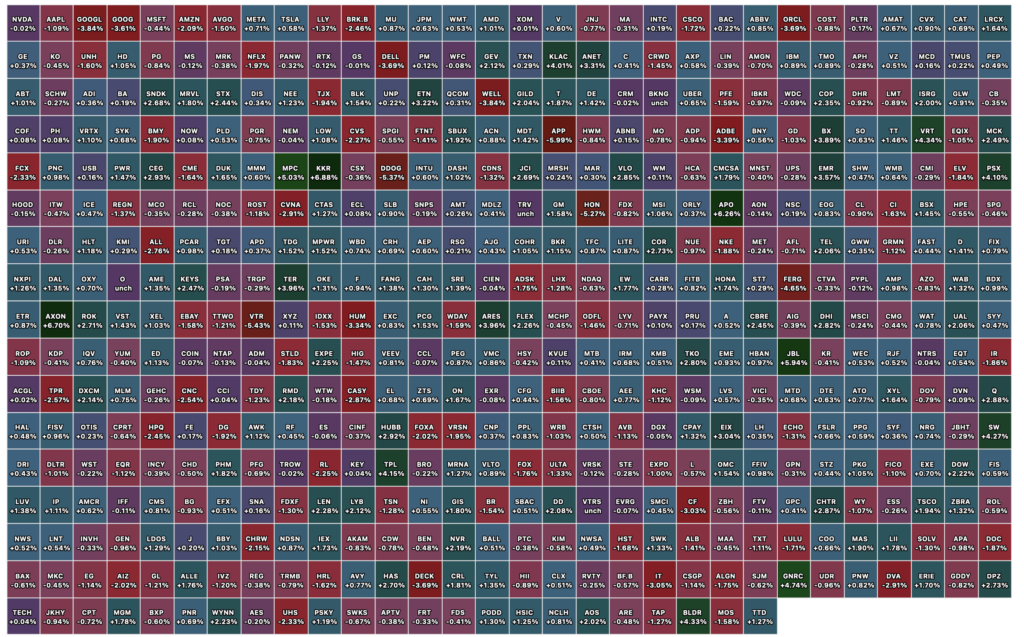
Our newest short Berkshire Hathaway (BRK.B) is -$8/share today (FINTV was so excited about the stock yesterday).
From Monday:
Sorry, Warren (errr Greg)
Following a large run in the shares and this weekend’s announcements, I have initiated a short in Berkshire (BRK.B ) $532.63 this morning on the gap higher.
Soapbox warning. As a retired CPA who performed many accounting fraud investigations and led the group at a Big 4 that counseled auditors on how to detect financial statement fraud, I find myself damn near apoplectic at the current state of accounting in AI related names. The only thing worse than breaking the rules is nominally following the rules while achieving the same ends as breaking them. If Enron should have taught us anything, it is look at the substance over the form.
Alas, that takes auditors with significant understanding of finance and not those simply equipped with a flowchart of arbitrary rules. You also have to have an auditor with a spine who will stand up and say, “I know this technically meets the stated criteria, but it violates the spirit of the guidance.” Taking such a stand will likely cost you a client and audit firms from the Big 6 are suffering financially, so they don’t have the backbone.
This deal is stargate 2, another $500bn “announcement” that never really happened. Dunno why I’m surprised people fall for this every time lol. Blackstone and blackrock especially are already in a bunch of DC deals. They’ll just claim every one they do now is part of this https://t.co/ccTKHqBdsz
* The temptation is to discard textbook theory in favor of the assessment of the cold, automated factors that are driving our markets is intense
* Though frustrated and incorporating some fractal analysis into my investing process, I am resisting the temptation to be totally absorbed (corrupted?) by changing market structure …
“To survive in this ecosystem, an investor must look past the flashy, empty marketing headlines and the short-term algorithmic wiggles. Success requires standing shoulder-to-shoulder with the structural mechanics of the tape — understanding that when the technical and options springs are stretched to their absolute physical limits against an institutional ceiling, fundamental gravity and options expiration math will always look to claim their due.”
– Nina Rosella Strange
In the good old days the core purpose and foundation of our markets was for capital to be allocated based on the calculus of fundamental values.
Companies were evaluated by fundamental research, which included (but not restricted to) the relationship to tangible and intrinsic values, an assessment of balance sheets and present value was based on valuation models. Interest rates were at the core of this calculus, using a risk-free rate of return in model building.
Portfolio selection was also based on the quaint notion that managements should be visited and assessed, competition reviewed so investors could determine whether secular earnings expectations would exceed of disappoint relative to consensus expectations.
The analytical process was plodding — slow money vs. fast money, if you will!
This process no longer exists.
Instead (as I recently noted in “An Adverse Market (Structure) Event is Growing More Likely,” traditional and fundamental analysis has been replaced by what can only be described as an algorithmic battle gound and hyper-financialized casino (all engineered to extract premium), as active investment management is now dominated by passive investment management (that worships at the altar of price, knowing little about value and everything about momentum).
This helps to explain why rising interest rates (a 4.73% ten year Treasury note) and oil prices, persistent inflation, improvisational and undisciplined foreign and fiscal policy and an equity risk DISCOUNT are increasingly being ignored. (Again this morning the price of crude oil and bond yields are higher, yet stock futures are advancing modestly.)
Nina Rosella Strange (quoted earlier) elegantly describes the structural changes and challenges that “investors” face today. Strange writes:
1. The High-Frequency Mirage and the Passive ETF Loop
The primary engine behind today’s erratic, valuation-defying price action is the symbiotic relationship between High-Frequency Trading (HFT) algorithms and Passive Basket ETFs.
When a major macroeconomic data point crosses the terminal wires—such as a contractionary labor report or an inflation print—human traders attempt to digest the long-term systemic implications. HFT bots, however, operate on tunnel vision. They are pre-programmed to scrape headlines for specific trigger words and instantly execute massive buy or sell scripts within milliseconds based on a rigid, binary logic (e.g., “Soft data equals guaranteed central bank liquidity injections”).
This initial algorithmic impulse triggers the passive basket ETF loop. Trillions of dollars are parked in automated index funds that must maintain strict, weight-adjusted allocations. When the HFT bots jam index futures higher, these passive ETFs are structurally forced to blindly market-buy every single underlying stock in their basket.
Valuation metrics, credit default risks, and balance-sheet cracks are completely ignored. The result is a vertical rocket ship move built on “phantom liquidity”—a superficial pump that creates an optical illusion of market strength while the underlying economic foundation is actively skyrocketing or fracturing underneath the surface.
2. The Options Casino: Gamma Squeezes and Dealer Hedges
Once the HFT machines set the momentum in motion, the modern market’s most manipulative force takes over: The Options Market Maker Hedging Loop.
Retail trading platforms have effectively gamified options trading, turning complex derivative instruments into cheap casino chips. When a wave of momentum buyers floods an asset, aggressively purchasing out-of-the-money call options, they unwittingly trigger a violent, mechanical feedback loop known as a Gamma Squeeze.
Options market makers (the massive institutional desks writing these contracts) are risk-neutral operators. They do not want to bet on whether a stock goes up or down; they simply want to collect premium cash. However, when an asset begins rising toward a heavily crowded options strike, the Delta (the probability of that option expiring in-the-money) violently explodes toward 1.00.
To maintain delta neutrality and protect their balance sheets from astronomical upside risk, the market makers’ automated software is legally and structurally forced to blindly and aggressively market-buy millions of shares of the underlying equity.
The computers don’t care that the stock is fundamentally overvalued. This forced institutional buying hits a thin after-hours or early-morning order book, creating a supply vacuum that vacuums the price upward in a series of long, violent green candles. It is an option-fueled illusion designed to optimize dealer delta profiles and trap late-day breakout chasers right beneath a major institutional ceiling.
3. The Institutional Pushback: Breaking the Machine
The natural frustration for traditional investors is watching bad economic data twisted into a “liquidity party,” while asset prices flatline or surge on completely hollow structures. But the smart money—sophisticated macro hedge funds and risk officers—does not fight the HFT bots head-on. They exploit the structural blind spots of the machine to systematically extract wealth from the crowd.
The institutional pushback occurs through a calculated, two-stage operational playbook:
The Midday Premium Bleed
During the high-volume environment of the morning session, market makers keep their bid-depth dense to absorb the order flow. But as the session marches into the midday lunch hour, aggregate volume naturally thins out.
Rather than chasing the HFT momentum, institutional desks utilize this quiet block to completely flatline the asset. They construct a tight horizontal trading band, letting the clock do the heavy lifting. This allows Theta (time decay) to ruthlessly strip the remaining cash value out of the expiring, overvalued options, turning the retail crowd’s leverage into dust by the minute.
The Power Hour Trapdoor
The true structural reversal triggers when the market crosses into the late-afternoon clearing window heading toward a weekly expiration. By this point, the out-of-the-money options have seen their premium values completely decimated.
The market makers’ automated risk parameters run their end-of-day calculations and realize the probability of those options expiring in-the-money is near zero. Suddenly, the regulatory and capital mandate to hold those millions of shares of underlying stock hedges completely vanishes.
The computers turn off their artificial buy programs and instantly unleash a cascading wave of automated, de-hedging market-sell orders to dump their excess share inventory back into the public float simultaneously. Because the broader economy is facing structural cracks, there is no organic institutional cash buying resting on the floor to absorb that sudden supply shock. The bids are stripped from the Level 2 ladder, the trapdoor slams shut, and the asset suffers a severe, vertical mean-reversion flush to catch up with macroeconomic reality.
The New Market Paradigm
The modern stock market is no longer a pristine measurement of corporate health or a passive vehicle for long-term capital compounding. It is a highly sophisticated, electronic wealth-extraction matrix dominated by algorithmic delta-hedging, passive index inelasticity, and behavioral manipulation.
A Consolidation of the Cannabis Industry Is Likely in the Months Ahead
* Rescheduling is happening, hemp might be going away, the illicit market is finally going to be addressed, cannabis pricing is likely to rise, credit cards are being introduced and synergistic industry mergers lie ahead (we expect VRNO to be one of the first to be acquired)
* Buying cannabis stocks today is getting ahead of these and other favorable factors and developments
* By accumulating cannabis stocks today we are getting in front of institutional capital, which is going to come into the sector…
In that column I highlighted the case for industry takeovers and consolidation:
* The equity capitalization of the five largest cannabis players only totals about $5.5 billion!
* I expect industry consolidation over the balance of the year and it is not out of the realm of possibility that tobacco or consumer packaged goods companies try to get a toehold in the cannabis sector through the takeover of several of the top-five individual cannabis companies.
After the close, my friend Shadd Dales of The Dales Report hosted Curaleaf’s (CURLF) CEO Boris Jordan, who made a very strong case that we will see a swift consolidation and robust merger activity in the cannabis industry (upon rescheduling and the determination and (FinCen) guidance for some retroactive relief of U.S. uncertain tax positions (UTP)/liabilities): (starting at the 26 minute mark)
“M and A is definitely happening. Our job is to make our companies the best in the industry but there is no question that this industry is primed for consolidation. It’s going to happen, 100%. The benefits of the merger of two big MSOS – $150 million to $200 million of free cash flow drops to the bottom line after eighteen months. This industry makes no sense in having so many participants and existing in its current form. Already, all of our growth facilities are full (we are at 110% of growth capacity) and we are getting more efficient (we used to grow 50 grams/sq feet and we are now at 150 grams/sq feet) – double the efficiency of two years ago. We don’t have enough capacity. By bringing two companies together (instead of building another $100 million grow) is good for pricing… it’s the right thing for the industry. It’s a 2027 issue and it will happen quickly.
I have already approached top MSOSs for deals.Curaleaf would be better off being twice the size of its current state…
The tobacco companies need the cannabis companies, it’s a similar business (Altria and Philip Morris are already in the business. Japan Tobacco is looking around. Strategics will be buying. What will happen is that in the U.S is that we will ultimately have two or three major players.”
– Boris Jordan, Curaleaf CEO
Parenthetically I expect one of our largest individual positions (Verano Holdings (VRNO) to be one of the first large MSOSs to be acquired.
Post Script
Back to fundamentals. I highlighted that an important investing case was that cannabis fundamentals are stabilizing and beginning to improve, which we clearly saw in yesterday’s release of Curaleaf’s second-quarter report.
This proposed deal is likely the tip of the iceberg…. takeover activity has just started. I expect cannabis equities to respond positvely to today’s development.
At 7:45 a.m. this morning, Intel Corp. (Nasdaq: INTC) announced a $15 billion common stock offering. This afternoon, the Financial Times is reporting that Nvidia will raise an incredible $500 billion in debt with funding from…
Is this circular financing? No! It’s just us helping our partners raise billions in debt and us backstopping 25% of the deal for customers so then they can then buy our GPUs. If anything it’s spherical https://t.co/gPVrbulLRhpic.twitter.com/b2K2e3BBGc
— Ed Zitron (@edzitron)
Wow, $500 billion sure is a lot! Except it's not actually $500 billion, it's (theoretically) several smaller deals…
Wow, $500 billion sure is a lot! Except it's not actually $500 billion, it's (theoretically) several smaller deals...
...and it's a memorandum of understanding! It's a god damn MOU! That is not a deal!Show more
Negligible Capital
@negligible_cap
*WALL STREET GIANTS PARTNER W/ NVIDIA ON $500B AI FINANCING: FT
Financing deal could be announced as soon as today for $NVDA. Firms include $APO, $BX and $BLK. Pretty sizeable deal
The Death Scramble for Capital A.I. Has Begun. 👇
At 7:45 a.m. this morning, Intel Corp. (Nasdaq: INTC) announced a $15 billion common stock offering.
This afternoon, the Financial Times is reporting that Nvidia will raise an incredible $500 billion in debt with funding fromShow more
Is this circular financing? No! It’s just us helping our partners raise billions in debt and us backstopping 25% of the deal for customers so then they can then buy our GPUs. If anything it’s spherical
This deal is stargate 2, another $500bn “announcement” that never really happened. Dunno why I’m surprised people fall for this every time lol. Blackstone and blackrock especially are already in a bunch of DC deals. They’ll just claim every one they do now is part of this
Ed Zitron
@edzitron
Is this circular financing? No! It’s just us helping our partners raise billions in debt and us backstopping 25% of the deal for customers so then they can then buy our GPUs. If anything it’s spherical
It’s still crazy to me that they went on tv and did a whole media circuit about this and it just didn’t happen
Negligible Capital
@negligible_cap
ANTHROPIC IS MEETING WITH POTENTIAL INVESTORS TO SHORE UP CONFIDENCE AHEAD OF IPO THAT COULD LAUNCH IN SEPTEMBER OR EARLY OCTOBER - WSJ
Telling investors not to worry is often a great way to make them worry
Gonna guess that nobody at any point during this mentioned that it’s a memorandum of understanding, just like when they had Jensen on to talk about its $100 billion deal with OpenAI that never happened
cnbc.com/video/2025/09/…
 Doug Kass