Boockvar on Why CoreWeave Matters, Treasuries, Earnings
The following is from Peter Boockvar:
Why this really matters, I think
The reason why the fate of CoreWeave matters so much and also the cancellation of the IPO’s of Firmus, AirTrunk and now maybe Nscale is because the building of these data centers we know is so impactful to the entire AI supply chain, everything from semis, servers, transformers, electrical equipment, HVAC, steel, cement, aluminum, etc… that is flowing into creating and equipping these buildings. We also know all the power and electrical grid contributions to reliably plug these buildings in has also benefited tremendously from the building. Any slowing in the pace of data center construction, slows down the business of everyone feeding into it.
There will still be a robust pace of AI data center construction and spend in the coming year but what moves stock prices is rate of change so I highly recommend watching that over the coming quarters rather than the absolute pace of CapEx.
Bottom line, the growing financing costs and ever growing need for capital to pay for this massive buildout now puts into question the speed of the construction and what does that mean for the ultimate quality and capabilities of the models being created for US producers relative to their Chinese competitors.
The political, economic and social mess that is now France with the disturbing and despicable rioting, violence and destruction of property and business is why the CAC is down 1.4% today, the French 10 yr oat yield is higher by 9 bps to 4.90% and the euro is weaker vs the US dollar.
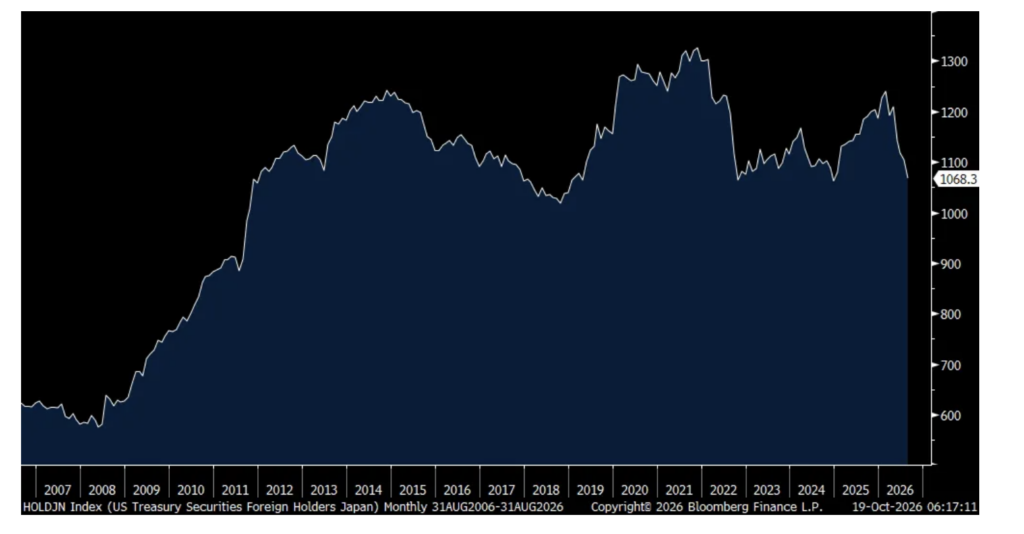
Understanding that some of this is due to the decline in the value of the holdings, as seen in the August TIC data, China and Japan continue to pare down their holdings of US Treasuries. Japan, the largest foreign holder, shed its holdings by $35.6 billion to $1.068 trillion, just off the lowest since 2019. The big picture global capital flow question is when/if Japanese institutions repatriate money back home because of the better investing opportunities. At what level of JGB yields is the better trade vs foreign bonds? As Japan’s holdings are down for the 4th straight month to the least since, maybe we’ve reached that level.
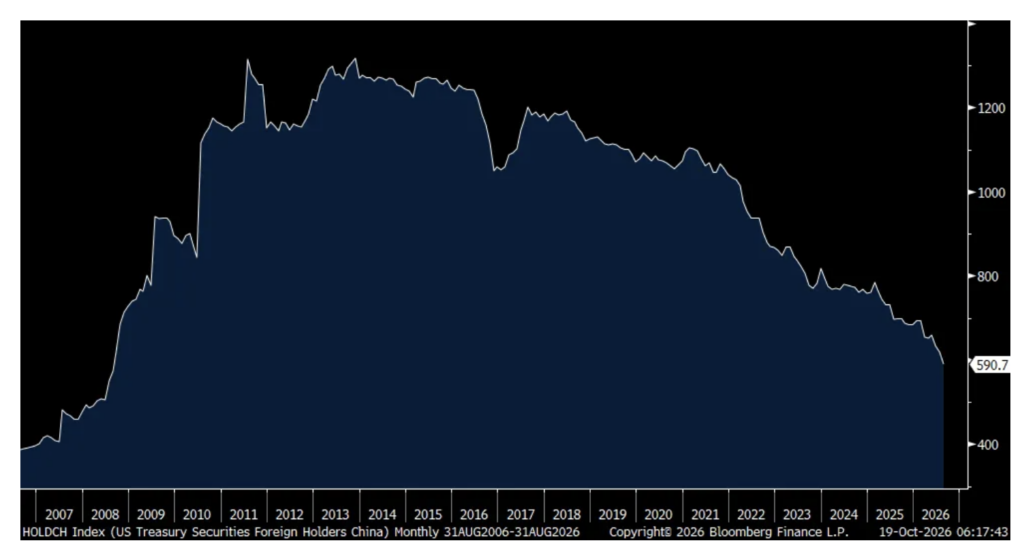
China’s holdings are down to $591 billion, lower by $27.3 billion m/o/m (yes, I’m sure they hide some of it by going thru UK banks and maybe others). That is the smallest since August 2008 with much of the capital diversion going to gold.
In August, the biggest foreign buyer of US Treasuries was the private sector, continuing the trend of dominating the buying rather than the ‘official’ central bank source.
Bigger picture, generated mostly in Asia, the large trade surpluses with the US being generated monthly are no longer being recycled back into US Treasuries, nor other developed bond markets like in Europe.
Japanese Treasury Holdings
Chinese Treasury Holdings
Speaking of China, they said overnight that Q3 GDP rose 4.5% y/o/y, about as expected but we know the contribution to GDP is as bifurcated as it is here. Industrial production continues to mainly drive growth and it rose 5.5% y/o/y as estimated in September. Retail sales in that month were up just 1.1% y/o/y but that was above the forecast of up .5%. From the perspective of the Chinese consumer, I believe home prices need to stop falling. In September they continued to drop but a bit less and continue to lift in the first-tier cities such as Shanghai, Guangzhou and Shenzhen. Beijing is still seeing lower home prices for new but now lifting a touch for existing. Reflecting the dramatic slowdown in new residential home construction, property investment was lower by 21% y/o/y in September.
Chinese stocks, both mainland and in Hong Kong, did rally but remain down on the year. We still hold a few holdings trading in Hong Kong and find the market and the stocks we have very attractively priced.
Just a few earnings calls of note ahead of the flood coming in the next few weeks.
From M&T Bank:
Loan growth was 2%. “This quarter’s growth was driven by commercial real estate and consumer. C&I loans were largely unchanged at $65.9 billion, with growth in institutional CRE offset by lower dealer commercial services.”
On the consumer loan side specifically, growth was 2% “with growth in recreational finance and HELOC portfolios.”
“Asset quality remained relatively stable this quarter, with net charge-offs below our initial year expectations and non-accrual loans remaining near cyclical lows.”
This was their macro view on things but nothing we don’t already know, “The US economy continues to expand despite multiple shocks and heightened uncertainty. Although geographical conflicts have not been fully resolved, we are cautiously optimistic with the outlook of continued growth. Gasoline prices remain high, but consumer spending has held up well in spite of energy shocks. We see households as having managed the shock by reducing spending in other areas.”
“The buildout of artificial intelligence infrastructure is helping drive overall construction and CapEx while other sectors are more subdued. While we do not see evidence of energy shocks seeping into core inflation, we expect overall inflation to decelerate going forward (let’s hope they are right, I’ll add). Labor market remains in a low-hire, low-fire environment, with slow job growth and low unemployment rate, with very little wage pressure.”
From Truist Financial:
“Wealth management performed ahead of plan. Client deposit growth and asset quality were both better than expected.”
“amid broader market volatility, we had some investment banking revenue get pushed out late in the quarter.”
Their loan book grew due to consumer loans and residential mortgage, “partially offset by lower C&I balances. Decline in C&I reflected both our focus on reducing exposure to lending segments that do not meet our ROTCE objectives and elevated paydowns experienced during the quarter in certain industry portfolios.”
“Overall credit this quarter remains strong.”
This was a quick view on the macro last Thursday from Alcoa:
“Our order book remains solid with significantly less volume available for sale than at this point last year. Most products are sold out or tightly committed. Packaging and electrical markets continue to lead demand. Transportation remains resilient, and construction, particularly in Europe, remains the softest end market. Customer sentiment is cautious but constructive, with continued interest in secure supply and long-term agreements.”
And with the Middle East situation, “I think the world has changed when it comes to aluminum within the Strait of Hormuz. And I think it’s going to be a while before that completely gets normalized of flows in and out. And so I think it is a big impact. You see it in pricing today, even though prices are off from where they were, we’re still sitting at close to $3,000 a ton. And so it has had a big impact, and I think it will still have a big impact going forward.”
BY Doug Kass · Oct 19, 2026, 10:15 AM EDT