Nvidia Is the Cheapest It’s Been in a Decade. But Is It Cheap for a Reason?
Elite fundamentals, a decade-low multiple, solid technicals, and analyst enthusiasm all point the same way. So why don’t I own more?
You've reached your free article limit
You've read 0 of 1 free Pro articles.

Have a stock you’d like Neil’s opinion on? Please email him at [email protected]
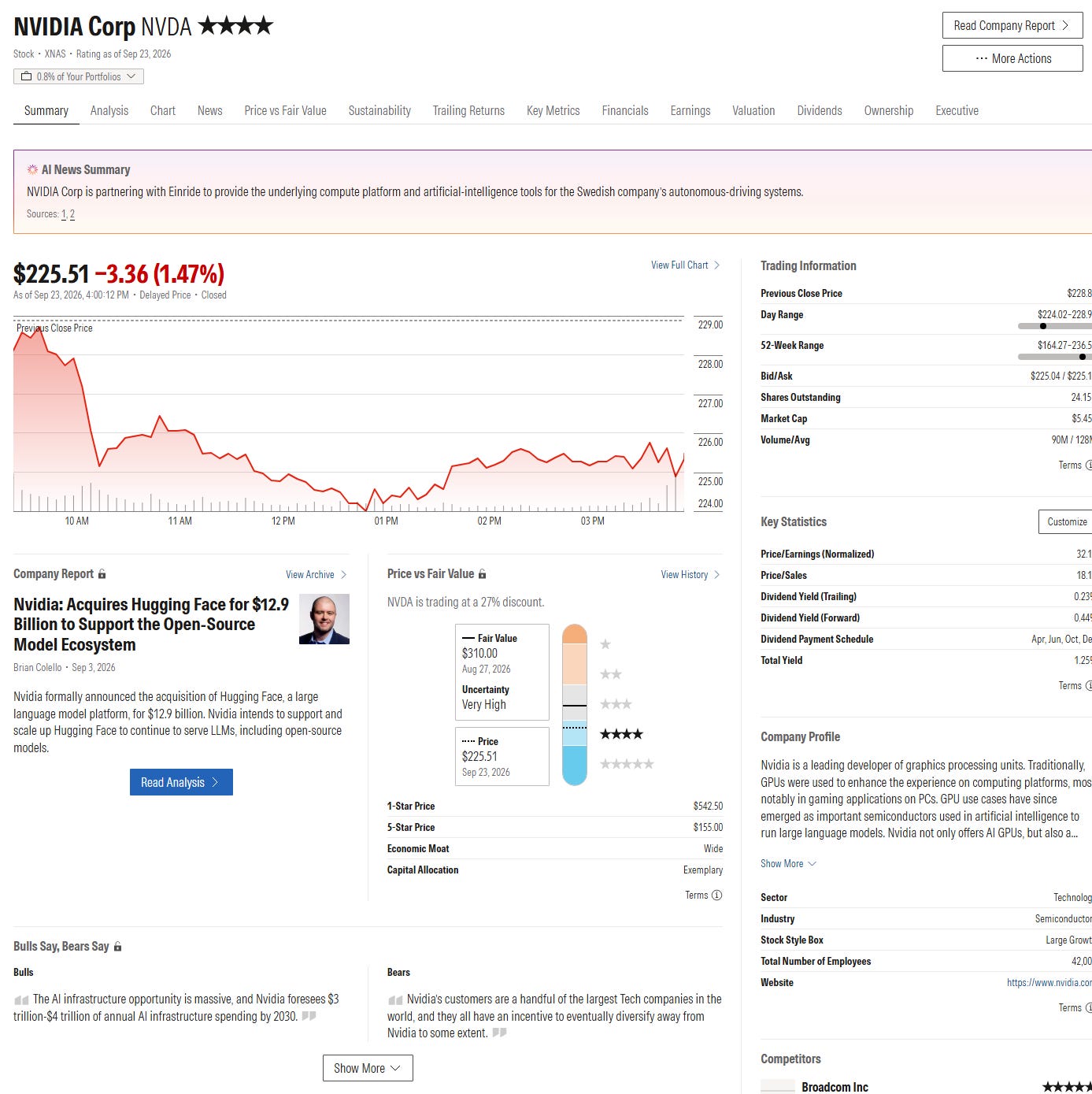
Nvidia (NVDA) is having an identity crisis: The most important stock in the market is also, on one key measure, the cheapest it’s been in more than 10 years. At under 17 times its long-term expected earnings — half the valuation it carried just a year ago — the AI kingpin is trading in the bargain bin even as it sits near a 52-week high, up ~23% on the year.
I’ve owned Nvidia off and on over the years, and it’s currently part of my portfolio. Let me explain why, but also why it’s not a larger position.
Fundamentals
The business is exceptional. Morningstar unsurprisingly gives Nvidia a wide moat and also an “Exemplary” capital-allocation rating — its top mark. It highlights the Cuda software lock-in that is an underappreciated revenue driver for the company (it’s not just a hardware company) and the NVLink/InfiniBand networking that ties GPU clusters together.
The economics are extraordinary as well: roughly 75% gross and 65% operating margins, a 117% return on equity, free cash flow at 42% of revenue, and a net-cash balance sheet carrying an S&P AA rating. Revenue has compounded about 67% a year over five years, and data-center revenue alone is modeled to jump from $194 billion in fiscal 2026 toward $385 billion in fiscal 2027. This is about as good as large-cap fundamentals get.
Valuation
As noted above, though, markets are giving Nvidia the “semiconductor discount.” What do I mean by that? Semiconductors are a famously cyclical industry, generally peaking on low valuations (as fundamentals outrun price appreciation) before crashing lower when the cycle turns down.
An expectation of that cycle is the only explanation for a trailing P/E of 29 against an 80 times five-year average with out-year estimates from BofA pegging it at roughly 16 times calendar 2027 — “the lowest in about a decade.” The PEG is 0.5, meaning it’s priced at half its growth rate. On my preferred cash-flow lens, price-to-free-cash-flow-to-equity, Nvidia trades near 36 times a blended figure against a “normal” of 63 — and unlike Meta (META), whose FCFE is set to turn negative, Nvidia’s is climbing.
Bloomberg similarly framed the sinking multiple as a warning sign — a de-rating this steep is skepticism that today’s earnings power lasts.
What Wall Street Analysts Say
The sell side isn’t buying it.
Morningstar carries a 4-star rating and a $310 fair value, about 35% above spot; Goldman is Buy with a $300 12-month price target; BofA is Buy at $350; while TipRanks scores it 88 of 100, Outperform, at $274.
Every published target sits above the current price with 31 buys, 0 holds and 0 sells.
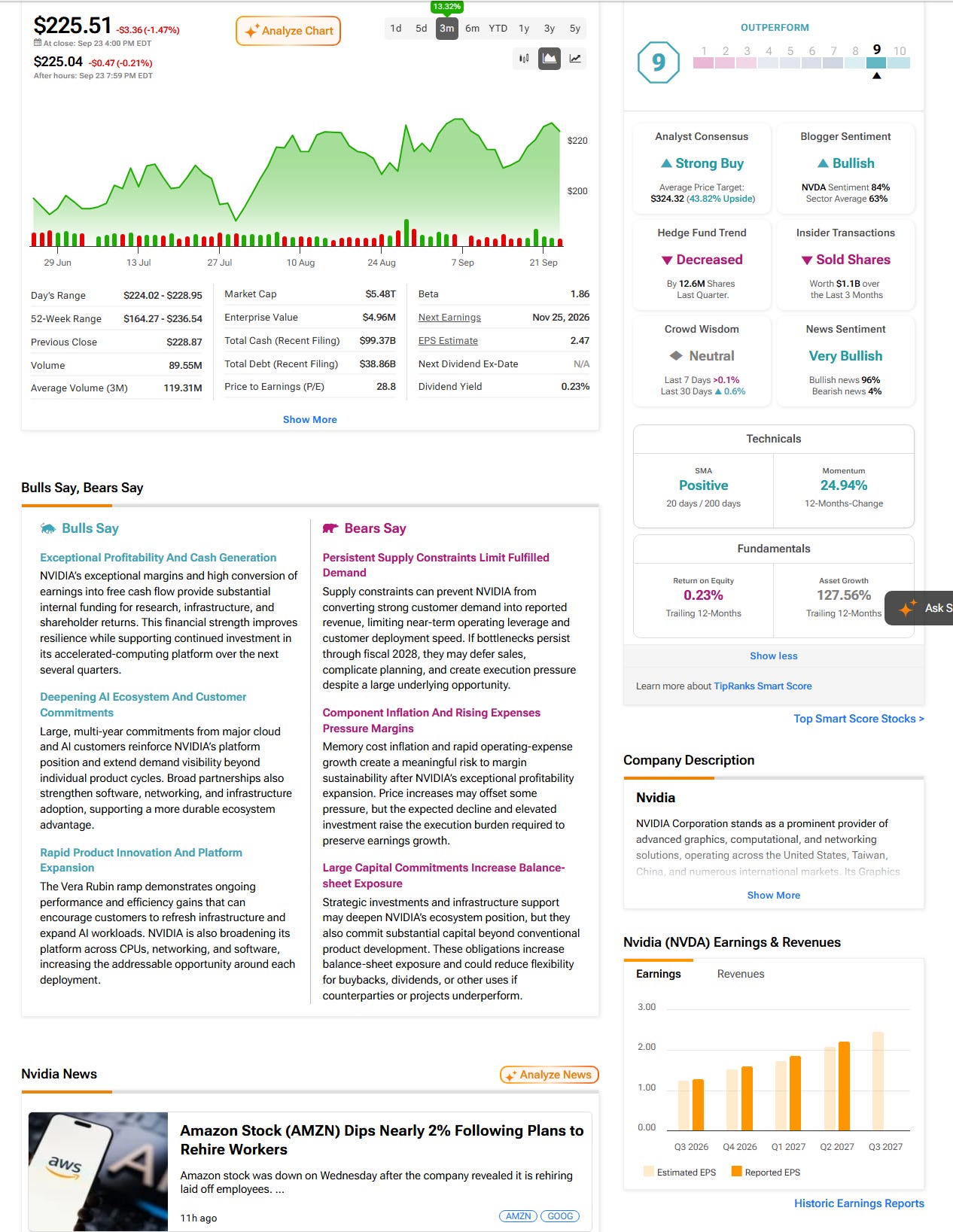
TCW’s Eli Horton argues the cheap multiple is already priced for an AI-capex slowdown that would require hyperscalers to pull back or regulators to step in — neither of which he sees — making this, in his words, a favorable multiple as an entry point.
Is This Time Different?
So it really feels like the entire question comes down to whether this time is different: Is Nvidia still a cyclical chip company, or has it become something more durable?
The bull case is that yes, this time is different. For one, a large share of future demand is locked into multi-year purchase agreements rather than spot orders. Additionally, Nvidia’s estimates sit atop a massive projected capital-spending wave.
The WSJ notes that five hyperscalers alone — Alphabet (GOOGL), Amazon (AMZN), Meta, Microsoft (MSFT) and Oracle (ORCL) — are on track to spend roughly $4.2 trillion on capacity in the four years through 2029 in no small part on chips.
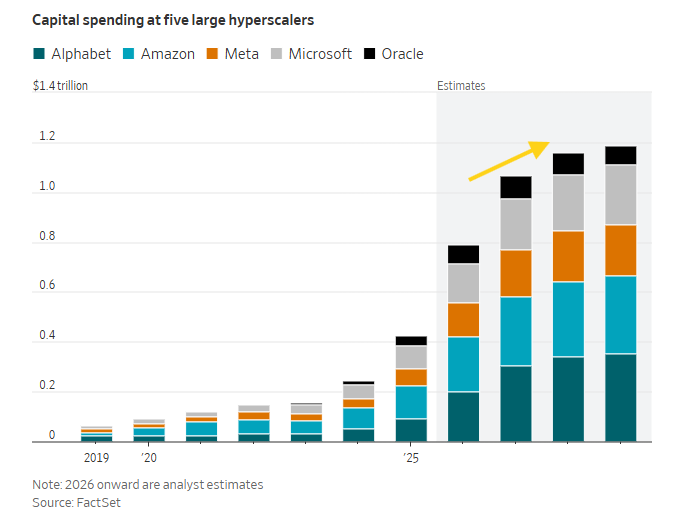
Skeptics push back that the buildout will increasingly be limited by government regulation, power availability for data centers, and debt financing constraints. They also point out a “vendor financing” circularity which was a predominant feature of the 2000 tech bust: Nvidia increasingly funds its own customers — bankrolling the very companies that then turn around and buy its chips, which can inflate demand and magnify the pain if the AI economics disappoint.
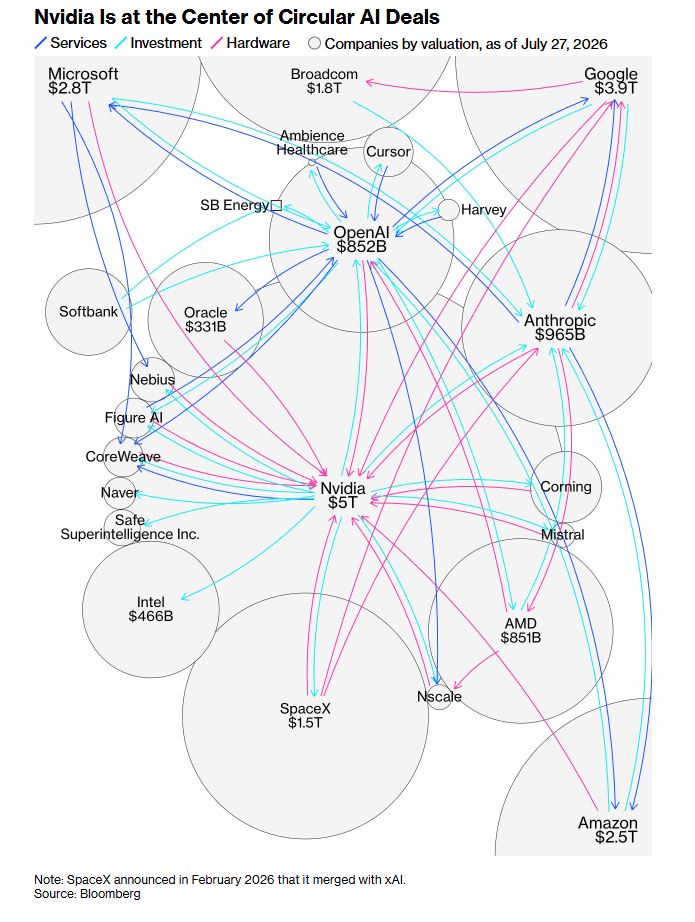
Critics from Goldman to Michael Burry have leaned on the point. But most analysts think it’s overblown. The sums Nvidia are funding are a small slice of what these customers are raising on their own, the deals are as much about locking up scarce memory supply as juicing demand, and — as CEO Jensen Huang argues in calling the circular framing “ridiculous” — real buyers with real budgets remain far larger than anything Nvidia is seeding.
Another pushback is that Nvidia’s own best customers are becoming its competitors. The hyperscalers spending that $4.2 trillion are also designing their own AI chips to cut their Nvidia bills — Alphabet has a genuine business in its TPUs, Amazon has Trainium, and Meta has touted homegrown silicon.
The bull rebuttal is that these custom chips are at the fringes, not able to compete with Nvidia’s core offerings and are more dangerous to secondary players such as Advanced Micro Devices (AMD) and Intel (INTC). Nvidia’s moat isn’t just the chip; it’s Cuda, the software layer customers have built their models on, plus the networking that lashes tens of thousands of chips into a single cluster. In-house accelerators can win specific, stable workloads, but enterprises are loath to bet everything on one internal design in a field where the techniques change monthly — keeping Nvidia the flexible, programmable standard. Chinese chips present a similar argument (again less relevant for Nvidia which has no Chinese sales to date while Chinese chips face larger hurdles in making inroads outside of China).
Finally, Nvidia itself in its last earnings release made a rare out-year forecast noting it estimates 70% growth in 2027 (fiscal 2028) with the limiting factor not demand but supply chains.
Technicals
The charts are bullish.
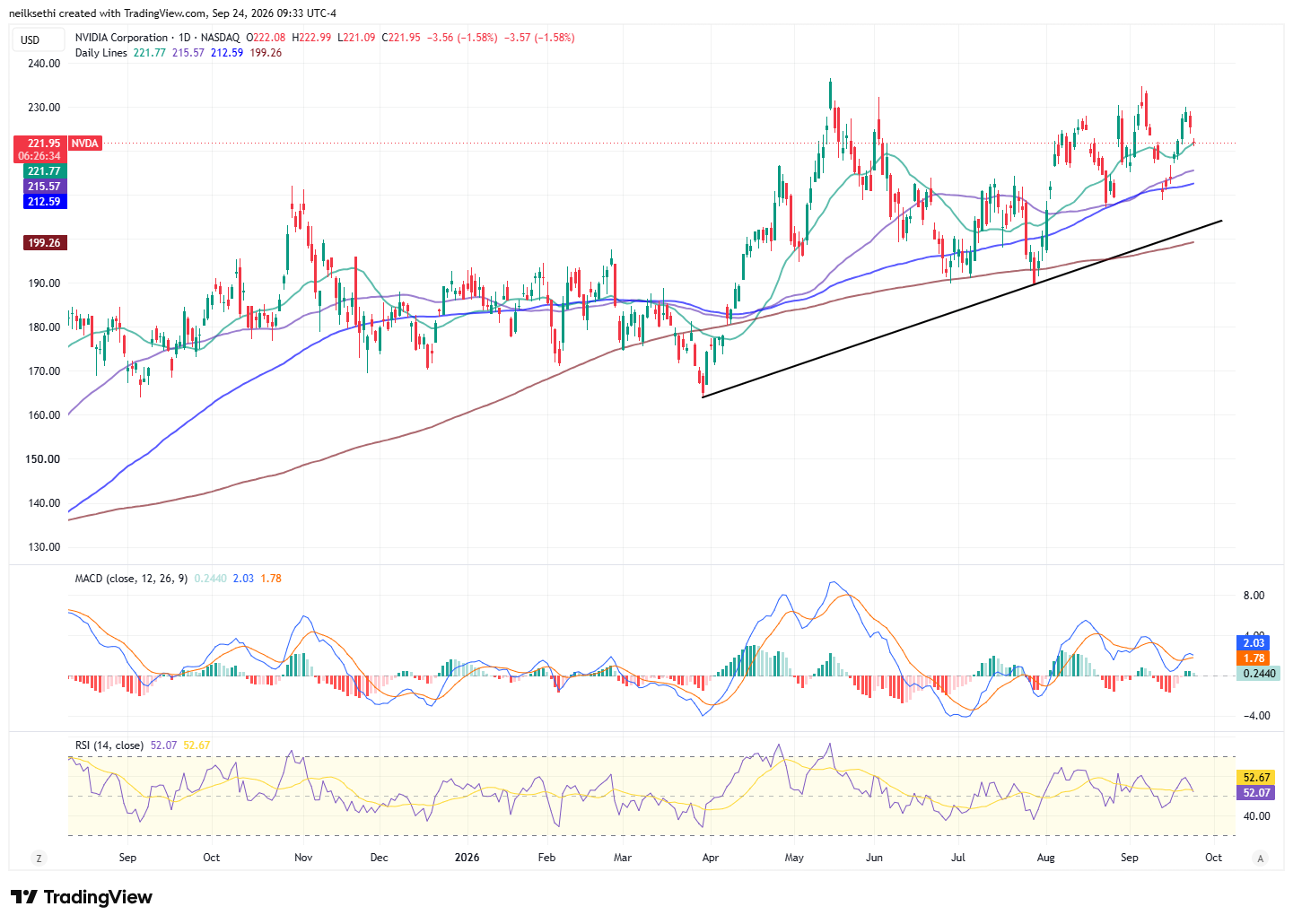
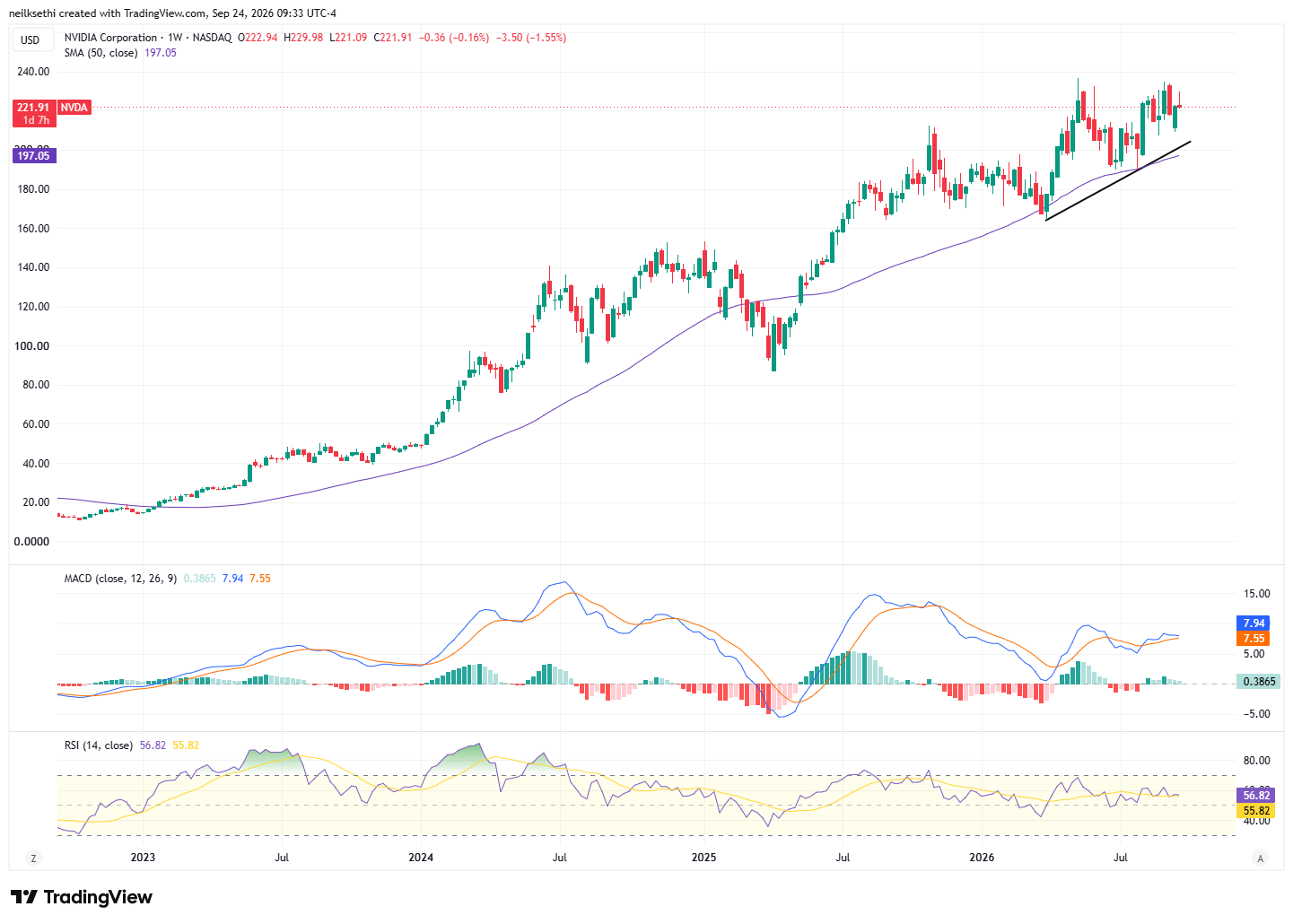
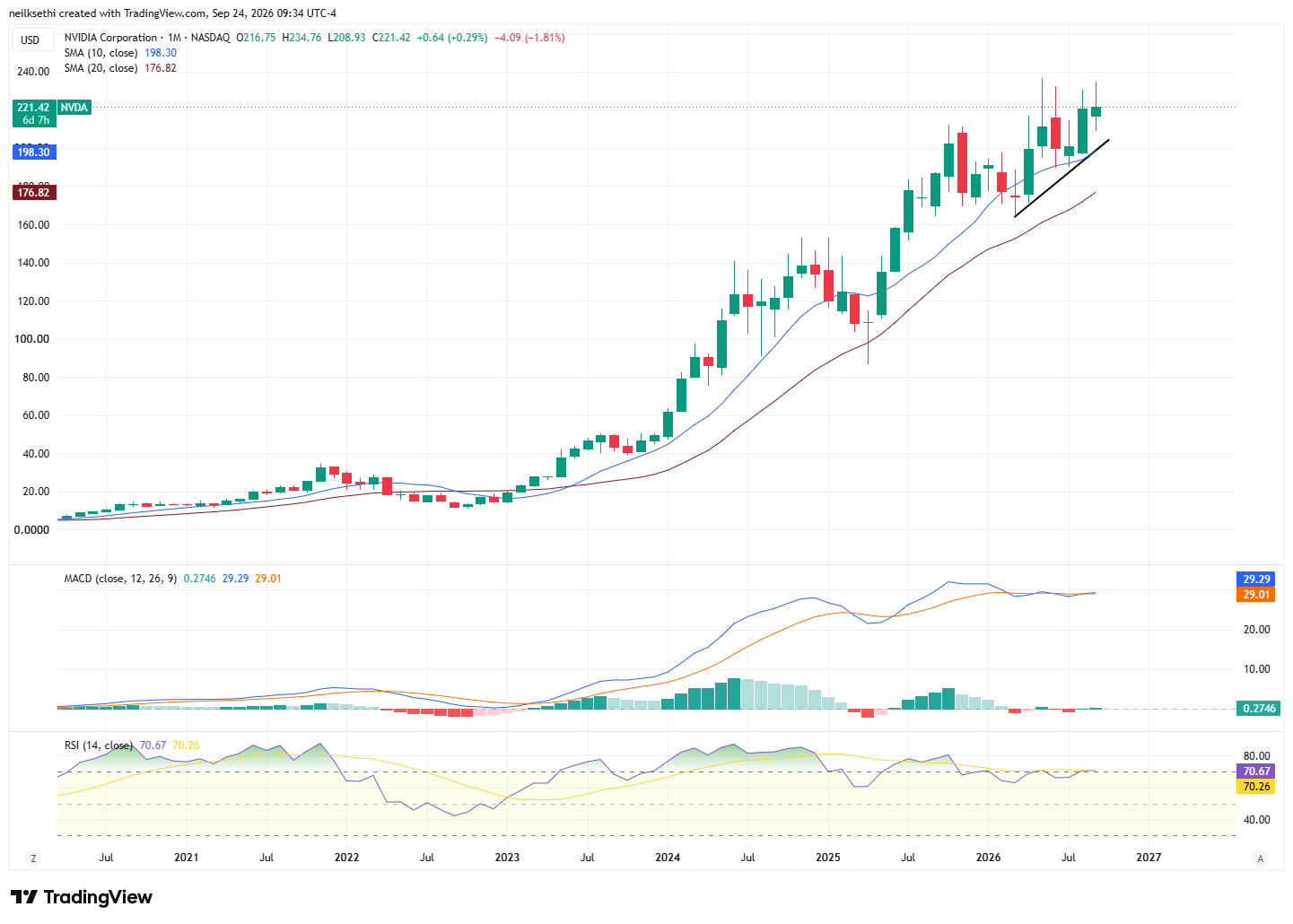
Nvidia trades above every moving average I track on the daily, weekly and monthly timeframes, and momentum is aligned — the MACD is on a buy signal and the RSI above 50 across all three as well.
There’s resistance at the $235-$236 (52-week high) area. Support levels are not particularly clear but there are numerous levels all the way down to the 200-DMA/50-WMA/10-MMA all around the $200 area. A break of that area would see me selling.
Daily
Weekly
Monthly
Where I Come Out
I try not to go against my screening process unless every hair is standing up on the back of my neck. This is a name with most everything pointing in the right direction — elite fundamentals, historically cheap on both earnings and cash flow, analyst upside, and a constructive chart.
And just because I buy it today doesn’t mean I have to own it forever. While there may be cracks, they are almost certainly not something that will surface in the next 18 months. Nvidia is cheap because the market doubts the durability of its earnings stream, something that will likely become evident well in advance.
But even granting the bear arguments, Nvidia has two important cushions. The first is the valuation — at a decade-low multiple, a lot of disappointment is already in the price. The second is optionality: Nvidia isn’t only selling chips, it’s taking stakes across the entire AI stack, so it captures upside almost regardless of which lab or model wins.
A key example is the $12.9 billion Hugging Face acquisition — giving Nvidia a large stake in the open-source, open-weight model game. If those take off and commoditize the closed labs Nvidia is financing, Nvidia still has a big bet on the rails of an open ecosystem. So even if Nvidia misses the lofty targets, a cheap starting point plus a portfolio of AI bets gives it a margin of safety a pure chip play wouldn’t have.
The larger debate is around AI of course. A debate around the entire ecosystem is beyond the scope of this article, but suffice to say I’m more on the “AI is the next big thing” train than I am on the “AI won’t monetize and will implode” one, even as I do think there is a wide swath of companies that will likely be washed away when we do inevitably have a downturn in the space. I don’t think Nvidia will be one of them.
Other Takes From the TheStreet Pro
The desk is split on this one, which is fitting given the debate. On the bullish side, Nvidia is a TheStreet Pro Portfolio holding — rated a Buy with a $300 price target and a $175 downside “panic” level — and one of the book’s biggest winners, up more than 150% since it was added in April 2024.
Not everyone on Pro is a fan, though. Doug Kass, in particular, runs a recurring “Tales From Nvidia” feature — nominally about the broader AI ecosystem but often circling back to the stock — and has been short as recently as late August. His bearishness mapped squarely onto the durability question above: he pointed to Dan Niles’s comments on CNBC about double- and triple-ordering of GPUs — demand that may be inflated by shortage and could reverse — and to skepticism that the unprecedented ~70% revenue-growth forecast for next year holds, a useful counterweight to the Portfolio’s Buy.
At the time of publication, Sethi was long NVDA.