Microsoft Price Target After $25 Billion Bond Sale Update
The Big Tech firm enjoyed a strong earnings beat.
You've reached your free article limit
You've read 0 of 1 free Pro articles.
Microsoft beats and borrows! Hmm. I was OK at “beats.” Borrowing doesn’t thrill me.
The stock was up overnight on Wednesday. It still is on Thursday, but not as much as it was before the morning’s headline broke. Let’s talk about it.
On Wednesday evening, longtime Sarge-folio name Microsoft (MSFT), which has been in rally mode since the June bottom (really since 2008), went to the tape with the firm’s fiscal first quarter financial results.
For the period ended September 30, Microsoft posted an adjusted EPS of $4.89 (GAAP EPS: $4.92) on revenue of $92.279 billion. These top- and bottom-line numbers both easily beat Wall Street’s expectations while that sales print was good for year-over-year growth of 18.8%. This was, for Microsoft, the best quarter for the pace of annual sales growth since FQ2 2021. No joke. For a firm this size, that’s really incredible.
CEO Satya Nadella commented in the press release:
“We are delivering greater capability, choice, control, and cost efficiency for customers across our entire stack. By helping organizations build and own their own intelligence, and earning trust through agent safety and security, we are translating our innovation into growing adoption and real-world impact across every industry.”
Operations
For the quarter reported, as sales grew 18.8%, the cost of that revenue increased to $29.72 billion. That left a gross profit of $62.559 billion (+16.7%) as gross margin dropped to 67.8% from 69%. This still decisively beat expectations. GAAP operating expenses grew just 6.2% to $16.644 billion, leaving a GAAP operating income of $45.915 billion (+21%). This took operating margin up to 49.8% from 48.9%, again beating expectations.
Once factoring for interest, other income and expenses and taxes, GAAP net income printed at $36.629 billion (+32%). This works out to $4.92 per fully diluted share, up sharply from the year ago $3.72 comp. Wall Street had been looking for something close to $4.72.
Segment Performance
Agents and Infra generated sales of $76.795 billion (+24.5%), which produced operating income of $40.558 billion (+24%), crushing expectations. Within Agents and Infra, Azure generated sales of $33.165 billion (+48.2%), which crushed expectations.
Devices and Consumer generated sales of $15.484 billion (-3.2%), which produced operating income of $5.357 billion (+2.2%), also beating expectations.
Guidance
During the earnings call, CFO Amy Hood indicated that the firm expects current quarter revenue to land between $96 billion and $97.1 billion, well above the $95.8 billion consensus. Included in this total is $80.1 billion to $80.7 billion in revenue to be generated by the Agents and Infrastructure unit, with Azure growth at 49% to 50% year over year in constant currency.
Hood went on, stating that “Customer demand continues to exceed available supply.” For that reason, she added, “In Q2 (current quarter), we expect CapEx spend will be over $50 billion. Therefore, for the calendar year, spend should be approximately $170 billion due to the 3P capacity delays noted earlier.”
Expectations had been for $175 billion, so though the number is huge, here is a hyperscaler downsizing capex projections. Not common in this environment.
Fundamentals
For the period reported, Microsoft generated operating cash flow of $58 billion (+29%). Out of that number came capex spending of $39.367 billion. This left free cash flow of $18.633 billion (-27.4%). Then, out of this number, Microsoft repurchased $4.379 billion worth of common stock and paid out cash dividends of $6.757 billion to shareholders. The fact that Microsoft is still running with significantly positive free cash flow is starting to differentiate Microsoft (yet again) in an environment where many hyperscalers are drowning in negative cash flow situations.
Moving on to the balance sheet, Microsoft ran with a cash position of $64.509 billion at quarter’s end. The firm also had inventories of $1.835 billion on the books as current assets totaled $186.137 billion. Current liabilities amounted to $151.968 billion, including shorter-term debt of $4.391 billion and unearned revenues of $66.866 billion. That is not a true financial obligation, by the way. Adjusted for those unearned revenues, Microsoft’s current ratio landed at 2.19, which is outstanding.
Total assets amount to $779.403 billion, of which just 17.6% is labeled as either goodwill or other intangibles. Total liabilities less equity comes to $308.894 billion, including long-term debt of $31.09 billion. Obviously, the firm has enough cash on the books to take care of this debt load twice over. This is a very strong balance sheet.
Thursday Morning’s News
On Thursday morning, Microsoft filed a prospectus with the SEC disclosing a bond offering. The filing did not specify how much capital the firm intends to raise, though Microsoft did disclose that this could be a multi-part offering. Bloomberg News reported that Microsoft intends to raise at least $25 billion from this offering which will be the firm’s first U.S. investment-grade bond sale in more than nine years.
Bloomberg reports that Microsoft is marketing this offering as coming in as many as 10 tranches, with maturities ranging from two years all the way out to 40 years. No final decision appears to have been made concerning the offering’s final size, which may change according to demand.
Opinion
The quarter was excellent. Guidance was solid. Cash flows are almost surprisingly strong. The balance sheet is fortress-like. There’s a lot to like here. Azure is growing like a weed, which is huge. As far as the debt offering is concerned, it’s hard to say. If it comes to $25 billion, the firm’s cash position still covers it in its entirety.
That may help Microsoft find demand for this issuance as such demand is now becoming a bit “iffy” of competitors that have already tapped these markets or are unable to boast the kind of free cash flow that Microsoft still can. Microsoft has already stated an intention to to cut headcount by as many as 60,000 individuals. While that is not a positive headline economically, it is for Microsoft. I mean, the most useless thing a kid can leave college with in late 2026 is a degree in coding. Might as well study drama. AI already does that job. More efficiently and far more quickly.
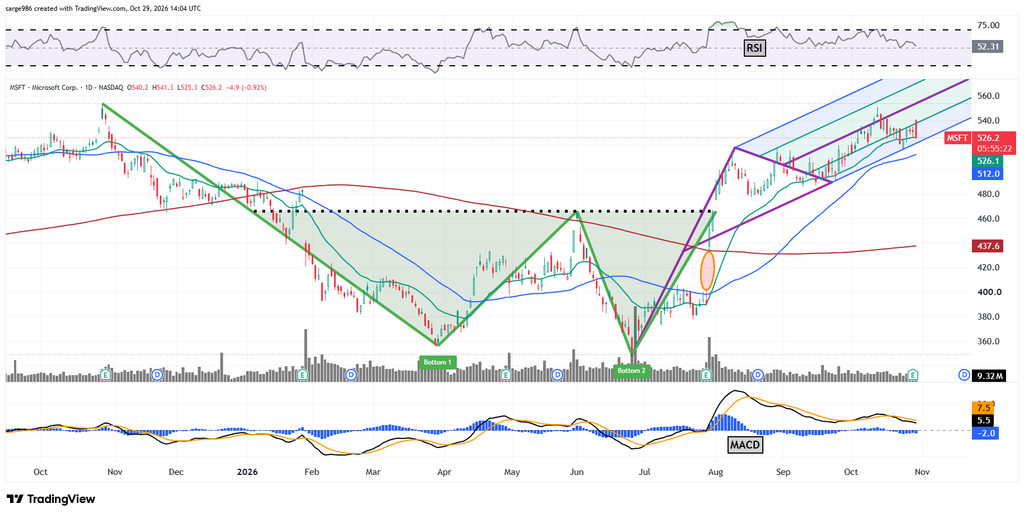
Readers will see that MSFT has broken out from a double-bottom pattern of bullish reversal that stretched into the summer. I have used an Inside pitchfork model to map the breakout. As the shares battle to hold onto their 21-day EMA, they have also been fighting to hold onto the bottom trendline of that model. As long as the stock holds above the 50-day SMA, I am fine. The model can be adjusted if the action supports the addition of another trendline, which it would in that case.
Moving on to the indicators, relative strength is still better than neutral. However, the daily MACD is a bit wonky at this time. The bright side of this is that it won’t take much to turn all three EMAs within that item in a more bullish direction. I am not selling MSFT, and I may add if I see sufficient weakness.
Target Price: $640
Pivot: 50-day SMA (currently $512)
Add: Close to 50-day SMA
Panic: Loss of 200-day SMA.
At the time of publication, Guilfoyle was long MSFT equity.