Merck Beats Estimates and Appeals as a Long-Term Investment
The pharma giant continues to see results from a powerhouse.
You've reached your free article limit
You've read 0 of 1 free Pro articles.

Merck (MRK) shares edged higher after the company reported healthy third quarter results before Thursday’s opening bell. The New Jersey-based pharmaceutical giant earned $2.49 per share, soundly beating analysts’ expectations of $2.09. Revenues of $18.09 billion beat estimates of $17.3 billion.
For the full year, Merck modestly raised its earnings and revenue estimates.
Keytruda and Gardasil
Merck’s immunotherapy drug Keytruda continues to be a powerhouse, with sales of $8.6 billion for the quarter. Analysts were looking for $8.0 billion.
Sales of Gardasil rebounded, with sales rising by 14% to nearly $2 billion for the quarter. Estimates were for $1.8 billion.
Gardasil sales were driven by purchases by the U.S. Centers for Disease Control and Prevention, which stockpiles the HPV vaccine. HPV is responsible for 37,000 U.S. cancer cases every year, and Gardasil can prevent up to 90% of these cases.
Charting Merck
Merck has been moving sideways for the past two months, as it consolidates its recent gains. Year to date, shares of Merck have gained 32%. The stock has slipped beneath its 50-day moving average (blue). Not because the stock is falling, but because that moving average is still rising.
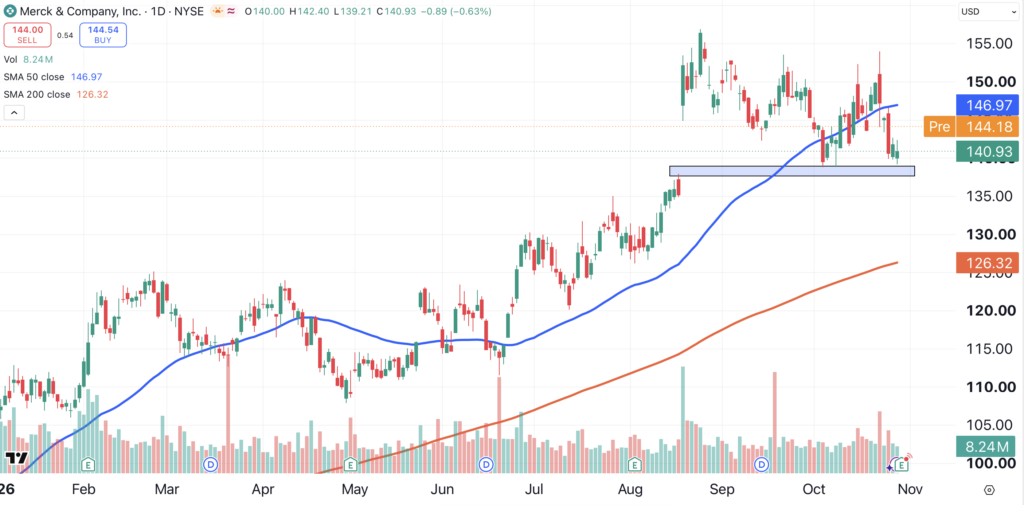
Merck’s bullish gap from August 18 has mostly been filled (shaded area). The lower end of that gap is $138, which should act as support for the stock.
Keytruda QLEX and Patent Strategy
Keytruda is most often administered via an intravenous line. The process takes about 30 minutes, and is performed every three to six weeks, depending on the type of cancer and the plan for treatment.
A new injectable form of Keytruda, called Keytruda QLEX, is taken via needle, and can be administered in just one minute per three weeks. This newer version of Keytruda was approved last year, and accounted for $830 million in sales for the quarter.
Not only is Keytruda QLEX popular with patients, it serves a purpose for Merck’s patent strategy going forward. Patents related to Keytruda begin to expire in 2028. When those patents expire, Merck anticipates a wave of new competition.
Once healthcare providers and patients experience the convenience of Keytruda QLEX, Merck believes they’ll remain loyal to the brand. While patents for Keytruda expire in 2028, the patents for Keytruda QLEX are expected to remain intact until 2040 in the European market, and 2043 in the U.S.
Bottom Line
Merck shares currently offer a 2.4% dividend yield. Merck has increased that dividend for 15 consecutive years. The company’s dominant market position and strong pipeline make it an attractive long-term holding.
At the time of publication, Ponsi was long MRK.