Home Depot Stock Headed for Multi-Year High as Management Improves
The home improvement retailers appears to be headed in the right direction.
You've reached your free article limit
You've read 0 of 1 free Pro articles.
On with the retailers!
Some readers know. Perhaps many readers know. I have been kicked off of Wall Street a few times. I believe “laid off” was the politically correct term as human traders were replaced by high-speed algorithmic traders. I also left Wall Street on my own a few times. I loved free market price discovery. It was the culture on Wall Street that I, as a religious guy, never really got along with. I evolved. I reinvented myself a number of times.
For the record, I left my last employer because I had had enough of them in 2016 and bet on myself. That’s when I founded my family office. Scary? Of course. That said, that was the best decision I ever made in my professional life. I probably never would have enjoyed the magnitude of the professional comeback that I did had I kept toiling away for someone else. Never be afraid to bet on yourself if you know that you know your stuff.
Why am I telling you all of this? Because for almost a year, while I cleared my head and purified my Wall Street brain, after the collapse of the open outcry market model (which started to fall apart in late 2006), I drove a forklift for Home Depot (HD). While it didn’t really pay, it was one of the most fun civilian jobs that I ever held. No hours of homework at night or on weekends. No working while you’re theoretically off from work. I found it incredible just how much free time a person has when they only work full time. Full time on Wall Street, for those who don’t know, begins at 70 hours a week and goes higher. Much higher.
I will always be grateful to Home Depot for allowing me to clear my head at a time I needed it. They even let me take six weeks off while I worked there, twice. Once because I got called up by the National Guard and a second time because a broker-dealer, that will remain nameless, was in need of an interim chief economist. I was friendly with the CEO. They knew I was qualified. They knew that I was not looking to return to Wall Street full-time just yet. Oh, and Home Depot gave me stock in the company as a perk. How nice was that?
Home Depot Reports!
On Tuesday morning, Home Depot released the firm’s fiscal second quarter financial results. For the period ended August 2, Home Depot posted an adjusted EPS of $4.92 (GAAP EPS: $4.79) on revenue of $47.861 billion. These top- and adjusted bottom-line results both easily beat Wall Street’s expectations, while the sales print was good for year-over-year growth of 5.7%. On a year-over-year basis, comp sales for the second quarter of fiscal 2026 increased 1.7% (best since 2022), and comp sales in the U.S. increased 1.3%.
CFO Richard MacPhail commented in the press release:
“Our second quarter results exceeded our expectations. We saw broad based demand across the business as customers continued to engage in smaller projects.”
Senior Executive Vice President Ann-Marie Campbell added:
“This quarter’s results were a testament to our investments across the business and our associates’ focus on customer service. Our teams did an exceptional job executing throughout a dynamic environment, and I would like to thank them for their continued hard work and dedication.”
For those about to ask, CEO Ted Decker recently took a temporary medical leave of absence and will be out for a few months.
Operations
As sales grew 5.7% to $47.861 billion, the cost of those sales increased 5.3% to $31.746 billion. This left a gross profit of $16.115 billion (+6.5%) as gross margin increased from 33.4% to 33.7%. Total GAAP operating expenses grew 8.2% to $9.276 billion, which left a GAAP operating income of $6.839 billion (+4.3%). After accounting for interest, other income and expenses and taxes, GAAP net income hit the tape at $4.766 billion (+4.7%). That works out to $4.79 per fully diluted share, up from $4.58. After factoring in adjustments, primarily for the amortization of acquired intangibles EPS printed at $4.92, up from the year-ago comp of $4.68.
Guidance
For the full fiscal year, Home Depot is projecting sales growth of 2.5% to 4.5%. That took the midpoint if the range below the 3.8% Wall Street consensus. That said, operating margin is seen at 12.4% to 12.6% and adjusted EPS is seen at growth of 4%, well above the 1.8% growth that had been expected.
Fundamentals
For the period reported, Home Depot generated operating cash flow of $11.422 billion. Out of that number came capex spending of $1.724 billion and another $1.333 billion on acquired businesses. That left free cash flow of $8.365 billion (+19.3%). Out of this number, the firm paid out $4.643 billion in cash dividends to shareholders.
Turning to the balance sheet, Home Depot ended the period with a cash position of $2.085 billion and inventories of $26.847 billion. That puts current assets at $37.72 billion. Current liabilities add up to $34.988 billion, which includes short-term debt of $4.248 billion (-4.8% over six months). This puts the firm’s current ratio at 1.08, up from 1.06 over six months’ time.
Total assets amount to $109.384 billion. Of that total about 30% is labeled as either goodwill or other intangibles. Total liabilities less equity comes to $92.767 billion, including long-term debt of $43.951 billion (-5.2% over six months).
Opinion
This ship is starting to sail more smoothly. Cash flows are improving. Profitability is set to improve. The balance sheet, which has been a mess for years, is finally looking a bit better. The firm has clearly made an effort in 2026 to use its beefy free cash flow to pay down some debt. We like that. It has been my opinion that this company had been mismanaged for years. There is still a long road ahead, but it does appear that adults have finally won over the firm’s c-suite.
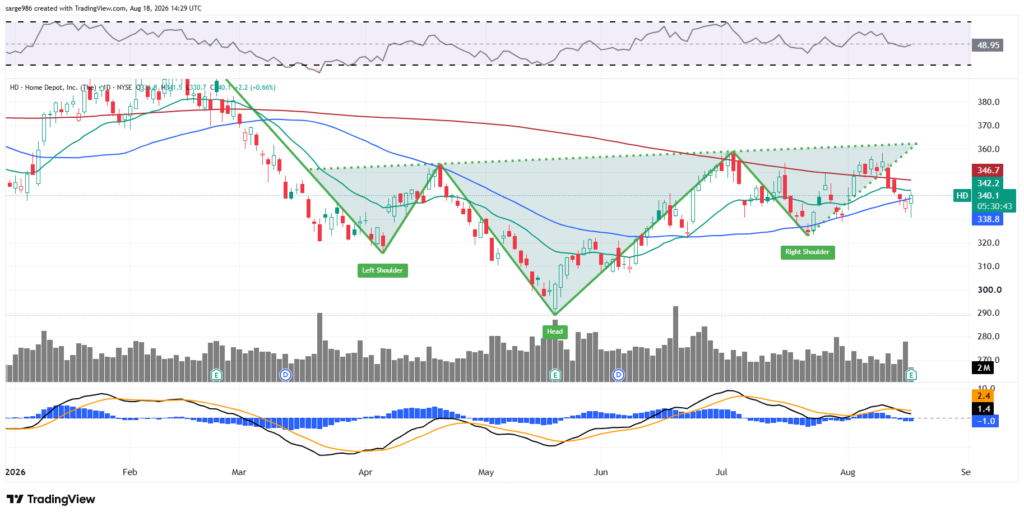
Readers will see that the shares of HD have developed an inverse head-and-shoulders pattern of bullish reversal this year with an upside pivot of $360. The firm is obviously executing better as folks fix up what they have rather than wading into the housing market. Should the shares take their 50-day SMA, the 200-day line becomes the nest line of attack. I think that HD can be initiated on weakness. If I am right about the inverse head and shoulders, the shares could by year’s end or early next year, approach their multi-year high of $439.
At the time of publication, Guilfoyle had no positions in any securities mentioned.