Stock Market Today

Market updates and conversation from TheStreet Pro team. Follow the latest and join the conversation below.

Stock Market Today: October 26, 2026

Newest first · All times Eastern · 3 updates

DATE:
By Neil Sethi

Meta Wastes No Time

That didn’t take long. When Meta Platforms (META) unveiled its new non-voting Class C shares alongside earnings last week, I noted that its filing showed management’s long-range plan needing to raise “hundreds of billions of dollars” beginning as early as this fall. The filing also said the company “expects to conduct offerings of Class C common stock from time to time.”

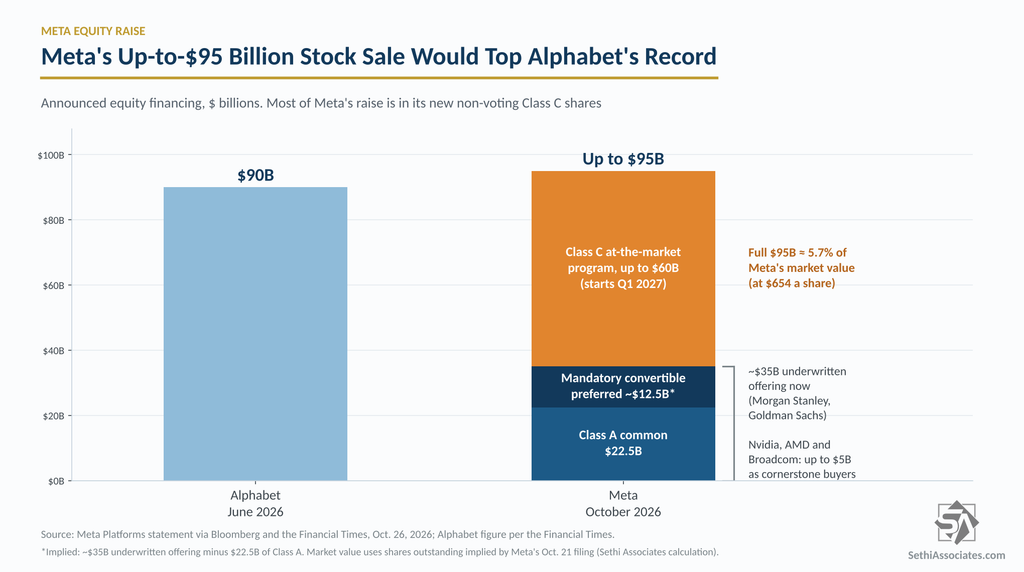
On Monday it got started. Meta is seeking to raise as much as $95 billion by selling common and preferred stock, per Bloomberg. About $35 billion is being offered now, roughly $22.5 billion in Class A common and the rest in mandatory convertible preferred. The remaining roughly $60 billion will come through an at-the-market program in the new Class C shares, which the Financial Times says is expected to begin in the first quarter of 2027.

Nvidia (NVDA), Advanced Micro Devices (AMD) and Broadcom (AVGO), all Meta chip suppliers, have agreed to buy up to $5 billion of the common as cornerstone investors. Morgan Stanley and Goldman Sachs are leading the deal.

If fully executed, Meta’s raise would top Alphabet’s $90 billion June offering, which lead bookrunner JPMorgan called the “largest multi-tranche equity transaction in history,” per the FT. At about $654 a share, the full $95 billion is roughly 5.7% of Meta’s market value.
The timing fits what Meta’s special committee flagged in the filing: it wanted to front-run potential equity offerings from Alphabet (GOOGL), SpaceX (SPCX), Anthropic and OpenAI. Alphabet has raised once already, SpaceX completed the biggest-ever IPO in June, and Anthropic is expected to list before year-end, per the FT.

One wrinkle: because the Class C shares won’t exist until January, this first tranche is voting Class A stock. According to Claude, the $22.5 billion of Class A trims CEO Mark Zuckerberg’s voting control voting control only modestly, to about 60.2% from 60.6%, before any conversion of the preferred. The $60 billion ATM goes into the non-voting shares, so it won’t dilute his control at all.

It appears this was priced in by the market with Meta shares little changed as of 8:30 am ET.

At the time of publication, in terms of securities mentioned, Sethi was long META, NVDA, GOOGL, and SPCX and short AMD.
By Neil Sethi

Is Japan Selling of Treasuries a Risk?

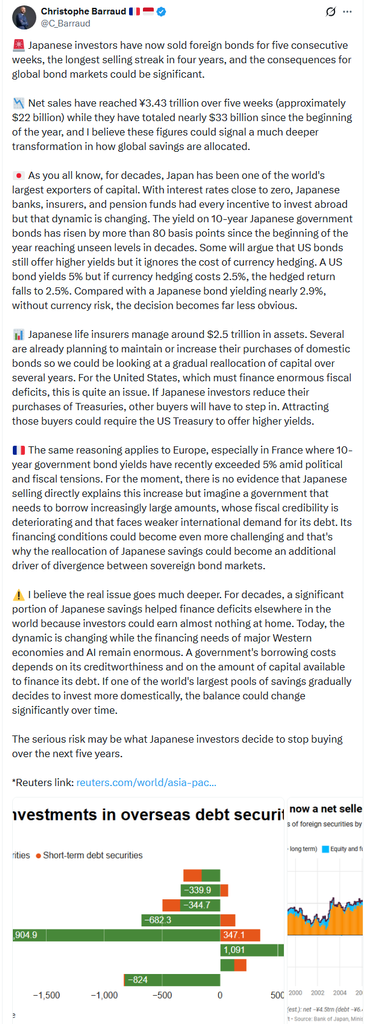
Economic analyst Christophe Barraud, Head of Discretionary Management and Research at LIOR GP, had an X post last week with his thoughts on the selling by Japanese investors in global bonds “for five consecutive weeks, the longest selling streak in four years.” [post at the bottom].

As he noted, “the consequences for global bond markets could be significant,” with Japanese yields now trading above US equivalents once hedging costs are taken into account.

“Japanese life insurers manage around $2.5 trillion in assets. Several are already planning to maintain or increase their purchases of domestic bonds so we could be looking at a gradual reallocation of capital over several years.”

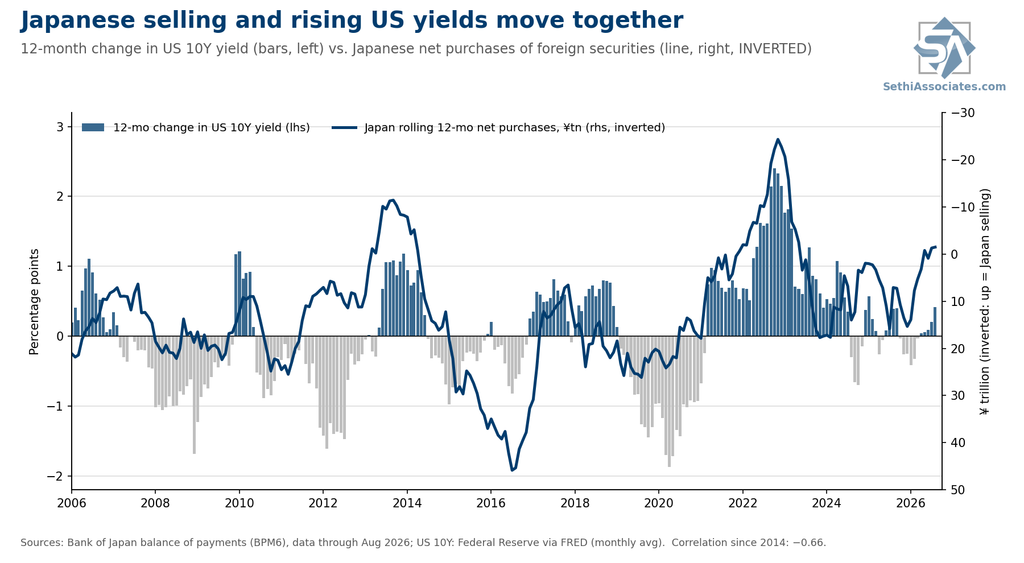
Given that backdrop, I had Claude do an analysis of how Japan’s flows line up with US 10-year yields, using Bank of Japan data on Japanese net purchases of foreign securities. Its takeaways were consistent with the risk Christophe flagged:

1. Japan flows do have a strong correlation with the change in 10-year yields. Comparing rolling 12-month net purchases to the 12-month change in the US 10Y results in a correlation of about −0.66 since 2014. That is consistent with Japanese selling driving yields. The 2013 taper tantrum and 2022 stand out.

2. Neither series, though, conclusively leads the other; the fit is tightest when both are measured over the same period. So while that’s consistent with Japanese selling pushing yields up (which makes a lot of sense), it is equally consistent with sharp rises/drops in yields and hedging costs pushing/pulling Japanese investors out/in. In 2022, the cost of hedging dollars back into yen went from roughly 0.2% to over 4%, and Japan sold a record amount of foreign bonds.

3. Flows have little correlation with a given level of 10-year yields. The correlation between Japan’s rolling 12-month net purchases and the US 10Y level is weak: about −0.14 since 1997 and −0.4 since 2014.

So it seems the reallocation risk is very real if higher Japanese yields do pull flows back home.

By Neil Sethi

A Quiet Start to the Week

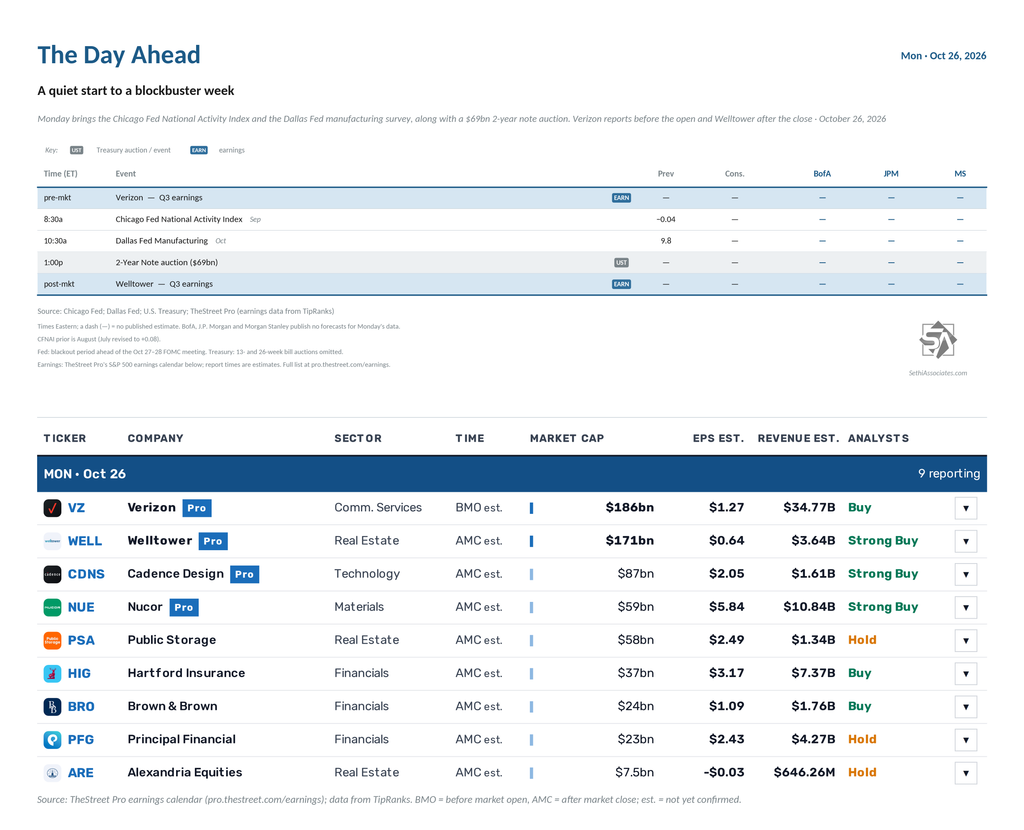
It’s a quiet start to a busy week for US economic data, with October’s Dallas Fed manufacturing survey and September’s Chicago Fed National Activity Index the only reports.

The Fed remains in its blackout period ahead of the October 27–28 FOMC meeting, so there are no Fed speakers.

Non-Bill (>1yr in maturity) US Treasury auctions include a $69bn 2-year note auction.

Nine S&P 500 components report, two of them with market caps over $100bn:

  • Before the open: Verizon (VZ)
  • After the close: Welltower (WELL), Cadence Design Systems (CDNS), Nucor (NUE), Public Storage (PSA), The Hartford (HIG), Brown & Brown (BRO), Principal Financial (PFG) and Alexandria Real Estate Equities (ARE)

Conversation 0 Comments

One ongoing discussion across all days. Everyone can read; sign in to take part.

Your voice matters. Discussions are moderated for civility. Read our guidelines .

Log in to join the conversation

Loading comments...