Why Midterm Change Won’t Disrupt the AI Buildout as Much as Feared
Let’s ask some key questions and game things out amid a potential market knee-jerk reaction.
You've reached your free article limit
You've read 0 of 1 free Pro articles.
Amid a post-midterm election market rebound that is lifting all the major market averages, the Vaneck Data Center Supply Chain ETF (RACK) is down almost 5% and we are seeing bigger declines in individual stocks like Caterpillar (CAT), GE Vernova (GEV) and several holdings in the EPS All-Stars basket, not to mention Eaton (ETN) and Marvell (MRVL) shares.
Part of the pressure on MRVL shares is arb related, owing to its recent bid for Lumentum (LITE) and that fixed exchange offer, but for the group as a whole, the concern is the “Blue Wave” that’s washing over Congress and governorships will bring the AI and data center buildout to a halt.
Our view is that changing landscape could translate into slower approvals and slow the overall grow rate of new data center construction starting in 2027.
Slow, but not stop.
We’ve seen many knee-jerk reactions in the market in our time, and there is little question in our mind that over time the influence of social media, the need to program 24/7 cable news, the rise of single-stock ETFs, and trading algorithms that feed on all that has accelerated the size and speed of those knee-jerk reactions.
That is why, when we see them occur, our reaction is to slow down and ask key questions so we can rationally think things through, lest we make a decision or take an action we may later regret. And let’s also remember that promises to get elected don’t always make their way to policy action, especially when there are big dollars and other ramifications to consider.
With that in mind, let’s ask the following:
Q: Will the Democrats want to throw a bucket of cold water on the economy as they take office, something that would hobble their chances in the 2028 election cycle?
Probably not, is the answer.
The Bureau of Economic Analysis’s (BEA) third estimate of Q1 2026 GDP showed real GDP growth of 2.1% annualized, and it’s estimated that AI-related investment in data center equipment and software contributed roughly three-quarters of that.
For Q2 2026, ING finds that roughly one-third of GDP was due to the build out of AI and data center infrastructure and that figure excludes imported hardware, but includes all information processing equipment, data center construction and software.
While we’ve only received the first GDP print for Q3 2026, of the 3.4% figure, research firm CEPR finds total AI investment added 1.78 points to growth, leaving it to conclude that the quarter was clearly driven by AI investment and stock-fueled consumer spending. That’s about 52% of Q3 2026 GDP but we’ve seen other figures that have it between one third and one half.
Here’s the thing, with AI and data center capex expected to step up again next year, odds are that contribution to GDP remains a sizable percentage. Stijn Van Nieuwerburgh, a finance and real estate professor at Columbia Business School, projects that AI-related investment in data centers, power infrastructure, chips and computer equipment will total $10.3 trillion from 2025 to 2032, or roughly 3.6% of U.S. GDP per year.
Q: Do the Democrats want to bring about a stock market collapse?
Given that stock market gains are helping provide cover for consumer spending, a key part of what’s driving the economy, here too the answer is most likely no.
But when we look at S&P 500 EPS, Goldman Sachs estimates that AI infrastructure alone will add about 15 points to S&P 500 EPS growth in 2026, tapering to 11 points in 2027 and 8 points in 2028.
Looking at data from FactSet, we see that companies tied to the information technology sector, which include AI and data center infrastructure companies, are driving the lion’s share of revenue and EPS growth this year and in 2027:
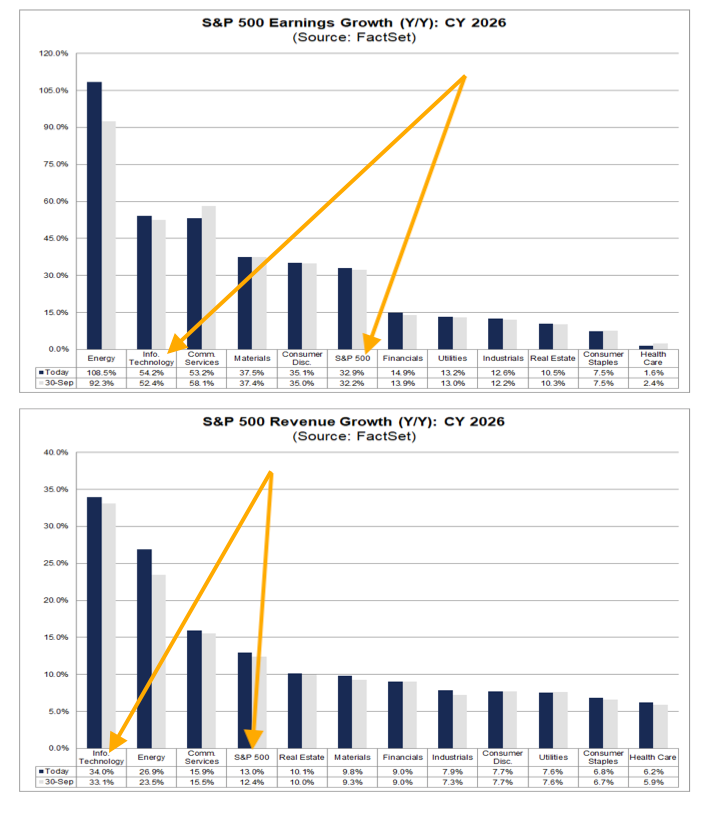
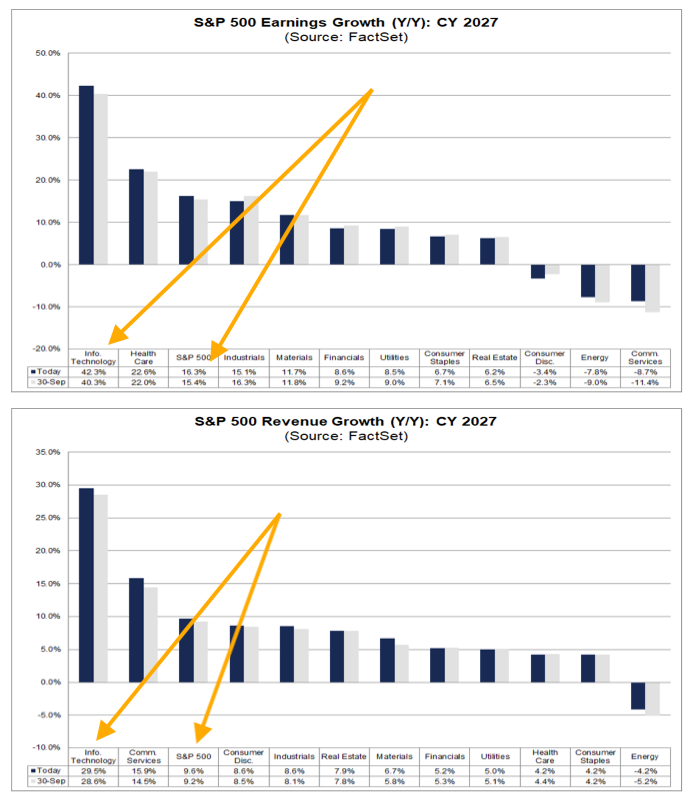
What this tells us, if we see a dramatic slowdown in the AI and data center building, is that it’s going to translate into far slower growth expectations for the S&P 500… and that would raise investor questions about the real speed of EPS growth and what the right multiple should be.
Q: Do states want to risk data center tax receipts and jobs?
While data centers tend not to employ a large number of people to run them, the U.S. data center industry generated an estimated $204.4 billion in federal, state and local tax revenues in 2024. That stream has helped offset potential property tax increases and, in some cases, it’s gone a bit further. As Loudoun County, Virginia turned into a data center hub, it grew its commercial tax base at an astronomical pace and was able to reduce tax rates on homes and vehicles. Between 2009 and 2026, the real property tax rate went from $1.245 per $100 of assessed value to 80.5 cents.
Said a different way, data centers pay about 80% of all personal property taxes in Loudoun County. Loudoun is home to more than 200 data centers, with more than 40 under construction as of the start of 2026. In fiscal 2027, which began July 1, 45% of Loudoun County’s total local tax revenue will come from data centers, according to county officials. That’s nearly $1.3 billion in taxes.
And that helps explain why states other than Virginia were eager to court data centers, and odds are if some states eschew new data centers, there will be ones that remain open for business.
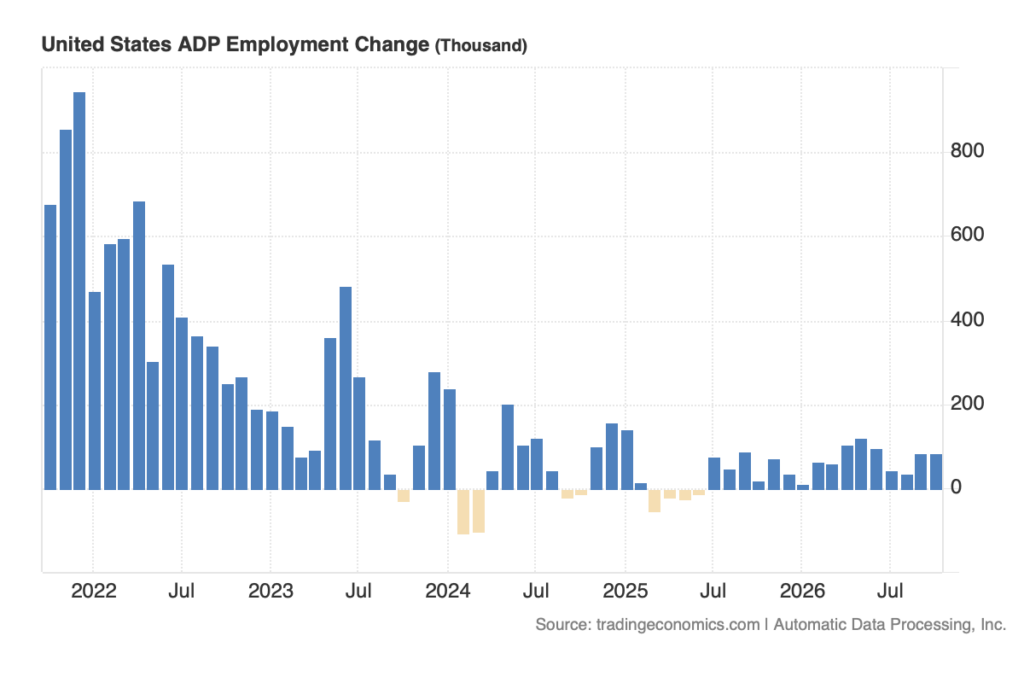
Back to jobs, while operating a data center may not require many workers, building them out is a different story. Stanford’s Stanford Institute for Economic Policy Research (SIEPR) estimates the current pace of data center construction could sustain over 300,000 U.S. jobs. As that grow rate rises or falls, that means either more or fewer jobs. The Associated Builders and Contractors (ABC) trade association says construction job growth is increasingly concentrated on the nonresidential side, something we’ve seen in recent monthly Construction Spending data. In ABC’s view, the data center boom supports rapid hiring of specialty trade contractors.
As one thinks about that and what the impact of halting data center buildout would mean, let’s look at recent private sector job creation figures tallied by ADP.
The Almost-Bottom Line
Working through the above, our thinking is the reaction we are seeing on AI and data center infrastructure stocks is likely close to if not already overdone. Could there still be more downside in some of the stocks? Possible, but with the shares of Eaton back at levels last seen in April and those for Marvell now entering an oversold condition, before too long, we’re likely to see more investors start to contemplate the questions we laid out above and maybe some others.
For example, less than a month ago, Marvell management shared a calendar 2030 EPS target of $30-plus. That was before the announced deal for Lumentum, and per S&P Global Market Intelligence, the market has already adjusted its view on calendar 2030 EPS to just over $28. But as calmer heads emerge and game things out, assigning haircuts to the current 2026 to 2029 EPS compound annual growth rate of more than 100% implied by pre-Blue Wave expectations for Marvell, what they uncover will catch their attention.
A 50% compound annual growth rate between calendar 2026 and 2029 for Marvell would put calendar 2029 EPS at around $14.50 based on $4.22 it is expected to deliver this year. While we could trot out the 0.2 PEG ratio that Wednesday’s share price would equate to, 2029 is a bit of a way away. But if you did the same analysis on calendar 2027 and 2028 EPS, you’d find MRVL shares are trading at a PEG ratio of 0.5-times and 0.3-times calendar 2027 and 2028 EPS of $6.33 and $9.50, respectively. Those figures compare to the current consensus EPS of $7.38 and $12.85 for those two years.
Like we said, that should start to attract some attention, especially with an oversold condition. And while we can see the strategic perspective for a Marvell-Lumentum tie up, it’s hard to miss the market is not loving the hook-up. Should Marvell become attuned to this, and re-think the acquisition — we’re not saying it will, but if it did and called it off — boy, would that be a big catalyst for the shares.
We will be ruminating on this as well as what similar analysis shows for a few other holdings.
It may take some time for the market to come around to this line of thinking, but we’ll want to be there when it starts to. And it goes without saying that we will revisit the above as the Democrats start to discuss potential policy.
More Pro Portfolio
- Increasing Exposure to This Chip Name as Shortage Endures
- Tracking 49 Signals Across 11 Portfolio Investment Themes
- October Monthly Roundup: Navigating the Tech Pullback. What We Bought and Our Shopping List.
At the time of publication, TheStreet Pro was long ETN, LITE and MRVL.