Weekly Roundup: When Earnings, Rates, and Oil Collide
We closed out a profitable position, added to two others, and adjusted several price targets. Here’s what we’re watching next.
You've reached your free article limit
You've read 0 of 1 free Pro articles.
Stocks finished a choppy week on a mixed note, with the S&P 500 securing its second straight weekly decline and the Nasdaq Composite essentially round-tripping as Wednesday’s gains were erased by Thursday’s hyperscaler-led selloff. While we saw many reasons to remain bullish on the Pro Portfolio’s holdings, the week was a good reminder of just how quickly sentiment can turn when geopolitics, rates, and earnings season all show up on the same calendar.
Monday and Tuesday saw the market drift lower as oil prices advanced on the back of renewed U.S.-Iran military exchanges. Higher energy costs stoked continued concerns over inflation pressures as well as fresh headwinds for consumers and businesses. Treasury yields crept higher, while risk appetite remained subdued as the market prepared for an onslaught of corporate earnings.
Wednesday was the week’s bright spot. Semiconductors and tech broadly rallied, and early industrial earnings came in better than feared — 3M (MMM) jumped more than 7% and General Motors (GM) rose nearly 5% on top-line and bottom-line beats. That lifted the major indexes, and it looked like the market would shake off the week’s earlier jitters. Then came Thursday, the week’s clear stress test and its worst session in a month.
Alphabet (GOOGL) fell 7.5% after roughly doubling its capex forecast to $205 billion, reigniting the debate over whether AI infrastructure spending is running ahead of returns. That dragged the rest of the hyperscalers down as well, with Microsoft (MSFT), Meta (META), Amazon (AMZN) and Oracle (ORCL) each falling 3%-5%. Tesla (TSLA) slid 14% on margin concerns and a big lift in its capital spending plans, which overshadowed a favorable backdrop for its EVs.
Layer on top of that a spike in Brent crude toward $100 a barrel after attacks on Saudi oil tankers in the Red Sea, plus the 10-year yield pushing above 4.7% as traders priced in better odds of another Fed hike, and you have the ingredients for the 1.2% drop in the S&P 500 and a nearly 2% decline in the Nasdaq 100. While the S&P 500 stabilized on Friday, the Nasdaq Composite traded off further, leaving those market indexes in the red for the week.
We think the practical takeaways are straightforward. We will focus on hyperscalers’ AI and data-center monetization and backlog levels to determine if they are investing properly to meet revenue demand for the coming quarters. Second, we are keeping an eye on the Iran war and its impact on oil and other sources of inflation. As we do that, we will also watch movement in the 10-year yield and what those combined things are likely to mean for the tone of Fed policy comments next week. Finally, we will continue to dig into quarterly earnings reports and guidance to determine if the market reaction is warranted or if it is setting up a potential opportunity for us.
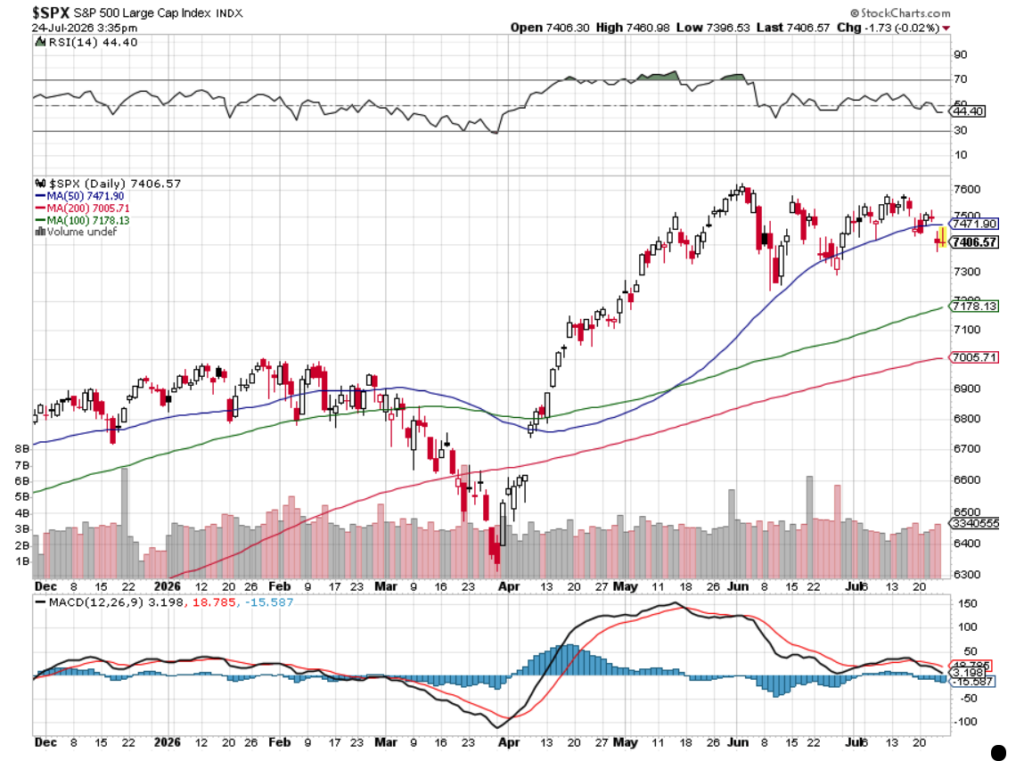
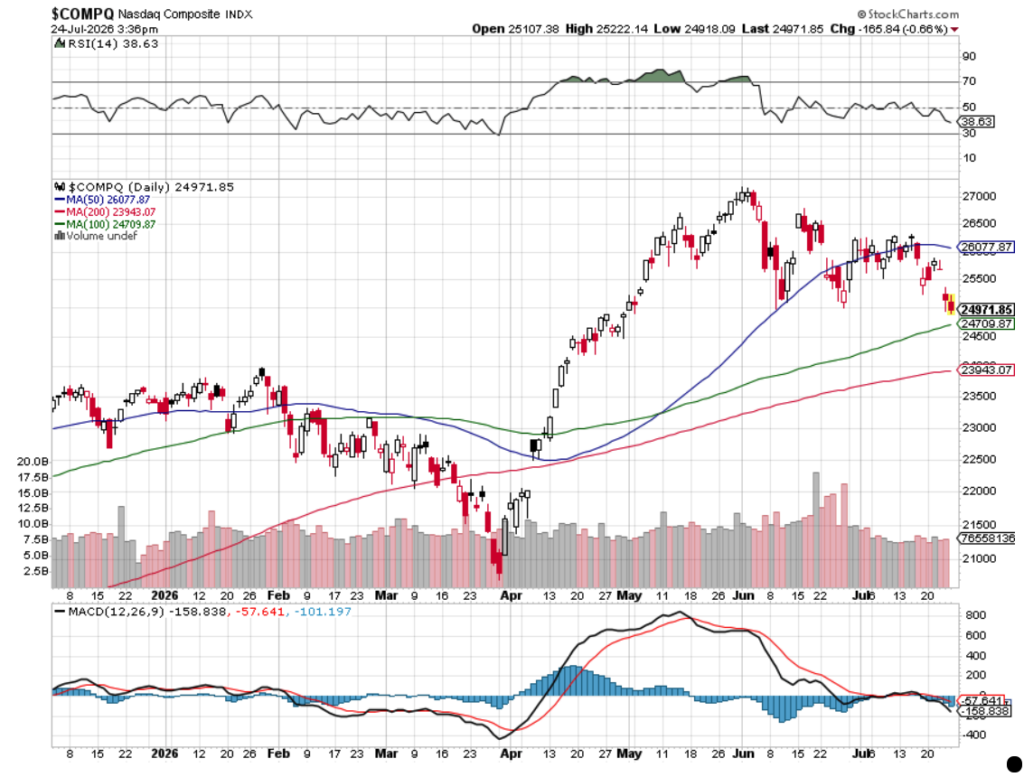
As we do all of that, we’ll continue to watch key support levels for the S&P 500 and Nasdaq Composite and be mindful of the market mood as we move deeper into earnings season.
Enjoy your weekend and be sure to read Saturday’s signals alert. See you back here, bright and early, on Monday.
Catching Up on the Portfolio This Week
The Pro Portfolio felt the pressure this week, especially in the Tech Sector that led the Nasdaq Composite to shed more than 2%. However, the Portfolio experienced a tamer decline of less than 1%, largely due to gains posted by United Rentals (URI), Paccar (PCAR), and Welltower (WELL). As we discussed Friday, we are keeping a close eye on Alphabet (GOOGL) and American Express (AXP) given the post-earnings drop in these shares in the face of developments that keep us bullish on both. If you missed those alerts, you can read the one for Alphabet here, and for American Express here.
The EPS All-Stars rose just under 2%, week over week, led by the double-digit gain in shares Eldorado Gold (EGO) as well as a rebound in Micron (MU), Seagate Technologies (STX) and Ciena (CIEN). That helps take some of the sting out of the basket’s quarter-to-date performance, which has been a drag on the Portfolio. Still, rising capex levels for AI and data-center capacity should be a tailwind for multiple holdings in the basket as should the growing disconnect between the demand for power and current capacity.
We opened the week putting fresh capital to work. We added to Boeing (BA) as the Farnborough Airshow delivered a string of new order wins and reinforced our thesis that production rates have room to climb well beyond the company’s currently disclosed pace — commentary from GE Aerospace (GE) on strengthening 787 engine demand only added to our conviction. We also built out our Neostellar Capital (NSLR) position, using a sharp, technically oversold dip to buy into weakness we viewed as overdone.
On the other side of Monday’s ledger, we trimmed the Portfolio’s exposure to Labcorp (LH), locking in a more-than-respectable gain. We also took our rating down a notch following HCA Healthcare’s (HCA) disclosure on lost ACA coverage, which raised concerns, especially with LH shares near the high-end of the trading range they have been trapped in for the last several months. We saw it as a good opportunity to bank some gains and rebuild cash heading into a heavier stretch of earnings.
On Tuesday, we added to the Portfolio’s positions in both Applied Materials (AMAT) and Marvell (MRVL) after Taiwan Semiconductor’s (TSM) pricing commentary and a guidance raise from wafer supplier IQE reaffirmed that AI and data-center chip demand remains very much intact, even as capacity constraints persist elsewhere. Both names had also found their footing technically at key moving averages, which gave us a cleaner entry to keep rebuilding positions we’d trimmed for gains earlier in the summer. In the same alert, we shared we’re keeping a close watch on Axon (AXON) shares, which have since moved below their 200-day moving average. The next level of support, the 100-day moving average, clocks in near $476.
On Thursday, we used a sharp pop in Labcorp shares to close out the rest of our position for a tidy gain, taking advantage of a stock that has repeatedly struggled to break through the same technical ceiling, all while geopolitical risk was pushing yields higher. We’ve parked Labcorp in the Bullpen for now and will look to re-engage if a better entry presents itself.
Also on Thursday, we raised our price target and checkpoint for United Rentals following a clean beat-and-raise quarter, with management’s commentary — echoed by both CSX (CSX) and Union Pacific (UNP) on their own earnings calls — reinforcing that data-center construction, power infrastructure investment, and re-shoring activity remain durable, multi-year demand drivers. Comments from CSX about tight truck capacity also bodes well for our position in Paccar, which reports next week.
Net-net, we closed the week with one less position and slightly higher cash levels as we get ready for earnings season to heat up further. As companies continue to report, we will continue to revisit our investment rationale for our holdings, making changes where necessary to best position the Portfolio for what’s ahead. That includes scouting for new additions.
Now let’s see what others on Wall Street had to say about the Portfolio’s holdings this week:
Monday, July 20: Phillip Securities upgraded Netflix (NFLX) to Buy from Accumulate with an unchanged price target of $110, following the stock’s recent selloff. CLSA initiated coverage of Microsoft (MSFT) with an Outperform rating and $535 price target. RBC Capital raised its Morgan Stanley (MS) target to $243 from $207.
Tuesday, July 21: Rothschild & Co. bumped up its Meta (META) target to $1,000 from $900. Wells Fargo took its Alphabet (GOOGL) target to $438, raised Amazon’s (AMZN) to $322, and hoisted Meta’s to $835. Morgan Stanley resumed coverage of Microsoft with an Overweight rating and a price target of $600.
Wednesday, July 22: Mizuho raised its Welltower target to $260 from $239.
Thursday, July 23: Pivotal Research nudged its Google target to $475, up $5, while Barclays lifted its a bit more to $425 from $405. Wedbush added GOOGL to the firm’s Best Ideas List, keeping an Outperform rating on the shares with a price target of $445. Freedom Broker upgraded Alphabet to Buy from Hold with an unchanged price target of $400. Morgan Stanley raised the firm’s price target on Apple (AAPL) to $364 from $360 and keeps an Overweight rating on the shares. BofA raised the firm’s price target on United Rentals to $1,300 from $1,195 and kept a Buy rating on the shares. UBS took its URI target to $1,350 from $1,300.
Friday, July 24: Citi raised its United Rentals target to $1,330 from $1,270, while Wells Fargo bumped its URI target to $1,355 from $1,245. Baird raised its Apple target to $330 from $310 and increased its United Rentals target to $1,300 from $1,275.
Key Global Economic Readings
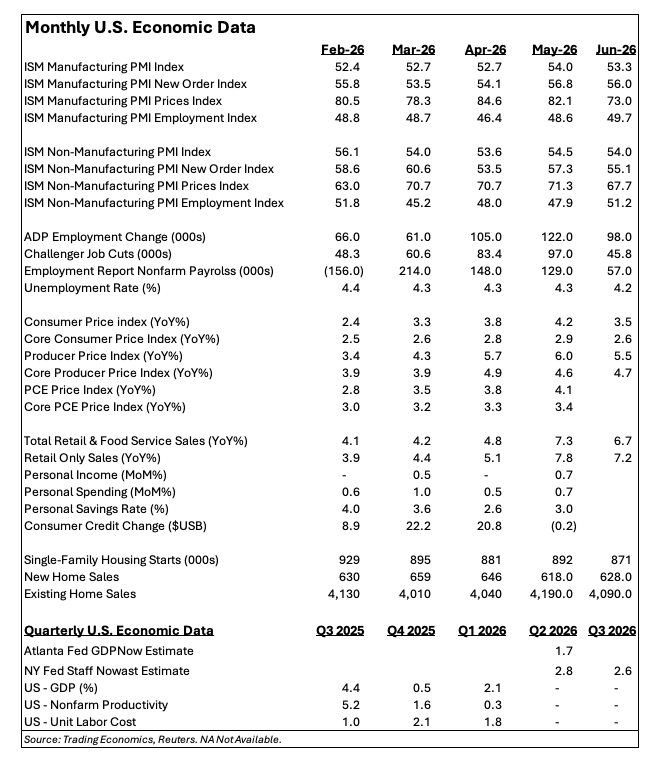
Chart of the Week: The Two-Year Treasury Yield
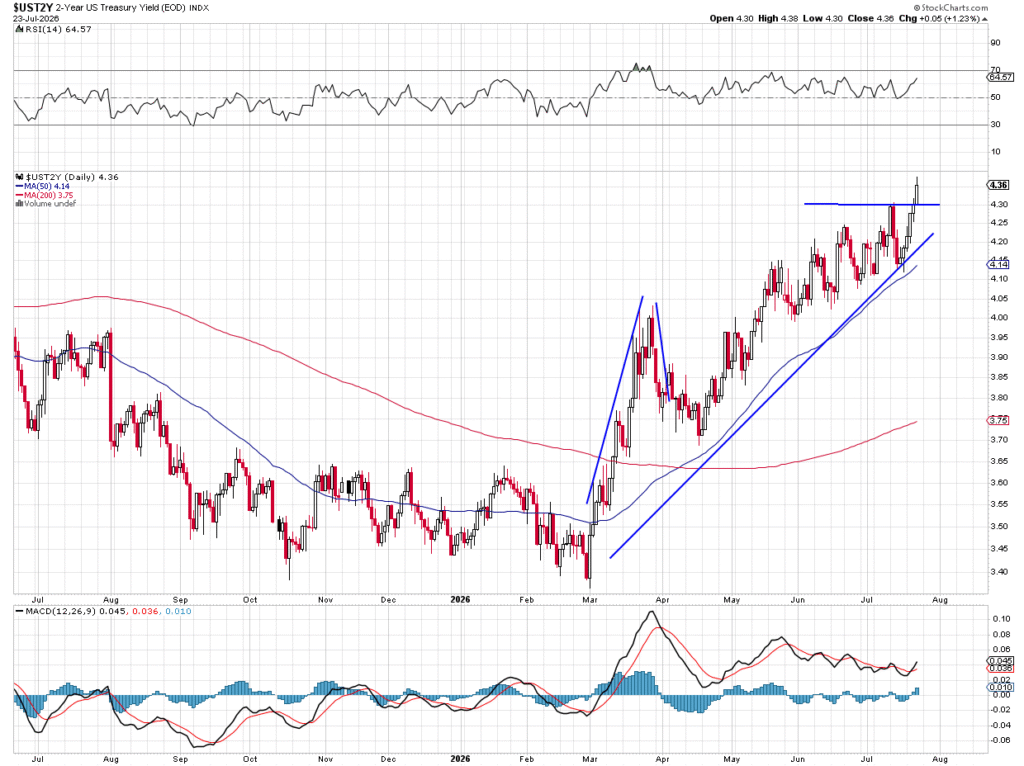
With the fifth Fed meeting of 2026 coming up next week it is time to look at short-term interest rates to see how they are currently priced and what may happen next. The two-day meeting on July 28/29 will be the second chaired by Kevin Warsh, who is looking to make some big changes on the committee with respect to analysis, communication and accountability.
Of course, these changes take time, but he is laying the foundation for a different way of analyzing data and presenting it to the public (or not). We’ll find out more of these plans in the press conference that follows.
When we consider the Fed Funds futures market, we should also pay close attention to what the 2-year U.S. Treasury yield is doing. This implied rate has historically been a good predictor of where rates will be in two years and filters out the noise of shorter-term paper like the 3-month, 6-month or even one-year note.
So, what is the 2-year yield telling us about the future of rates? Currently this bond trades in the market with a 4.36% yield, a far cry from the current Fed Funds rate of 3.5%, implying the market sees inflation rising over that time. The higher yield on the 2-year implies investors want to be compensated for that inflation, and if it is not “tamed” then it may continue rising.
Just to prove the market is right, we also looked at other yields like the one for the 10-year, which is useful as a marker for implied mortgage rates. The spread between the two yields should be rather wide but that has not always been the case. We analyze the spread by simply subtracting the yield of 10-year from the 2-year. This spread is currently 0.35. It had been coming down, implying slower growth and/or a shift in Fed policy.
The chart of the 2-year yield remains in a strong uptrend. Pushing to 4.36% is nearly 100 basis points more than where it was in late March. That is a staggering move, but the market is telling us inflation may be a huge problem in two years unless the Fed does something (raise rates) to eradicate it.
Other charts we shared with you this week were:
Monday, July 20: S&P 500 – Still Bullish… But Some Worry
Monday, July 20: Alphabet (GOOGL) – Setback for Alphabet
Tuesday, July 21: Welltower (WELL) – Welltower’s Technicals Tower Over the Competition
Wednesday, July 22: Micron (MU) – Micron Comes Down With a Bout of Volatility
Thursday, July 23: Palantir (PLTR) – Checking In on a Struggling Palantir
The Week Ahead
If this week felt busy, next week may be the single most important stretch of the entire earnings season — and it collides directly with the Fed. The FOMC meets Tuesday and Wednesday, with the rate decision due Wednesday afternoon and Fed Chair Kevin Warsh’s press conference to follow. This isn’t a meeting with an updated “dot plot,” so markets will be parsing Warsh’s tone as much as the decision itself — and given the hawkish drift in commentary and rhetoric we’ve heard recently, plus this week’s jump in oil and yields, we wouldn’t be surprised to see those comments be incrementally hawkish.
Supporting that thinking, Friday’s Flash July PMI report from S&P Global found that Input cost inflation rose to its highest since May 2025, as cooler manufacturing cost growth was more than offset by a 14-month high in services. Selling price inflation also accelerated as firms passed higher costs on to customers, with the overall rise in charges the steepest since August 2022.
That suggests we are likely to see an uptick in July inflation data compared to the reprieve we saw in the June data. Keep in mind this is the Flash report, and the data for that is typically capped at either the 22nd or 23rd day of the month. Should we see oil and petrochemical prices move even higher in the coming days, that will be reflecting in the July PMI data from ISM out the first week of August.
Thursday brings the first look at Q2 GDP and the June PCE inflation data — the Fed’s preferred inflation gauge — arriving just a day after the rate decision. That sequencing matters: If PCE comes in hotter than expected right after a hawkish-leaning Fed, we’d expect yields and rate-hike odds to climb further, adding to the pressure on growth and AI-linked names. Some would argue that a softer June PCE print would work the other way and could give the market room to breathe, but our thinking given the July move in energy prices and the findings of the Flash July PMI data discussed above, is most investors will look through soft June PCE figures.
On Friday, we will get the latest employment cost and consumer sentiment data. Useful color, but if this were a movie or a play, they would be part of the supporting cast compared to the Fed decision and the oil-inflation story.
Here’s a closer look at the economic data coming at us next week:
U.S.
Monday, July 27
Durable Orders – June (8:30 AM ET)
Tuesday, July 28
ADP Employment Change Report – Weekly (8:15 AM ET)
Advanced Retail & Wholesale Inventories – June (8:30 AM ET)
S&P Case-Shiller Home Price Index – May (9:00 AM ET)
FHFA House Price Index – May (9:00 AM ET)
Consumer Confidence – July (10:00 AM ET)
Wednesday, July 29
MBA Mortgage Applications Index – Weekly (7:00 AM ET)
EIA Crude Oil Inventories – Weekly (10:30 AM ET)
Fed Interest Rate Decision (2PM ET)
Thursday, July 30
Initial & Continuing Jobless Claims – Weekly (8:30 AM ET)
GDP – Q2 2026 (8:30 AM ET)
Personal Income & Spending – June (8:30 AM ET)
PCE Price Index – June (8:30 AM ET)
EIA Natural Gas Inventories – Weekly (10:30 AM ET)
Friday, July 31
Employment Cost Index – Q2 2026 (8:30 AM ET)
University of Michigan Consumer Sentiment Index (Final) – July (10:00 AM ET)
International
Monday, July 27
China: Industrial Profits – June
Japan: Leading Economic Index (Final) – May
Germany: Ifo Business Climate and Conditions – June
Wednesday, July 29
UK: Bank of England Consumer Credit – June
Thursday, July 30
Japan: Consumer Confidence – July
Germany: Flash GDP – Q2 2026
Eurozone: Flash GDP – Q2 2026
Eurozone: Economic Sentiment & Consumer Confidence – July
UK: Bank of England Interest Rate Decision
Germany: Inflation Rate (Prelim.) – July
Friday, July 31
China: NBS Manufacturing & Non-Manufacturing PMI – July
Japan: Bank of Japan Interest Rate Decision
Germany: Import Prices – June
Eurozone: Flash Inflation Rate – July
Next week isn’t just about the Fed an inflation. Arguably, it’s the single busiest stretch of earnings season, with nine Pro Portfolio holdings reporting alongside a parade of more than 177 S&P 500 companies and nine Dow 30 components. The week kicks off Monday afternoon with Welltower (WELL), which should continue to benefit from senior housing demand and management’s efforts to lean further into that growing tailwind.
Tuesday brings two Portfolio names before the bell. First is Boeing (BA), where investors will focus on delivery cadence and free cash flow progress as the company works through its production ramp. Second is Paccar (PCAR), and like Boeing our play here is with rising production volumes and the incremental operating leverage that should benefit its bottom line. Waste Management (WM) reports after the close and, while more defensive in nature, remains a steady contributor. Our focus in that report will be on pricing and margin trends as well as an update on its Healthcare Solutions integration.
The rest of Tuesday’s lineup reads like a who’s-who of consumer and industrial bellwethers — PayPal (PYPL) and Visa (V) on payment volumes and consumer spending health, United Parcel Service (UPS) on shipping volumes as a real-time economic pulse check, plus Coca-Cola (KO), Hilton (HLT), and Sherwin-Williams (SHW) rounding out a broad cross-section of the economy. With Coke’s earnings, we’ll be interested in the discussion around the recent cyberattack on its Fairlife business, which hobbled production.
Wednesday and Thursday is where things get interesting on the AI front, with two Portfolio names — Meta (META) and Microsoft (MSFT) — reporting after Wednesday’s market close followed by Amazon (AMZN) on Thursday. Together, this trio represents the epicenter of the AI capex story, and it’s hard to overstate how closely Wall Street will scrutinize their cloud segments. Azure, AWS, and Meta’s ad/AI infrastructure spend will be the real headline numbers: the big four hyperscalers are on pace for a combined $725 billion in capital spending in 2026, up roughly 77% from last year, with Amazon alone guiding to around $200 billion and Meta having already raised its full-year range to $125 billion-$145 billion.
As we discussed following Google’s Q2 2026 earnings results this week, the market continues to be anxious over potential overbuilding and whether the hyperscalers and others are able to monetize that oncoming capacity. That is why when we dig into the quarterly results and guidance from Meta, Amazon, and Microsoft, our focus will be on the AI and cloud runway suggested by backlog figures while also scrutinizing both reported margins and incremental operating margins per added dollar of revenue. Any hint of decelerating cloud growth alongside still-rising capex guidance would likely spook the market hard, given how much of this year’s index gains have ridden on the AI infrastructure narrative.
Thursday’s other headline name besides Amazon is Apple (AAPL). In the last several weeks, Apple has announced price increases averaging around 20% on MacBooks, iPads, and other hardware this summer, driven by a surge in memory and storage costs tied to AI data center demand. More recently, Apple has nudged up prices for various aspects that fall under its Services umbrella, a move that should help lift those already impressive margins.
The iPhone was spared in that round, but the market widely expects Apple to raise iPhone 18 pricing by 10-15% when the new lineup launches in September, with some estimates putting the Pro model increase at $50-$100. That sets up an important subplot for this print: Investors will want to hear how Apple is thinking about pricing power and demand elasticity heading into its most important product cycle of the year, particularly with memory costs unlikely to ease anytime soon.
The week wraps Friday with Eaton (ETN) reporting before the open. We continue to see the company extremely well positioned given the growing pain point between rising electricity demand and available capacity. It also stands to benefit from rising aerospace production. Those twin tailwinds keep us bullish on ETN shares.
Here’s a closer look at the earnings reports coming at us next week:
Monday, July 27
Close: Applied Digital (APLD), Celestica (CLS), F5 Networks (FFIV), Navitas Semiconductor (NVTS), Nucor (NUE), Welltower (WELL)
Tuesday, July 28
Open: American Tower (AMT), Armstrong World (AWI), Boeing (BA), Coca-Cola (KO), Corning (GLW), Herc Holdings (HRI), Hilton (HLT), Illinois Tool Works (ITW), Paccar (PCAR), PayPal (PYPL), Polaris (PII), Sherwin Williams (SHW), UPS (UPS)
Close: Avis Budget (CAR), Ford (F), KLA Corp. (KLAC), Mondelez (MDLZ), NXP Semiconductor (NXPI), Rush Enterprises (RUSHA), Skyworks (SWKS), Visa (V), Waste Management (WM)
Wednesday, July 29
Open: AstraZeneca (AZN), Eagle Materials (EXP), Flex (FLEX), General Dynamics (GD), Johnson Controls (JCI), M/I Homes (MHO), Procter & Gamble (PG), SK Hynix (SKHY), VF Corp. (VFC), Vulcan Materials (VMC)
Close: American Water Works (AWK), ARM (ARM), Chipotle (CMG), Equinix (EQIX), Fortinet (FTNT), Lam Research (LRCX), Meta (META), Microsoft (MSFT), Qualcomm (QCOM), Robinhood (HOOD)
Thursday, July 30
Open: AGCO (AGCO), Altria (MO), Bristol-Myers (BMY), Builders FirstSource (BLDR), Check Point Software (CHKP), Hershey Foods (HSY), Martin Marietta (MLM), Mastercard (MA), Quanta Services (PWR), Terex (TEX), Trinity Industries (TRN)
Close: Amazon (AMZN), Apple (AAPL), Floor & Décor (FND), Ingersoll-Rand (IR), Universal Display (OLED)
Friday, July 31
Open: AbbVie (ABBV), AutoNation (AN), Chevron (CVX), Colgate-Palmolive (CL), Dominion Energy (D), Eaton (ETN), Exxon Mobil (XOM), Lear (LEA), Linde (LIN), Magna (MGA)
Portfolio Investor Resource Guide
Economic Data: Here’s a List of Links to the Key Economic Data We Closely Watch
Investing Terminology: 16 Key Terms Club Members Should Know
10-Ks: Want to Know About a Stock? Read the Company’s Reports
10-Qs: Unlock the Numbers and Key Information Behind Your Stock With the 10-Q
Income Statement: Our Cheat Sheet to Understanding This Financial Document
Balance Sheet, Cash Flow Statements, and Dividends: How to Know If a Company Is Off-Kilter? Read Its Balance Sheet
Valuation Metrics: Everyone Wants a Value. Here’s How Investors Can Find
Thematic Investing 101 Webinar
Like the Benefits of ETFs? Let’s Talk About Models
The Portfolio Ratings System
1 – Buy Now (BN): Stocks that look compelling to buy right now.
2 – Stockpile (SP): Positions we would add to on pullbacks or a successful test of technical support levels.
3 – Holding Pattern (HP): Stocks we are holding as we wait for a fresh catalyst to make our next move.
4 – Sell (S): Positions we intend to exit.