Weekly Roundup: Market Sobers Up on Inflation
The full impact of the market's decline this week was blunted by our inverse ETFs, cash position, and several outperformers, including Apple, Axon, Costco, GLD and Alphabet.
You've reached your free article limit
You've read 0 of 1 free Pro articles.
Challenging conditions for the market brought on by sobering inflation reports ended with all four major stock market indexes closing the week lower as geopolitical tensions and March-quarter earnings guidance bubbled up. As we discussed in Friday’s video, we will be watching Middle East developments over the weekend and their implications for the start of trading next week. We will also be mindful of what that means for the S&P 500’s technical setup and support levels entering next week.
With several pieces of March inflation data and the market coming around to our way of thinking about rate cuts, the focus will shift next week to the March-quarter earnings season. Because of the expected acceleration in earnings growth compared to last year that commences in the June quarter, we see earnings guidance as a big factor for the market and where it heads next. That was made plain to see on Friday with earnings from JPMorgan (JPM), Wells Fargo (WFC), and Citigroup (C). While less than a handful of companies, the volume of those reports will grow considerably in the next few weeks, telling us how likely the market forecast captured in the below chart might be.
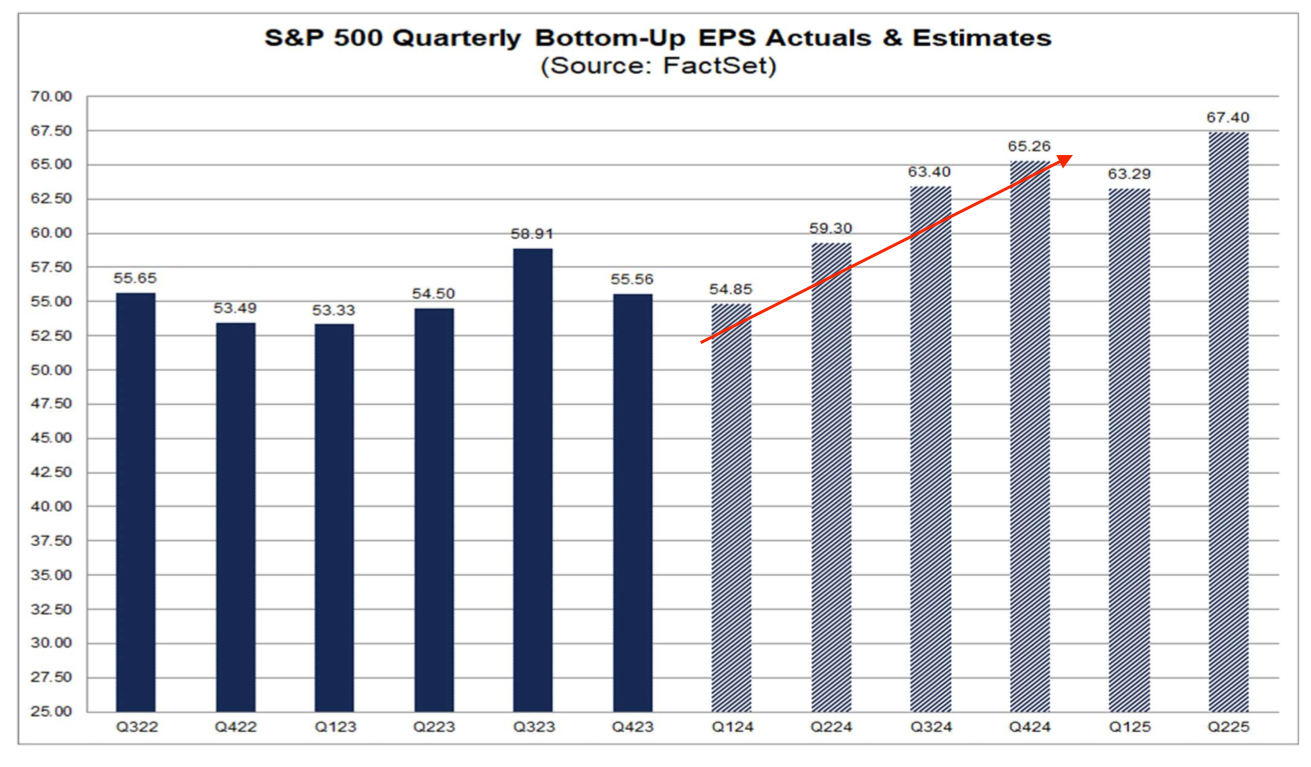
As we look at our holdings and those positions on our shopping list, we see drivers for improving earnings in the coming quarters. This weekend’s developments could either bring an opportunity to rework that list or reasons to be patient for a bit longer and potentially book another slice of gains in SPDR Gold (GLD) and Energy Select Sector SPDR Fund (XLE) shares. Once we have a clearer picture, we’ll know our next course of action.
Catching Up on the AAP Portfolio This Week
The market’s move lower was felt in the portfolio’s performance this week, but the full impact was blunted by our inverse ETFs as well as our cash position. Outperformers relative to the S&P 500 this week included Apple (AAPL), Axon (AXON), Costco (COST), SPDR Gold (GLD), and Alphabet (GOOGL), each of which finished the week higher. If we included those positions that didn’t fall as much as the S&P 500, that list would see more than a few additions.
Because of the timing for the March Consumer Price Index and Producer Price Index reports, the only addition we made was on Thursday to the portfolio’s holdings in Nvidia (NVDA). We didn’t book any gains this week, nor did we do any other portfolio selling.
As we head into next week and wait to see the outcome of rising Israel-Iran tensions, our shopping list remains the same – Universal Display (OLED), PepsiCo (PEP), Waste Management (WM), and if we get the right chance, Applied Materials (AMAT). At lower levels, we would be open to taking another bite of McDonald’s (MCD). Meanwhile, our plan to eventually exit our inverse ETF positions also remains in place.
This Week's Portfolio Videos and Podcasts
We cover a lot of ground during the week in our Daily Rundowns and the AAP Podcast. If you happened to miss one or more of them, here are some helpful links:
Monday, April 8: Key Reports and Events for Investors to Watch This Week
Tuesday, April 9: How March CPI Could Weigh on the Market and News From the Tech World
Tuesday, April 9: Portfolio Manager Cole Smead on Tech, Banks, and His 'Liberal Arts' Podcast
Wednesday, April 10: Here's Our Up-to-Date Shopping List Following the March CPI Report
Thursday, April 11: PPI's Trend, Our Nvidia Trade, Costco and Early Earnings to Watch
Friday, April 12: 3 Factors That Are Hitting Stocks Friday
Key Global Economic Readings
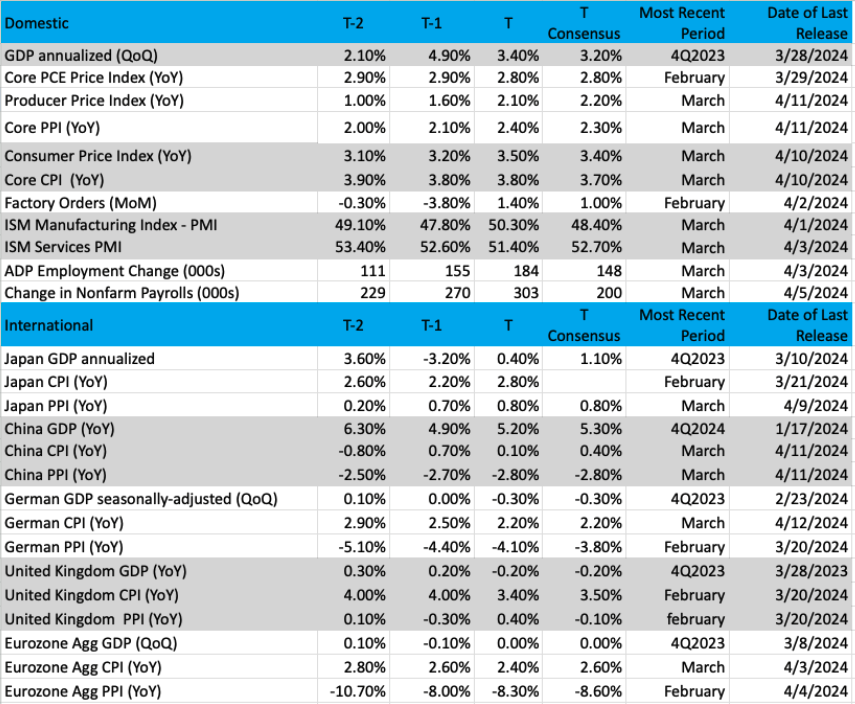
(Note: T is the most recent period, T-1 is the prior period's reading and T-2 is two periods back, the intent being to illustrate any trends)
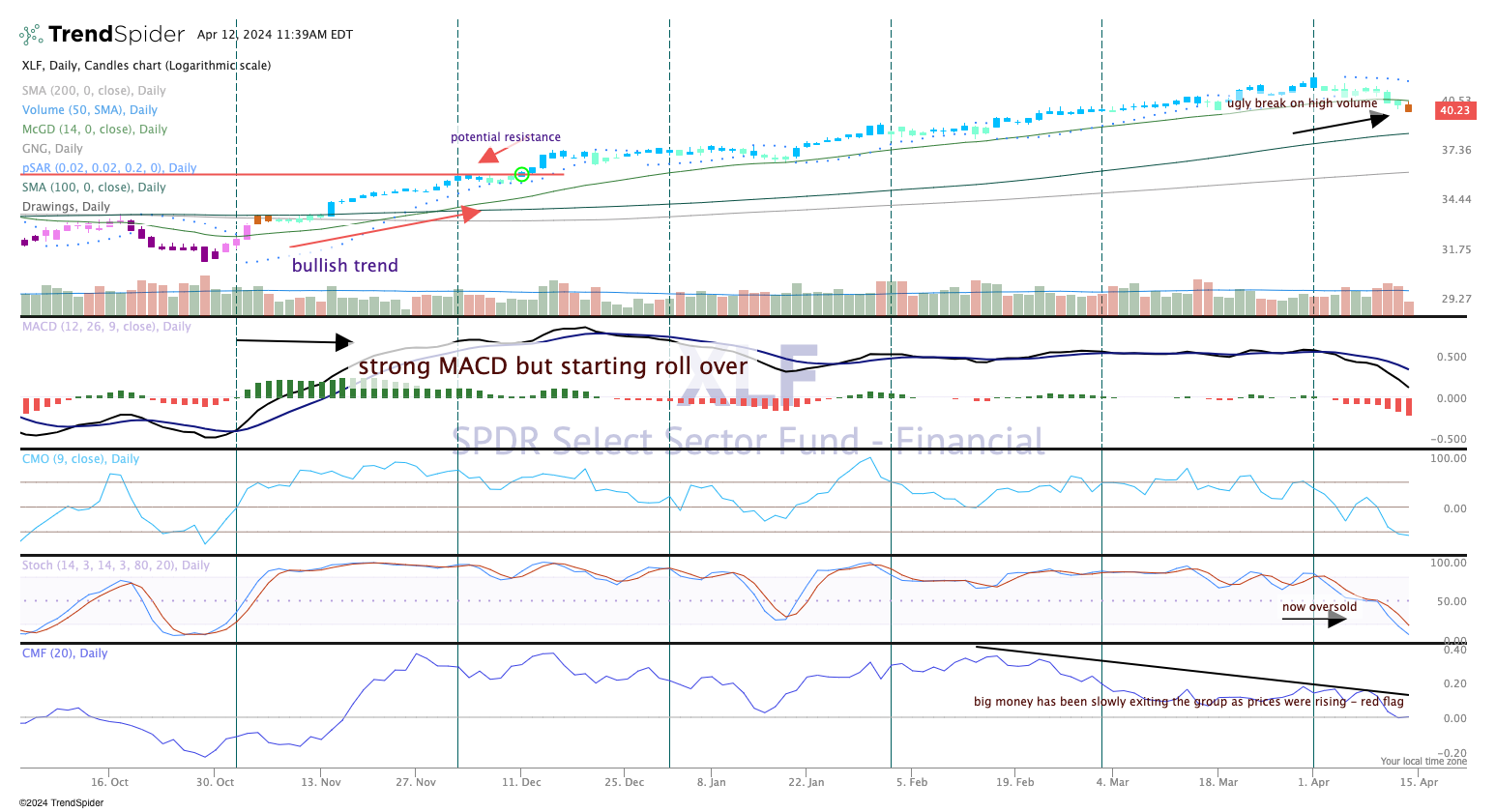
Chart of the Week: Financial Select SPDR Fund (XLF)
We have finally reached the point when earnings will start to matter. On Friday, April 12, we were treated to first-quarter results from JPMorgan, Citigroup, Wells Fargo, and fringe financial BlackRock. While posting strong results, the companies issued some cautious guidance on the economy, warning that inflationary trends remain even as prices are significantly lower than last year across the board. Next week we’ll have a handful more of banks/financial companies report and they may give us a similar read on the economy. But make no mistake, the push by the banks higher since the start of the year has been notable, leaving these stocks vulnerable to selling if their earnings report is not pristine.
The chart of the Financial Select SPDR Fund (XLF) has now fallen below strong support, and if it confirms that move next week, we’ll have a change in trend. But as we can see from the color shift in April from blue to teal that was already starting to happen a couple of weeks ago. Stochastics started to roll over back then and are now firmly on sell signals.
The high-volume selling of the past several days makes it difficult for the XLF to overcome resistance, but if the market turns up, we may find leadership again from the financials, such as we had seen earlier in the year.
Please click here for a larger view of this chart.
Other charts we shared with you this week were:
Monday, April 8: S&P 500 - We'll Ride the Momentum for Now
Monday, April 8: Lockheed Martin (LMT) - Lockheed Martin Is Set for Takeoff
Tuesday, April 9: Applied Materials (AMAT) - Applied Materials Is Right Where It Should Be
Wednesday, April 10: Meta Platforms (META) - Here's When We'd Add Meta to the Portfolio
Thursday, April 11: Costco Wholesale (COST) - Costco Heads Higher From a Solid Bottom
The Coming Week
We collect more March economic puzzle pieces next week with the release of the Retail Sales, Industrial Production, Housing Starts and Existing Home Sales reports. The manufacturing data found in the Industrial Production report will give another view of what we saw in the March Manufacturing PMI reports earlier this month.
The increasing likelihood of far fewer than expected rate cuts will be a headwind for the housing market from an affordability perspective. We will look to this next iteration of the Housing Starts report to determine if a mid-single-digit increase is likely this year and what that could mean for our shares of United Rentals (URI) and Vulcan Materials (VMC) as well as two of our Bullpen residents.
Turning to the March Retail Sales report, we are expecting to see an uptick in overall spending due to Amazon’s (AMZN) spring sales event and competing offers. That should lead to robust year-over-year sales gains for digital shopping. As we discussed in Thursday’s video, we’ll also be looking at the March report for what it says about trends in March for PepsiCo (PEP), McDonald’s (MCD), and Mastercard (MA), as well as the strength of their markets during Q1 2024. As we digest those insights, we’ll contemplate existing price targets and potential moves for those positions.
The other piece of data we’ll be thumbing through will be the next iteration of the Fed’s Beige Book, an anecdotal collection of comments and insights from the various regional Fed banks.
And while we have no fresh inflation data next week, there will be half a dozen or so appearances by Fed officials. Coming off this week’s March Consumer and Producer Price Indices, which were not good data for rate cuts, and the market coming around to our thinking about fewer cuts later in the year, we are likely to hear similar comments from those Fed heads. Following this week’s sobering inflation reports, both Bank of America and Deutsche Bank, which previously expected the Fed to start cutting rates in June now see the central bank doing only one rate cut in December.
Here's a closer look at the economic data coming at us next week:
U.S.
Monday, April 15
· Retail Sales – March (8:30 AM ET)
· Business Inventories – February (8:30 AM ET)
· NABH Housing Market Index – April (10:00 Am ET)
Tuesday, April 16
· Housing Starts & Building Permits – March (8:30 AM ET)
· Industrial Production & Capacity Utilization – March (8:30 AM ET)
Wednesday, April 17
· Weekly MBA Mortgage Applications (7:00 AM ET)
· Weekly EIA Crude Oil Inventories (10:30 AM ET)
· Fed Beige Book
Thursday, April 18
· Weekly Initial & Continuing Jobless Claims (8:30 AM ET)
· Existing Home Sales – March (10:00 AM ET)
· Leading Indicators – March (10:00 AM ET)
· Weekly EIA Natural Gas Inventories (10:30 AM ET)
International
Monday, April 15
● Eurozone: Industrial Production - February
Tuesday, April 16
● China: GDP Growth Rate - 1Q 2024
● China: Retail Sales, Industrial Production - March
● Eurozone: ZEW Economic Sentiment Index - April
Wednesday, April 17
● Eurozone: Inflation Rate - March
Thursday, April 18
● China: Foreign Direct Investment - March
Friday, April 19
· Japan: Inflation Rate – March
· Eurozone: New Car Registrations – March
· Germany: PPI - March
· UK: Retail Sales - March
The pace of quarterly earnings picks up next week with roughly 200 companies reporting, including more than 30 S&P 500 constituents. While that level of S&P 500 companies won’t be enough to give us a clear earnings picture for the overall basket, we’re sure there will be many usable nuggets when it comes to our holdings. From a portfolio perspective, we have quarterly results from Bank of America (BAC) and Morgan Stanley (MS) on Tuesday, April 16, and Elevance Health (ELV) on Thursday, April 18.
Outside of those reports, we will be focused on Taiwan Semiconductor’s (TSM) earnings, its end-market breakdown, and its outlook for those markets when it publishes its March-quarter results on Wednesday, April 17. As we work through those learnings, we’ll revisit our price targets and positions for Nvidia (NVDA), Marvell (MRVL), Qualcomm (QCOM), Universal Display (OLED), and Apple (AAPL). Should TSM boost its capital spending forecast for 2024, it would be a reason for us to rethink our price target for Applied Materials (AMAT) as well.
We will also be mining earnings reports from Crown Castle (CCI), Discover Financial Services (DFS) D.R. Horton (DHI), Nokia (NOK), American Express (AXP), ASML (ASML), and Procter & Gamble (PG) for insights relating to our holdings due to report in the coming weeks.
Here's a closer look at the earnings reports coming at us next week:
Monday, April 15
● Open: Charles Schwab (SCHW)
Tuesday, April 16
● Open: Bank of America (BAC), BNY Mellon (BK), Ericsson 9ERIC), Goldman Sachs (GS), Johnson & Johnson (JNJ), Morgan Stanley (MS), PNC (PNC), United Health (UNH)
● Close: Interactive Brokers (IBKR), JB Hunt (JBH), United Airlines (UAL)
Wednesday, April 17
● Open: Abbott Labs (ABT), ASML (ASML),
● Close: Alcoa (AA), Crown Castle (CCI), CSX (CSX), Discover Financial Services (DFS)
Thursday, April 18
● Open: DR Horton (DHI), Elevance Health (ELV), Nokia (NOK), Taiwan Semiconductor (TSM)
● Close: Netflix (NFLX)
Friday, April 19
● Open: American Express (AXP), Procter & Gamble (PG)
Portfolio Investor Resource Guide
● Economic Data: Here's a List of Links to the Key Economic Data We Closely Watch
● Investing Terminology: 16 Key Terms Club Members Should Know
● 10-Ks: Want to Know About a Stock? Read the Company's Reports
● 10-Qs: Unlock the Numbers and Key Information Behind Your Stock With the 10-Q
● Income Statement -Our Cheat Sheet to Understanding This Financial Document
● Balance sheet, Cash Flow Statements, and Dividends - How to Know If a Company Is Off-Kilter? Read Its Balance Sheet
● Valuation Metrics - Everyone Wants a Value. Here's How Investors Can Find
Portfolio Ratings System
1 - Buy Now (BN): Stocks that look compelling to buy right now.
2 - Stockpile (SP): Positions we would add to on pullbacks or a successful test of technical support levels.
3 - Holding Pattern (HP): Stocks we are holding as we wait for a fresh catalyst to make our next move.
4 - Sell (S): Positions we intend to exit.
ONES
Alphabet GOOGL; $157.73; 1,035 shares; 3.92%; Sector: Communication Services
WEEKLY UPDATE: Our view has been not to count Google out of the AI race given the volume of data across its businesses, which in our view, positions it well on the consumer side of the AI equation. The company held its Google Cloud Next event this week that showcased a number of announcements, including its in-house Axion chips and its AI-powered video creation Workspace App called "Vids.” Google highlighted how companies across a range of industries are already using its various AI products. For example, one short video features Mercedes-Benz CEO Ola Kallenius, who said the automaker is applying Google Cloud AI for sales assistants, improving call centers, and optimizing marketing. Other companies with executives featured in brief video appearances included Uber, Walmart, and Goldman Sachs. Following the event, JPMorgan reiterated its "Overweight" rating and $165 price target for GOOGL shares as did Morgan Stanley, while Wedbush reiterated its $175 target. We see both its Search and YouTube businesses benefitting from the continuing shift to digital advertising, but those businesses should benefit in 2024 as digital advertising tied to the 2024 presidential election heats up.
1-Wk. Price Change: 3.4%; Yield: 0.00%
INVESTMENT THESIS: We believe that while search and digital ad dominance are what will carry shares in the near- to mid-term, longer-term it is the company's artificial intelligence "moat" that will provide for new avenues of growth. AI is what has made the company's search, video, and targeted ad capabilities best-in-class and is the driving force behind the company's success in voice (Google Home) and autonomous driving (Waymo). Furthermore, we believe it is this AI expertise that will also make the company more prevalent in other industries, including healthcare via its subsidiary Verily, as AI and machine learning continue to disrupt operations across industries. Lastly, adding to our positive view of the company's future opportunities, we believe that Alphabet's free cash flow generation and solid balance sheet set it apart and are what will allow the company to continue taking chances on far-out ground-breaking and potentially world-changing projects. The company is also preparing to roll out Gemini Subscription with enterprise plans for workspace, according to a report. All good news for Alphabet.
Target Price: Reiterate $165; Rating: One
Panic Point: $125
RISKS: Regulatory risk (data privacy), competition, and macroeconomic slowdown impacting consumers and therefore ad buyer activity.
Amazon AMZN; $186.13; 835 shares; 3.72%; Sector: Consumer Discretionary
WEEKLY UPDATE: Amazon AMZN shares continued to power ahead this week, bringing the month-to-date gains to nearly 5% compared to a modest decline for the S&P 500. During the week Amazon appointed Andrew Ng managing general partner of the AI Fund and the co-founder of DeepLearning.AI, suggesting the company remains focused on AI. That focus was also present in CEO Andy Jassy’s 2023 shareholder letter, which called out AI as the “largest technology transformation since the cloud… and perhaps the internet.” He naturally went on to point out how Amazon is well positioned because of Amazon Web Services' own AI efforts as well as its investments in companies like Anthropic. Jassy also highlighted that Amazon's advertising business is strong, growing 24% year over year in 2023 to $47B on the strength of sponsored ads. Perhaps the greatest takeaway from Jassy’s letter was that cost reduction remains a key focus of management and the team has “found several areas where we believe we can lower costs even further while also delivering faster for customers.” This suggests we could see further margin improvement in the coming quarters and the potential for EPS expectations to be dialed up even further. The March Retail Sales report findings will give us a good reason to revisit our AMZN price target. We expect the report will show a meaningful increase in digital shopping because of Amazon’s “Big Spring Sale” event, the first of its kind in the March quarter. While Amazon was tight-lipped about the results, data from CivicScience suggests 36% of U.S. consumers shopped the event.
1-Wk. Price Change: 0.6%; Yield: 0.0%
INVESTMENT THESIS: We believe upside will result from Amazon's continued eCommerce dominance, AWS's continued leadership in the public cloud space, and ongoing growth of the company's advertising revenue stream, which feeds off Amazon's eCommerce business. Additionally, we believe profitability will continue to improve as AWS and advertising account for a larger portion of total sales as both these segments sport higher margins than the eCommerce operation. While we believe the increasing share of the revenue from these higher margin businesses will be key to driving profitability longer-term, we think margins on eCommerce stand to improve as the company's infrastructure is further built out and economies of scale further kick in. The embedded call option is that management is always looking to enter a new space and generate new revenue streams.
Target Price: Reiterate $200; Rating: One
Panic Point: $147
RISKS: High valuation exposes the stock to volatile swings, eCommerce has exposure to slower consumer spending and competition, management is not afraid to invest heavily, potential headwinds resulting from new eCommerce regulation in India, and management is not scared to invest aggressively for growth, which can at times cause volatile reactions as near-term concerns arise relating to the impact on margins.
Coty Inc. COTY ; $10.51; 13,705 shares; 3.44%; Sector: Consumer Discretionary
WEEKLY UPDATE: Morgan Stanley published a note on consumer staples performance in the March quarter, calling out Coty’s COTY as a positive standout. Coty’s shares have been under some pressure the last couple of weeks following the “shoot first, ask questions later” reaction to Ulta Beauty’s JPMorgan conference appearance. Related headlines pointed to a sudden and sharp slowdown in the beauty business, and while Ulta did discuss slower growth prospects as well as market-share loss in a few categories, comparing those comments against Ulta’s March 14, 2024, outlook, they look more like a reiteration than any meaningful revision. As we pointed out, Coty largely does not compete in either of the two beauty categories where Ulta has been losing share. The stock has fallen about 17% in six weeks, which seems rather overdone, and explains why DA Davidson reiterated its "Buy" rating and price target of $17.50 earlier this week.
1-Wk. Price Change: -4.7%; Yield: 0.0%
INVESTMENT THESIS: Founded in Paris in 1904, Coty is one of the world's largest beauty companies with a portfolio of iconic brands across fragrance, color cosmetics, and skin and body care. Coty serves consumers around the world, selling luxury and mass-market products in more than 130 countries and territories. The company derives almost 45% of its revenue from the Americas, 44% from Europe, the Middle East, and Africa, and the balance from Asia Pacific. By revenue category, Prestige drives 62% of Coty's revenue but more than 80% of its operating income with the balance derived from its Consumer Beauty segment. Management intends to further grow the Prestige business, expanding its prestige fragrance brands, through the ongoing expansion into prestige cosmetics, and the building of a comprehensive skincare portfolio leveraging existing brands. Management is also targeting margin improvement at its Consumer Beauty brands as well as expanding its presence in China across both of its reporting segments. China's beauty and personal care market is expected to grow at a quicker pace of 5.4% per annum through 2027, putting it at $70 billion-$75 billion by 2027.
Target Price: $14; Rating: One
Panic Point: $9.50
RISKS: Industry competition and consolidation, product efficacy and safety, currency, and brand licensing.
Marvell Technology MRVL; $70.16; 2,370 shares; 4.02%; Sector: Technology
WEEKLY UPDATE: Following Marvell’s MRVL “Accelerated Infrastructure for the AI Era” event on Thursday, and Friday we reiterated our One rating and $95 price target. We expected it was going to be an upbeat one, and the company did not disappoint as it discussed the expected multi-year impact of AI on its Data Center business. But it also confirmed our thinking that would lead to a pull-through for its other digital infrastructure businesses. During the event, Marvell shared a top-down view of more than $2 trillion coming over the next decade in Data Center investments due to AI. This suggests we are in the early innings of AI and supports our thinking the coming upgrade cycle led by AI-on-devices will turbocharge the need for not only data center investments but also those for network and carrier infrastructure. Marvell also said it has won a third custom chip customer, which brings Microsoft into its customer fold alongside Amazon and Google. Management expects that business should hit more than $550 million this year, $1.5 billion next year, and $2.5 billion in 2026 as the business between just Amazon and Google ramps. On Friday, Roth MKM renewed its "Buy" rating on MRVL as well as its $95 price target, KeyBac confirmed its "Overweight" rating and $90 price target, and Cantor Fitzgerald reiterated its $85 price target. The next catalyst for MRVL shares will be quarterly earnings next week from Taiwan Semiconductor on April 17.
1-Wk. Price Change: -3.4%; Yield: 0.3%
INVESTMENT THESIS: Marvell is a fabless supplier of high-performance standard and semi-custom infrastructure semiconductor solutions. These solutions power the data economy, enabling the data center, carrier infrastructure, enterprise networking, consumer, and automotive/industrial end markets. With roughly 75%-80% of Marvell's revenue stream tied to digital infrastructure, we see it continuing to benefit from rising content consumption and creation. Pointing to that rising demand that necessitates network densification and the build of digital infrastructure, Ericsson sees global monthly average usage per smartphone reach 46 gigabytes (GB) by the end of 2028 vs. 19 GB in 2023 and 15 GB in 2022.
Target Price: Reiterate $95; Rating: One
Panic Point: $57
RISKS: Technology risk, customer risk, competition risk, reliance on manufacturing partners, and supply chain constraints.
Vulcan Materials Company VMC ; $262.78 ; 613 shares; 3.87%; Sector: Building Materials
WEEKLY UPDATE: VMC shares received several price target increases this week, with Loop Capital upping its to $305 from $295, while Citigroup boosted its to $322 from $263. Next week, we’ll be digging into the March Housing Starts report to gauge housing construction activity and what that could mean for Vulcan’s aggregate business. We recognize winter weather, as well as some severe weather in key Vulcan geographic territories, could limit any potential upside surprise for Vulcan’s March-quarter results. Vulcan will report those results on May 2. We continue to see the shares benefitting from multiple stimulus streams on non-residential construction, and the eventual rebound in housing construction as the Fed enters the eventual rate-cutting cycle.
1-Wk. Price Change: -2.7%; Yield: 0.7%
INVESTMENT THESIS: Vulcan Materials operates primarily in the U.S. and is the nation's largest supplier of construction aggregates (primarily crushed stone, sand, and gravel), a major producer of asphalt mix and ready-mixed concrete, and a supplier of construction paving services. Its products are the indispensable materials used in building homes, offices, places of worship, schools, hospitals, and factories, as well as vital infrastructure including highways, bridges, roads, ports and harbors, water systems, campuses, dams, airports, and rail networks. Ramping spending associated with the Biden Infrastructure Law should drive demand for Vulcan's products over the coming years. Vulcan has historically complemented its organic growth prospects by acquiring businesses to expand its geographic reach and product scope. Since 2014, the company has acquired more than two dozen companies, including the 2021 acquisition of U.S. Concrete. That combination has allowed the company to deliver steady top and bottom-line growth over the last decade, with only a modest decline when the pandemic hit in 2020.
Target Price: Reiterate $310; Rating: One
Panic Point: $225
RISKS: General economic and business conditions; dependence on the construction industry; timing of federal, state, and local funding for infrastructure; changes in the level of spending for private residential and private nonresidential construction.
TWOS
Apple AAPL ; $176.55; 790 shares; 3.34%; Sector: Technology
WEEKLY UPDATE: After drifting lower since late February, AAPL shares rebounded nicely this week following three developments. First, was the March-quarter revenue report from Taiwan Semiconductor that showed its revenue climbed 16.7% year over year. We recognize that strength is likely due more to AI and data center demand than smartphone volumes, and we’ll look for more clarity on that end-market exposure when TSM reports next week. Its guidance for smartphones will also help set the tone for Apple’s iPhone guidance but we will also be listening for TSM’s comments about the AI-on-device rollout we see coming. Second and to that AI-on-device point, reports indicate Apple will focus its next version of its M-family of chips (M4) on artificial intelligence in an effort to boost Mac sales. Given the use of those chips in other Apple products, we suspect this also means AI will be included in iPhone as well as iPad. The third development was March-quarter share gains for Apple’s Mac business per findings from IDC that showed those shipment volumes rose 14.6% year over year, far faster than the 1.5% gain for overall PC industry shipments. We’ve shared expectations Apple shares will likely be rangebound until the company showcases its aggregate AI efforts at June’s 2024 WWDC event. We continue to see AAPL shares benefitting from the forthcoming AI-led upgrade cycle for PCs, smartphones, tablets, and other devices. We have a tiny bit of room to add a few more shares to the portfolio, something we would aim to do before the AI upgrade cycle begins.
1-Wk. Price Change: 4.1%; Yield: 0.5%
INVESTMENT THESIS: While we acknowledge that near-to-midterm performance remains heavily influenced by iPhone sales, the dynamic is shifting as investors finally place greater emphasis on Services growth. We are bullish on the 5G upgrade cycle and believe longer-term upside will continue to come as Services revenue grows its share of overall sales. Services provide for a recurring revenue stream at higher margins, a factor that serves to reduce earnings volatility while allowing for a higher percentage of sales to fall to the bottom line; as a result, we believe that Services growth and the installed base, are much more important than how many devices the company can sell in each 90-day period. In addition to improved profitability, we also believe the transparent nature of this revenue stream will demand an expanded price-to-earnings multiple as segment sales grow. Furthermore, we believe that Apple's desire to push deeper into the healthcare arena will help make its devices invaluable as more life-changing features are added and the company works to democratize health records. Lastly, also see upside resulting from increased adoption of wearables (think the Apple Watch) and potential new product announcements such as an AR/VR headset or an update on Project Titan, the company's secretive autonomous driving program.
Target Price: Reiterate $205; Rating: Two
Panic Point: Reiterate $150
RISKS: Slowdown in consumer spending, competition, lack of new product innovation, elongated replacement cycles, failure to execute on Services growth initiative.
Applied Materials Inc. AMAT ; $207.86; 275 shares; 1.37%; Sector: Semiconductor Manufacturing
WEEKLY UPDATE: AMAT is building a nice base here following a strong month of February. A two-month base is plenty of time for some sellers to get out of the stock (following a strong move up), replaced by strong-handed investors who see higher prices ahead. Staying above that 20-day moving average has been key for Applied. Market volatility is on the rise lately so we have seen big moves up/down for the stock, but the trend is still bullish and any deep pullback (to say the 50-day moving average at $198) would be ideal for adding more shares. On Friday New Street reiterated a "neutral" rating on Applied but raised its price target to $220 from $200. Cantor Fitzgerald upgraded to an "overweight" with a $260 price target. On Friday, Deutsche Bank initiated coverage in AMAT shares with a $225 target. Catalysts on the horizon include quarterly results from competitor Lam Research on April 24 and from lithography company ASML on April 17.
1-Wk. Price Change: 0.0%; Yield: 0.8%
INVESTMENT THESIS: Applied provides manufacturing equipment, services, and software to the semiconductor, display, and related industries. With its diverse technology capabilities, Applied delivers products and services that improve device performance, power, yield, and cost. Applied's customers include manufacturers of semiconductor chips, liquid crystal, and organic light-emitting diode displays, and other electronic devices. Applied operates in three reportable segments: Semiconductor Systems (73% of 2022 revenue, 78% of 2022 operating income), Applied Global Services (22%, 19%), and Display and Adjacent Markets (5%, 2%). Key customers include Samsung (12% of 2022 sales), Taiwan Semiconductor (20%), and Intel (10%).
Target Price: Reiterate $225; Rating: Two
Panic Point: $175
RISKS: Manufacturing and Supply Chain, Competitive Factors, Government Regulation, Technology Change.
Axon Enterprise AXON; $310.81; 535 shares; 4.01%; Sector: Aerospace & Defense
WEEKLY UPDATE: This week AXON shares hit a fresh high and broke out of its trading range of the last several weeks. The catalyst for both moves were Needham hiking its price target to a Wall Street high of $400 from $315, and JPMorgan lifting its target to $365 with a new "Overweight" rating. While we agree Axon has a strong and growing position in the public safety market, and we remain bullish on the positive mix shift toward cloud, we would rather see Axon court some wins with its recently acquired real-time crime center Fusus business than simply assume they will be had. Over the weekend, the International Security Conference & Exposition (ISC West) will conclude and as the dust settles on that event, based on program wins and other announcements we’ll revisit our AXON price target as needed.
1-Wk. Price Change: 0.3%; Yield: 0.00%
INVESTMENT THESIS: Axon Enterprise develops, manufactures, and sells conducted energy devices and cloud-based digital evidence management software designed for use by law enforcement, corrections, military forces, private security personnel, and private individuals for personal defense. The company operates in two segments: Taser and Software & Sensors. Taser develops and sells CEDs used for protecting users and virtual reality training. Software & Sensors manufactures fully integrated hardware and cloud-based software solutions such as body cameras, automated license plate reading, and digital evidence management systems. Axon delivers its products worldwide and gets most of its revenue from the United States. President Biden's fiscal year 2023 budget requests a fully paid-for new investment of approximately $35 billion to support law enforcement and crime prevention -- in addition to the President's $2 billion discretionary request for these same programs. According to Mordor Intelligence, the wearable, and body-worn cameras market on its own was valued at $1.62 billion in 2020 and is expected to reach $424.63 billion by 2026.
Target Price: Reiterate $330; Rating: Two
Panic Point: $260
RISKS: Manufacturing and supply chain, competitive factors, government regulation, technology change.
Bank of America Corp. BAC ; $35.79 ; 4,000 shares; 3.43%; Sector: Financial Services
WEEKLY UPDATE: Shares of Bank of America BACXL traded off this week, primarily after quarterly results on Friday from JPMorgan Chase, Citigroup, and Wells Fargo. While all three delivered stronger-than-expected top and bottom-line results for their March quarters, Net Interest Income (NII) prospects and expected expense growth, especially at JPMorgan, weighed on the shares. Bank of America previously guided its NII to fall in H1 2024 and rebound in H2 2024, and with its revenue mix more in line with JPMorgan, which essentially maintained its NII outlook for 2024, that should be what we hear next week. Our thinking is that improving investment banking activity and asset growth for its wealth management businesses should offset the impact of higher for longer interest rates. Bank of America will report its quarterly results on Tuesday, April 16. We are close to a full position with BAC shares, but if we see them fall back to the $32 level while the IPO market outlook continues to improve, it would be a great place to round out our position size.
1-Wk. Price Change: -3.6%; Yield: 2.7%
INVESTMENT THESIS: Bank of America is one of the world's leading financial institutions, serving individual consumers, small and middle-market businesses, and large corporations with a full range of banking, investing, asset management, and other financial and risk management products and services. The company provides unmatched convenience in the United States, serving approximately 67 million consumer and small business clients with approximately 3,900 retail financial centers, approximately 16,000 ATMs, and award-winning digital banking with approximately 56 million verified digital users. Bank of America is a global leader in wealth management, corporate and investment banking, and trading across a broad range of asset classes, serving corporations, governments, institutions, and individuals around the world. Bank of America offers industry-leading support to approximately 3 million small business households through a suite of innovative, easy-to-use online products and services. The company serves clients through operations across the United States, its territories, and approximately 35 countries. From a reporting basis, the company's business breaks down as follows: Net Interest Income breakdown: Consumer Banking 57%, Global Banking 23%, Global Wealth & Investment Management 14%, and Global Markets 6%; Income Before Tax breakdown: Consumer Banking 42%, Global Banking 27%, Global Wealth & Investment Management 16%, and Global Markets 15%. Bank of America pays a quarterly dividend of $0.22 per share.
Target Price: $39; Rating: Two
Panic Point: $31
RISKS: Financial markets, fiscal, monetary, and regulatory policies, economic conditions, and credit ratings.
Costco Wholesale COST ; $731.31; 240 shares; 4.22%; Sector: Consumer Staples
WEEKLY UPDATE: Costco COST not only delivered a knockout March revenue report this week, it also boosted its quarterly dividend by 13.7% to $1.16 per share. For now, we’ll keep our $800 price target, but if the company’s April sales show similar gains, it could be a reason for us to revisit that target with an upward bias. The first of that new quarterly dividends will be paid on May 10 to shareholders of record on April 26. We continue to wait for the eventual membership fee price increase announcement, one that will lead to upward EPS expectations and be a catalyst to boost our price target.
1-Wk. Price Change: 2.5%; Yield: 0.6%
INVESTMENT THESIS: We like Costco's long-term prospects, driven by a club-based operating model that focuses on volumes, not margins, and therefore offers its customers a value proposition of everyday low prices. The strength of this model has created an incredibly loyal customer base with low churn and continued share gains in both bricks-and-mortar and e-commerce. This is a global concept, evidenced by the strength of sales both in the U.S. and abroad, which includes an emerging China opportunity. We see the company's membership model as a key differentiator vs. other retailers and its plans to open additional warehouse locations in the coming quarters should drive retail volumes and the higher-margin membership fee income as well. We also appreciate management's approach to capital returns and their willingness to return cash when it is in excess on the balance sheet.
Target Price: Reiterate $800. Rating: Two
Panic Point: $615
RISKS: Inability to pass through higher costs, fuel prices, weaker consumer, and membership churn.
Elevance Health ELV; $497.49; 275 shares; 3.28%; Sector: Health Care
WEEKLY UPDATE: Ahead of Elevance ELV reporting its quarterly results on April 18, Cantor Fitzgerald reiterated its "Overweight" rating on the shares and its $580 target. Later in the week, Wells Fargo also reiterated its "Overweight" rating and moved its price target to $557. Higher inpatient medical occupancy rates, up more than 115 basis points in Q1 2024 compared to Q4 2023, bode well for Elevance’s earnings. We continue to favor the company’s expanding footprint and its position to benefit from the aging domestic population as well as its ability to keep a lid on costs. We look forward to management’s comments for 2025 private Medicare Advantage rates to increase by 3.7% in 2025 compared to 3.3% in 2024.
1-Wk. Price Change: -1.9%; Yield: 1.3%
INVESTMENT THESIS: Elevance, formerly Anthem/Blue Cross Health, is a premier healthcare brand that appears to be in the sweet spot for HMO companies. Mostly domestic, this company has a wide reach and coverage across the U.S., serving more than 118 million people via medical, pharmacy, clinical, and care solutions. Founded in 1944, Elevance offers a terrific business model that works in boom or bust economic times. The opportunity to find a company with reliable and dependable revenue and cash flows is right here with Elevance. Revenue growth for this company has surged in recent years, with better than double-digit growth since 2018 as the company thrived during the pandemic.
Target Price: Reiterate $550; Rating: Two
Panic Point: $425
RISKS: With any insurance business the risk is high for changes in regulation and government programs. Since the onset of Obamacare more than 10 years ago, companies like Elevance have changed their model to be more in line with a better cost/benefit analysis, reducing waste and squeezing out excesses (as was outlined and suggested in Obamacare). Separately, as the population increases and ages, there is more opportunity for Elevance to grow, but with those changes, there is a risk. Lastly, competition is brisk with some very strong opponents who keep their costs low (Humana, Cigna, UNH, CVS/Healthnet).
The Energy Select Sector SPDR Fund XLE ; $96.13; 1,345 shares; 3.10%; Sector: Energy
WEEKLY UPDATE: Energy names continue to remain hot; the XLE had a modest three-day correction but moved much higher towards the end of the week. Oil/gas traders are getting nervous over the rumors of an imminent attack on Israel by Iran, lifting crude prices into the weekend with WTIC pushing toward $90 per barrel. The growing view late in the week is Brent crude futures could spike to $100 per barrel if Iran directly attacks Israel. Looking at the chart, the parabolic move continues, and as long as oil remains well-bid so will this ETF. Recently we trimmed some shares to right-size the position, and based on weekend developments we may look to lock in another slice of these outsized gains.
1-Wk. Price Change: -2.0%; Yield: 3.5%
INVESTMENT THESIS: The Energy Select Sector SPDR Fund is an exchange-traded fund that tracks the performance of the Energy Select Sector Index. The ETF holds large-cap U.S. energy stocks. It invests in companies that develop & produce crude oil & natural gas and provide drilling and other energy-related services. The holdings are weighted by market capitalization.
Target Price: Reiterate $100; Rating: Two
Panic Point: $84
RISKS: Interest rates, weakness in the broad economy, energy prices.
First Trust Nasdaq Cybersecurity ETF CIBR ; $54.85; 2,530 shares; 3.33%; Sector: Cybersecurity
WEEKLY UPDATE: Another week, another raft of headlines for the latest hacks and cyber-attacks. The chart shows a gentle decline from recent highs at $59 after a monster run higher from late October 2023. With a series of lower highs, and lower lows the CIBR is in a downtrend. This glide-down has the CIBR nearly tagging the 100-day moving average, a spot where the ETF should catch some good support and likely a good buying opportunity (at $54.60 or so). Above the $58 level, CIBR looks primed to make another run at its previous highs.
1-Wk. Price Change: -1.6%; Yield: 0.0%
INVESTMENT THESIS: The First Trust Nasdaq Cybersecurity ETF seeks investment results that correspond generally to the price and yield (before the fund's fees and expenses) of an equity index called the Nasdaq CTA Cybersecurity Index. The Nasdaq CTA Cybersecurity Index is designed to track the performance of companies engaged in the cybersecurity segment of the technology and industrial sectors. It includes companies primarily involved in the building, implementation, and management of security protocols applied to private and public networks, computers, and mobile devices to protect the integrity of data and network operations. To be included in the index, a security must be listed on an index-eligible global stock exchange and classified as a cybersecurity company as determined by the Consumer Technology Association. Each security must have a worldwide market capitalization of $250 million, have a minimum three-month average daily dollar trading volume of $1 million, and have a minimum free float of 20%.
Target Price: Reiterate $62; Rating: Two
Panic Point: Reiterate $48
RISKS: Cybersecurity spending, technology, and product development, the timing of product sales cycle, new products, and services in response to rapid technological changes and market developments as well as evolving security threats.
Lockheed Martin Corp. LMT; $450.40; 330 shares; 3.58%; Sector: Aerospace & Defense
WEEKLY UPDATE: It seems that almost every week we learn of new program wins for Lockheed LMT that build up its multi-year backlog. That was again the case this week, but Lockheed was also awarded a $4.1 billion contract to maintain and upgrade the battle command system for the U.S. Missile Defense Agency. The program spans May 2024 to April 2029 and could be extended to April 2034. The nature of that win speaks to the multi-year visibility we like so much about Lockheed. Other notable wins this week include Greece signing a Letter of Offer and Acceptance for a fleet of 35 UH-60M Black Hawk aircraft from Lockheed’s Sikorsky unit. That bags a $1.95 billion win for the company. Ongoing tension in the Middle East and between Ukraine and Russia suggests we are likely to see more program wins as countries look to beef up and re-stock their defenses. However, the key catalyst we are waiting for will be the resumption of F-35 production, something that could come late in the quarter or early in the following one. We expect this will be a hot topic when Lockheed reports its quarterly results on April 23.
1-Wk. Price Change: -1.1%; Yield: 2.8%
INVESTMENT THESIS: Lockheed Martin is the largest defense contractor globally and has dominated the Western market for high-end fighter aircraft since the F-35 program was awarded in 2001. Lockheed's largest segment is aeronautics, which is dominated by the massive F-35 program. Lockheed's remaining segments are rotary and mission systems, which is mainly the Sikorsky helicopter business; missiles and fire control, which creates missiles and missile defense systems; and space systems, which produces satellites and receives equity income from the United Launch Alliance joint venture. Historically, the stability of defense spending has been a haven during periods of economic uncertainty, and we see that repeating once again even as geopolitical conflicts are likely to lead to incremental demand for Lockheed's products. The company has increased its dividend consistently over the last 19 years and is widely expected to boost it again in the coming days. In October 2022, Lockheed announced its board authorized the purchase of up to an additional $14.0 billion of LMT stock under its share-repurchase program.
Target Price: $520; Rating: Two
Panic Point: $375
RISKS: Contracts and budget risk with the U.S. government and the Department of Defense, F-35 program funding and renewal, competition, and subcontractor issues.
Mastercard MA; $465.38; 275 shares; 3.07%; Sector: Info. Tech
WEEKLY UPDATE: TD Cowen initiated coverage on MA shares with a "Buy" rating and a $545 target. During the week we explained why Mastercard’s geographic exposure sets it up well for the ongoing shift to card and digital payments from cash and checks. As we wait for Mastercard’s China JV to come on stream in the coming quarters, the market’s focus will remain on spending prospects, both consumer and corporate T&E. That means digging into next week’s March Retail Sales report. For now, our price target remains $490, but given the strength of the economy and return of real wage growth in the U.S., we will look for incremental upside to that target as retail sales data for the U.S., eurozone, and other key geographies are published. While we wait for that data, you should mark your calendar for May 9, which is when Mastercard will pay its next quarterly dividend of $0.66 per share. Ahead of Mastercard reporting its quarterly results on May 1, we will dig into earnings next week from American Express.
1-Wk. Price Change: -2.5%; Yield: 0.6%
INVESTMENT THESIS: Mastercard is a card network company that benefits from the secular shift away from cash transactions and toward card-based and electronic payments. On Covid-19 dynamics, we view MA as a "reopening" play and an economic recovery play within technology because its cross-border volumes fell sharply during the pandemic but will rebound as mobility increases and travel restrictions ease. Mastercard has more international exposure relative to Visa (V), making its growth outlook more susceptible to new travel restrictions. However, we view MA as the better long-term play as we are betting on that inevitable recovery.
Target Price: Reiterate $490 Rating: Two
Panic Point: $400
RISKS: The recovery in cross-border transactions, regulation in the payments market, competition from other fintechs, and pricing pressures.
McDonald's Corp. MCD ; $267.39; 455 shares; 2.92%; Sector: Consumer Cyclical
WEEKLY UPDATE: This week TD Cowen also reiterated its Buy rating on MCD shares and reiterated its $325 target price even though Stifel trimmed its target to $300 from $315. In Piper Sandler’s 47th semi-annual Taking Stock with Teens survey, McDonald’s jumped to the number two spot for restaurant preference, coming in ahead of Chipotle. We continue to see McDonald’s well positioned amid ongoing inflation pressures, which is leading diners to pivot to quick service and fast-food options over casual dining ones. We will be assessing consumer spending on restaurant dining for the March quarter when the March retail sales report is published early next week. MCD shares are oversold at current levels, and there is some support for the shares near the $262 level. We have some room to add to our MCD position, potentially before McDonald’s reports its Mach quarter results on April 30.
1-Wk. Price Change: 0.3%; Yield: 2.5%
INVESTMENT THESIS: The company franchises and operates McDonald's restaurants, which serve a locally relevant menu of quality food and beverages in communities across more than 100 countries. Of the 40,275 McDonald's restaurants at year-end 2022, approximately 95% were franchised. The U.S. market accounts for ~40% of total revenue, International 50%, and International Developmental Licenses Markets & Corporate ~10%. With consumers facing continued inflation pressures, we see McDonald's winning consumer wallet share as it benefits from pricing action put in place in recent quarters and improving input costs.
Target Price: $325; Rating Two
Panic Point: $240
RISKS: Consumer spending, competition, supply chain interruption, franchise business model, employment challenges.
Microsoft Corp. MSFT; $421.90; 325 shares; 3.29%; Sector: Technology
WEEKLY UPDATE: Coming into this week, Citi reiterated MSFT's place on its Research Recommended List as well as its $480 price target. Looking to steal some of the cloud and AI spotlight from Google, early in the week Microsoft announced it is opening a new AI hub in London, another step in driving adoption for Copilot and other AI efforts. On Thursday, Morgan Stanley shared its view that AI and related adoption could double Microsoft’s earnings by 2029. Along those lines, Morgan thinks by fiscal 2029 Microsoft could generate as much as $120 billion in revenue from generative AI, via its Azure cloud computing unit, a "growing" contribution from Copilot for Office 365, and "more modest growth" from its More Personal Computing Segment with upside potential from gaming. That line of thinking led Morgan to boost its price target on Microsoft to $520 from $465 and reiterate its "Overweight" rating on the stock. Similar to our comments with Axon and Needham’s price target boost late this week, while we agree there is much more upside to come as AI adoption plays out, we would prefer to see more concrete evidence before simply assuming the outcome. To us, a more realistic approach was taken by BMO Capital Markets, which raised its MSFT target to $465 from $455 on Friday.
1-Wk. Price Change: -0.9%; Yield: 0.7%
INVESTMENT THESIS: We believe the cloud to be a secular growth trend and that upside to the shares will result from Microsoft's hybrid cloud leadership as the company grabs market share in this expanding industry. While companies may look to build out multi-cloud environments, Microsoft's Azure offering will be a prime choice thanks to its decision to provide the same "stack" used in the public cloud, to companies for their on-premises data centers. Additionally, we would note that hybrid environments are currently the preference for most companies because they allow them to maintain critical data in-house while taking advantage of the agility and scalability provided by public clouds. Outside of the cloud opportunity, we maintain a positive view on the company's growing gaming business, which we believe is becoming an increasingly prominent factor in the Microsoft growth story as gaming becomes more mainstream, management works to convert its gaming revenue from one-time license purchase to a recurring subscription model and as technologies like augmented/virtual reality evolve. Finally, as it relates to LinkedIn and other subscription-based services such as O365 and various Dynamics products, we continue to value them highly for their recurring revenue streams, which, we remind members, provide for greater transparency of future earnings.
Target Price: $450; Rating: Two
Panic Point: Reiterate $350
RISKS: Slowdown in IT spending, competition, cannibalization of on-premises business by the cloud.
Morgan Stanley MS ; $86.19; 1,575 shares; 3.24%; Sector: Financial Services
WEEKLY UPDATE: Ahead of Friday’s big bank earnings, MS shares were under pressure following reports the company’s wealth management arm is being probed by multiple regulators. In an Alert to members, we shared our view that not all probes become larger matters and the worst-case outcome would likely see Morgan face a fine and be required to make some operational changes. MS shares traded off again on Friday following big bank earnings that raised questions about Net Interest Income (NII) prospects and expense growth. When we parse the reports from JPMorgan, Citigroup, and Wells Fargo, it appears the larger NII issue stems from higher-for-longer interest rates, offset by asset management growth and investment banking activity. That suggests a more positive outcome for Morgan’s March-quarter results next week. We have some room to add to our MS position in the portfolio and that will have us watching support levels as well as its outlook for the IPO market.
1-Wk. Price Change: -6.8%; Yield: 3.9%
INVESTMENT THESIS: Morgan Stanley reports in three business segments: Institutional Securities (42% of trailing 12-month revenue, 38% of trailing 12-month Income Before Tax), Wealth Management (48%, 55%) and Investment Management (10%, 6%). While the IPO window has yet to reopen, the potential IPO class for 2024 continues to build with recent additions including Panera Bread, Reddit, Fanatics, and Skims, which is backed by Kim Kardashian. This along with the Fed increasingly likely to start cutting rates in H1 2024, suggests we are far closer to the IPO window opening on a sustained basis than we have been in some time. That would be a boon to private equity firms and others that have been nursing IPO candidates during the dark period and a positive for Morgan's investment banking business. Marginally lower rates could also generate a pick-up in M&A activity as the cost of capital with rates improving. As the Fed continues its cutting cycle to get rates back to normalized levels, that effort would also reduce rates for stock market alternatives, ones that quashed the "there is no alternative" trade earlier this year. That along with folks continuing to be behind in retirement savings bodes well for Morgan's wealth management business in the coming quarters.
Target Price: $97; Rating Two
Panic Point: $78
RISKS: Market and interest rate risk, credit risk, country risk, and operational risk, including cybersecurity.
Nvidia Corp. NVDA; $881.86; 115 shares; 2.43%; Sector: Technology
WEEKLY UPDATE: Following Taiwan Semiconductor’s March-quarter revenue surge, we added to our position in NVDA this week. Estimates for Nvidia to retain up to 75% of the AI accelerator market tell us it remains well positioned. Some estimates put the AI accelerator market at around $90 billion this year, rising to about $200 billion in 2027. We also see Nvidia’s data center business well positioned as the looming AI-on-device upgrade cycle helps drive data center chip demand. Marvell’s $2 trillion forecast for data center spending over the next decade is also a very strong positive for Nvidia and our shares. In terms of our NVDA price target, we will revisit it once we have next week’s earnings report from TSM in hand. Not only will that give us the March-quarter revenue breakdown between High-Performance Computing (data center and AI) vs. smartphone, but TSM’s guidance will help us get our arms around market expectations for Nvidia as well.
1-Wk. Price Change: 0.2%; Yield: 0.0%
INVESTMENT THESIS: Nvidia is well positioned to benefit from ramping AI and data center spending. The company pioneered accelerated computing to help solve the most challenging computational problems. Nvidia is now a full-stack computing infrastructure company with data-center-scale offerings that are reshaping the industry. The company's full stack includes the foundational CUDA programming model that runs on all Nvidia GPUs, as well as hundreds of domain-specific software libraries, software development kits, or SDKs, and Application Programming Interfaces, or APIs. This deep and broad software stack accelerates the performance and eases the deployment of Nvidia accelerated computing for computationally intensive workloads such as artificial intelligence, or AI, model training and inference, data analytics, scientific computing, and 3D graphics, with vertical-specific optimizations to address industries ranging from healthcare and telecom to automotive and manufacturing. Nvidia reports in two business segments: Compute & Networking and Graphics. The Compute & Networking segment (78% of revenue, 85% of operating income) is comprised of Data Center accelerated computing platforms and end-to-end networking platforms including Quantum for InfiniBand and Spectrum for Ethernet; NVIDIA DRIVE automated-driving platform and automotive development agreements; Jetson robotics and other embedded platforms; Nvidia AI Enterprise and other software; and DGX Cloud software and services. The Graphics segment (22% of revenue, 15% of operating income) includes GeForce GPUs for gaming and PCs, the GeForce NOW game streaming service and related infrastructure; Quadro/NVIDIA RTX GPUs for enterprise workstation graphics; virtual GPU, or vGPU, software for cloud-based visual and virtual computing; automotive platforms for infotainment systems; and Omniverse Enterprise software for building and operating metaverse and 3D internet applications.
Target Price: $950; Rating Two
Panic Point: $760
RISKS: Market and interest rate risk, credit risk, country risk, and operational risk, including cybersecurity.
PepsiCo Inc. PEP; $168.10; 800 shares; 3.23%; Sector: Consumer Defensive
WEEKLY UPDATE: PEP has been trying to regain some positive footing but remains stuck in a wide twelve-point range. It is good for a stock to build a base and it appears the lower $160’s are an area where buyers are stepping in to buy. That’s an important reference point as we would suggest adding to shares at that level (between $162-$166). With earnings coming out soon we may see Pepsi moving sharply off this level, especially if our thinking management’s initial 2024 outlook was conservative rings true. During the week, Barclays raised their price target to $184 from $183 (yes, really!) and kept an overweight rating in front of their Q1 report. Remember last week Jefferies joined our thinking that PepsiCo management’s outlook for 2024 looks to be conservative. The firm added PEP shares to its Franchise Picks List and upped its target to $209 from $199. Next week brings the March Retail Sales report, and based on what it finds for grocery spending in March and Q1 2024, we will plot our next move with PEP shares.
1-Wk. Price Change: -0.6%; Yield: 3.0%
INVESTMENT THESIS: PepsiCo is one of the largest food-and-beverage companies globally. It makes, markets, and sells a slew of brands across the beverage and snack categories, including Pepsi, Mountain Dew, Gatorade, Doritos, Lays, and Ruffles. The firm uses a largely integrated go-to-market model, though it does leverage third-party bottlers, contract manufacturers, and distributors in certain markets. In addition to company-owned trademarks, Pepsi manufactures and distributes other brands through partnerships and joint ventures with companies such as Starbucks. The combination of the consumable nature of those products along with PepsiCo's ability to realize price increases has led to consistent revenue, EPS, and dividend growth during both the Great Recession and the Covid pandemic.
Target Price: Reiterate $185; Rating: Two
Panic Point: $145
RISKS: Economic conditions, supply chain constraints, raw material costs.
Qualcomm Inc. QCOM ; $171.29; 1,040 shares; 4.29%; Sector: Technology
WEEKLY UPDATE: QCOM shares are once again bumping up against our price target after receiving two price target increases this week to $200 and $205 from Bernstein and Susquehanna. Both are aligned in our thinking that Qualcomm’s business and our shares will benefit from the looming AI-on-device upgrade cycle. When Taiwan Semiconductor reports its March-quarter results next week we’ll have far greater insight into the end-market mix that drove its 16.5% year-over-year revenue increase for its March quarter. TSM’s guidance will also reaffirm smartphone market expectations for at least H1 2024. As Qualcomm announces AI-related wins, we suspect the market will rethink not only how it values QCOM shares but also the 2024-2025 smartphone upgrade cycle. Indications the AI-on-device smartphone upgrade cycle is catching on, new program wins or favorable monthly revenue reports from TSM are all catalysts that could lead us to revisit our QCOM price target.
1-Wk. Price Change: -0.1%; Yield: 2.0%
INVESTMENT THESIS: Qualcomm focuses on foundational technologies for the wireless industry, including 3G (third generation), 4G (fourth generation), and 5G (fifth generation) wireless technologies and processor technologies including high-performance, low-power computing, and on-device artificial intelligence technologies. As a connected processor company, its technology roadmap aims to enable the connected intelligent edge (the next generation of smart devices) across industries and applications beyond handsets, including automotive and the Internet of Things (IoT). Qualcomm has three reportable segments: QCT (Qualcomm CDMA Technologies) semiconductor business, which develops and supplies integrated circuits and system software based on 3G/4G/5G and other technologies for use in mobile devices; automotive systems for connectivity, digital cockpit, and ADAS/AD; and IoT including consumer electronic devices; industrial devices; and edge networking products. QCT accounts for 80%-85% of revenue. QTL (Qualcomm Technology Licensing) licensing business grants licenses or otherwise provides rights to use portions of the company's intellectual property portfolio, which includes certain patent rights essential to and/or useful in the manufacture and sale of certain wireless products. QTL accounts for ~15% of Qualcomm's revenue but contributes a greater portion of the company's operating income.
Target Price: $175; Rating Two
Panic Point: $140
RISKS: Customer risk, technology advancement, competition risk, third-party supplier, and manufacturing partner risk.
SPDR Gold Shares ETF GLD ; $216.89; 312 shares; 1.62%; Sector: Commodities
WEEKLY UPDATE: Gold continued to make new highs this week, trading above $2,400 per ounce for the first time on April 12. That put the metal up more than 4% this week. Our GLD ETF was higher on very strong turnover, which tells us big institutions are still buying even at high levels. Gold is a great alternative to fiat currencies like the U.S. dollar if inflation is starting to rise. The yellow metal has historically done a nice job sniffing out price imbalances (inflation). The GLD hit an all-time high this week again as the chart has gone parabolic with the shares moving past our recently raised price target. are happening now. Potential Fed rate cuts coming off the table implies inflation is still too high as has been mentioned several times by Chair Powell and other Fed officials. Increasing geopolitical tensions are also a contributor. Should GLD keep climbing much further, the smart move will be to realize at least a portion of these sharp gains.
1-Wk. Price Change: 0.8%; Yield: 0.0%
INVESTMENT THESIS: The GLD ETF is a proxy for gold. This "trust" buys and sells gold futures each day to mimic the daily moves in the underlying asset, in this case, gold. We see gold as an ideal hedge against a weaker dollar, strong inflation (which tends to weaken the dollar) alternative, and in uncertain times (worry over war and battles). For the past 15 years, gold has been a strong asset class held by fund managers, countries, and banks. The metal is not correlated with markets and will move based on the demand/supply dynamic in the marketplace. Other precious metals such as silver and platinum are good proxies for the criteria stated earlier, however, gold is far more liquid and offers better upside opportunities.
Target Price: Reiterate $220; Rating: Two
Panic Point: $190
RISKS: Weak inflation data, interest rate risk, dollar strength relative to other currencies, geographic risk.
United Rentals URI ; $674.81; 232 shares; 3.74%; Sector: Industrials
WEEKLY UPDATE: There we no meaningful developments for URI this week. Following the February Construction Spending report that showed double-digit non-residential spending gains for February and the first two months of 2024, we recently lifted our URI price target to $750 from $700. We continue to see the share benefitting from multiple stimulus streams on non-residential construction, and the eventual rebound in housing construction as the Fed enters the eventual rate-cutting cycle.
1-Wk. Price Change: -4.5%; Yield: 1.0%
INVESTMENT THESIS: United Rentals, the largest equipment rental company in the world, operates throughout the United States and Canada, and has a limited presence in Europe, Australia, and New Zealand. It serves industrial and other non-construction; commercial (or private non-residential) construction; and residential construction. Industrial and other non-construction rentals represented approximately 50% of rental revenue, primarily reflecting rentals to manufacturers, energy companies, chemical companies, paper mills, railroads, shipbuilders, utilities, retailers, and infrastructure entities; commercial construction rentals represented approximately 46% of rental revenue, primarily reflecting rentals related to the construction and remodeling of facilities for office space, lodging, healthcare, entertainment, and other commercial purposes; and residential rentals around 4% of revenue. We see the company benefiting on three fronts -- the seasonal uptick in construction spending; the release of funds and projects associated with the five-year Biden Infrastructure Bill; and the company's nip-and-tuck acquisition strategy that should further enhance its geographic footprint. In January, the company announced a fresh $1 billion buyback authorization following the completion of $4 billion in share repurchases over the 2012-2021 period.
Target Price: Reiterate $750; Rating: Two
Panic Point: $600
RISKS: Industry and economic risk, competition and competitive pressures, and acquisition risk.
Universal Display OLED ; $159.59; 720 shares; 2.76%; Sector: Technology
WEEKLY UPDATE: We recently used the recent pullback in OLED shares to build up the portfolio’s exposure to them. The catalyst for that move was another data point supporting the forthcoming AI-led upgrade cycle for PCs, smartphones, tablets, and other devices, which are adopting organic light-emitting diode displays. With that in mind, in the coming weeks, Apple is expected to release updated iPads, the first to use that display technology. We have room to add further to this position and we will do so opportunistically. Next week, what we learn from Taiwan Semiconductor’s March-quarter results and outlook could be a catalyst for such a move.
1-Wk. Price Change: -2.0%; Yield: 1.0%
INVESTMENT THESIS: Universal Display focuses on the development and commercialization of organic light-emitting diode (OLED) technologies and materials for use in display and solid-state lighting applications. OLED displays are capturing a growing share of the display market, especially in the mobile phone, television, monitor, wearable, tablet, notebook, personal computer, augmented reality (AR), virtual reality (VR), and automotive markets. This adoption reflects advantages over competing display technologies with respect to power efficiency, contrast ratio, viewing angle, video response time, form factor, and manufacturing cost. Universal's business strategy is to develop new OLED materials and sell existing and new materials to product manufacturers for display applications, such as mobile phones, televisions, monitors, wearables, tablets, portable media devices, notebook computers, personal computers, and automotive applications, and specialty and general lighting products. The company also looks to license its OLED material, device design, and manufacturing technologies to those manufacturers. As such, Universal has a significant portfolio of proprietary OLED technologies and materials with more than 5,500 patents issued and pending worldwide.
Target Price: Reiterate $210; Rating: Two
Panic Point: $140
RISKS: Patent and Intellectual property protection; maintaining OLED manufacturing and customer relationships; technology risk; market risk.
Waste Management WM ; $205.37; 425 shares; 2.09%; Sector: Industrials
WEEKLY UPDATE: WM shares have slipped a bit this month but a pullback to the 50-day moving average (currently) is probably a great spot to add more. That level would be about $204, representing a 10% pullback from the recent highs, a very normal correction. From the October lows, WM is up a scorching 35%, so a modest pullback is not too damaging. Next week brings the March data for Industrial Production and Housing Starts, both of which could be catalysts for WM. Meanwhile, infrastructure spending should continue to drive its non-residential business while the combination of prudent pricing and the accelerating deployment of automated trucks bodes well for incremental margin gains in the company's residential-facing business. Waste Management will report first-quarter earnings on April 24.
1-Wk. Price Change: -0.8%; Yield: 1.5%
INVESTMENT THESIS: 2024 will see more nonresidential construction activity because of the Biden Infrastructure Law, but now we can finally factor in activity for the CHIPS Act, which saw its first award this week. Other potential drivers include spending associated with the Inflation Reduction Act, including the much-awaited start of building out a nationwide network of EV charging stations. Recently President Biden announced an $8.2 billion passenger rail project, which will likely take several quarters to come onstream, leading us to think it's more of a 2025 catalyst. Alongside that bright outlook for WM's commercial business, automation efforts and pricing power in its sticky residential business should drive margins and EPS generation higher in the coming quarters.
Target Price: Reiterate $220; Rating: Two
Panic Point: $178
RISKS: Industry and economic risk, competition and competitive pressures, and acquisition risk.
THREES
ProShares Short QQQ ETF PSQ; $44.50; 814 shares; 0.87%
WEEKLY UPDATE: On Tuesday, PSQ underwent a 5-for-1 reverse split. That altered the number of shares owned in the portfolio as well as the current PSQ share price, but the net effect was cosmetic as it left our overall position size unchanged. While our plan for PSQ has been to exit them when the relative strength index for the Nasdaq Composite returns to more normalized levels below 50, the growing number of data points and Fed official comments pushing back on rate cuts this year means we will continue to own PSQ near-term. Should we get the sense that June-quarter EPS growth expectations for the S&P 500 are aggressive it would be another reason to own PSQ.
1-Wk. Price Change: 0.7%; Yield: 0.0%
INVESTMENT THESIS: ProShares Short QQQ ETF seeks daily investment results, before fees and expenses, that correspond to the inverse (-1x) of the daily performance of the Nasdaq 100 Index. The Nasdaq 100 Index includes 100 of the largest domestic and international non-financial companies listed on The Nasdaq Stock Market based on market capitalization.
Target Price: N/A
Panic Point: N/A
RISKS: Because PSQ shares track the inverse of the Nasdaq 100 Index, PSQ shares will move lower when the Nasdaq 100 Index moves higher.
ProShares Short S&P500 ETF SH; $12.19; 3,310 shares; 0.97%
WEEKLY UPDATE: While our plan for SH shares has been to exit them when the relative strength index for the S&P 500 returns to more normalized levels below 50, the growing number of data points and Fed official comments pushing back on rate cuts this year means we will continue to own the shares near-term. Should we get the sense that June-quarter EPS growth expectations for the S&P 500 are aggressive it would be another reason to own SH.
1-Wk. Price Change: 1.7%; Yield: 0.0%
INVESTMENT THESIS: ProShares Short S&P 500 ETF seeks daily investment results, before fees and expenses, that correspond to the inverse (-1x) of the daily performance of the S&P 500. We are using SH shares to blunt market volatility and hedge the portfolio's performance against its benchmark, the S&P 500. Given the tactical nature of this position, we do not expect to hold SH shares for the same length of time as we do the portfolio's long positions.
Target Price: N/A
Panic Point: N/A
RISKS: Because SH shares track the inverse of the S&P 500, SH shares will move lower when the S&P 500 moves higher.