Bank Business Loan Demand Falls Despite Surging Equipment Spending
Bank loan demand from businesses weakened even as private credit increased. Standards tightened for CRE while consumer card demand was the strongest in four years.
You've reached your free article limit
You've read 0 of 1 free Pro articles.

Executive Summary
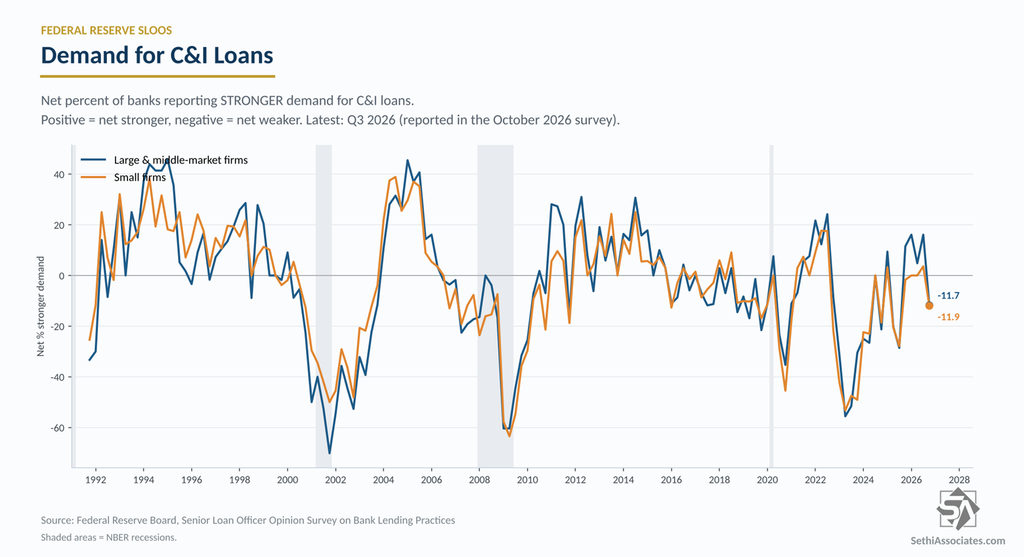
- The Fed’s October Senior Loan Officer Opinion Survey showed business loan demand weakened in the third quarter for firms of all sizes for the first time since the second quarter of 2025. With equipment spending surging, borrowers moving to cheaper lenders looks like the real reason.
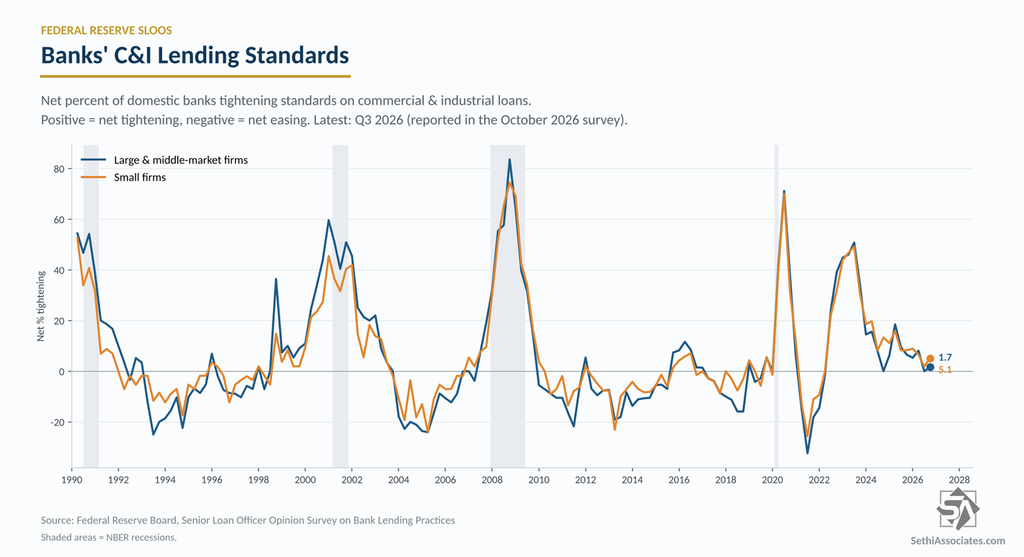
- Bank standards for commercial and industrial loans were roughly unchanged (some modest tightening) but they tightened more significantly for nonbank lenders, which includes private credit, citing “a deterioration in the financial strength of…borrowers” even as private credit’s demand for bank loans rose.
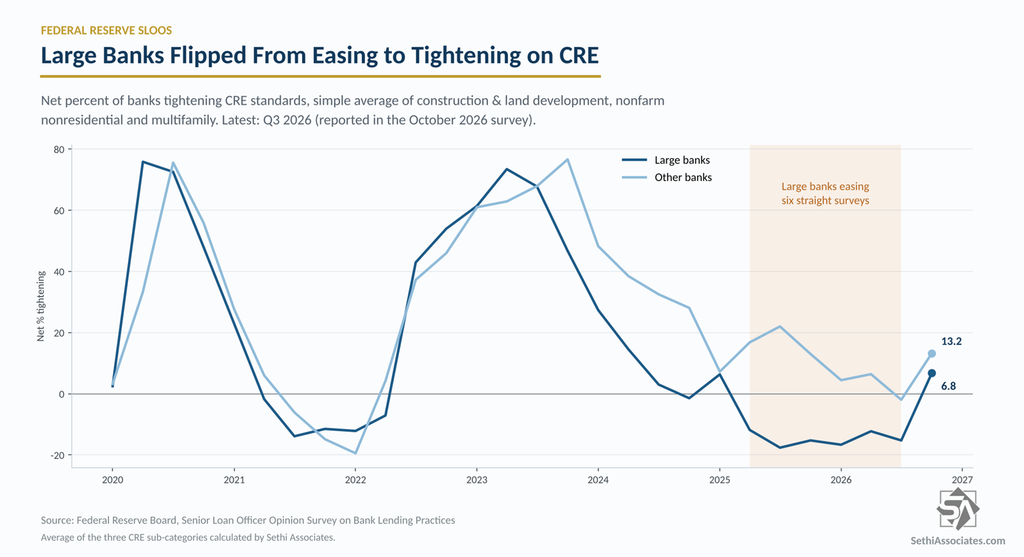
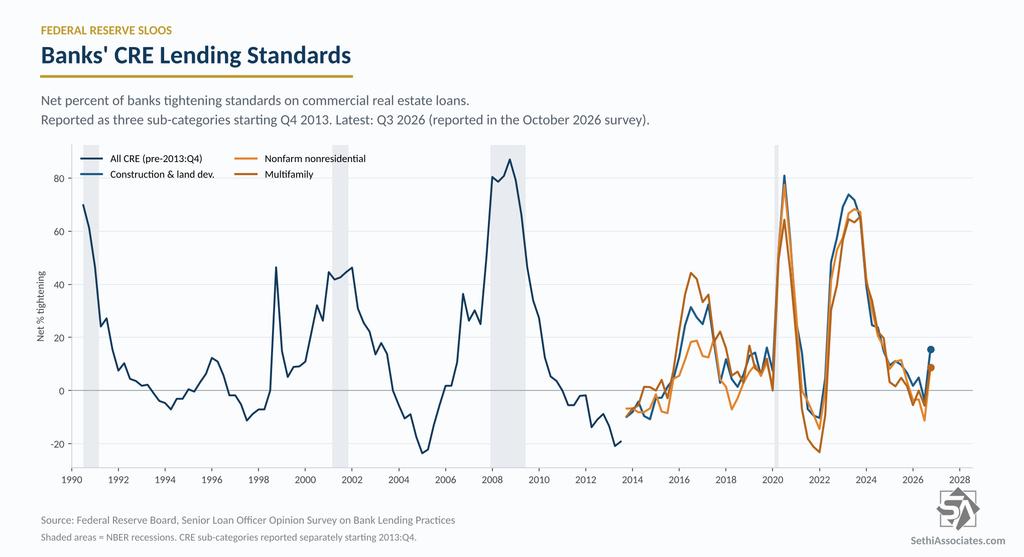
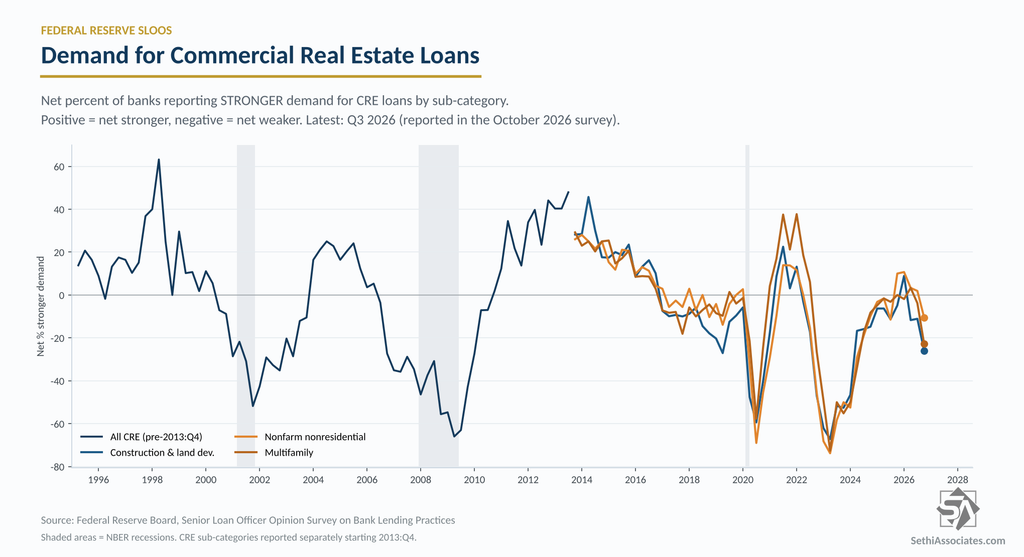
- Commercial real estate standards tightened in all three categories for the first time since the third quarter of 2024, as large banks flipped from six quarters of easing on construction and multifamily lending. Construction loan demand was the weakest since the fourth quarter of 2023
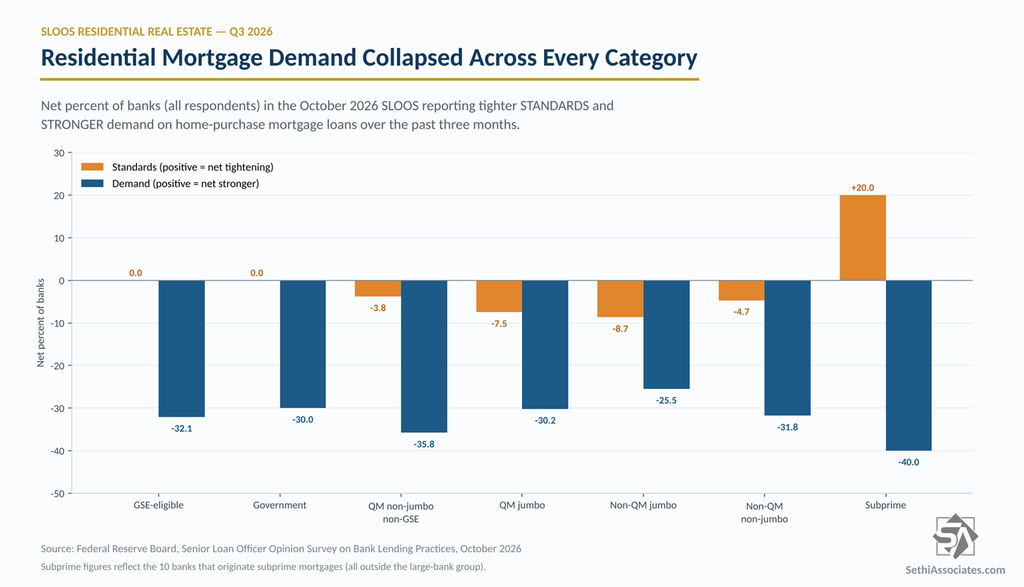
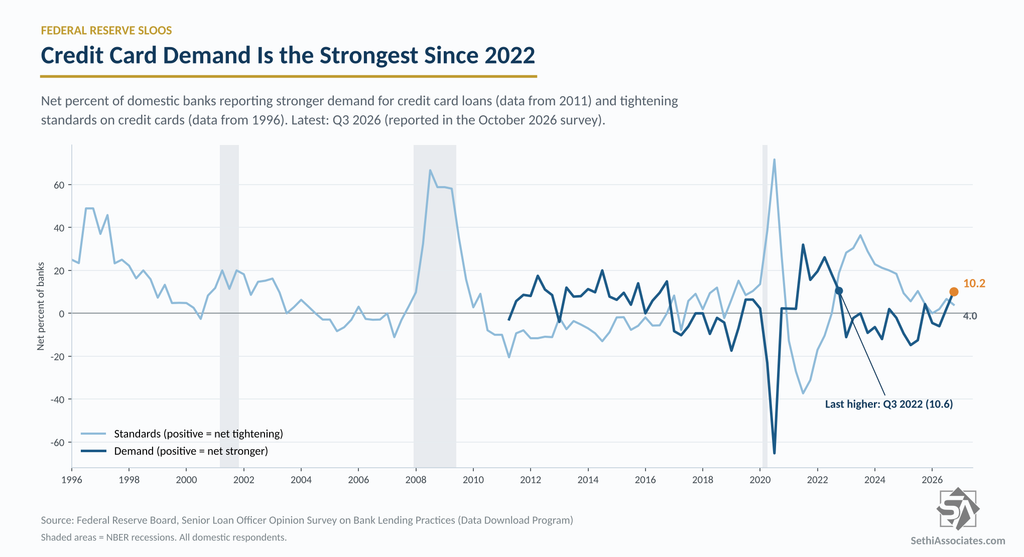
- Residential mortgage demand weakened in all seven categories, but credit card demand was the strongest in four years, with banks pointing to higher prices.
Business Demand Falls
The Fed’s October Senior Loan Officer Opinion Survey showed a clear softening in demand for commercial and industrial (C&I) loans from banks. A net 11.7% saw weaker demand from large and middle-market firms and 11.9% from small firms, the first weaker readings since the second quarter of 2025.
That was even as standards on such loans barely moved: basically unchanged for large and middle-market firms (a net 1.7% of banks tightening) and modestly tighter for small firms (5.1%).
That dovetails with the reasons banks gave: “decreasing customer investment in plant or equipment products and customer borrowing shifting to more attractive bank or nonbank funding sources.”
However, the first reason is hard to square with the data, which emphasizes the second. Last week’s GDP report showed equipment spending surged at a 20.9% annualized rate in the third quarter, adding more to growth than in any quarter in six years (see Q3 GDP Beats on Strong Consumers and Equipment Spending). Reuters points out that when demand last weakened, in the second quarter of 2025, banks didn’t cite borrowers moving to other lenders.
Oxford Economics, quoted by Reuters, called the absence of further tightening for large firms “encouraging” and “another reason to bet on the broadening out of business investment beyond AI.” And while they didn’t soften standards, banks are still competing on price: a net 15% narrowed spreads for large and middle-market firms.
A Different Story for Private Credit
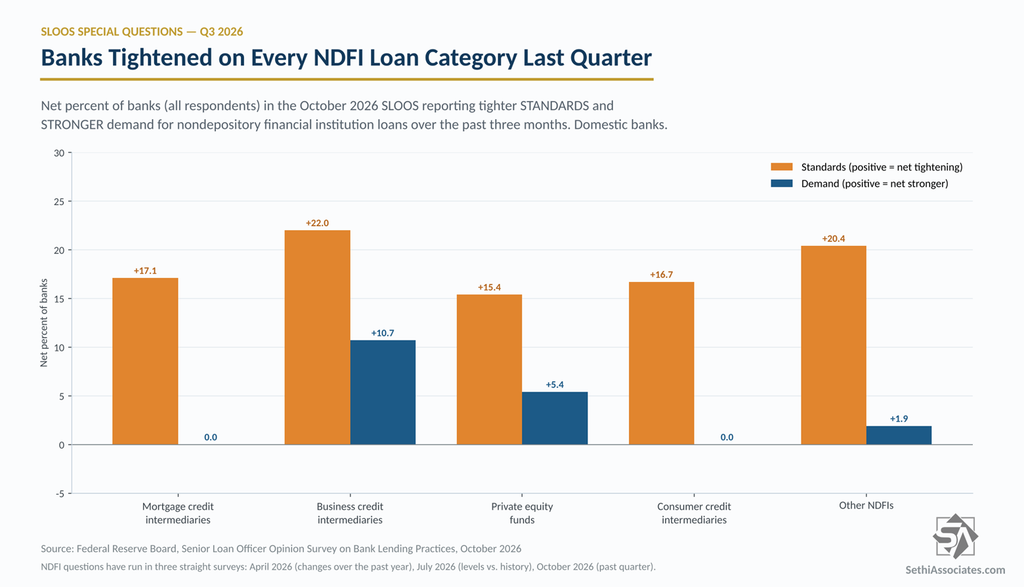
This is the third straight survey with questions on bank lending to nondepository financial institutions (NDFIs). In the third quarter, banks tightened standards moderately to significantly on every customer type: business credit intermediaries — the Fed’s category for private credit — by a net 22%, other NDFIs 20.4%, mortgage credit intermediaries 17.1%, consumer credit intermediaries 16.7% and private equity funds 15.4%. The top reasons were a less favorable or more uncertain outlook and “a deterioration in the financial strength of NDFI borrowers.”
In contrast to the weak demand noted above, a net 10.7% of banks reported stronger demand from private credit lenders and 5.4% from private equity funds, driven by working capital and liquidity needs, better investment opportunities and refinancing needs.
To the extent companies are moving borrowing to nonbank lenders, banks are tightening funding to those lenders.
CRE: The Large Banks Flipped to Tighter Standards
Banks tightened commercial real estate standards across the board: construction and land development by a net 15.5%, nonfarm nonresidential 8.8% and multifamily 8.8%. All three last cleared the Fed’s 5-point “tightened” threshold together in the third quarter of 2024.
Large banks tightened after having eased eased construction and multifamily standards for six straight surveys. This quarter they tightened all three categories for the first time since the fourth quarter of 2023, and other banks tightened even more.
Perhaps unsurprisingly, demand fell: construction loan demand was the weakest since the fourth quarter of 2023 and multifamily since the first quarter of 2024.
Households: Mortgages Down, Cards Up
Demand weakened in all seven mortgage categories, with net shares from 25.5% to 40% of banks reporting weaker demand. Standards were mostly unchanged, although subprime lending standards tightened by a net 20%, the most since the second quarter of 2023 (though only 10 banks in the survey make subprime loans).
A net 10.2% of banks reported stronger credit card demand, the strongest uptick in four years, while auto demand weakened (a net 12.5% weaker). In a special question, banks most often attributed rising card demand over the past year to customers’ spending needs “in response to price changes for goods and services.” They also said they’re more likely to approve super-prime and prime applicants than a year ago and less likely to approve subprime.
Takeaways
The Fed had this survey in hand when it held rates on October 28, so we’ll see if any commentary shows up in the minutes. Overall, the slower demand seems to be a shift to nonbank lenders, but we’ll need more time to determine for sure.
The commentary from the banks did little though to ease the Fed’s concerns about private credit. In commercial real estate, construction now faces tighter credit on top of high rates, and the mortgage numbers show rate relief hasn’t reached housing demand. The mortgage numbers show rate relief hasn’t reached housing demand, while card demand is increasing.
Source: Federal Reserve Board, October 2026 Senior Loan Officer Opinion Survey on Bank Lending Practices; Reuters, “Business loan demand softened last quarter, Fed survey shows,” November 2, 2026.