When Thinking About Rate Hikes, Something Just Doesn’t Compute
Let’s discuss a base case for rates, market ‘fallacies’ and my outlook across the yield curve.
You've reached your free article limit
You've read 0 of 1 free Pro articles.
I have been spending a lot of time thinking about interest rates ahead of September. Not only are they important in their own right, but they contribute to overall market performance.
With a new Fed Chair who seems intent on “re-writing” the rules, it is particularly tricky. I actually like what Kevin Warsh is trying to do, but “regime changes” like this can be difficult to navigate.
Now let’s discuss my assumptions, some market “fallacies” and then my outlook on rates across the curve.
Reaction Function
I hear a lot of people complaining/whining that we no longer know the Fed’s reaction function. What I think they really mean is we no longer know what data will determine the Fed’s reaction. That is an important distinction and one that I think people are missing.
We have argued over data sources repeatedly. We won’t go into much more detail here. But we will highlight a chart that makes the angst over reaction function and Fed independence seem a little “stretched.”
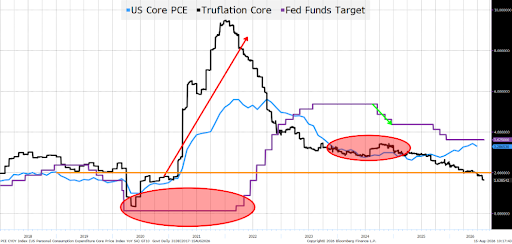
The Fed did not hike until March 2022, even as inflation was running rampant in 2021. In fact, we continued to implement QE until the day we hiked, which seemed nonsensical to me at the time, and it still does.
Also the “alternative” data I think we should pay some attention to told an even scarier story than the “official” data. Similarly, we had no problem cutting ahead of an election even with inflation looking sticky above 3%.
Should You Hike if the Sources of Inflation Won’t Respond?
“Conventional” wisdom says hikes help to quell inflation. But that is a very broad reaction function. When I look at the world I see two main sources of inflation, neither of which will be impacted by rate hikes:
- Iran war inflation. Hiking rates is not going to get more energy product flowing across the globe. Maybe a hike trims demand a little bit, but the problem right now is supply (actually a flow of supply) not demand driven. If anything, doesn’t a hike make it more expensive to bring alternative projects on line?
- The “Compute” Spend. Building out data centers and AI is causing inflation. Memory chip prices have been skyrocketing, affecting the cost of building out the compute, but also impacting the prices of cell phones. But will hiking help slow the demand to build compute? Companies building the compute are trying to make 20x or 50x or some huge profit margin. Is a 50 basis point hike in borrowing costs going to slow them down? I don’t think so.
Why No Hikes
- Alternative measures of inflation (which have the potential to be more accurate and more timely) tell a better inflation story than some of the “old” ones. Even the Cleveland Fed’s Real Time Rent metric is better than what shows up in the CPI data.
- The main sources of current inflation aren’t likely to improve with hikes, so why hurt people when you won’t get the response you want?
That covers two years and in. I continue to believe that too many hikes (conversely, not enough cuts) are priced in. I trade the Simplify Short Term Treasury Futures Strategy ETF (TUA) to capture this. I have a small/medium-sized allocation here now, but will add on any dip.
I like the TUA ETF because while it tracks the 2-year Treasury, it uses futures to create more volatility. Just buying a 2-year bond ETF doesn’t have enough potential upside (or corresponding downside) to be of interest for me in my portfolio.
Longer-Dated Bonds Are Likely to Be in a Range
While I expect no hikes, I don’t think we will see a big move lower in longer-dated bond yields. The pressure remains for longer-dated bond yields to stay the course or drift higher.
- Some portion of traders will view a less hawkish Fed as being a signal against Fed independence or inflation fighting and might sell longer-term bonds (as a contrarian, that would make me get interested).
- Global supply is massive. Sovereigns are issuing more debt. Global rates are no longer so low that investors are forced to chase U.S. Treasuries. The supply on the corporate side of the bond market is very large – heavily focused on longer-dated bonds issued by those looking to build out compute.
So my “hesitancy” to buy long end is more about global supply than any particular fear about “losing control” etc.
I have money to allocate and am deciding on the iShares iBoxx $ Investment Grad (LQD) (I like the exposure to longer-dated compute bonds at an almost 6% yield.) However, I’m also looking at adding to some closed-end muni funds, which remain the bread and butter of my income portfolio.
I expect rates to be neutral to a small positive for stocks as rate hikes get priced out.
VanEck Alternative Asset Manager ETF (GPZ), which I liked as a way to get exposure to alternative managers at the peak of the private credit fears, has bounced nicely and am tempted to take some profits there.
At the time of publication, Tchir had positions in TUA and GPZ.