Warsh, Bessent and the Battle for Long-Term Treasury Yields
Let’s discuss what’s pressuring yields, steps that can be taken, and the beneficiaries so far.
You've reached your free article limit
You've read 0 of 1 free Pro articles.

We are seeing the start of a “battle” to control longer-term Treasury yields.
30-year Treasury yields above 5.3% seemed to trigger the start of the battle. The 30-year Treasury went from 4.83% at the end of June to 5.31% last Monday, in almost a straight line. That has attracted a lot of attention. I think the 10-year is still more important for the economy (used to set mortgage rates, etc.), but that falls into the broader context of “longer-dated bonds” so should be handled.
I see two sources of pressure on bond yields. One is more “traditional” and is related to the U.S. government. The other is more “external.”
‘Traditional’ Headwinds for Treasury Yields
- Inflation has been steady and with no deal yet on Iran, and now new tariffs on Canada, the potential for inflation relief is diminishing. I think this fear is incorrect, but I understand why that fear exists. The promised “Economic D-Day” for Iran is not likely to help inflation up front.
- Total debt hit the round number of $40 trillion, which seems to have caught the attention of people as round numbers often do. This number is currently being overhyped and playing a limited role in the rise to higher yields.
- The deficit is big and no signs of being reduced. With defense spending on the rise, the interest payments dwarfing discretionary spending, etc., the deficit, which was supposed to go down, has increased. There seems to be increased fear that no matter who is in power, we will see deficits continue to rise. The latter is more of a “nagging” concern, but the rising deficit and the structural nature of the interest rate component is concerning.
‘External’ Headwinds for Treasury Yields
- Global supply of sovereign debt. Even Europe is figuring out ways to spend money on defense and infrastructure. We are likely in a period where rising deficits and debt financing is the norm. That crowds out the U.S. Treasury, as there is increased competition for bond investors’ money.
- There is likely less Treasury buying, as countries are not in position to buy U.S. Treasuries when they have to spend money or have seen their own revenues diminish (the Gulf Countries are a prime example of that as they face the pressures of the ongoing conflict with Iran).
- Supply of corporate debt. When a Monday in August is one of the biggest issuance days of the year, you know that supply in the bond market is real. It doesn’t matter whether that supply is hitting public, private or structured credit markets (it is hitting all three) it provides further competition for bond investors’ money. I’m in the camp that I’d rather own highly rated “compute” bonds at a hefty all-in yield (spreads are wide) rather than Treasuries.
Both traditional and external are important factors! I think the external factors are the bigger problem and am not sure Treasury Secretary Bessent sees it that way.
Steps That Can Be Taken
1. Treasury has increased the buyback amount for each “operation” to at least $4 billion. The operations seem to occur roughly on a weekly basis. We don’t have a sense of whether “at least” means $4.2 billion or $10 billion. If the commitment to grow the size is real, then we can see some support, but $4 billion is too small if the compute bonds are going to be issued at their ongoing pace (and so far, no signs of that slowing, despite my view that it should).
2. CNBC reported that the Treasury could use the almost $1 trillion in its general account to buy bonds. It is unclear how easy it is to actually use that money for this purpose. This would be even better than issuing shorter-dated bonds to buy longer-dated bonds (what we believe is currently occurring), as it reduces the total amount of debt outstanding.
3. I think a Federal Reserve Operation Twist would be a key element of any strategy to get longer-dated bond yields lower.
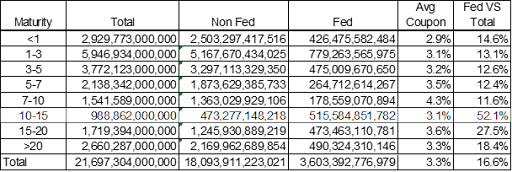
The Fed could shift their $1.2 trillion of bonds maturing in the next three years, into longer-dated bonds. $1.2 trillion would be a big number, even if spread over a year. Fed Chair Warsh is on record for not wanting to increase the size of the balance sheet. Operation Twist lets him suck immense amounts of duration out of the market (supporting bond yields), while not adding to the balance sheet. Getting the Fed on board with this seems easier than convincing the Fed to cut rates.
4. Taking the “Hike” narrative off the table. I don’t think we can talk about cuts so long as the conflict in the Middle East is disrupting global energy supplies (oil, diesel, etc.). But since the interest rate servicing costs are playing a role in driving out bond yields (greater need for domestic issuance), getting hikes off the table would help. I do think we should be discussing cuts, not hikes, so it makes sense to me for reasons we’ve discussed in recent posts.
4. Sell gold to buy Treasuries? The U.S. is sitting on over $1 trillion of gold valued at $11 billion. If we sold $100 billion of gold, we’d reduce the deficit by that amount (it would show up as profit) and it would let the government buy back more Treasuries without raising debt. A bit “out of the box” but a step I’d like to see as part of the plan.
Beneficiaries So Far:
- Bitcoin, nice pop, but I’d be reducing exposure here. Lot of “good things” happened in the past week and shorts got hurt, but not sure we can break much higher here.
- Gold. Makes sense, unless the administration starts hinting that they could sell some gold (or actually sells gold).
- Not the Nasdaq 100. This surprises me a bit, as typically this index responds well to moves like the ones we’ve seen. That concerns me – it’s never good when an asset doesn’t respond the way you would expect it to.
For me, I’m relatively neutral until we see how Warsh plays this out. I’m also keeping an eye on Bessent, whether he has new announcements here, and what the economic D-Day actually looks like.