Two Funds vs. Six: Do More ETFs in Your Portfolio Make It a Better One?
While it’s possible to tilt toward leading asset classes with more funds, it doesn’t always work out.
You've reached your free article limit
You've read 0 of 1 free Pro articles.
When it comes to funds in your portfolio, is keeping it simple the way to go? Or is this a case where more really is better?
Let’s start with the basic two-fund portfolio. Owning the Vanguard Total World Stock ETF (VT) along with the Vanguard Total World Bond ETF (BNDW) is cheap and easy. Since BNDW’s inception in 2018, that combination, in a 60% stock/40% bond allocation, has returned about 8.22% annually.
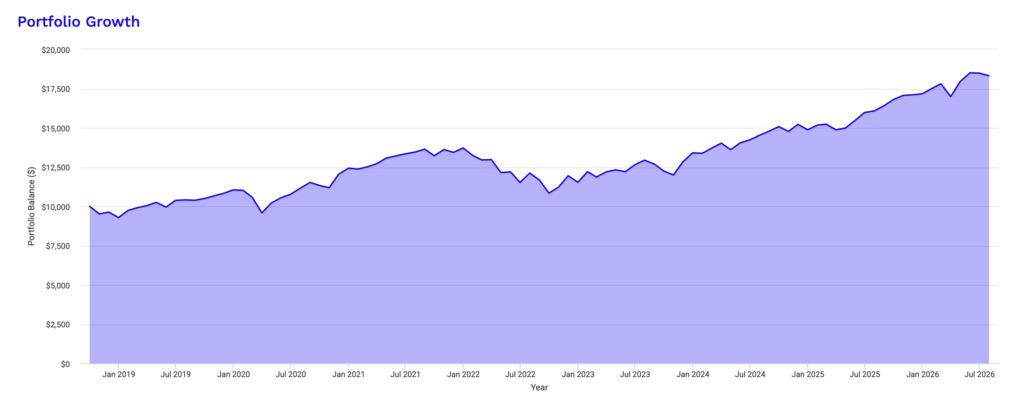
You’ll find that portfolio recommended by the Bogleheads.org forum as being “entirely reasonable and good.”
Warren Buffett has advocated for a simple two-fund portfolio; so has author J.L. Collins in “The Simple Path to Wealth.”
But some investors like to parse a greater number of holdings into thinner slices.
The question isn’t “is more diversification better,” because VT and BNDW do provide diversification.
Instead, the question pertains to which additional funds would drive a distinct, identifiable difference in excess return, versus which would just mean additional paperwork and hassle, with no actual diversification benefit.
Unfortunately, there’s no “one answer” to that question, at least not a clear set of instructions to “buy this or buy that.”
However, with pretty much any asset class, there’s more than one fund that can do the job. Some may have higher expense ratios or they may differ somewhat in composition, but I’ve always been a believer in starting with something, and fine tuning from there, rather than trying to nail perfection on the first try.
A Six-ETF Sampler
Here’s an example of a portfolio build consisting of six ETFs, each with its own specific job. It’s designed to avoid overlap.
- Vanguard Total Stock Market ETF (VTI): Tracks the investable U.S. equity market, large-cap through micro-cap. Could function as the six-fund portfolio’s core domestic holding.
- iShares Core MSCI Total International Stock ETF (IXUS): Measures performance of developed and emerging-market stocks outside the U.S. Could serve as the international core.
- Avantis U.S. Small Cap Value ETF (AVUV): An actively managed, rules-based fund tilting toward smaller, cheaper U.S. stocks. Targets the small-cap value factor premium. A hedge against Magnificent Seven concentration in the large-cap index.
- Avantis International Small Cap Value ETF (AVDV): The international counterpart to AVUV, applying the same small-cap value tilt to non-U.S. developed-market companies.
- SPDR Gold Shares (GLD): Physically backed by gold bullion. Could be used as a real-asset diversifier with low correlation to stocks and bonds.
- Schwab U.S. Aggregate Bond ETF (SCHZ): Tracks the broad U.S. investment-grade bond market at a very low expense ratio.
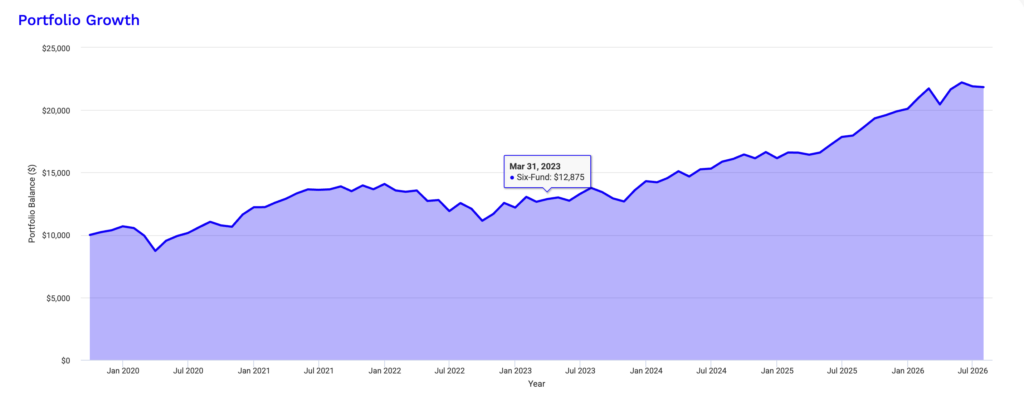
Here’s how the growth in this portfolio looks, going back to the 2019 inception date of AVUV and AVDV.
So now let’s compare apples to apples.
Aligned to the same window, starting with September 2019 and running until August 2026, here are the performance numbers:
- Two-fund portfolio: +8.68% a year
- Six-fund porftolio: +12.09% per year
The performance gap is mostly due to the six-fund portfolio’s lighter allocation to bonds, at 20% versus 60%. It also caught a good run in small-cap value stocks and gold.
The gap isn’t really about diversification; instead, it’s about control of which investments you own.
A two-fund, market-cap-weighted portfolio can’t tilt toward anything; it just owns the market in a “come as you are” fashion. That means Mag 7 dominance and all.
Splitting your money among six ETFs gives you some dials that the simpler version doesn’t. You can choose to deliberately overweight small-cap value or gold instead of accepting whatever the index hands you in any given quarter or year.
That’s the academically grounded case for factor investing, and it’s why the six-fund portfolio outpaced the two-fund version since 2019.
But a dial that can be turned up can also be turned down: Small-cap value spent most of the 2010s lagging the market, and an investor who “controlled” their way into that tilt back then would have controlled their way into years of underperformance.
You Have to Get the Six Funds Right
Getting the six funds “right” is the obvious potential problem with manufacturing one’s own portfolio in an attempt to capture the leading asset classes. It’s pretty easy to get it wrong, whether through betting on the wrong hunch, or being either stubborn (“I know I’m right!!) or forgetful.
I’m going to come back to my basic tenet that some form of broad diversification is always better than none.
Yes, in the past seven years, tilting toward the leading asset classes, as we saw in the example above, created excess return above the diversified two-fund portfolio.
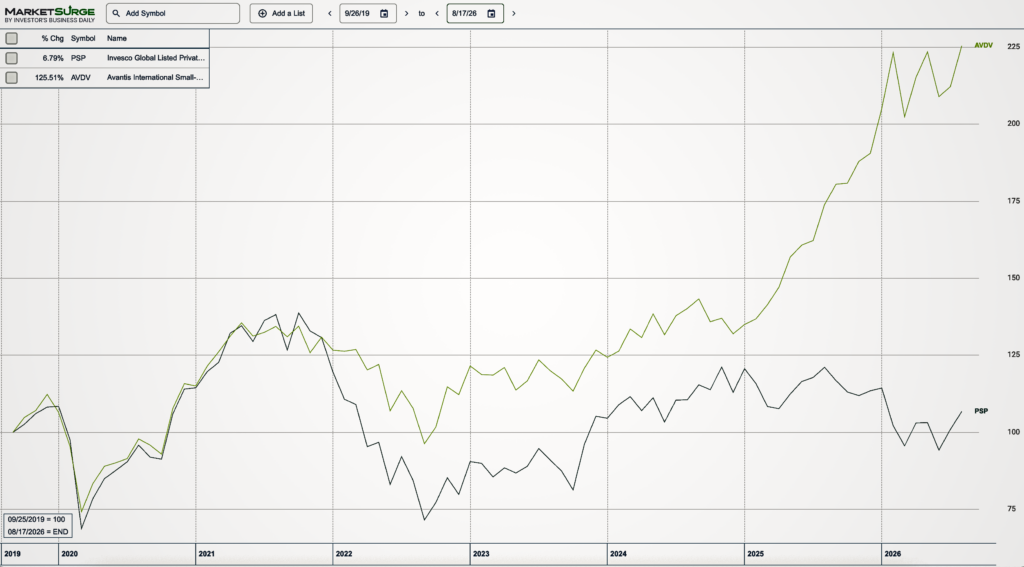
But it would have been just as easy to throw together a portfolio of six random ETFs, purchased because the investor had some conviction about an asset class like, I don’t know, a private equity fund. That asset class is hot now, but has been lagging the basic small-cap value fund above.
- Invesco Global Listed Private Equity ETF (PSP): +7.64% per year since September 2019.
- Avantis International Small Cap Value ETF (AVDV): +15.77% per year since September 2019.
So boring old small value returned more than double what flavor-of-the-month private equity delivered.
Here’s how that looks.
My problem with the “more is better” mentality is that it’s very possible to clutter up your holdings with junk that literally doesn’t add value.
If you decide to add more funds (and six is about the maximum before you start diluting the effectiveness of any given asset), try to keep them less esoteric and tilt toward investments that have historically compensated investors for the amount of risk they’re taking, or added an element of ballast to protect during equity market downturns.