Tech And Small Caps Lead Tuesday
A sixth day of gains for semiconductors drives the Nasdaq-100 to its first record since June while a fifth day of losses for crude boosted small caps
You've reached your free article limit
You've read 0 of 1 free Pro articles.
Quick Summary
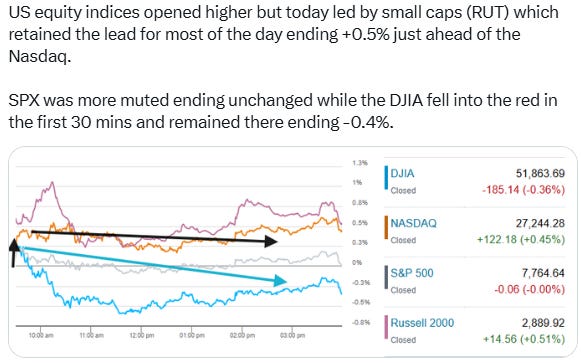
US equity indices opened Tuesday’s session again higher but in contrast to Monday’s Tech led rally, Tuesday saw small caps in the lead for most of the day (although marginally). The small cap Russell 2000 would finish +0.5%, just ahead of the Nasdaq Composite boosted by a fifth day of falling oil prices (the longest streak in over a year according to BBG) even as bond yields edged higher.
President Trump said U.S. officials had a “very good,” three-hour meeting with Iranian envoys Steve Witkoff and Jared Kushner on the sidelines of the UN General Assembly, with another meeting planned. In his speech at the UN, Trump said he expects a deal “right after the election,” while also floating a “big decision” between a deal and moving to “annihilate” Iran. Added pressure on oil prices came from unverified reports that Iran offered to reopen the Strait of Hormuz within seven days as well as that Saudi Arabia may restart its East-West pipeline this week.
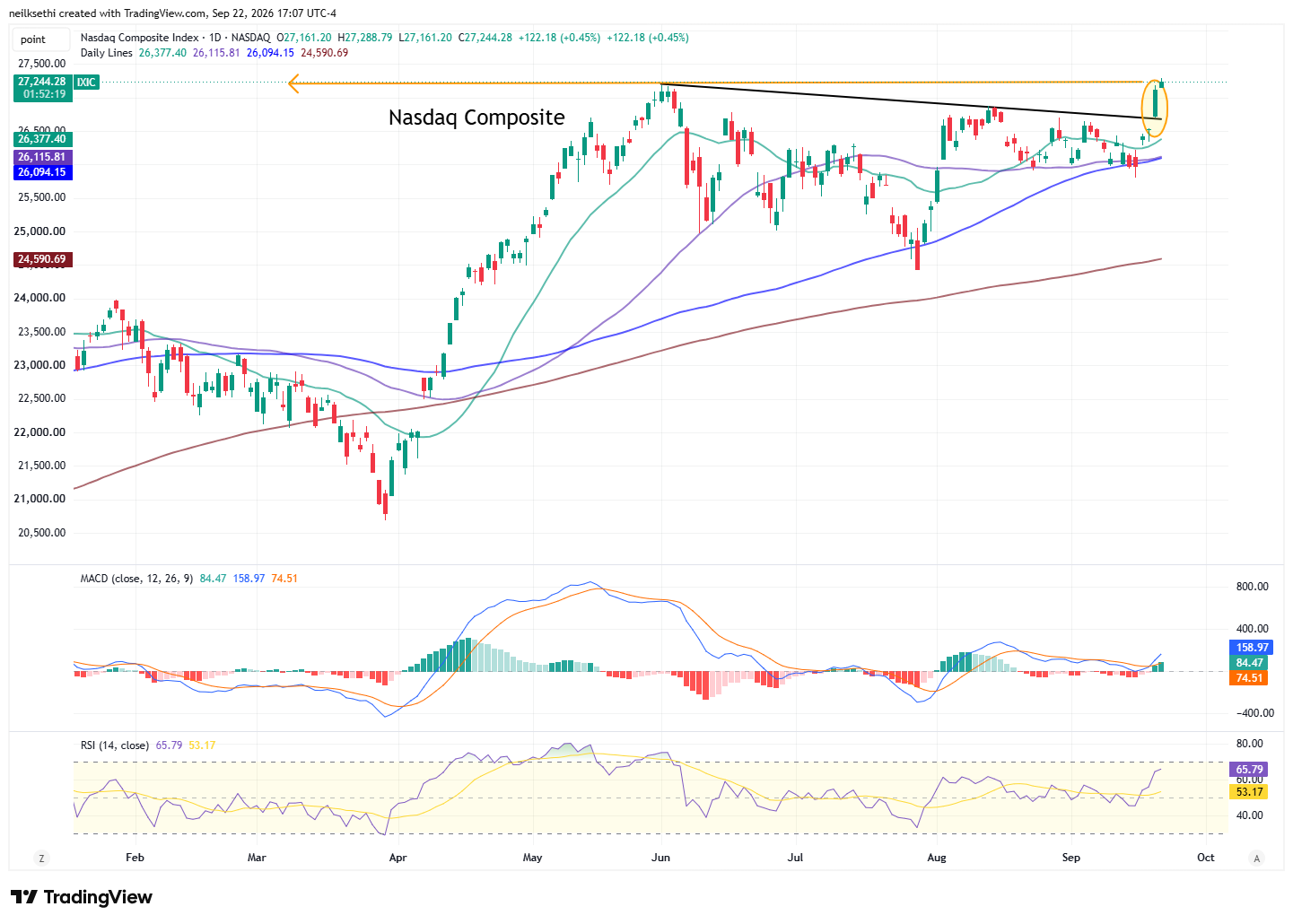
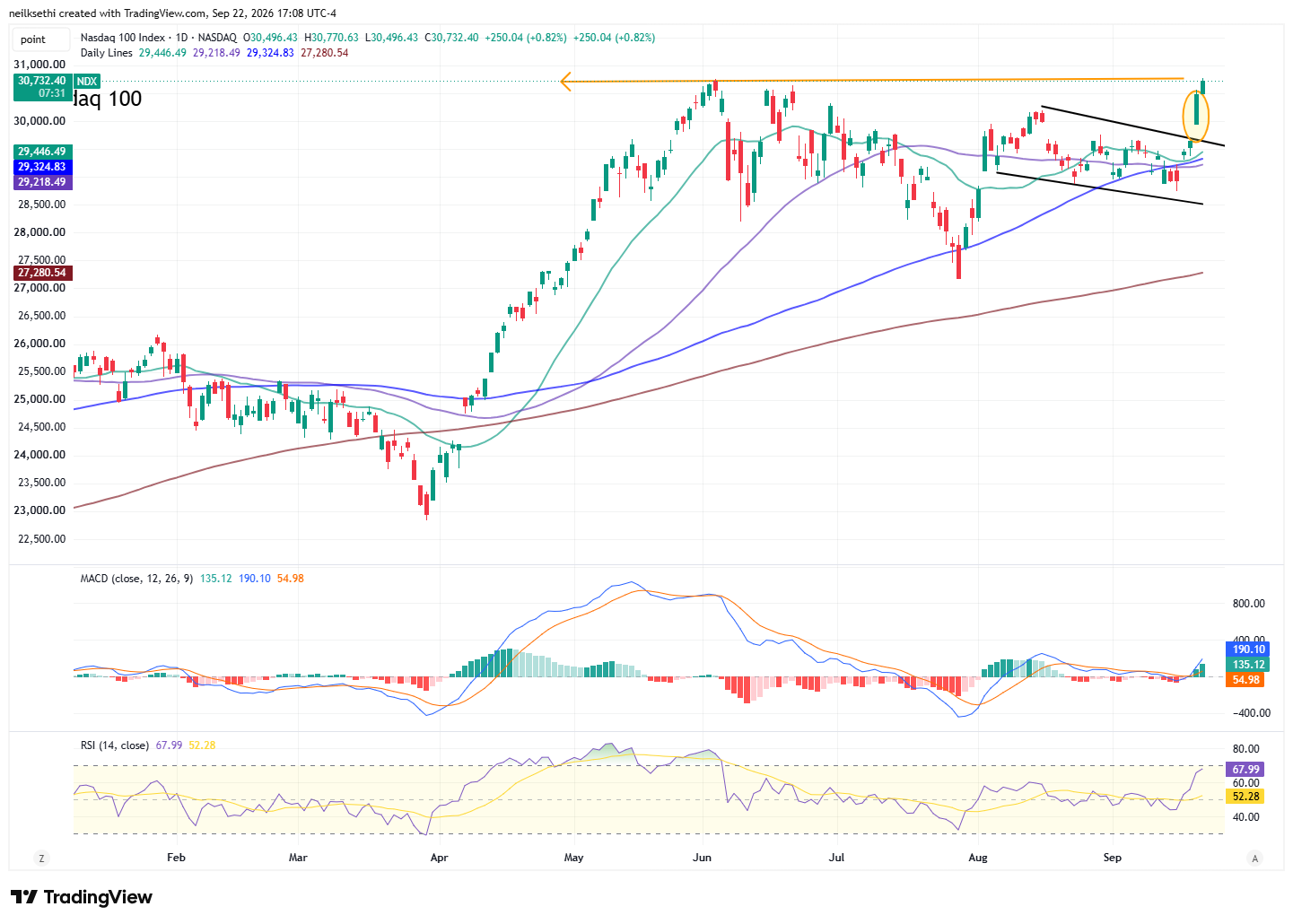
The AI-trade continued to also provide a boost with the Philadelphia Semiconductor Index (SOX) climbing for a sixth straight day. That carried the Nasdaq to a record, closing +0.45% at 27,244.28 and the Nasdaq 100 +0.8% also notching its first record high since June.
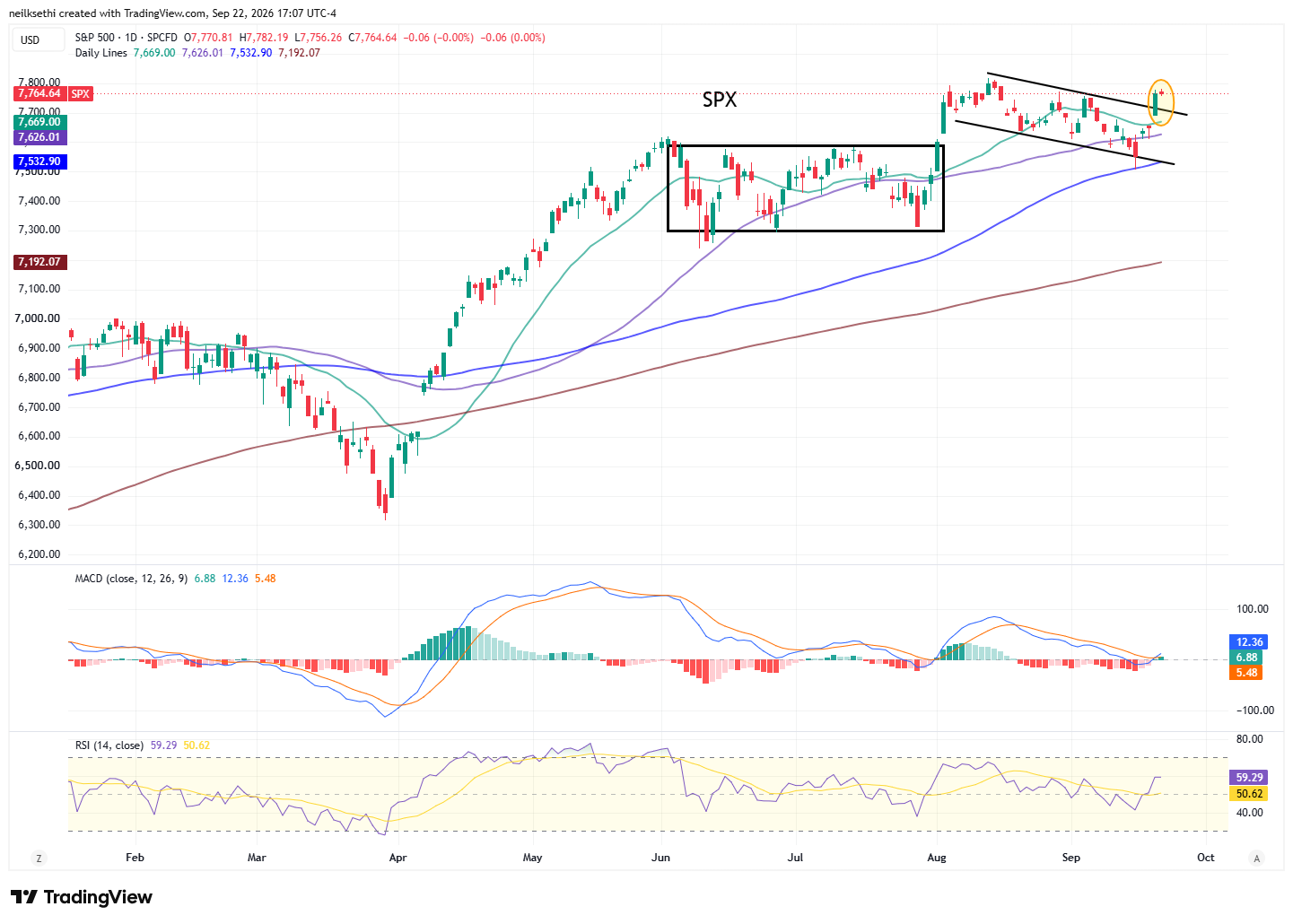
The S&P 500, though, finished essentially unchanged at 7,764.64 as over half of its sectors finished in the red, while the Dow Jones Industrial Average slipped into the red inside the first half-hour and stayed there throughout the session, ending -0.4%.
It’s a lighter day Wednesday before attention turns to this week’s Trump-Xi summit in Washington Thursday with the four T’s (Tariffs, Technology, Taiwan, and Tehran) all on the agenda.
Market Commentary
Equities:
- “Today focus will stay on geopolitics and if there’s any confirmation of progress towards a ceasefire between the US and Iran, look for oil and yields to fall further and for stocks to rally,” said Tom Essaye at The Sevens Report.
- “What happens this week may become critical for the direction of crude oil prices over the medium term,” said Thierry Wizman at Macquarie Group. “That’s because the key actors in the US-Iran War will be having meetings in New York, starting today.”
- “I don’t think markets have fully appreciated what a rate hike cycle even with a higher yield environment might mean,” said Tom Garretson, senior portfolio strategist of fixed income strategies at RBC Wealth Management. “I do think there’s quite a bit of complacency still priced into markets with respect to the idea that the 10-year [yield] moves above 5% and that there’s probably a pretty persistent risk that the Fed could certainly keep raising rates at least two more times and potentially back towards 5% into early 2027,” he continued.
Stock and Sector Breakdown:
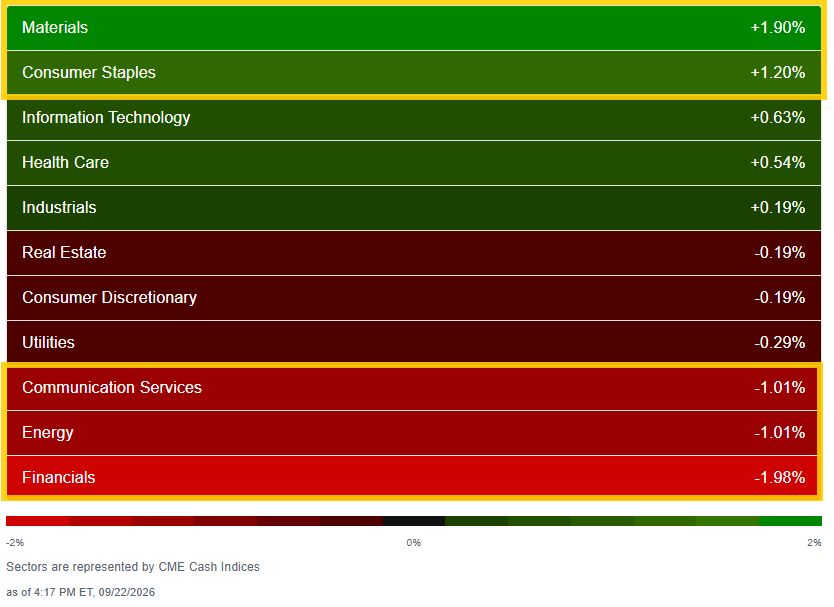
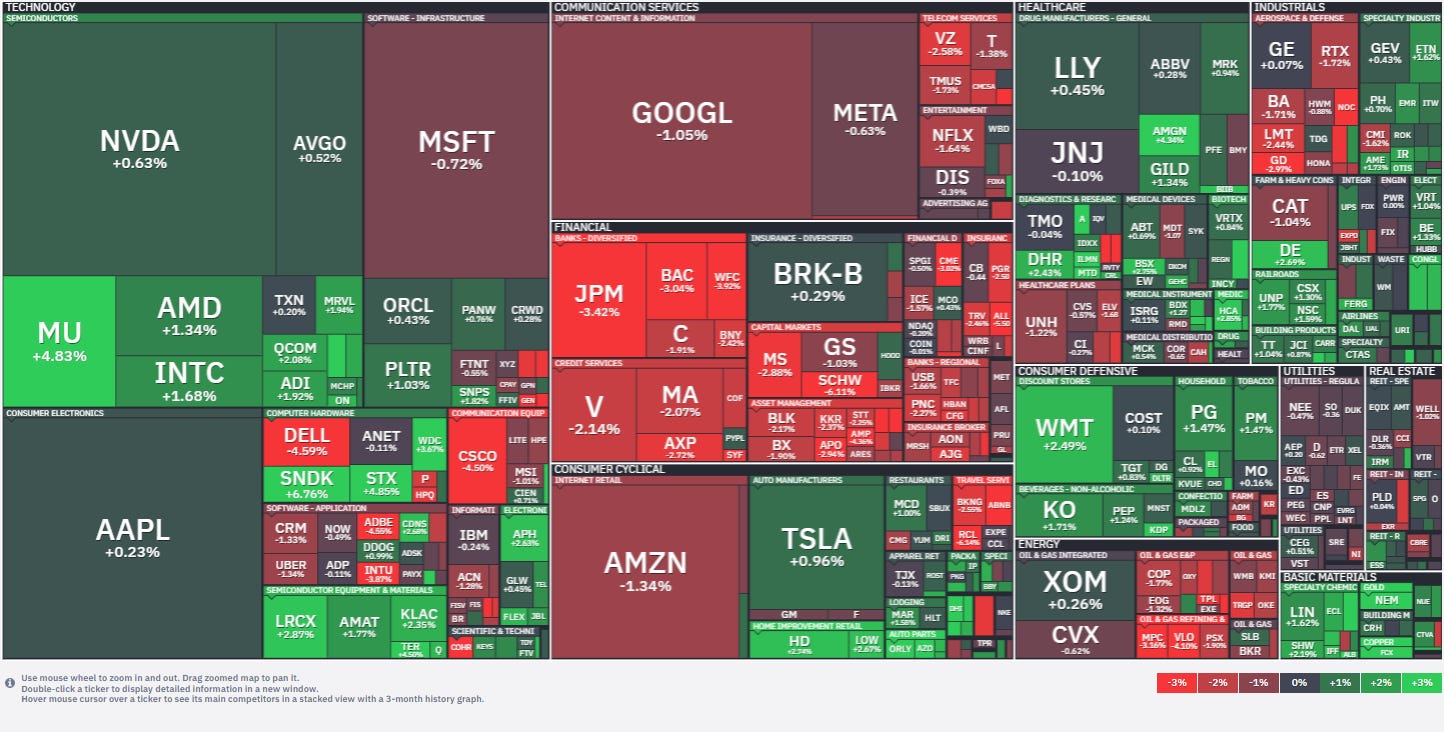
Sector breadth weakened to 5 of 11 sectors higher (from 7 Monday) and two of those up over 1% (from four) with just one of the megacap growth sectors (Tech which with its huge weighting kept the indices in the green most of the session) in the top three (+0.6%) after they had led Monday. Instead, Tuesday’s leaders were Materials (+1.9%) and Staples (+1.2%).
Three sectors finished down more than 1% led by Financials which dropped 2%, the worst session since April and taking the sector to the lowest levels since the start of July on a broad based pullback across banks, regional banks, insurers, and asset managers amid increased concerns on a flatter yield curve pressuring net interest income as well as broader worries about trading and investment income and potential AI-related disruption along with technical weakness. Charles Schwab (SCHW) -6.1%, Allstate (ALL) -5.6%, and Wells Fargo (WFC) -3.9% were particularly pressured, but heavyweights like JPMorgan (JPM) -3.4% weren’t spared.
Allstate also faced pressure after a New York Times report indicated that Meta Platforms (META) -0.6% Muse AI agent has helped users find insurance\. The same report initially pressured Expedia Group (EXPE) -0.1%, but the stock subsequently recovered after Expedia announced a partnership with Muse to bring AI-powered trip planning to hotels and other travel offerings.
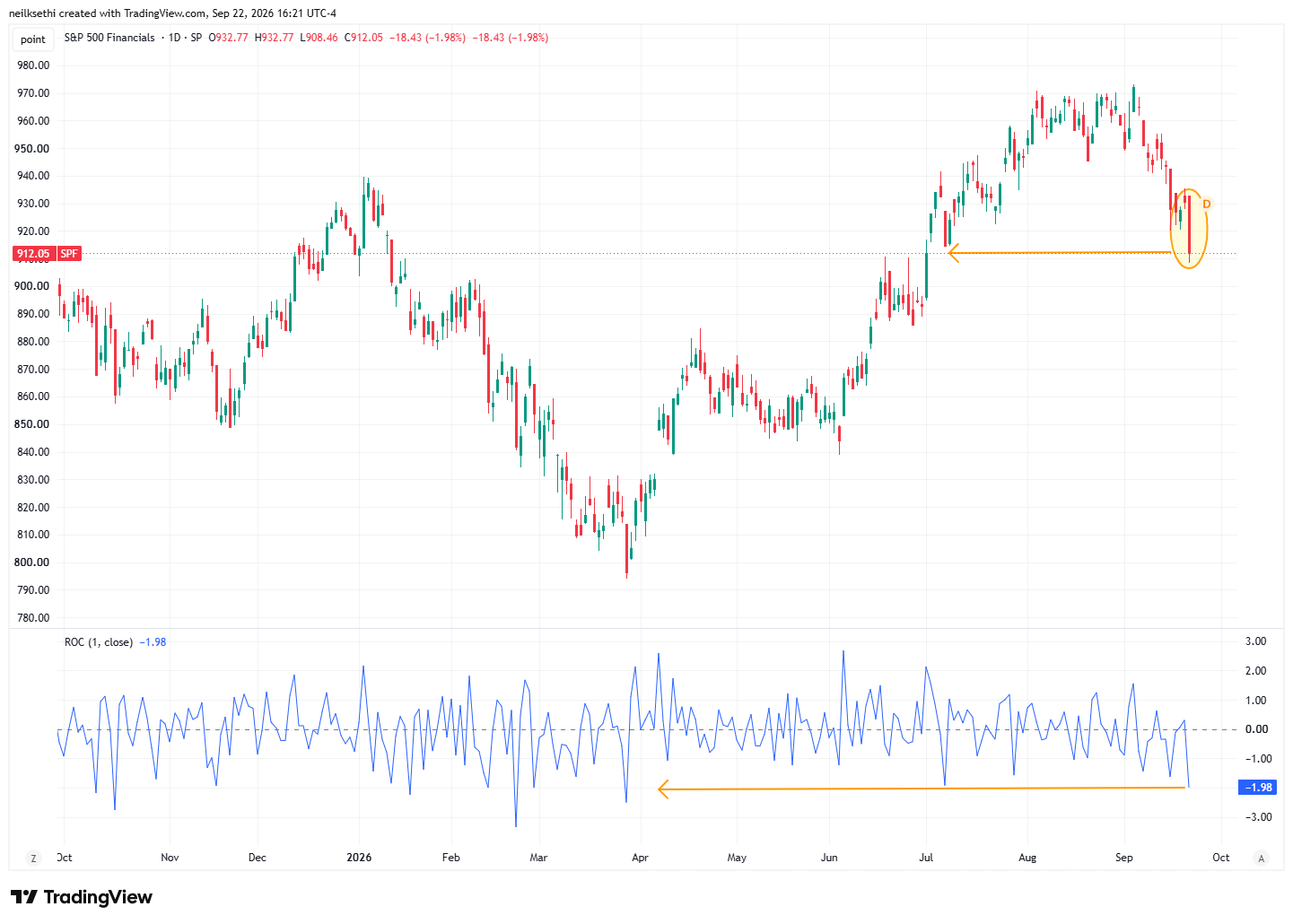
[Note: chart uses futures prices.]
The number of large SPX winners (up over 3%) fell back to ~25 from ~55 Monday, while the number of large losers (down over 3%) rose to ~25 from 11 Monday. Both of these metrics have remained very subdued the past six weeks rarely getting above 50 and only once above 100.
In other individual stock news,
Moderna (MRNA) +5.6% extended its recent surge to fresh multi-year highs. The stock is up over 175% since August 18th.
Homebuilders were another pocket of strength, with the iShares U.S. Home Construction ETF climbing 3.2% after Berkshire Hathaway (BRK.B) +0.3% added to its bets in the sector by buying roughly $212.4 million worth of home-builder Lennar’s (LEN) +6.4% shares in recent days, taking its stake to ~10%. Apple Inc. (AAPL) shares were slightly higher +0.2% following reports it is developing a screenless health and fitness tracker similar to Whoop Inc.’s wrist-worn device, part of an effort to rethink its smartwatch lineup and add new wearable technologies.
Shares of Capri Holdings (CPRI) advanced nearly 10% on Tuesday following a report from WWD that said the luxury global fashion brand could be bought out.
Shopify (SHOP) shares were up nearly 7% following a Monday announcement that the company would work with Meta’s personal AI agent, Muse, to enable agentic checkout on the platform’s stores.
Viking Therapeutics (VKTX) gained 35.7% after topline results from its Phase 1 VK2735-102 maintenance study for a dual-action obesity shot helped patients lose weight and keep it off, even after they cut their dosing schedule in a small, exploratory study.
Shares of Royal Caribbean Cruises (RCL) were down more than 5.5% after the Financial Times reported that Royal Caribbean was nearing a deal to take a 50% stake in Sandals Resorts International, the Caribbean resort chain, for $3 billion.
Monolithic Power (MPWR) +8.1% was the S&P’s best performer, while Gen Digital Inc. (GEN) -6.4% was the S&P’s worst performer, with no news to account for the moves in either stock.
Some stock-specific commentary from TheStreet Pro today:
- Stephen Guilfoyle –
- Chris Versace –
- James “Rev Shark” DePorre – Amid a Lack of Market Leadership, I’m Eyeing These 2 Stocks
- Bob Lang – Chart of the Day: Meta’s Amazing Move Has Stock Peering Toward the $800s
A Look At The Charts
Note on all charts the colored lines are moving averages (the average price over the lookback period — days on the daily charts, weeks on the weekly charts):
20 = green
50 = purple
100 = blue
200 = brownException is monthly charts where blue is 10-month moving average and brown is 20-month moving average.
MACD = Moving average convergence/divergence line, a measure of momentum that compares longer term and shorter term momentum to gauge if a move is strengthening or weakening. This is probably my favorite individual indicator (it’s also the favorite of Katie Stockton, a very fine technician).
RSI = Relative Strength Index (basically what it sounds like) = measures the strength of the move comparing gains to losses over the given lookback window (I use the standard 14 periods).
SPX didn’t extend but also didn’t give back Monday’s big gain. The daily MACD remains in a “go long” positioning, and the RSI near 60.
Nasdaq Composite edged to another fresh record. Also got a positive MACD crossover Monday and the RSI is the highest since June.
The Nasdaq-100 (QQQ) joined the Nasdaq in record high territory. Daily MACD had already flipped more positive last week, and the RSI like the Nasdaq is the highest since June.
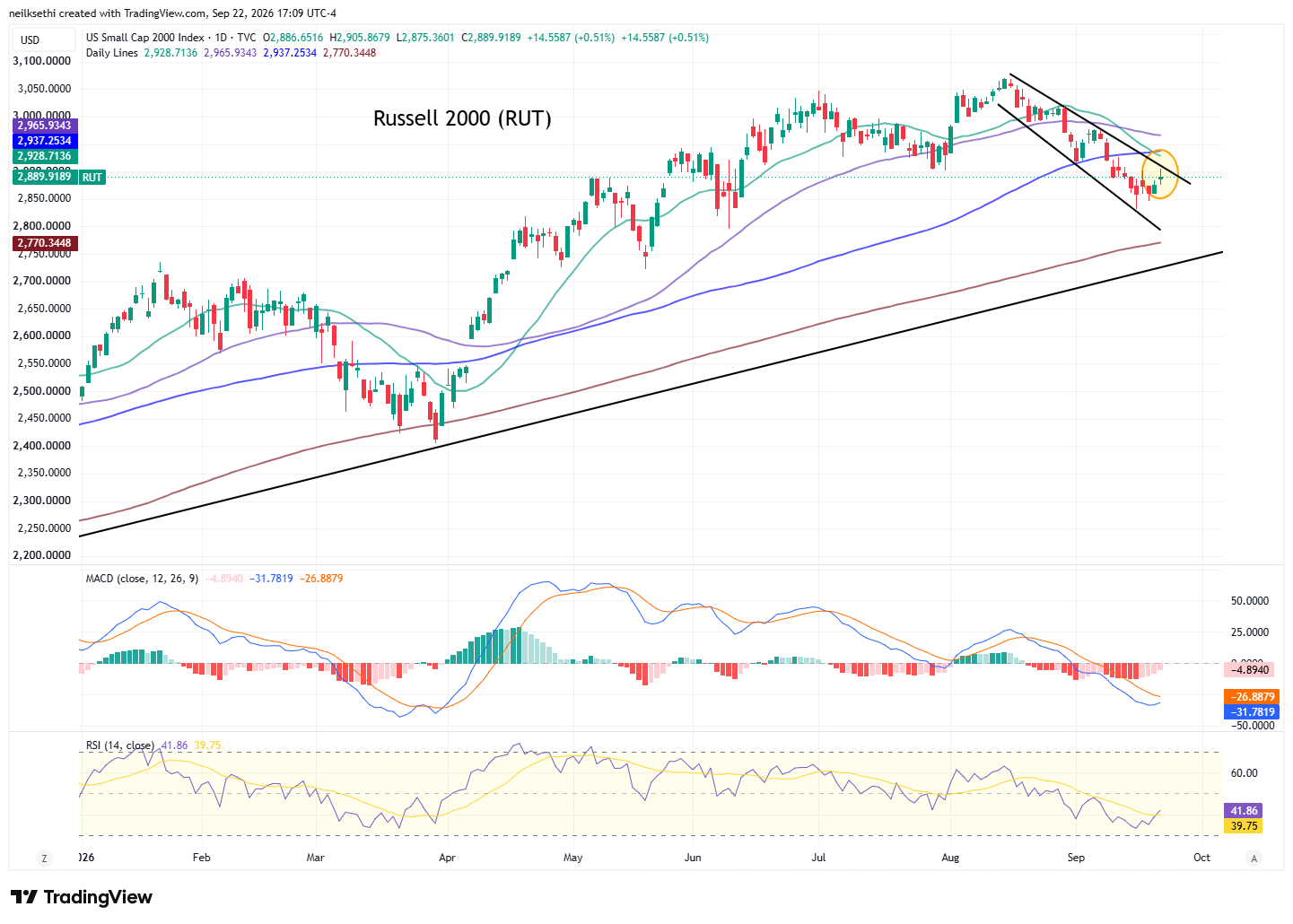
The Russell 2000 (RUT) I said two weeks ago was “much more problematic,” and that remains the case although as mentioned Friday “at least has not broken Wednesday’s low.” But its daily MACD remains in “go short” positioning (for now), and the RSI around 40. However both are bottoming. It needs to start by breaking out of this downtrend channel, but there is a lot of resistance above that. If it can clear that, though, it would bode well for further gains.
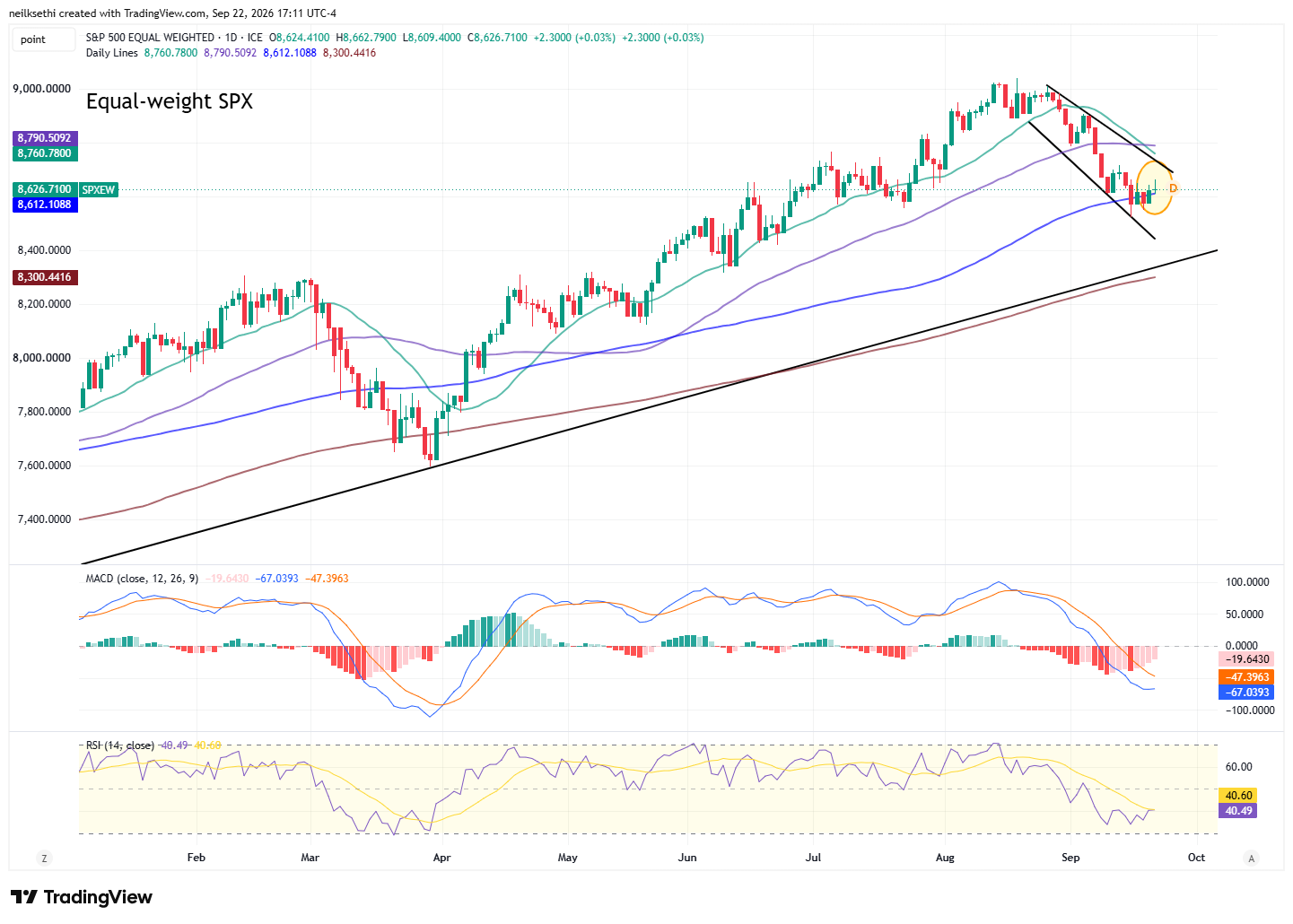
The equal-weighted SPX I said Wednesday is “back to concerning.” I mentioned early last week “I did take off most of my holdings in (RSP) for now. I’ll be looking for a tradeable bottom to form.” Like the RUT it has held Wednesday’s low, but daily MACD and RSI are still weak (although like the RUT are trying to turn more positive).
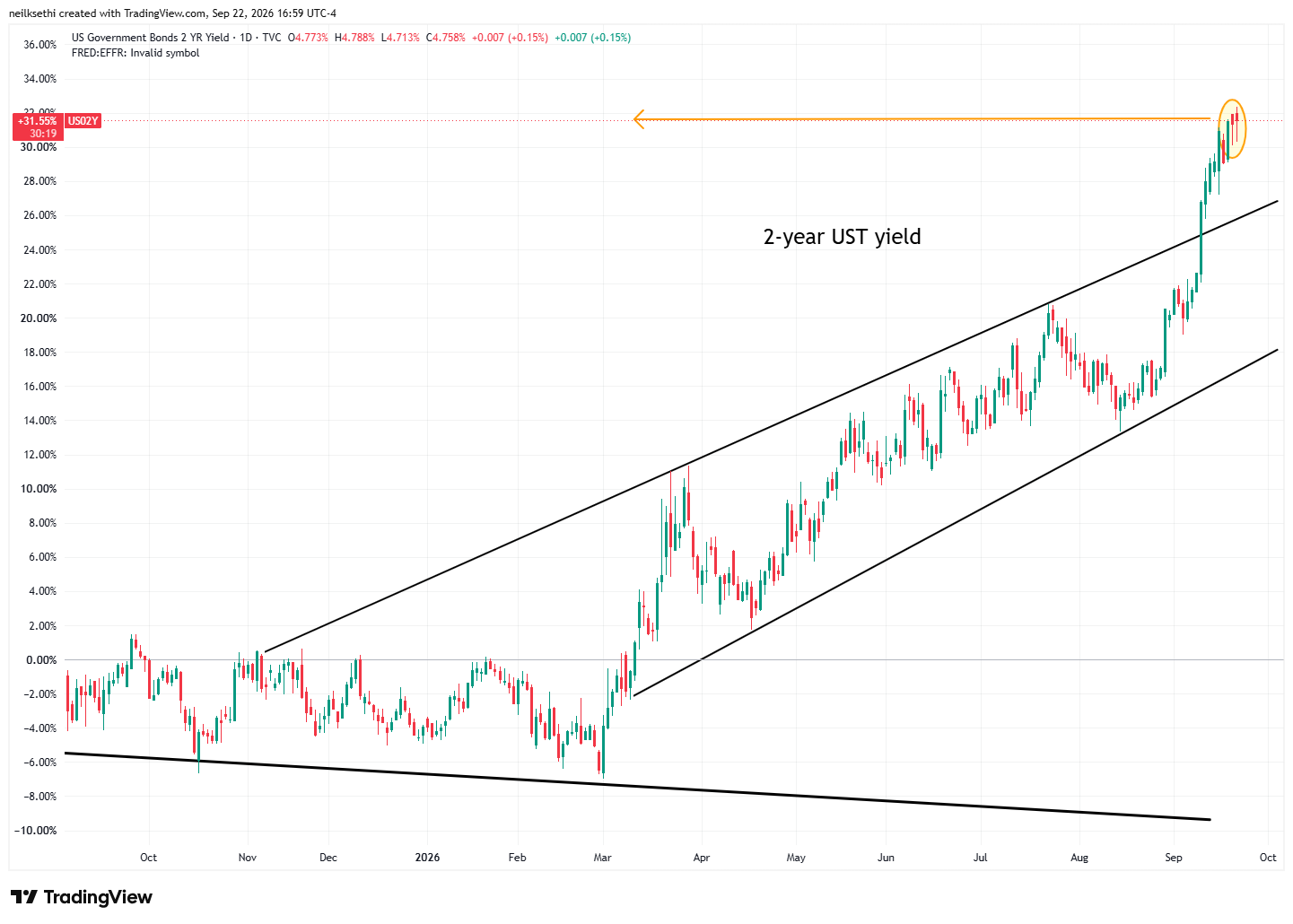
Treasury yields rose across the curve in a very mild bear steepening (shorter yields rising less than longer):
The 2-year Treasury edged up one basis point but that was enough for the highest close since July 2024.
It is now ~96 basis points above the Effective Fed Funds rate, so still screaming for more rate hikes. In that regard, Fed fund futures from CME’s Fedwatch tool were little changed still looking for one hike in 2026 with a 40% chance of two plus a third fully priced for 2027 (78 basis points of hikes in total through YE 2027).
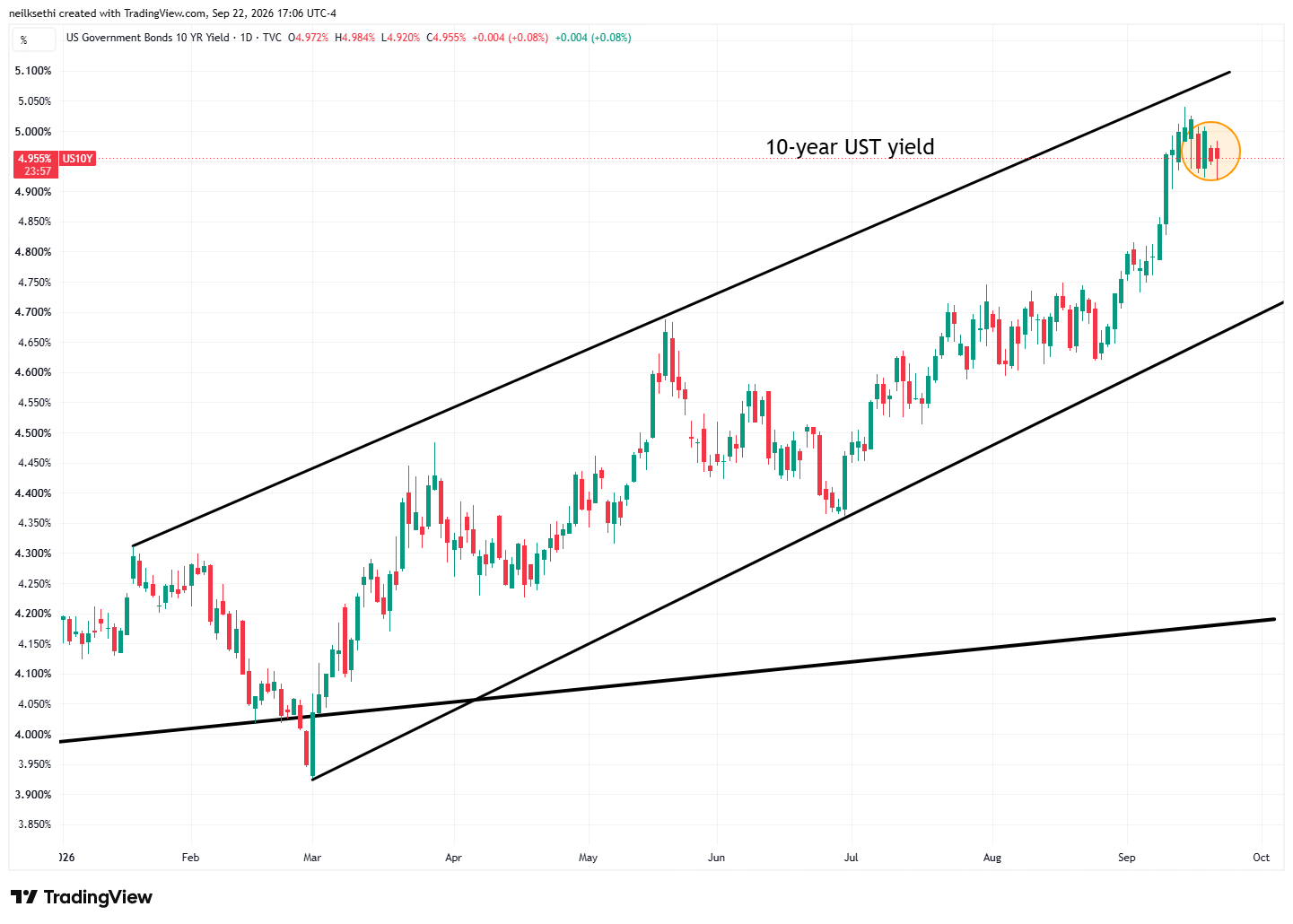
10-year yields up a little more than one basis point to 4.96%. It remains six basis points below Wednesday’s after hours close (the highest since 2007).
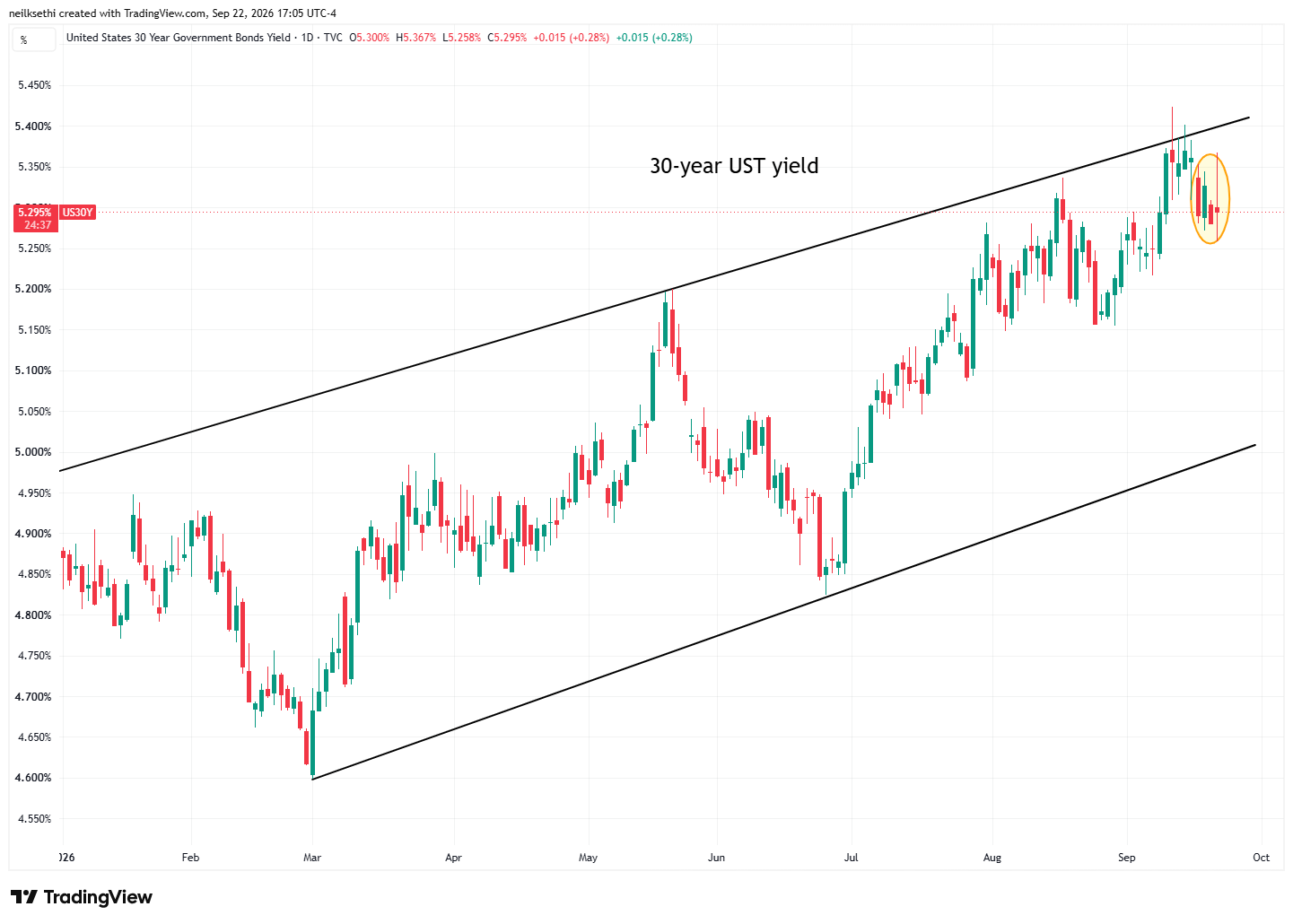
30-year yields up two basis points ending after hours at 5.30%, up from a nearly two-week low, seven basis points from last Tuesday’s close (the highest since 2007).
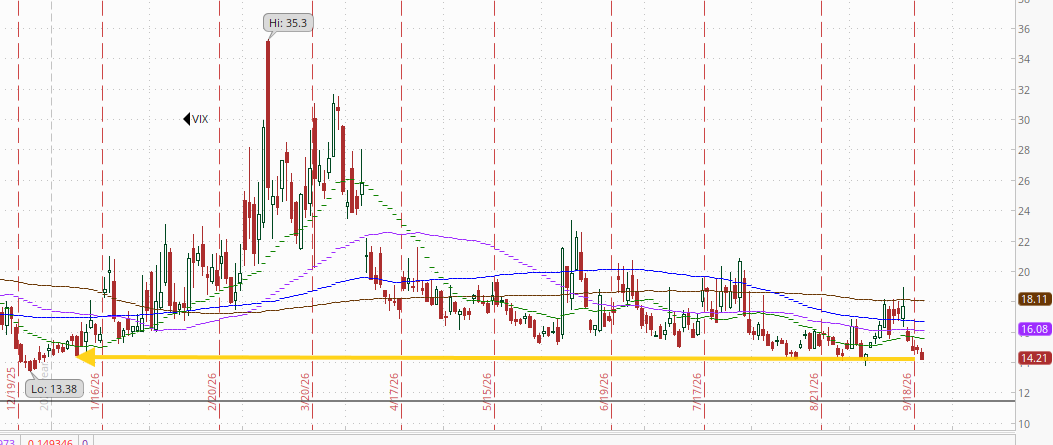
VIX fell back to 14.2, the lowest close of the year. That’s consistent with ~0.89% average daily moves in the SPX over the next 30 days.
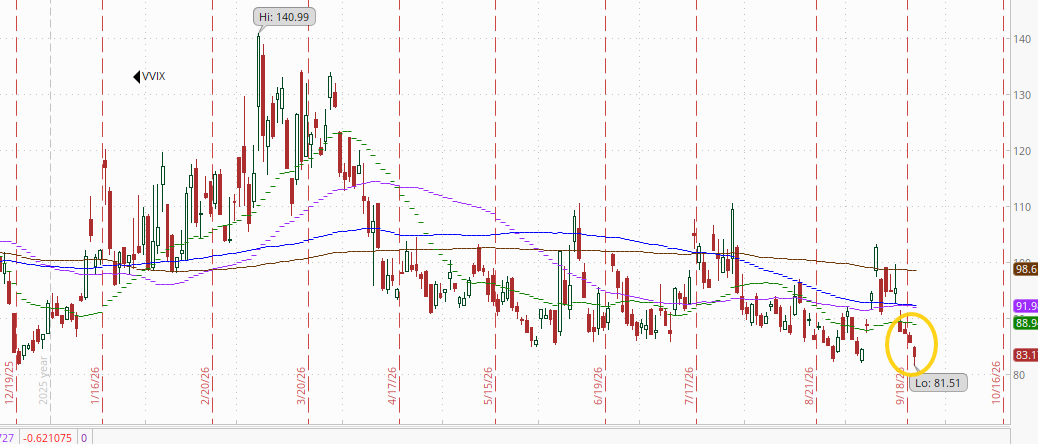
The VVIX (VIX of the VIX) at one point touched the lowest level since July 2024 before ending at 83.2, just off the lows of the year.
The current level is consistent with “moderate” daily moves in the VIX over the next 30 days (historically, normal is 80-100). Above 100 is the level flagged by Charlie McElligott as indicating higher stress.
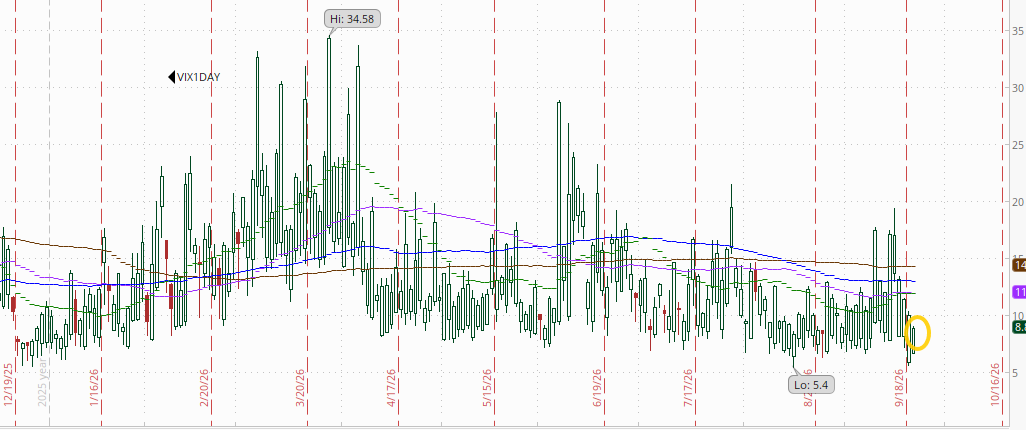
The 1-day VIX also eased to 8.8 (lowest close this year was 8.0 in early January). The current reading isconsistent with a move of just 0.55% in the SPX next session.
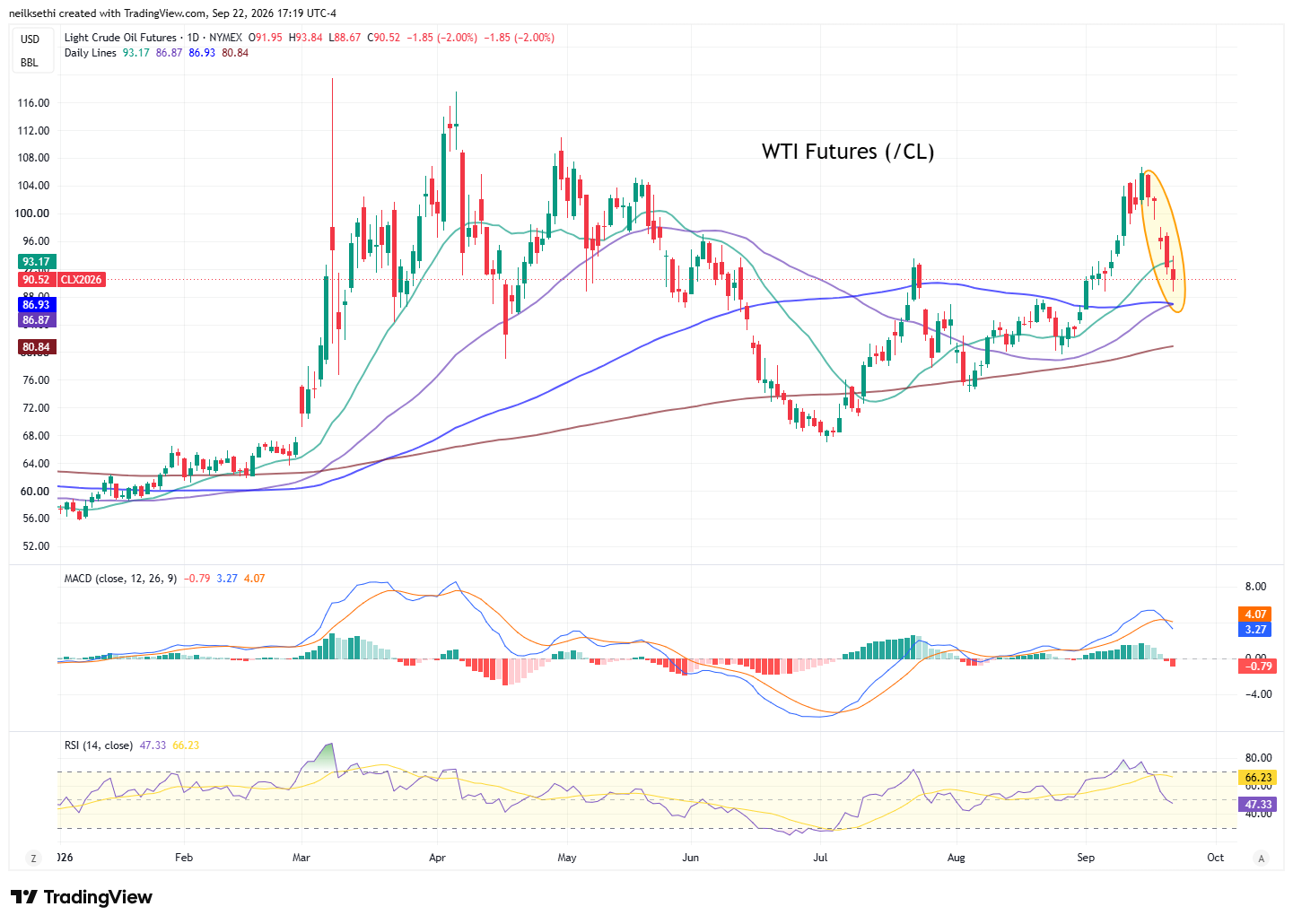
WTI futures (/CL) fell for a fifth session (the longest streak in over a year according to BBG) another -2.0% (including the after-hours session) to the lowest close since September 1st.
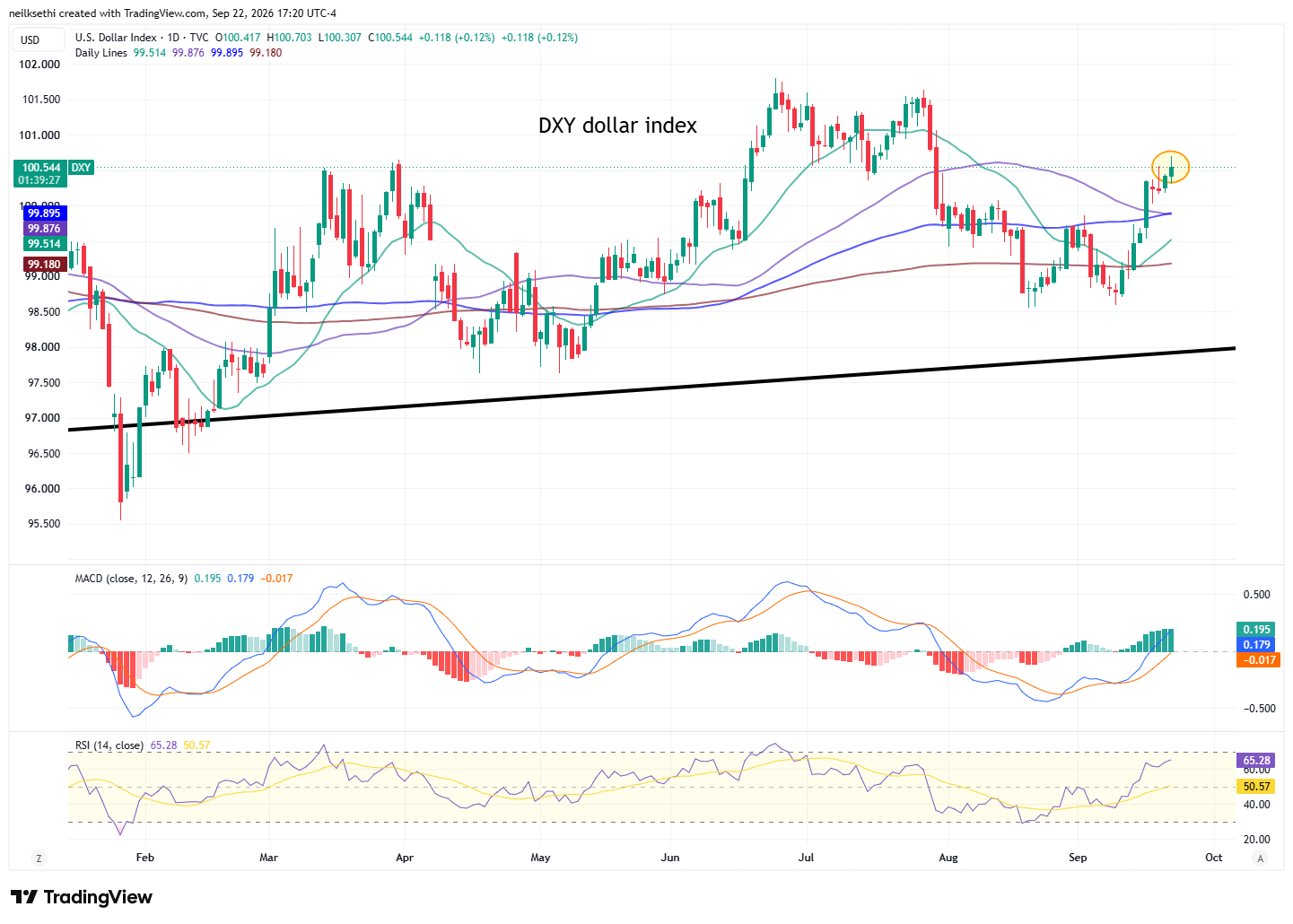
The DXY dollar index (which is fixed weighted with a heavy (57%) weighting vs the euro), pushed to the highest close since July.
As I mentioned last week “The daily MACD remains positive and the RSI is above 60 so it continues to have strong technical support.”
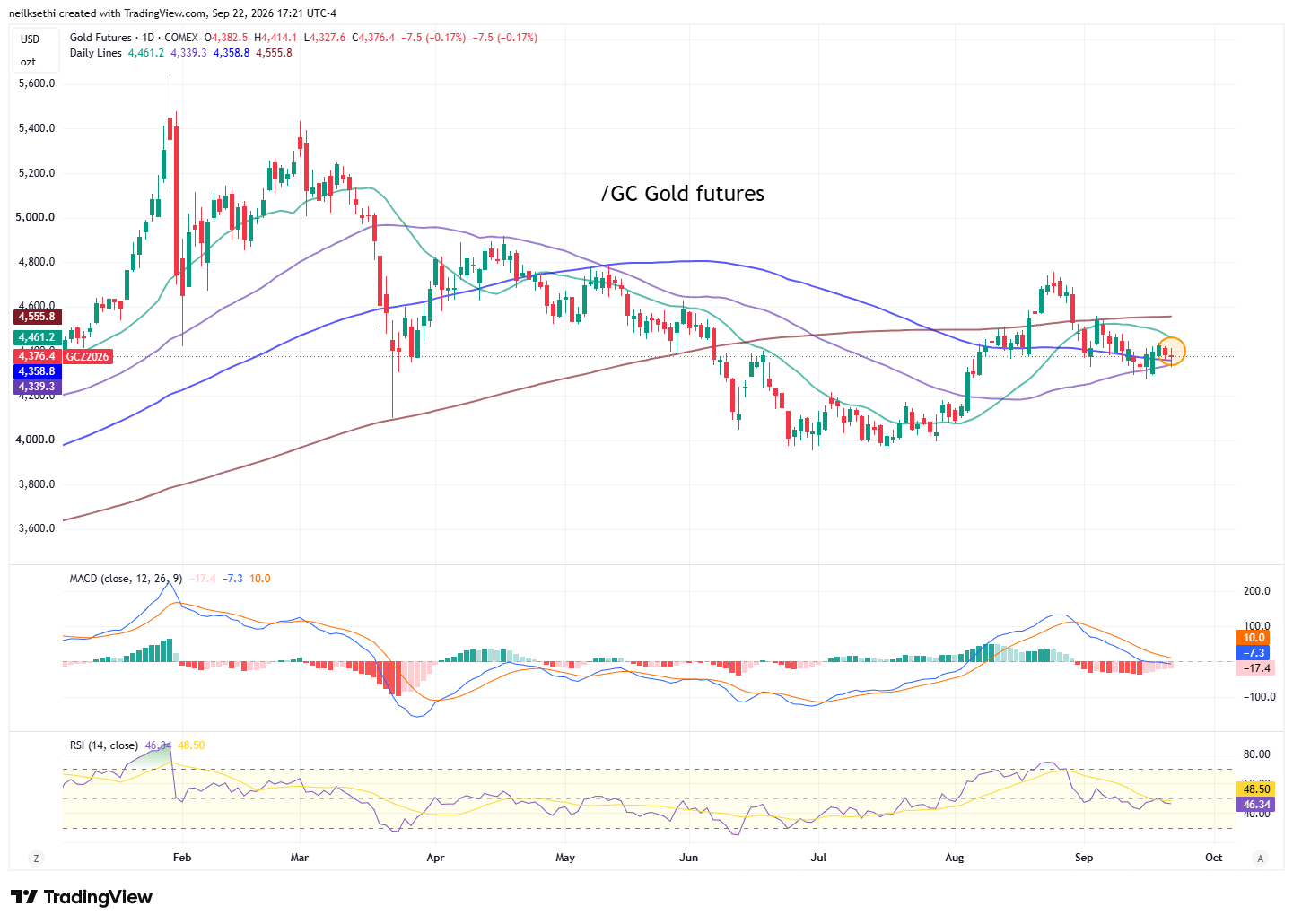
Gold futures (/GC) little changed. The daily MACD remains negative and the RSI is under 50, so I’m still holding off for now. As I said a week ago though “if it can continue to hold here and the technicals firm up, I may take a shot.”
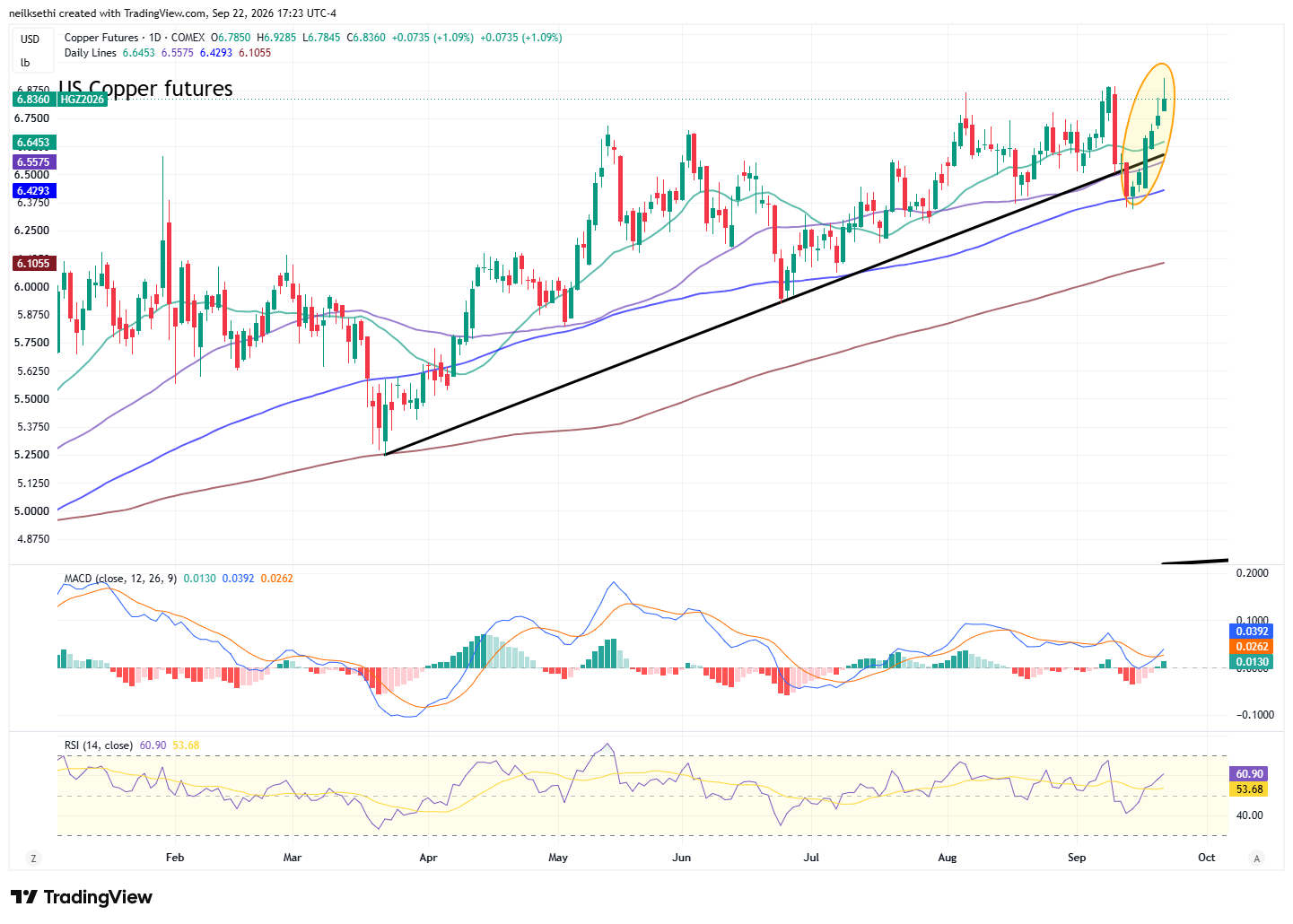
US copper futures (/HG) up for a sixth session at one point touching all time-highs. Daily technicals as noted Tuesday have “firmed up with the MACD crossing positively and the RSI over 60.”
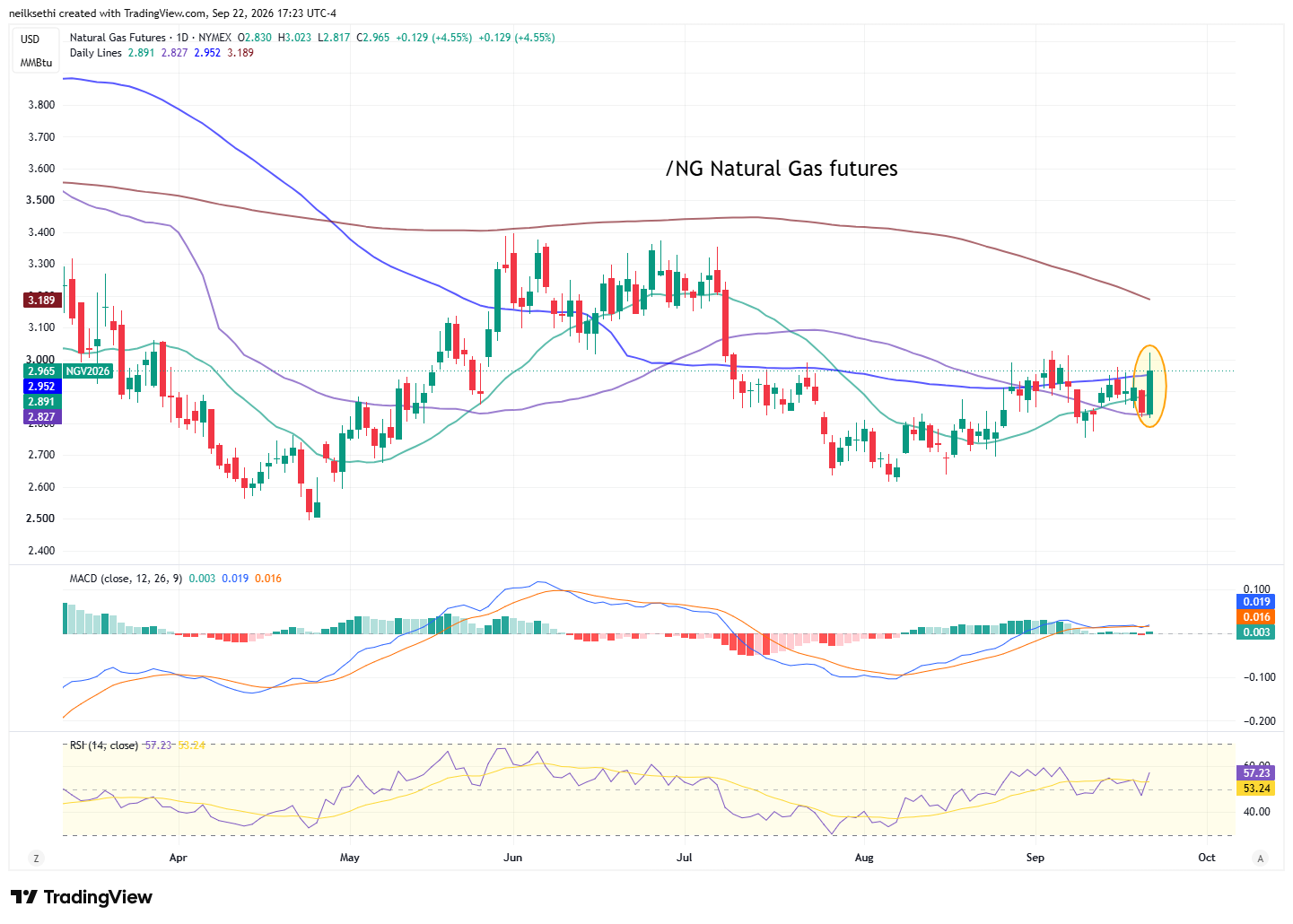
US natural gas futures (/NG) jumped 4.5%, their best day in six weeks, to the top of their trading range since the start of July. They couldn’t get through the $3.03 level though which marked the high earlier this month. A break over that, though, and this could run.
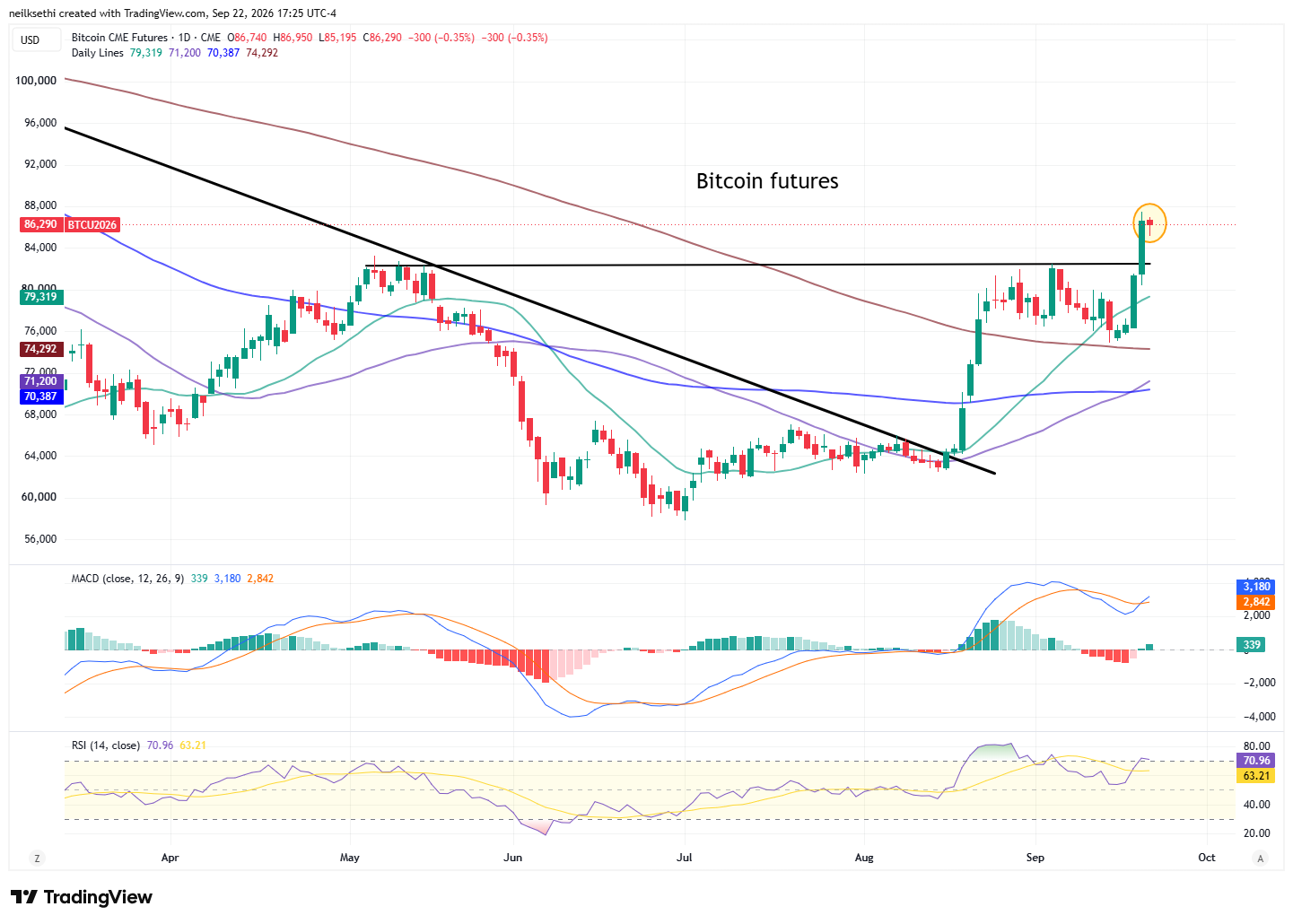
Bitcoin futures little changed as they digest their 13% two-day move. Daily MACD is positive while the RSI is over 70.
More From TheStreet Pro:
- James “Rev Shark” DePorre – Indices Churn On Mix of Good and Bad Action
- Ed Ponsi – Surprise Greenland Deal Has Investors Looking in the Wrong Place
- Chris Versace – Trump’s U.N. Address Before Iran’s: 8 Key Items Shaping the Stock Market Tuesday
Miscellaneous:
Wrap-Up – The Market Again Bends but Doesn’t Break
I said yesterday:
while I was expecting Tech to continue to lead, I’m not sure I was expecting a 2+% day for the group. But I’ll certainly take it. With the trade gaining further momentum, the technical picture even more improved, and no particular near term negative catalysts on the horizon (there can always be something unexpected of course), it feels like it probably has further to go.
And positively today it brought some of the non-Tech areas of the market with it, although it remains to be seen how much that depends on falling oil prices and bond yields.
So far so good, let’s see if we can keep it going Tuesday.
And I guess it depends on what you think I meant by “keep it going”. If you meant the AI-trade, that certainly kept going. But if you meant the “non-Tech areas” I guess Materials and Staples did well, but otherwise it was pretty weak (although we did see 47% of issues gaining on the NYSE along with 48% positive volume, so it wasn’t terrible).
But for now I remain in the camp of Citadel’s Scott Rubner who thinks pullbacks should be bought going into October:
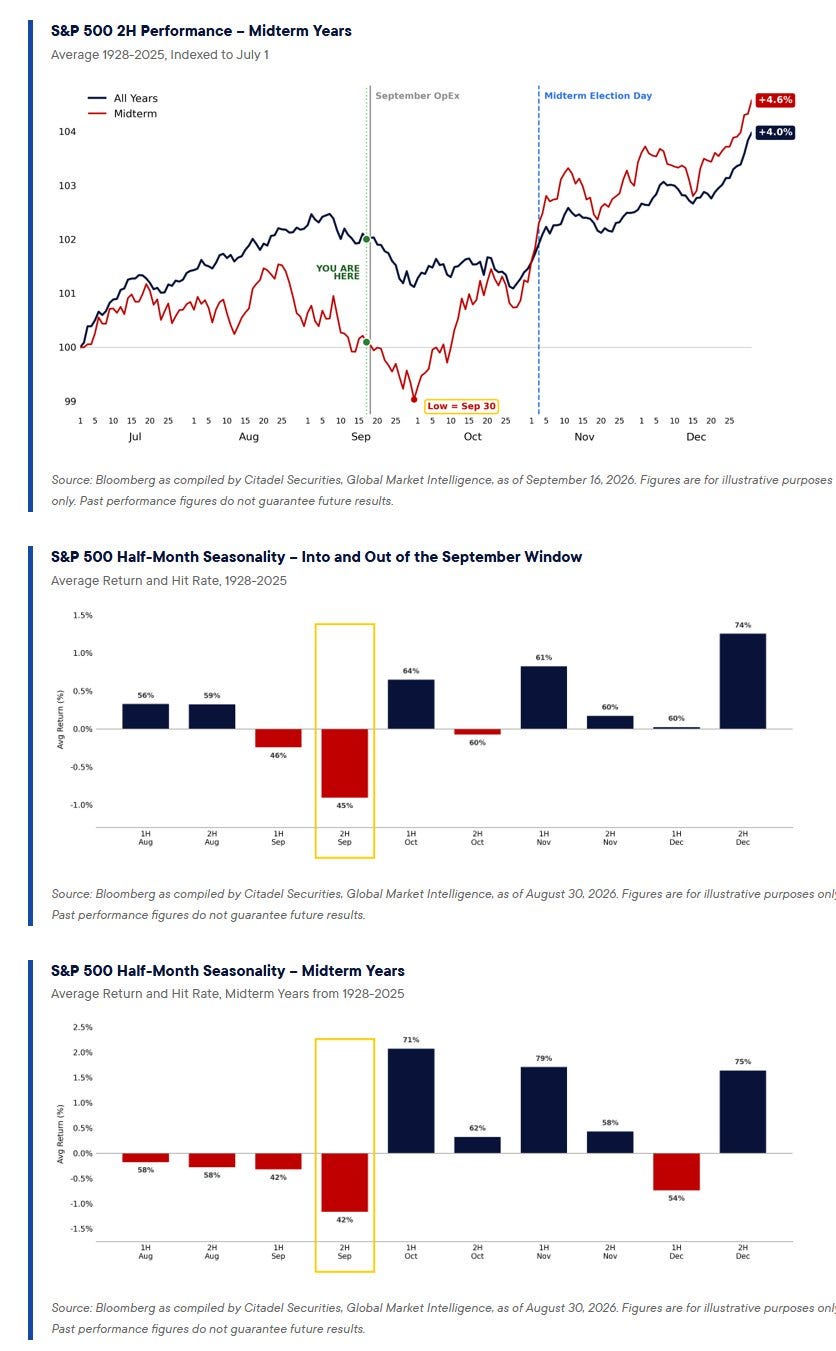
Our tactical view remains unchanged: we think equities have more downside into month-end. Buybacks are moving into blackout, $7T of options exposure [rolled] off Friday, systematic positioning remains a potential source of supply, quarter-end rebalancing is unfavorable, and we are entering the weakest part of the midterm-year calendar.
Historically, the average midterm-year path continues to weaken from here into quarter-end. Since 1930, the average path has declined roughly 1.1% between now and September 30, before recovering through October and accelerating into and beyond Election Day (chart). From the September 30 low, the average midterm year has gained 5.6% into year-end.
But importantly, we are becoming more constructive, not less, as that weakness develops.
Now: AI sentiment turned sharply negative and positioning has been reduced.
Through September: supply/demand and seasonality still point to downside.
Into October / Q4: those same September resets begin to work in the other direction, first in Tech and potentially across the broader market into earnings and year-end.
We would use further weakness into month-end to add to core longs. We will be back shortly with our full Q4 playbook and why we think the setup improves materially once we get through September.
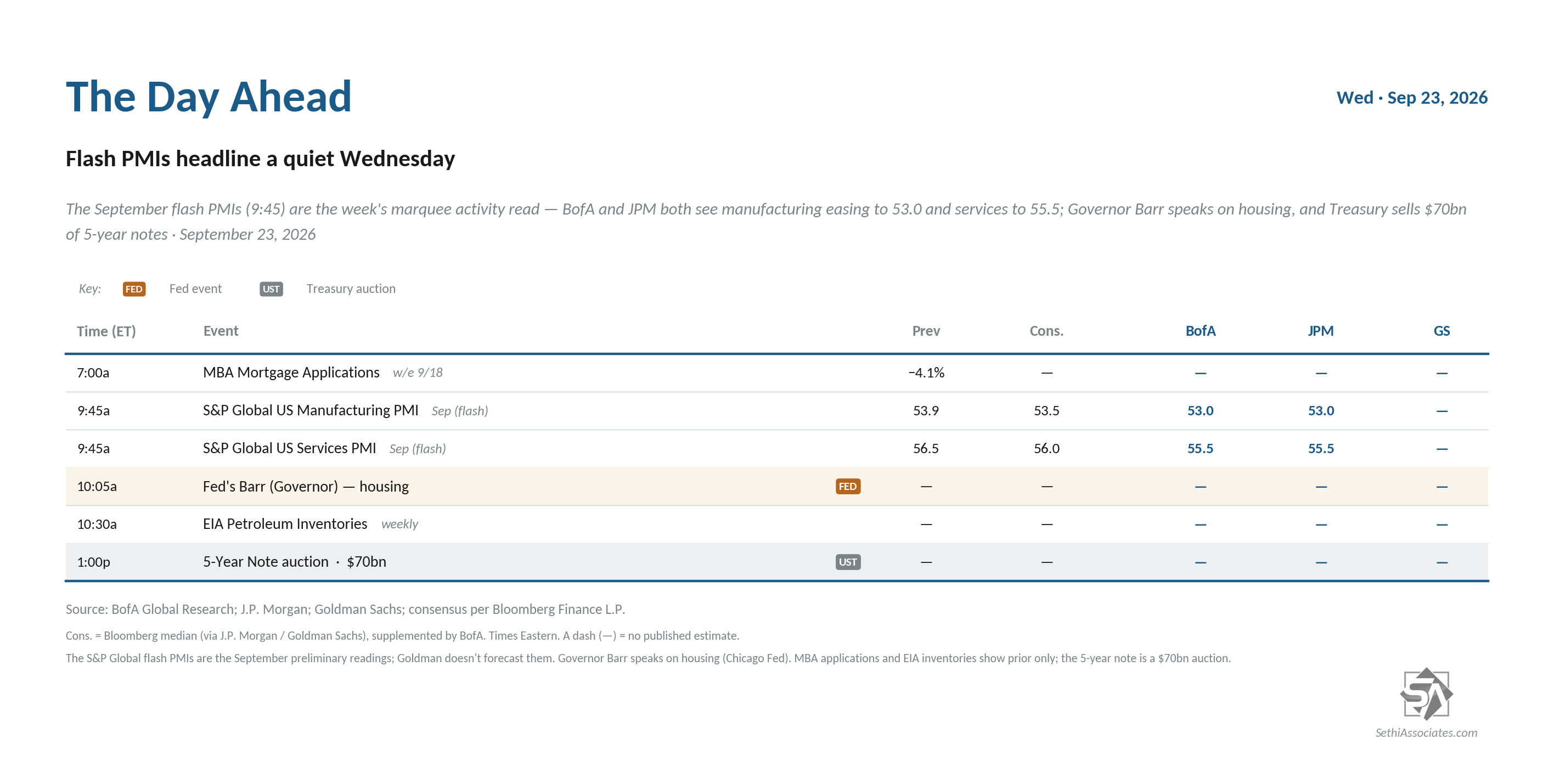
The Day Ahead – Global Flash PMIs Headline Another Light Day
US economic data remains light Wednesday with just September flash PMIs along with weekly mortgage applications and US petroleum inventories.
Fed speakers also lighten up with just Governor Barr on the schedule.
Non-Bill (>1yr in maturity) US Treasury auctions continue with 5-year notes.
As noted in the Week Ahead we are now in the weird middle ground between Q2 and Q3 earnings. Wednesday we’ll get three SPX components reporting in Cintas (CTAS), Paychex (PAYX) and General Mills (GIS). Also Meta (META) CEO Mark Zuckerberg gives a keynote speech at the Meta Connect developer conference, focused on AI, smart glasses and virtual reality.
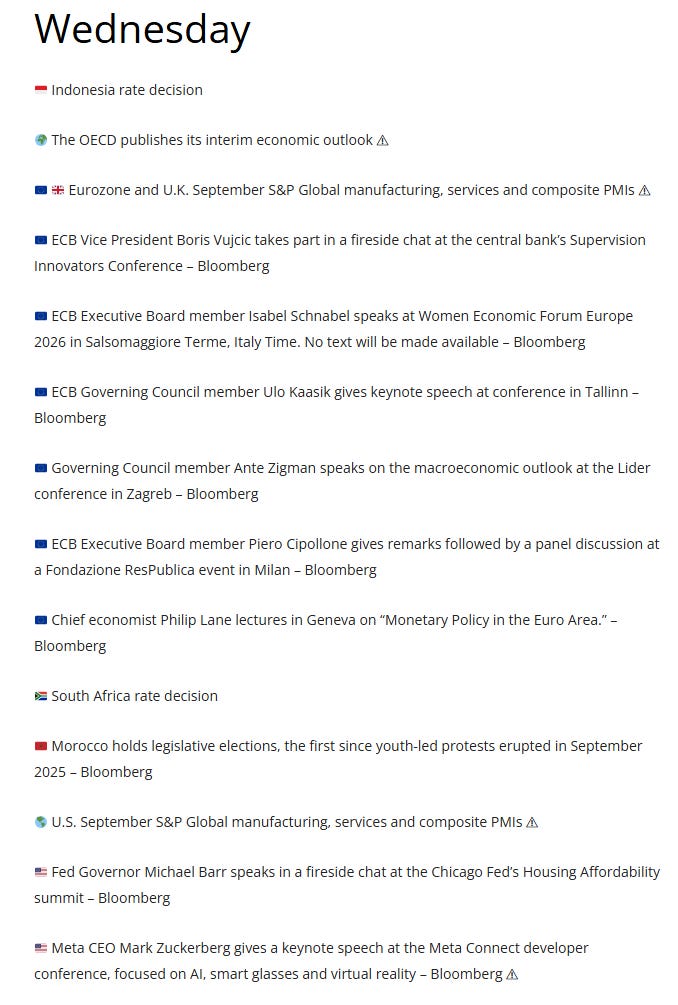
Ex-US highlights are global flash PMIs. Also quite a few ECB speakers (see list from Christophe Barraud below).
From Christophe Barraud’s international Week Ahead rundown:
As a reminder, if you do put a comment in for me on a post please be sure to put @NeilSethi in front. Comments are encouraged!