Small Business Sentiment Cools as Inflation Worries Climb
NFIB’s Small Business Optimism Index slipped to a three-month low as fewer expect conditions to improve.
You've reached your free article limit
You've read 0 of 1 free Pro articles.

Excerpt:
US NFIB Small Business Optimism Sep: 97.9 (est 98.2; prev 98.7)
Executive Summary
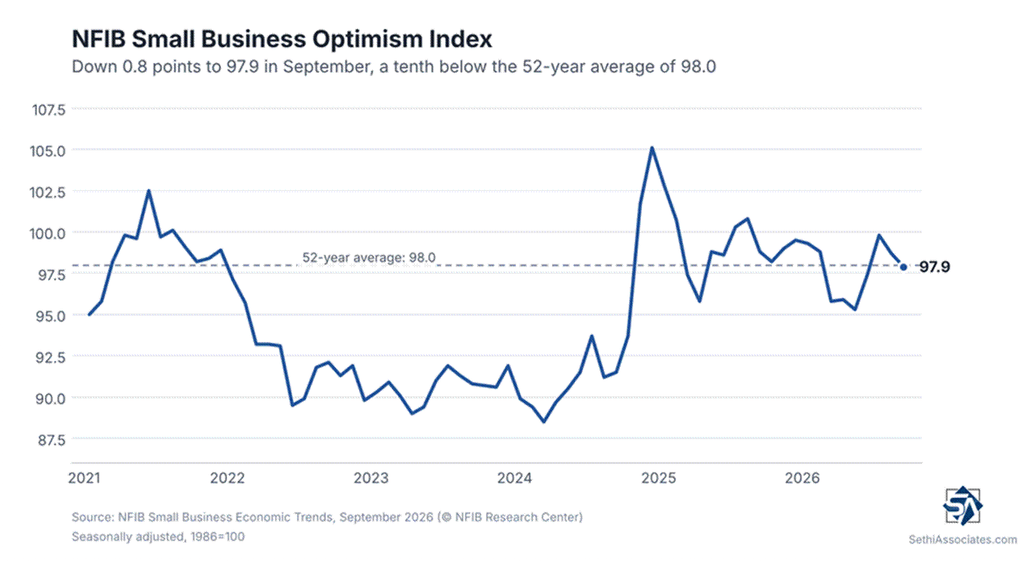
- The NFIB Small Business Optimism Index fell 0.8 points to 97.9 in September, below the 98.2 estimate, a three-month low and a tenth of a point under its 52-year average.
- Six of the 10 components fell, led by the share of owners calling it a good time to expand (down 5 points to 7%) and expecting better business conditions (down 4 points to a net 6%).
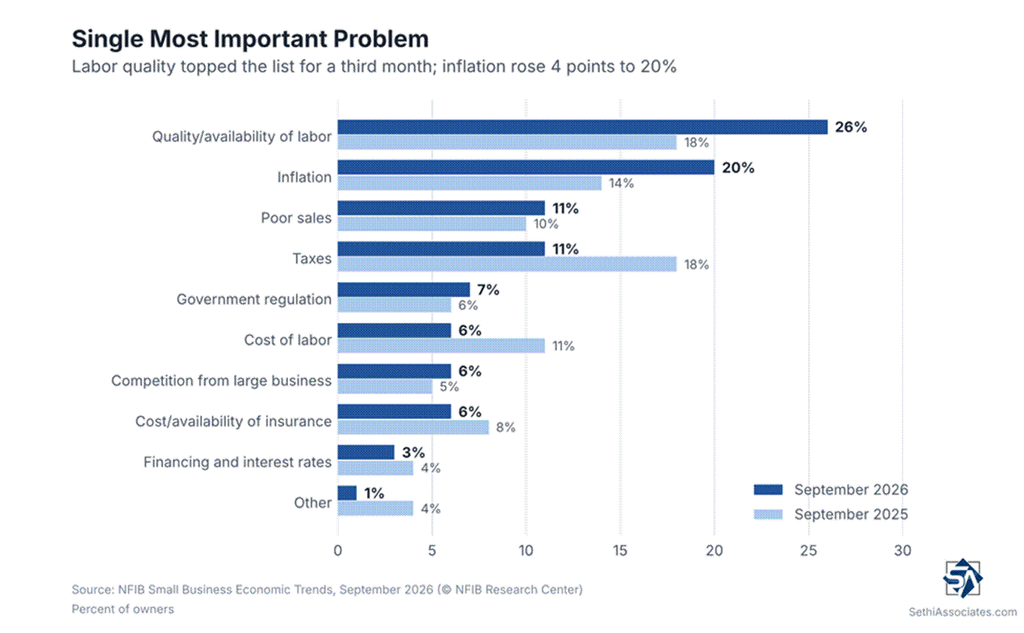
- Inflation rose 4 points to 20% as owners’ single most important problem, second only to labor quality at 26%, and a net 31% plan to raise prices, the highest since June.
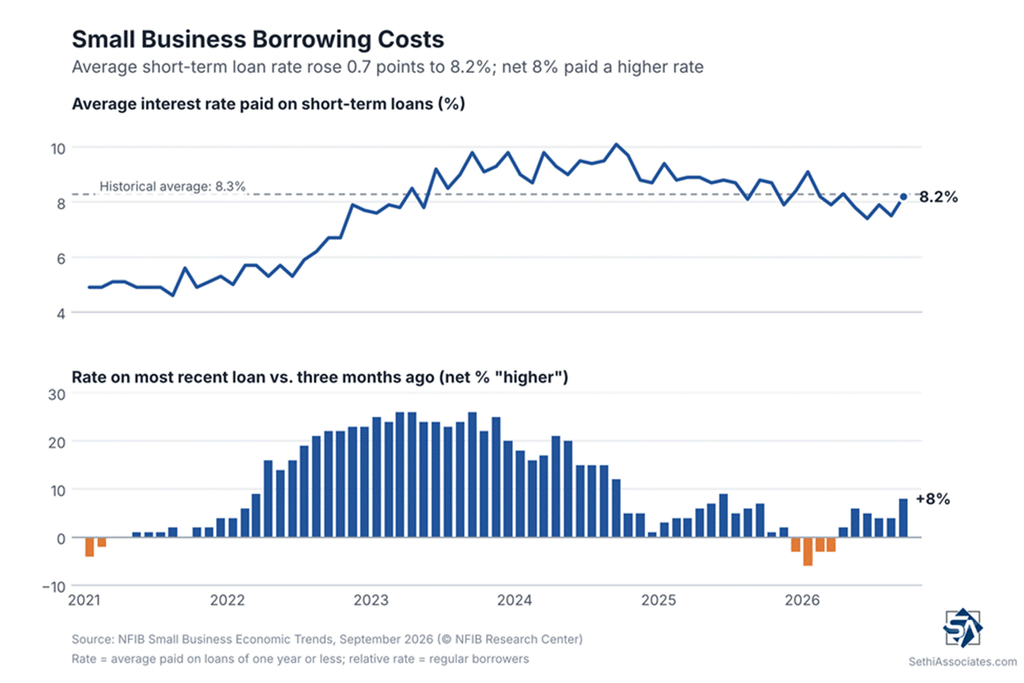
- The average rate on short-term loans jumped 0.7 points to 8.2%, and a net 8% of regular borrowers paid a higher rate, the most since June 2025.
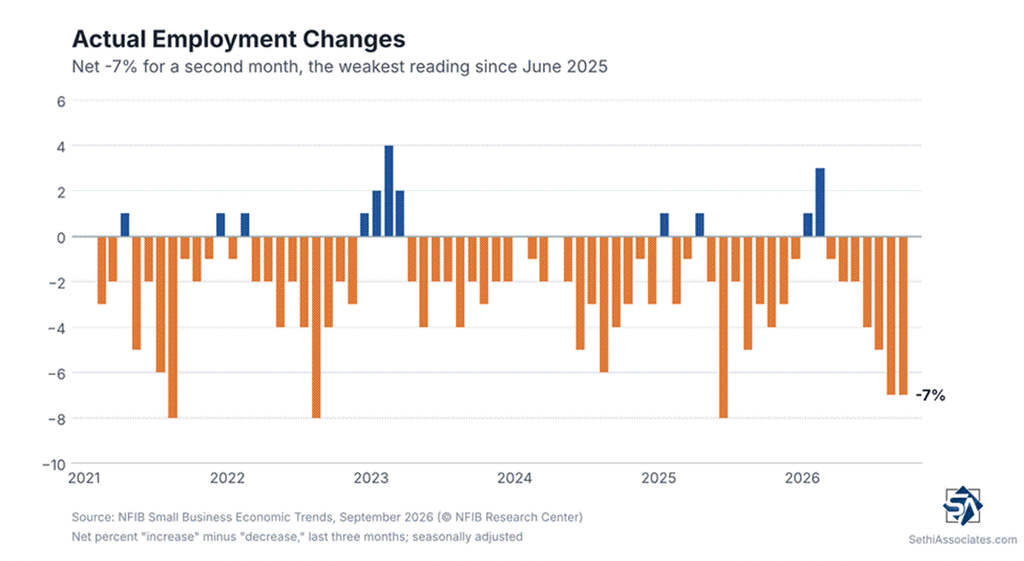
- Actual employment changes held at a net -7%, the weakest since June 2025, as unfilled job openings fell 3 points to 32%.
September Optimism Index
The NFIB Small Business Optimism Index fell 0.8 points to 97.9 in September, below the 98.2 consensus estimate and the lowest reading since June (97.4). Optimism now sits a tenth of a point below its 52-year average of 98.0, back under the long-term mark after two months above it.
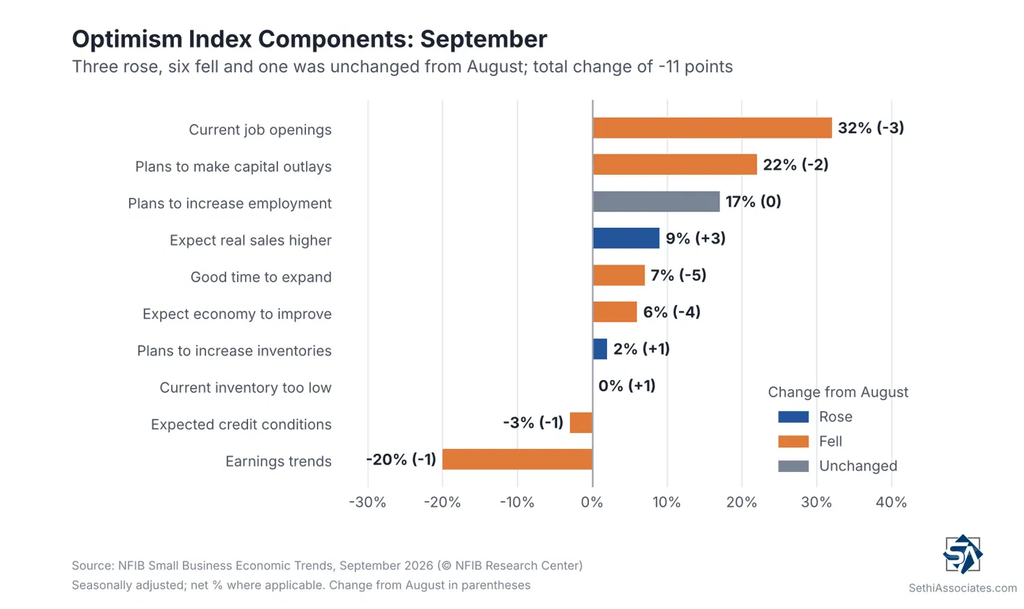
Of the 10 components, three rose, six fell and one was unchanged. According to NFIB, “Worsening expected business conditions and reports that it is a good time to expand contributed the most to the Index’s decline.“
The share calling it a good time to expand fell 5 points to 7%, and expected business conditions fell 4 points to a net 6%. Also falling were job openings 3 points to 32% and capital outlay plans 2 points to 22%. Earnings trends and expected credit conditions each slipped 1 point, to a net -20% and a net -3%, respectively.
Positively, expected real sales rose 3 points to a net 9%, inventory plans rose 1 point to a net 2% and the net share viewing current inventory as “too low” rose 1 point to 0%. Hiring plans were unchanged at a net 17%.
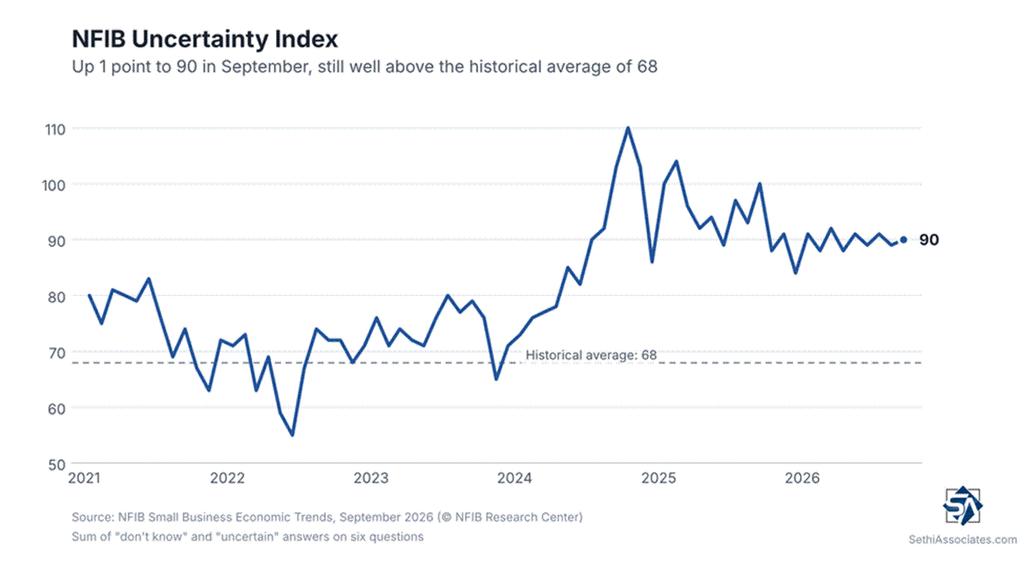
The Uncertainty Index rose 1 point to 90, which NFIB said was “still well above its historical average of 68,” as more owners were unsure whether it is a good time to expand and about their capital investment plans.
“Small business owners are proceeding with caution as they interpret how rising costs, interest rates, and the difficulty in finding qualified employees are impacting their business,” said NFIB Chief Economist Bill Dunkelberg.
Outlook
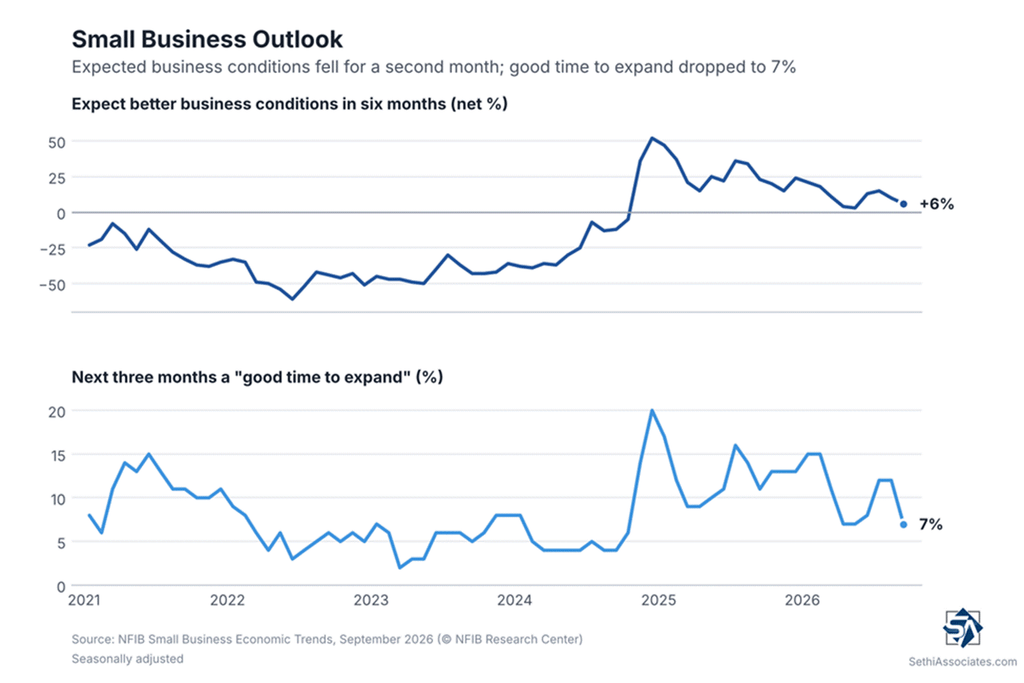
A net 6% of owners expect better business conditions over the next six months, down 4 points for a second straight monthly decline and the lowest since May (net 3%). NFIB noted the reading remains above its historical average.
Only 7% said the next three months will be a good time to expand, down 5 points and tied with April and May for the lowest since October 2024. Among owners who said it is not a good time to expand, economic conditions were the most cited reason (28% of all owners), followed by the political climate (8%) and the cost of expansion (5%).
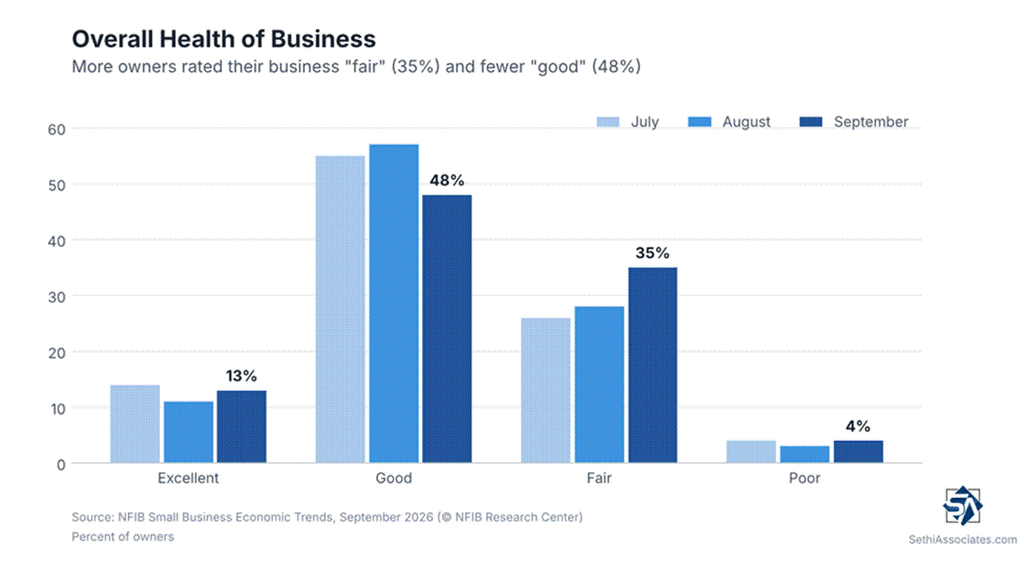
Owners’ assessment of their own businesses “shifted negative,” per NFIB, “with more reporting their business as fair rather than good.” Some 48% rated their business good (down 9 points) and 35% fair (up 7 points), while 13% said excellent (up 2 points) and 4% poor (up 1 point).
Earnings
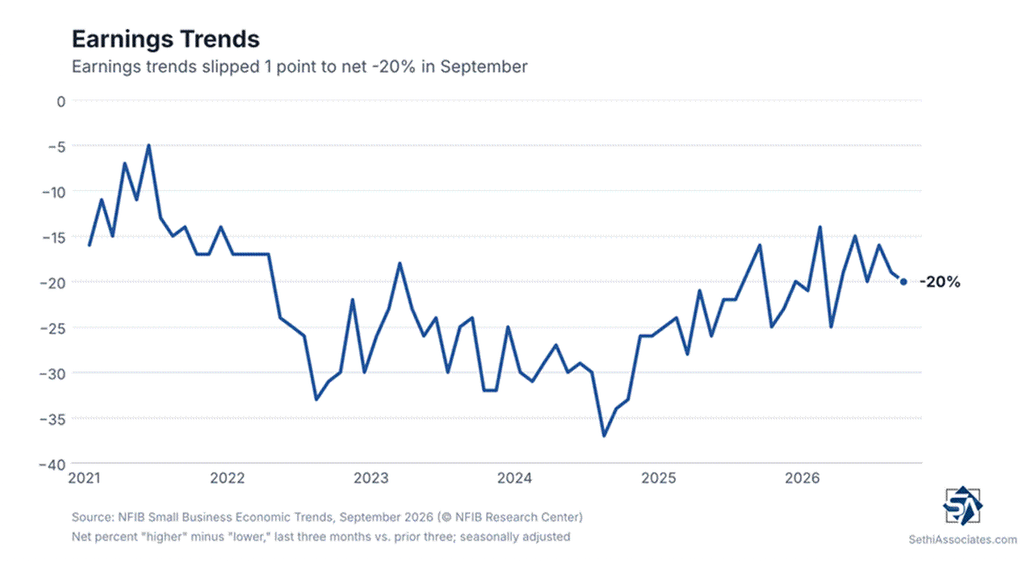
Earnings trends slipped 1 point to a net -20%, tying June for the weakest reading since March (net -25%).
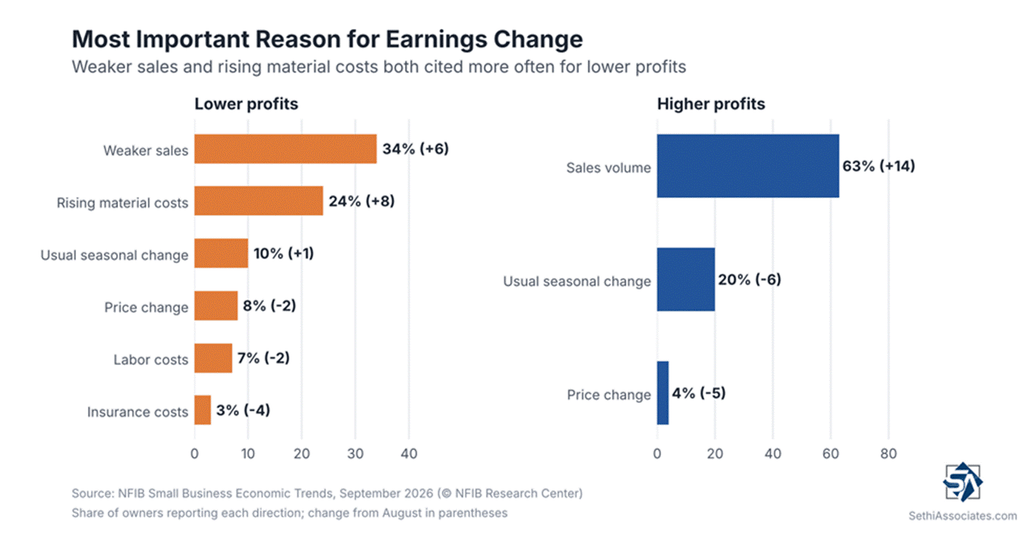
Among owners reporting lower profits, 34% blamed weaker sales and 24% rising material costs, up 6 and 8 points, respectively. Another 10% cited the usual seasonal change (up 1 point), 8% price changes (down 2 points), 7% labor costs (down 2 points) and 3% insurance costs (down 4 points).
Among owners reporting higher profits, 63% cited sales volume (up 14 points), 20% the usual seasonal change (down 6 points) and 4% price changes (down 5 points).
Sales and Inventories
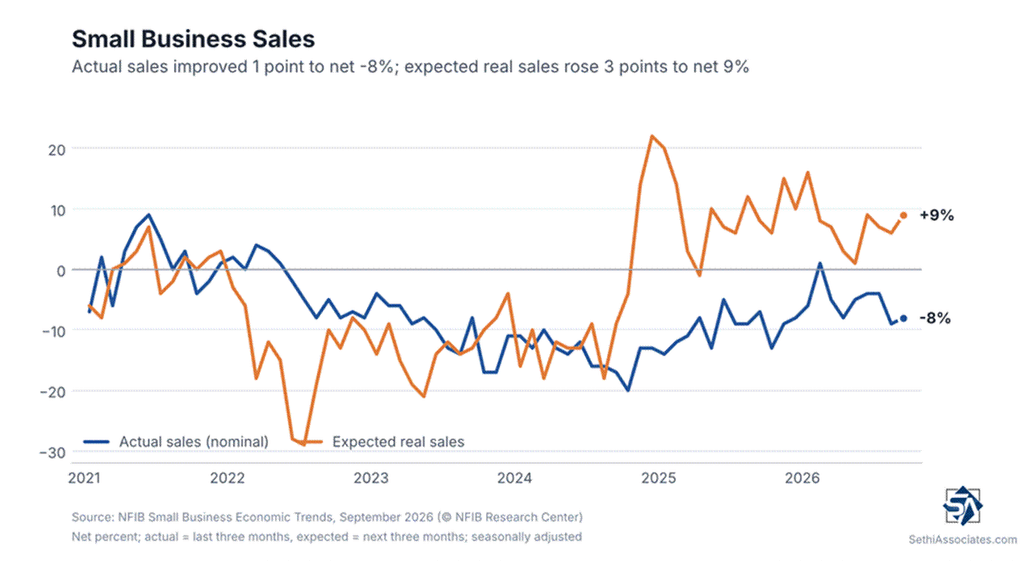
A net -8% of owners reported higher nominal sales over the past three months, up 1 point from August. Looking ahead, the net share expecting higher real sales volumes rose 3 points to a net 9%, tying June for the highest since January (net 16%).
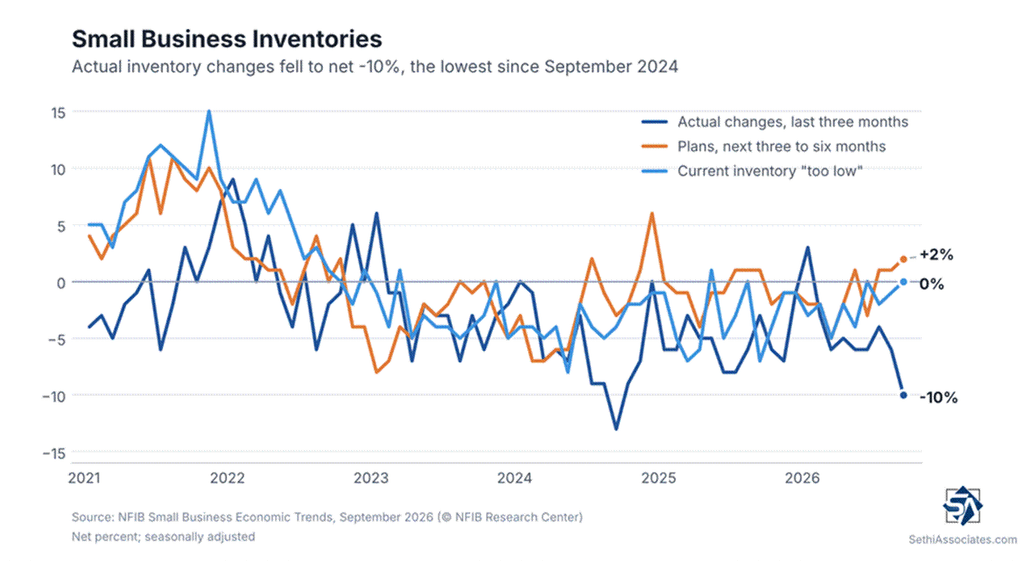
Inventory drawdowns were the most widespread since September 2024, with a net 10% of owners reporting they reduced stocks over the past three months. Unadjusted, 9% reported increases in stocks (down 2 points) and 18% reductions (up 3 points). Inventory plans rose 1 point to a net 2%, the highest since December 2024, while a net 0% viewed current stocks as “too low,” up 1 point.
Some 62% said supply chain disruptions affected their business to some extent, unchanged from August. Seven percent reported a significant impact (up 1 point), 21% moderate (up 2 points) and 34% mild (down 3 points), while 38% reported no impact (up 1 point).
Prices
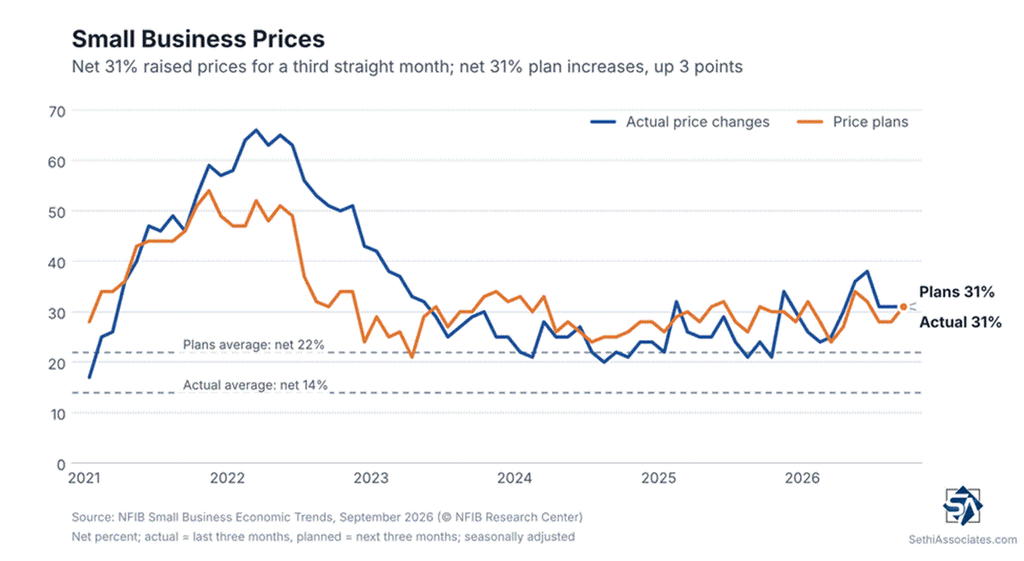
A net 31% of owners raised average selling prices, unchanged from August and at that level for a third straight month, well above the historical average of a net 14%. Unadjusted, 38% reported higher average prices and 8% lower, both unchanged.
A net 31% plan to raise prices over the next three months, up 3 points and the highest since June, above the historical average of a net 22%.
Labor Markets
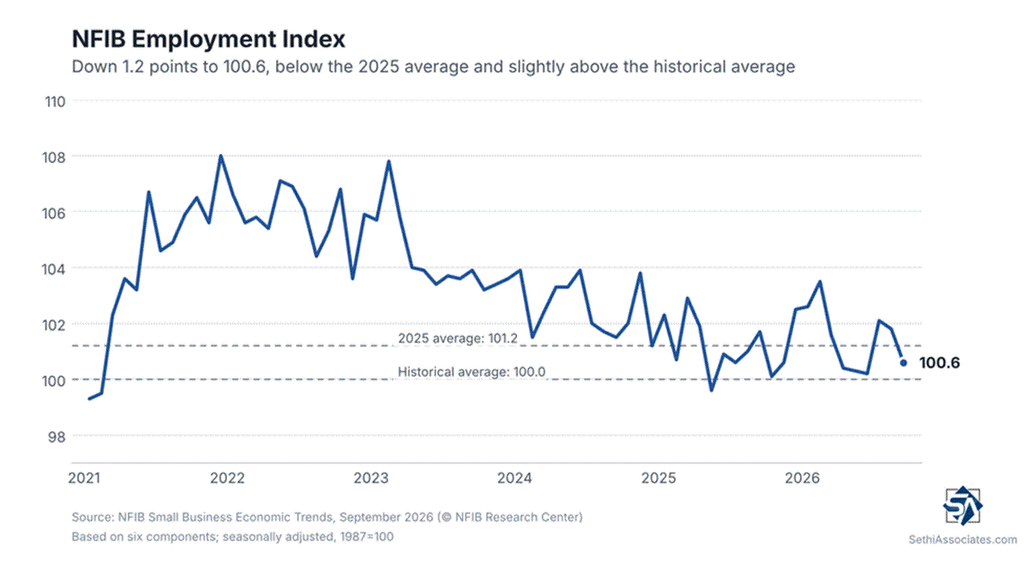
The NFIB Employment Index fell 1.2 points to 100.6, the lowest since June (100.2), below the 2025 average of 101.2 but slightly above the historical average of 100.0.
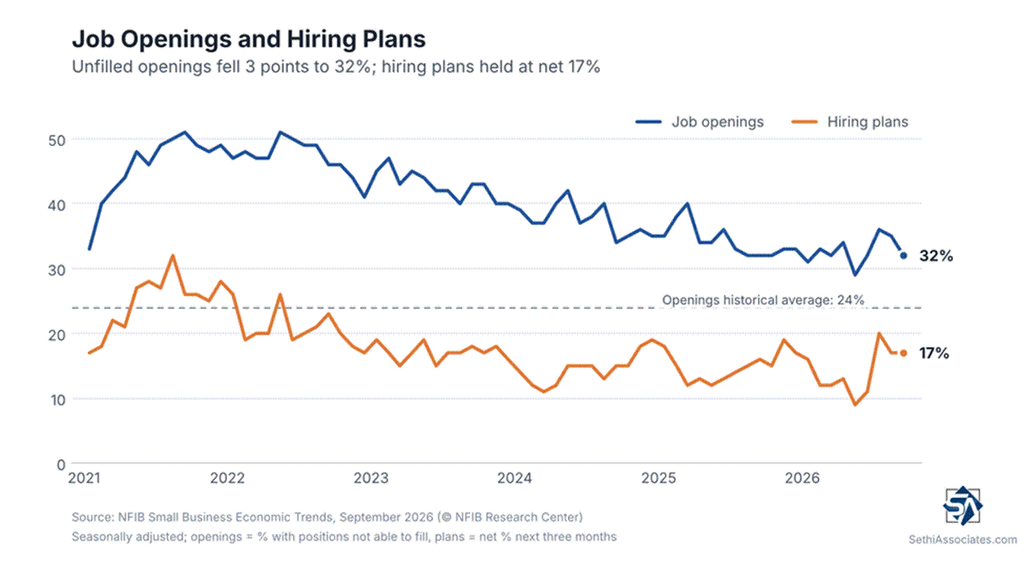
Per NFIB’s jobs report, 32% of owners reported job openings they could not fill, down 3 points but still 8 points above the historical average. Openings for skilled workers fell 4 points to 27%, while openings for unskilled labor rose 3 points to 16%. A net 17% plan to create new jobs over the next three months, unchanged from August.
Actual hiring activity declined, with 51% of owners hiring or trying to hire, down 5 points. Of those, 87% reported few or no qualified applicants (45% of all owners, down 2 points): 25% reported few (down 4 points) and 20% none (up 2 points).
Actual employment changes over the past three months held at a net -7%, the weakest reading since June 2025. NFIB’s commentary said “the AI boom hasn’t done much in changing the overall jobs landscape.”
Compensation
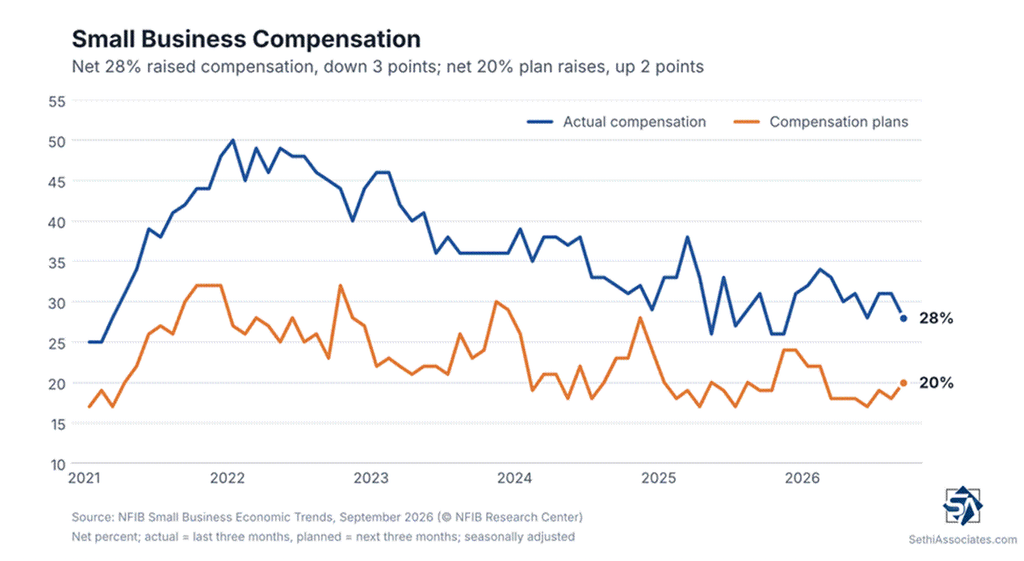
A net 28% of owners reported raising compensation, down 3 points and tied with June for the lowest since November 2025 (net 26%). A net 20% plan to raise compensation over the next three months, up 2 points and the most since February (net 22%). Both remain above their historical averages, per NFIB.
Credit Conditions
“The Fed raised its policy rate as most observers expected, and market rates followed suit,” NFIB’s commentary said, adding that “small business borrowers reported higher rates on their recently received loans.”
The average rate paid on short-term loans rose 0.7 points to 8.2%, the highest since April and close to the historical average of 8.3%. A net 8% of regular borrowers reported paying a higher rate on their most recent loan, up 4 points and the most since June 2025.
A net -3% of owners expect easier credit conditions, down 1 point, and a net 3% said their last loan was harder to get, unchanged. The share borrowing regularly fell 3 points to 22%, tying April and June for the lowest since November 2021 and below the historical average of 34%.
Capital Outlays
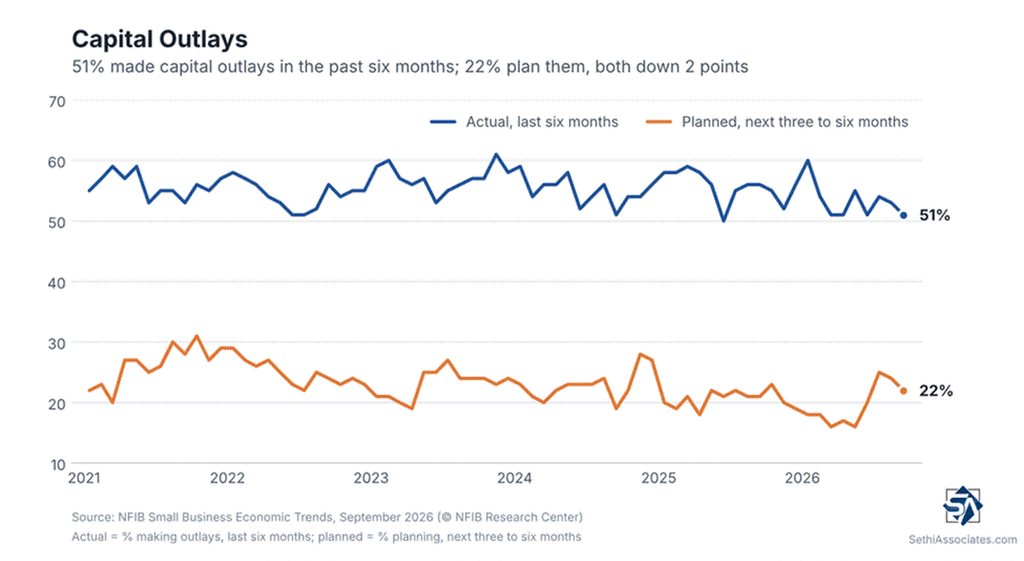
Some 51% of owners made capital outlays over the past six months, down 2 points and tied with March, April and June for the lowest since June 2025 (50%). Of those making expenditures, 32% spent on new equipment (down 4 points), 20% on vehicles (down 2 points), 16% on improving or expanding facilities (up 4 points), 8% on new fixtures and furniture (down 4 points) and 5% on new buildings or land (up 1 point).
Capital spending plans fell 2 points to 22%, the lowest since June, with both actual and planned outlays below their 52-year averages.
Single Most Important Problem
Labor quality or availability was the top problem for a third straight month at 26%, up 3 points and 14 points above its historical average of 12%. It was 18% a year ago. Inflation ranked second at 20% up from 14% this time last year and well above its historical average of 7%.
Poor sales rose 1 point to 11%, a third straight monthly increase, tying taxes for third. Taxes fell 5 points to 11%, the lowest since December 2022. Government regulation fell 2 points to 7%, and the cost or availability of insurance fell 2 points to 6%, the lowest since August 2024. Competition from large businesses rose 2 points to 6%, labor costs fell 1 point to 6%, the lowest since December 2020, and financing and interest rates held at 3%.
NFIB Commentary and Member Quotes
Looking ahead, NFIB’s commentary said “consumer spending and the AI boom will help keep the economy growing at a healthy pace for the rest of the year,” but cautioned that “major uncertainties remain to be resolved, including the mid-term elections and the Iran war.”
Member comments published with the report centered mostly on fuel and input costs, finding skilled labor and the cost of health insurance, with a handful of more upbeat notes, including a Virginia financial firm on track for “likely a record year.” Those NFIB highlighted on their summary page:
- “Prices for fuel and raw materials are too high, and finding qualified labor is difficult.” – Manufacturing, WI
- “Our business could increase if we were able to hire skilled labor.” – Services, ME
- “I find my guests are uncertain about the future of their financial conditions and are starting to cut back.” – Services, OH
All charts by Sethi Associates using data from the NFIB Small Business Economic Trends report for September 2026.