Rally Dreams, Millions of Jobs on Thin Ice, Canada Keeps It Together
Can the rally realistically continue another day? Also, when taken together, these 4 charts show a shaky situation for tens of millions of workers.
You've reached your free article limit
You've read 0 of 1 free Pro articles.

Sonnet 73
That time of year thou mayst in me behold
When yellow leaves, or none, or few, do hang,
Upon those boughs which shake against the cold,
Bare ruin’d choirs, where late the sweet birds sang.
– William Shakespeare (1609)
The Little Engine
U.S. equity markets tried on Monday. They really did. The S&P 500 gained 0.41%. The Nasdaq Composite added 1.1%. Those gains came on Monday, despite rising prices for crude oil and despite rising yields across the slope of the Treasury curve. Common sense told us that while the gains were nice to look at, they would fall short of what they had to do, technically, for the market bulls.
Twenty-four hours ago, I wrote to you, in this column: “Even a rally on Monday that does not recover Friday’s losses in their entirety could leave the 50-day simple moving average for that index as a point of resistance. The bulls do not want to see that.”
This, we saw evidence of, during Monday’s regular session. Those gains paled in comparison to the 1.95% loss suffered by the S&P 500 on Friday, not to mention the 4.48% beat down the Nasdaq Composite underwent.
Would there be any market rally carryover on Tuesday morning? As I sit here, stuck for the time-being more than 2,000 miles west of where I need to be, working through the zero-dark hours, that’s starting to look more like fantasy than reality. We told readers last week that the bearish change in trend had been confirmed. Monday’s “big” rally came on massive drop in trading volume from the Friday selloff. While that’s not necessarily a non-starter, it certainly does not inspire confidence. Let’s take a look at the charts, shall we?
What 4 Charts Show
Readers will see that the advance of the S&P 500 ran into trouble at its 50-day simple moving average (top of the wick) and closed below that level.
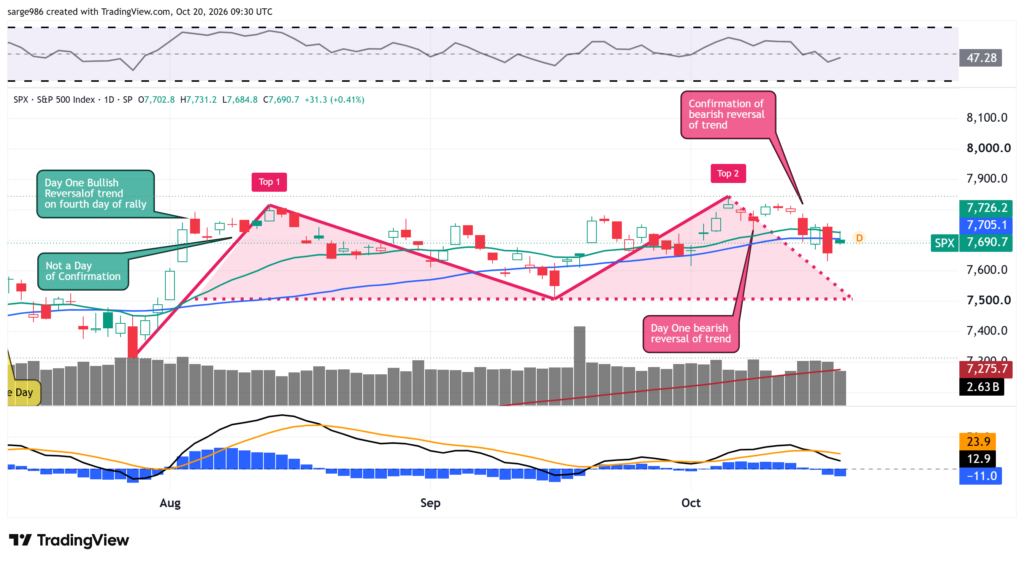
Readers will also see that once professional traders had allowed that level to be pierced to the upside, that swing traders did not buy in and put down the uprising at the 21-day exponential moving average. These two lines may have very well, now become resistance levels. Tuesday morning just became that much more important, technically.
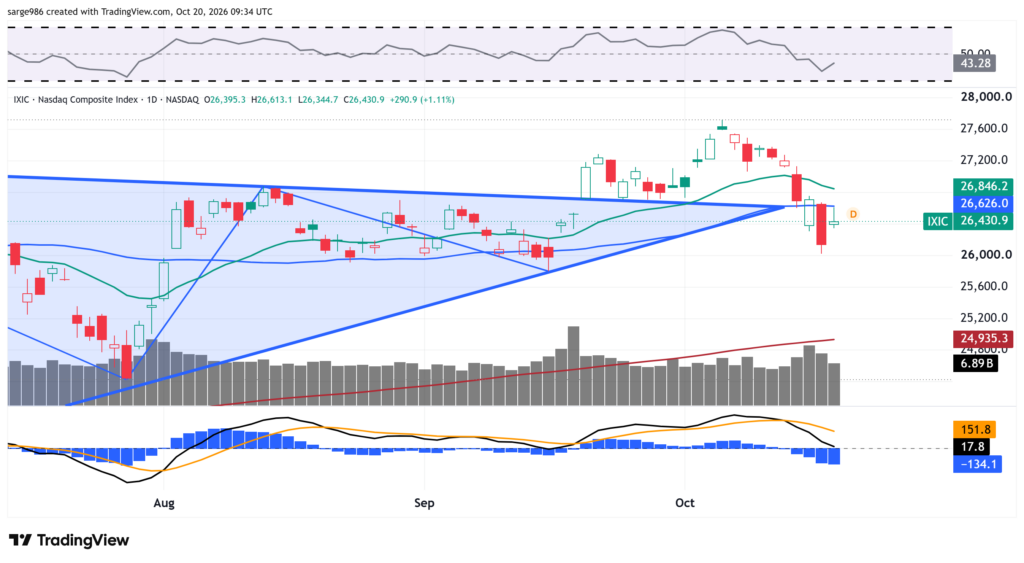
Notice how strict the 50-day SMA has been as resistance over the past three trading sessions for the Nasdaq Composite. As someone who is a natural tech bull, this is troubling. A down day for this index on Tuesday that does not show any kind of intraday rally would permit this index to lose contact with that thin blue line. The bulls do not want that. The bears are salivating at the thought.
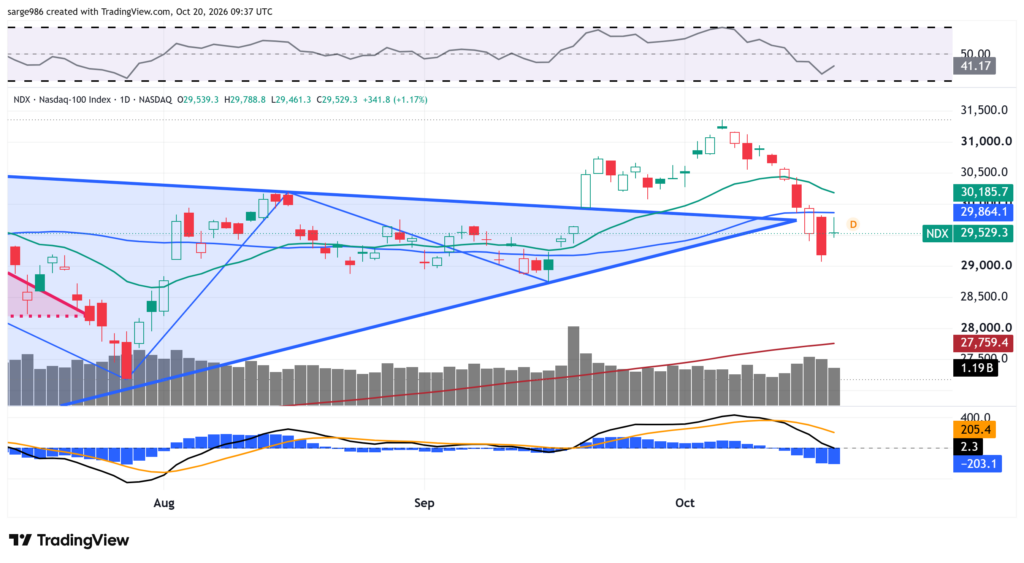
The Nasdaq 100, which has arguably surpassed the Nasdaq Composite in terms of market relevance, has already lost contact with its 50-day SMA. Is that good for tech stocks? This morning, traders in Korea and Europe voted “no.”
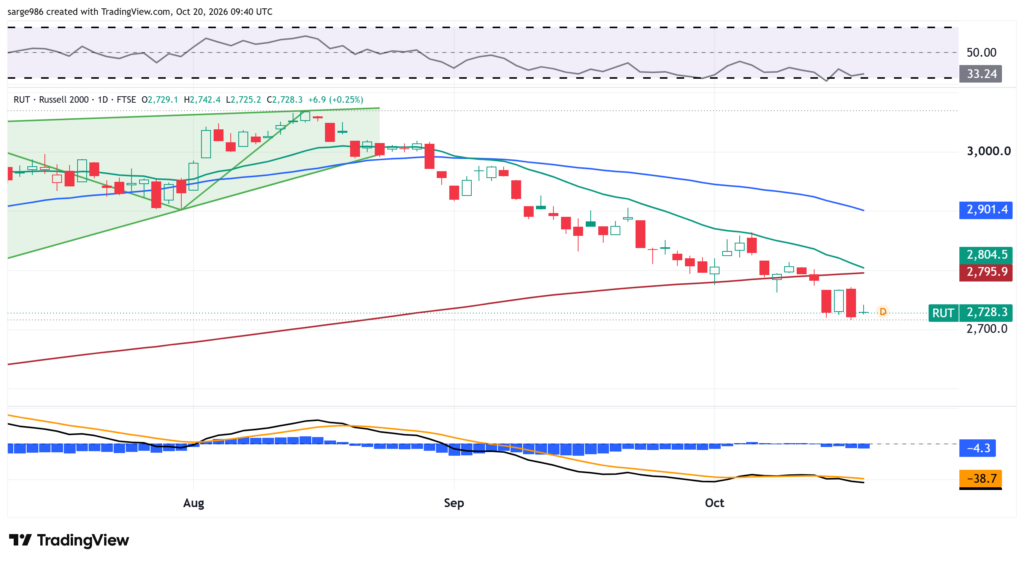
Readers can see that the Russell 2000, which is the major equity index for traders of and investors in small cap stocks, has turned into a dumpster fire. Yes, that red line that this index lost contact with last week, is the 200-day simple moving average, implying that professional managers are well into the process of taking exposure to small caps down to minimal levels.
This index closed out last week at its lowest level since this past April. Yes, small caps and tech are the epicenter of the visible impact of inflation and higher interest rates upon our marketplace. Oh, for the record, a rough 46% of U.S. workers (about 62.3 million people) are employed at small businesses. Another 10 million folks or so, are employed in the tech sector. That makes 72 million jobs on thinner ice than they need to be. Good times. Can someone please sit Beth Hammack down and explain the relationship between monetary policy and labor economics to her.
Nvidia on Jupiter
Researchers at Nvidia (NVDA) announced that it had run what the company claimed is a record fault-tolerant quantum simulation on Jupiter, Europe’s largest supercomputer. That’s pretty interesting. Supposedly, The 104-qubit simulation used 90% fewer physical qubits than prior attempts. This, according to Nvidia, may eventually facilitate research in the fields of drug discovery, financial modeling and materials science. This simulation was run on Nvidia’s GH200 graphics processing unit.
For those about to ask, Nvidia GH200 Grace Hopper Superchip is not just a GPU. This is a central processing unit and GPU superchip that combines a Grace CPU with a Hopper-based GPU in a single package. What makes this chip so special, is its coherent memory architecture, allowing the CPU and GPU to access a shared memory space more efficiently. This reduces or even eliminates the need to copy data back and forth between CPU and GPU memory.
Nvidia CEO Jensen Huang said: “Useful quantum computing will require fantastically complex, fault-tolerant systems — and understanding how they behave at scale is essential to building them. Our results from Jülich show how quantum processors and GPU supercomputers can work together to tackle research that would otherwise be out of reach—accelerating the discovery of transformative quantum applications.”
Wright’s Way
U.S. Energy Sec. Chris Wright made a splash at a Citadel Securities event on Monday. The U.S. government, apparently will authorize the sale of sanctioned oil tankers, allowing these vessels to ship crude legally to help rein in soaring shipping costs.
Wright noted that “a lot of people” approached the U.S. government, interested in buying these sanctioned tankers, fixing them up and operating them legally. These are captured vessels that had been caught transporting oil and related products from Venezuela, Iran and Russia. In some of the most simplistic language I have ever heard (read), Wright said, “We’re going to move some of the ships from what I call the ‘bad guy fleet’ to the ‘good guy fleet.’ They will not carry sanctioned oil anymore.”
Oh, Canada!
Early referendum results are showing that voters in Alberta have overwhelmingly decided that independence is not for them and back remaining part of Canada. With more than 1.5 million votes counted at the time of publication, 76% support remaining in Canada, while less than 24% chose to start a process to work toward separation.
It is key to note that Alberta holds the world’s fourth-largest proven oil reserve. It’s also key to note that Prime Minister Mark Carney campaigned ahead of the vote in the province, to promote a shared vision. Carney clearly pivoted away from economically harmful policies instituted under former Prime Minister Justin Trudeau and signed an agreement with Alberta Premier Danielle Smith to scrap or suspend the oil and gas emissions cap and clean electricity rules in order to pacify angry Albertans.
Did I ever tell you that when I was a college hockey player, we played an elite team from up north? They dominated us. We lost 5-1, but I did have a very pretty assist from behind the Canadian goalie. Ah… glory days.
Economics (All Times Eastern)
08:15 – ADP Employment Change (Weekly): Last 24.75K.
08:30 – Housing Starts (Sep): Expecting 1.3M, Last 1.275M SAAR.
08:30 – Building Permits (Sep): Expecting 1.4M, Last 1.403M SAAR.
08:55 – Redbook (Weekly): Last 10.4% y/y.
10:00 – Pending Home Sales (Sep): Expecting -0.2% m/m, Last 0.3% m/m.
4:30 p.m. – API Oil Inventories (Weekly): Last -11.1M.
The Fed (All Times Eastern)
Fed Blackout Period.
Today’s Earnings Highlights (Consensus EPS Expectations)
Before the Open: MMM (2.39), GE (2.01), GM (3.63), HAL (.58), HAS (1.85), NOC (7.18), RTX (1.78), SYF (2.40)
After the Close: COF (5.50), CB (6.80), NFLX (.82), SPCX (.13), UAL (2.59)
At the time of publication, Guilfoyle was long RTX, NVDA equity.