Kass: Welcome to the ‘Rosy Scenario.’ What Could Possibly Go Wrong?
We are at or approaching an important market top — and investors are under-appreciating the risks.
You've reached your free article limit
You've read 0 of 1 free Pro articles.

At words poetic, I’m so pathetic
That I always have found it best,
Instead of getting ’em off my chest,
To let ’em rest unexpressed,
I hate parading my serenading
As I’ll probably miss a bar,
But if this ditty is not so pretty
At least it’ll tell you
How great you are.
You’re the top!
You’re the Coliseum.
You’re the top!
You’re the Louve Museum.
You’re a melody from a symphony by Strauss
You’re a Bendel bonnet,
A Shakespeare’s sonnet,
You’re Mickey Mouse.
You’re the Nile,
You’re the Tower of Pisa,
You’re the smile on the Mona Lisa
I’m a worthless check, a total wreck, a flop,
But if, baby, I’m the bottom you’re the top!
– Cole Porter, You’re The Top
What follows is a compilation of my Daily Diary posts and communications I have had with my hedge fund’s (Seabreeze Partners) Limited Partners over the last 30 days.
I will call upon the opinions of DoubleLine Capital’s Jeffrey Gundlach, Berkshire Hathaway’s Warren Buffett (his famous “God’s Plan” quote in 1999) and former Morgan Stanley investment strategist Barton Biggs (in his “rosy scenario” condition). I will supplement their words with data and statistics that support our market and economic fears. Finally, I will expand on the temporary loss of price discovery and the gamification of our markets — both of which are contributing to our market concerns.
Based on most traditional metrics we are likely approaching an extreme level of investor optimism — reminiscent of early 2000 (the end of the dot-com boom) and late 2007 (which preceded The Great Financial Crisis):
“It is said no one “rings a bell” at risk market tops, but there are declarations of new asset classes involving “financial innovation” abetted by questionable ratings to watch for.”
– Jeffrey Gundlach, August 15, 2026
“Once a bull market gets underway and once you teach the point where everybody has made money no matter what system he or she followed, a crowd is attracted into the game that is responding not to interest rates and profits but simply to the fact that it seems a mistake to be out of stocks. In effect, these people superimpose an I-can’t-miss-the-party factor on the fundamental factors that drive the market. Like Pavlov’s dog, these “investors” learn that when the bell rings — in this case, the one that opens the New York Stock Exchange at 9:30 AM — they get fed. Through this daily reinforcement, they become convinced that there is a God and that He wants them to get rich.”
– Warren Buffett, November 1999
Here is more (statistical and concrete) evidence of the extreme bullishness that exists today:
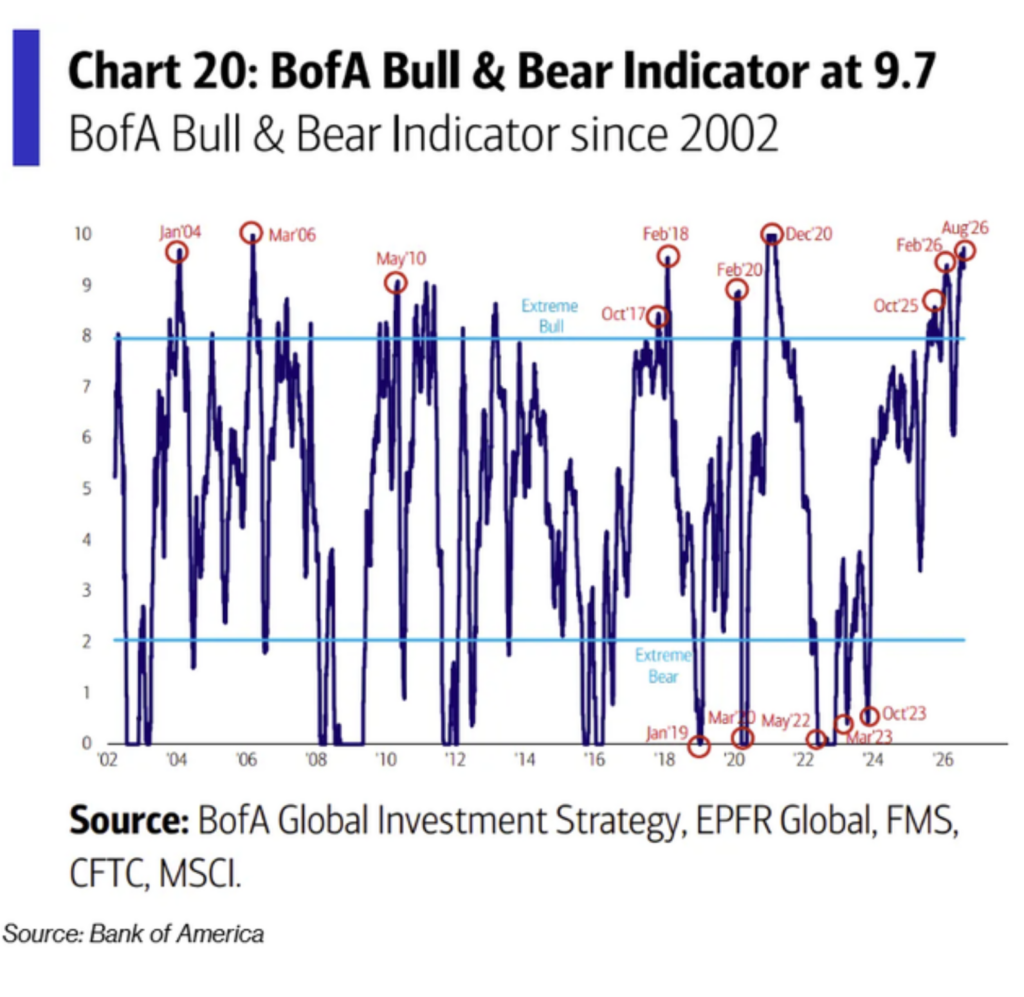
Welcome to Barton Biggs’ ‘Rosy Scenario’
“The ancient poet Philostratus said, “For the gods perceive things in the future, ordinary people things in the present, but the wise perceive things about to happen.”
– Barton Biggs, Hedgehogging
My favorite investment strategist of all time was Morgan Stanley’s (MS) Barton Biggs. Biggs used the phrase “rosy scenario” in the 1980s-2000s to describe his famous macro warnings and concerns that typically occurred late in a maturing bull market. In times like this, Biggs would detail the underlying and evolving risks that multiplied as investors’ narratives turned overly optimistic — convincing themselves that everything would work out perfectly in the future (despite the appearance of clouds overhead).
Importantly, he viewed Mr. Market as a manic depressive with huge mood swings. Investors, he surmised, should bet against him, not with him, especially when he is raving:
Barton Biggs was a cynical and wonderful wordsmith (his book “Hedgehogging” is a must-read!).
According to Biggs, a “rosy scenario” is a market backdrop in which investors extrapolate non-inflationary growth indefinitely, believing in a new paradigm of non-interrupted growth in which investors and policy makers assume perfect economic and market outcomes.
Biggs was particularly critical of overly ambitious company earnings forecasts (of an AI-kind?). He would often raise market concerns when the risk premia collapsed based on a growing consensus that “nothing bad can happen.”
If Barton Biggs were alive today, he might caution that the current bullish narratives have overwhelmed sober analysis.
Fast Forward to August 2026
Biggs would likely (as I am) be worried about several legitimate headwinds that exist now, in the belief that Mr. Market has been resilient in the face of items that would normally have produced less robust or even negative investment returns.
We have previously highlighted some of the following concerns last month — most have deteriorated further, surprisingly as equities continue their ascent. Specifically, the price of oil, interest rates, inflation, the level of the U.S. deficit/debt load and valuations are all higher over the last month. (Another example is that when President Trump signed the first memo of understanding for a peace treaty with Iran, the S&P Index was about 6500. It is now at 7800 despite no cessation of hostilities.)
Well respected by many, no doubt (if he were still with us) Biggs’ concerns about a “rosy scenario” would be seen in Barron’s “Up and Down Wall Street” column this coming weekend – perhaps with the following warning:
“Warren Buffett, a man, like me, who believes in America and the Tooth Fairy, presents the dilemma best. It’s as though you are in business with a partner who has a bipolar personality. When your partner is deeply distressed, depressed, and in a dark mood and offers to sell his share of the business at a huge discount, you should buy it. When he is ebullient and optimistic and wants to buy your share from you at an exorbitant premium, you should oblige him. As usual, Buffett makes it sound easier than it is because measuring the level of intensity of the mood swings of your bipolar partner is far from an exact science.”
Let’s reexamine some of my prior concerns:
* The lack of fiscal discipline in Washington, D.C. (on both sides of the political aisle), which has raised the U.S. annual deficit and overall debt load is being ignored by most investors.
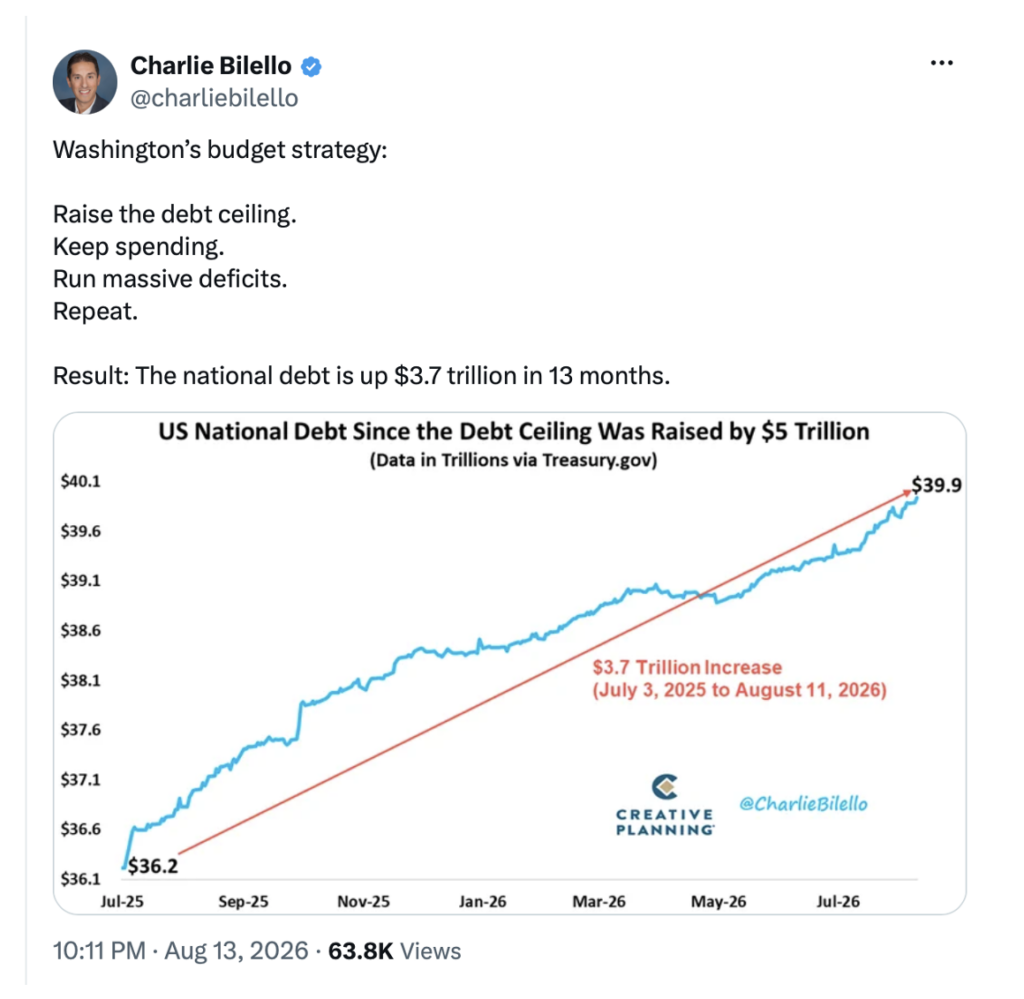
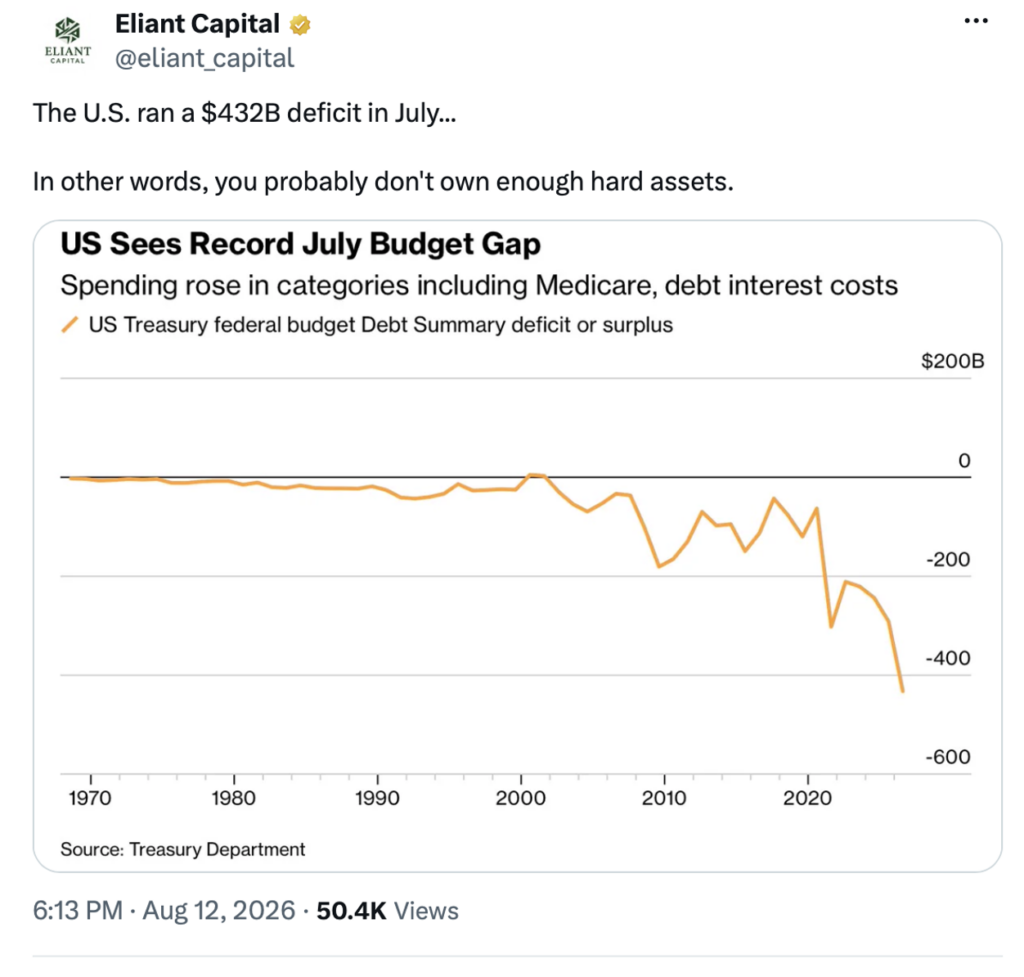
My good pal John Mauldin delivered an excellent analysis of our federal debt problem over the weekend in a “Thoughts From The Frontline” entitled “Caught in a Debt Trap.”
- Improvisational (and potentially dangerous) fiscal and foreign policy emanating from the current Administration.
- The rise in popularity of socialism (left wing of the Democratic party) and in nationalism/authoritarian rule (right wing of the Republican party).
- The likelihood that the AI capital spending spree (which has buoyed economic and corporate profit growth) will not produce an “adequate” return on invested capital.
* Every bubble ends in a debt crisis. It is our view that the AI bubble will also end in a debt crisis. (See Quoth The Raven’s “The Real AI Crash Will Start This Year“.)
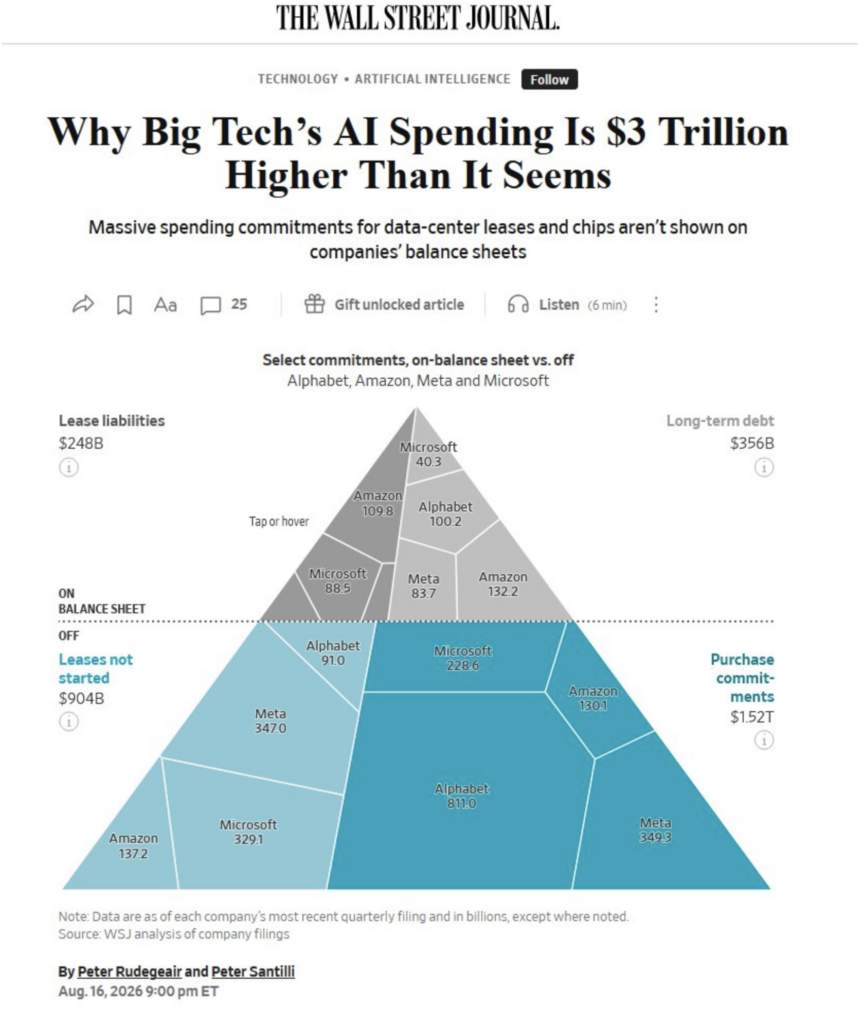
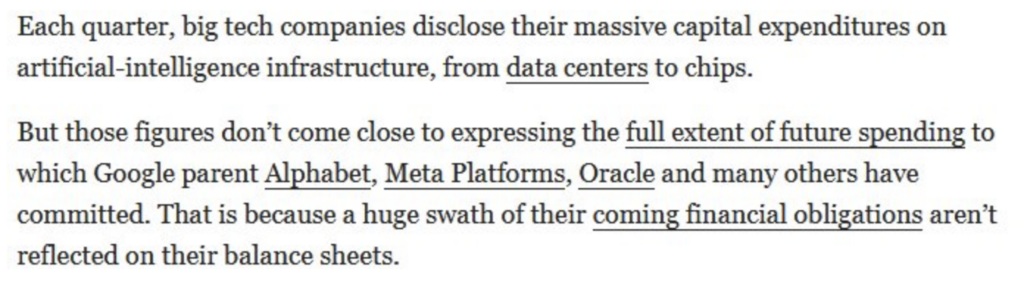
The must-read of the weekend goes to Stock Bubbles Don’t Scare U.S. in last week’s Wall Street Journal. The conclusion alone was worth the price of admission:
The $7 Trillion AI Bet on the Economy
“We are heading into a danger area now, thanks to the money being poured into artificial intelligence. Estimates of $7 trillion to be spent on data centers in the next four years are enough to seriously damage the economy if productivity gains aren’t big enough to justify it. And the increasing use of debt financing means that if AI more broadly turns out to be a bubble, it could hit the financial system, too. That isn’t something the broader market could ignore.”
Moreover, the circular AI vendor financing gambit remains problematic, with OpenAI, seen as an unprofitable AI lab which may not achieve enough consistency and level of income to satisfy its burgeoning capital plans and service its debt load:
* The equity risk premium (which, astonishingly, for the first time in nearly three decades) has morphed into an equity risk discount. A paper-thin equity risk premium has historically foreshadowed very low forward investment returns. We don’t expect it to be different this time.
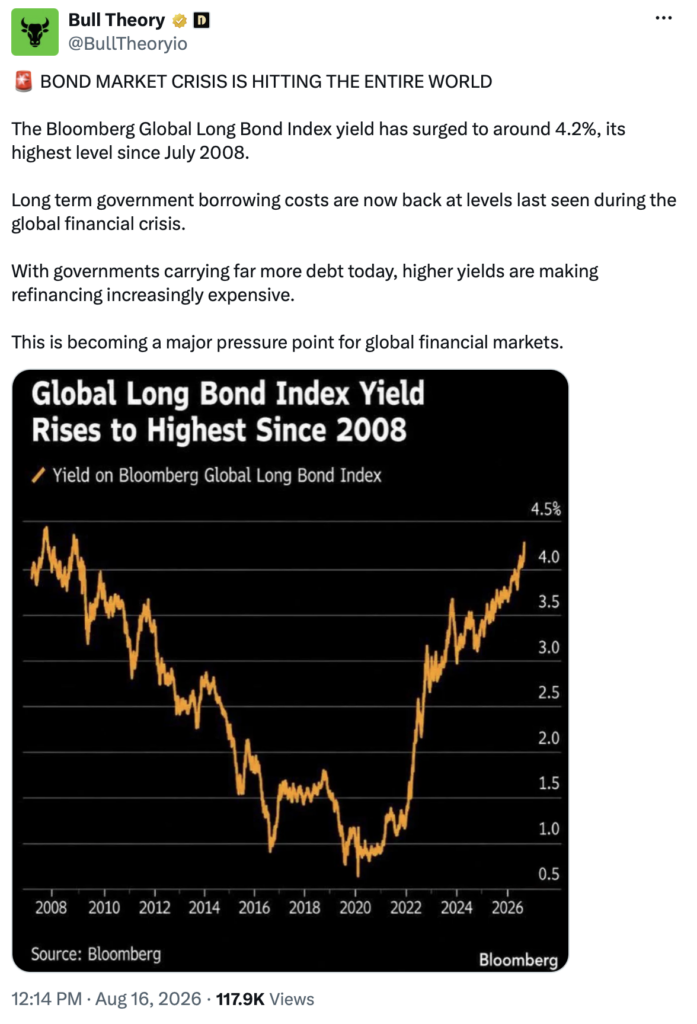
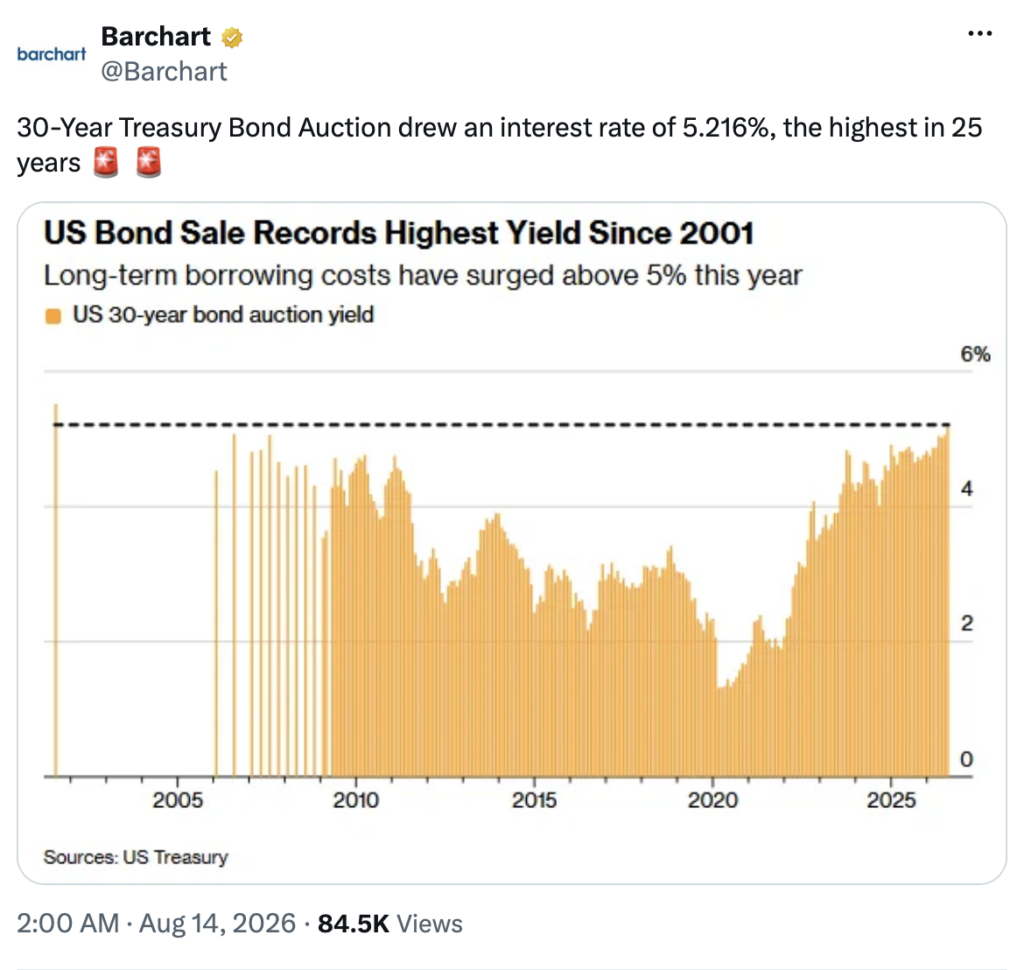
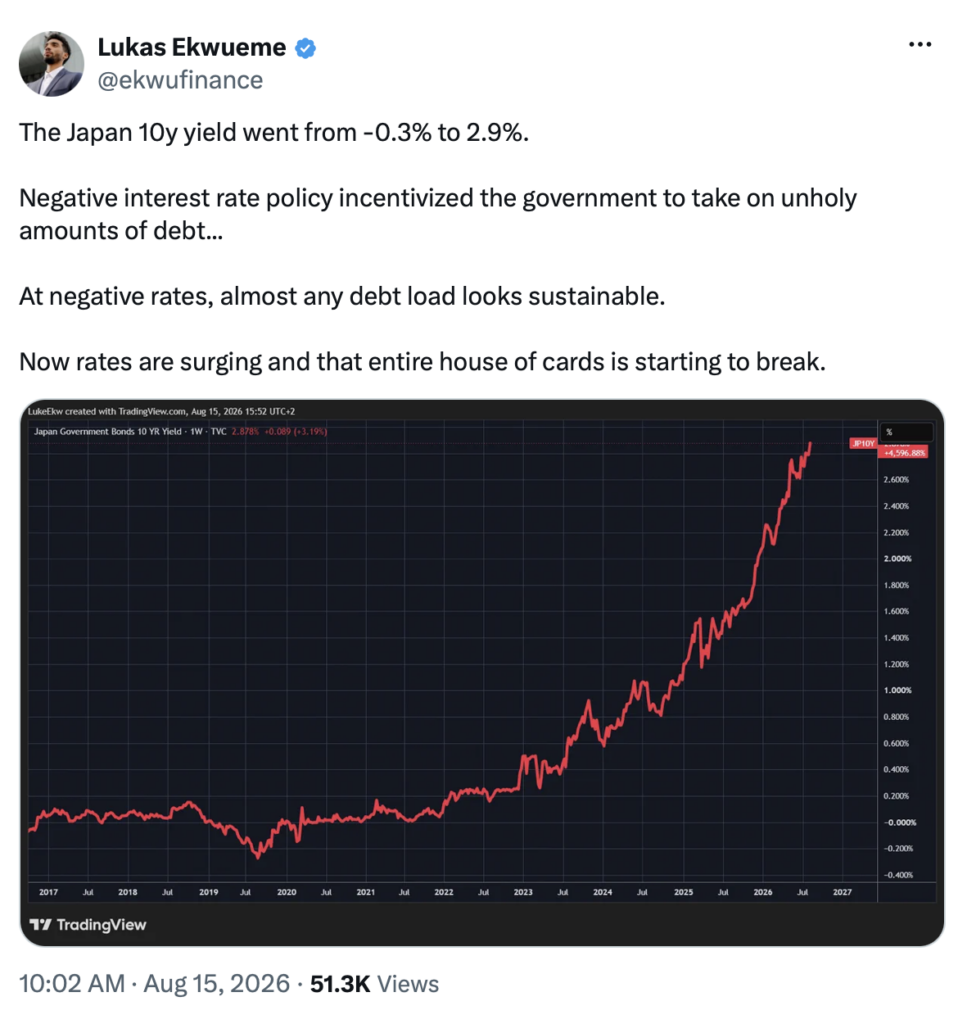
* Rising global interest rates that will likely stay higher for longer. Interest rates are the foundation of every valuation model:
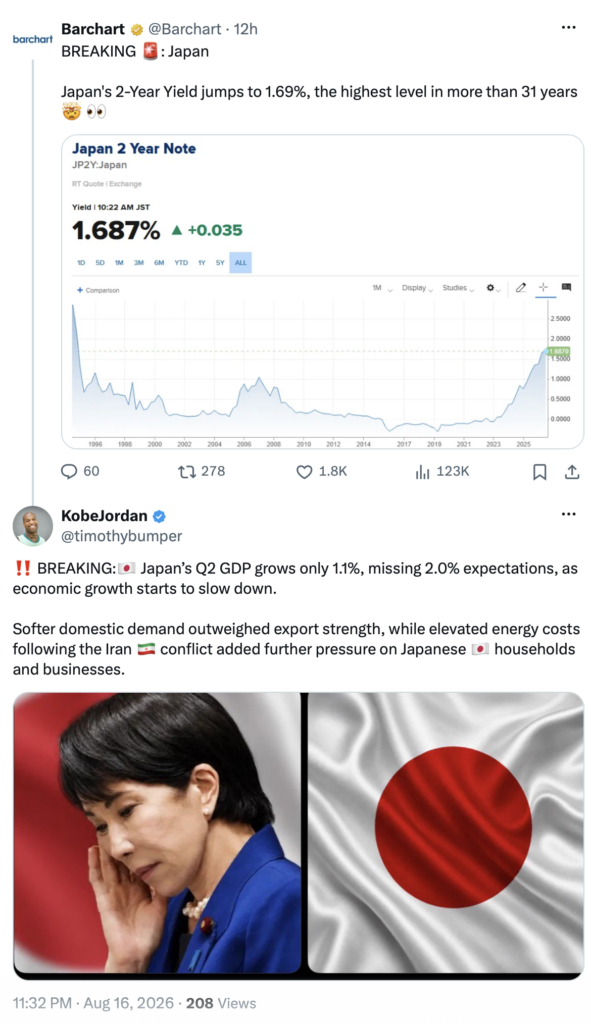
Despite the large miss to Q2 GDP expectations, Japanese bond yields (the last cheap global funding source) are rising as the BOJ faces reality:
* Persistent inflation. Recent data points suggest inflation, like interest rates, will be higher for longer.
* Elevated valuations (with traditional metrics (like Shiller’s CAPE Ratio or Buffett’s Ratio (total equity capitalization divided by Global GDP) in the 98%-tile and more than two standard deviations above their historical averages:
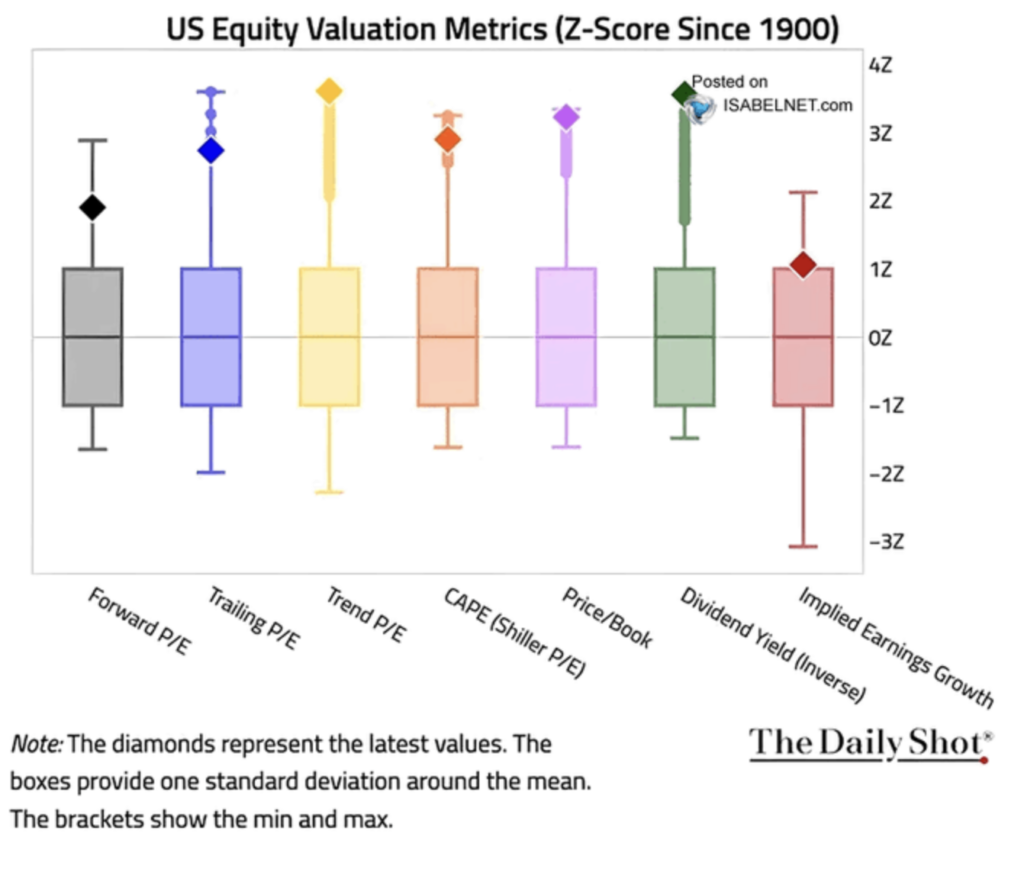
U.S. stocks have priced in a lot of good news, with most valuation metrics more than two standard deviations above their historical averages.
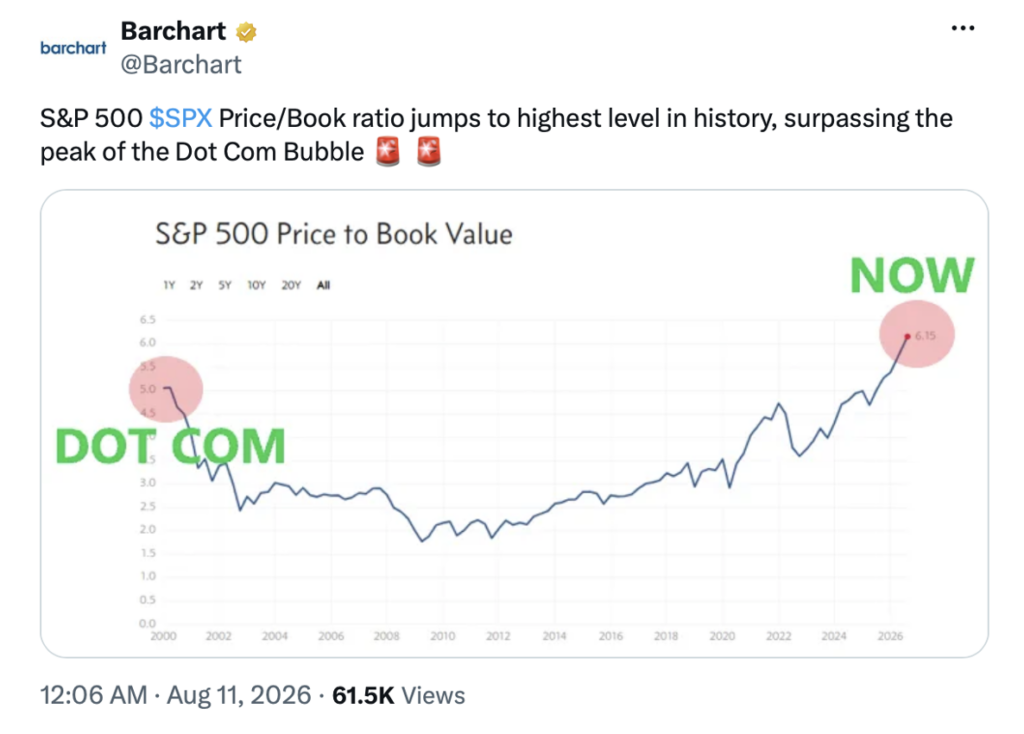
Market Structure Concerns Are Real
Last month we cautioned about market structure — specifically that there is too much hidden (and not-so hidden) leverage in our capital markets.
The July implosion of Leopold Aschenbrenner’s Situational Awareness hedge fund (a name that represents a true oxymoron!) briefly threw the market into a tailspin. The liquidation of the hedge fund’s public holdings might represent the first shot across the bow of today’s leveraged markets.
‘The Gamification of Capital: How Modern Market Microstructure Swallowed Traditional Investing‘
* The temptation to discard textbook theory in favor of the assessment of the cold, automated factors that are driving our markets is intense
* Though frustrated and incorporating some fractal analysis into our investing process, we are resisting the temptation to be totally absorbed (corrupted?) by changing market structure
I would like to end today’s commentary by highlighting the gamification of our markets (and the loss of price discovery) — two close relatives to our market structure concerns…
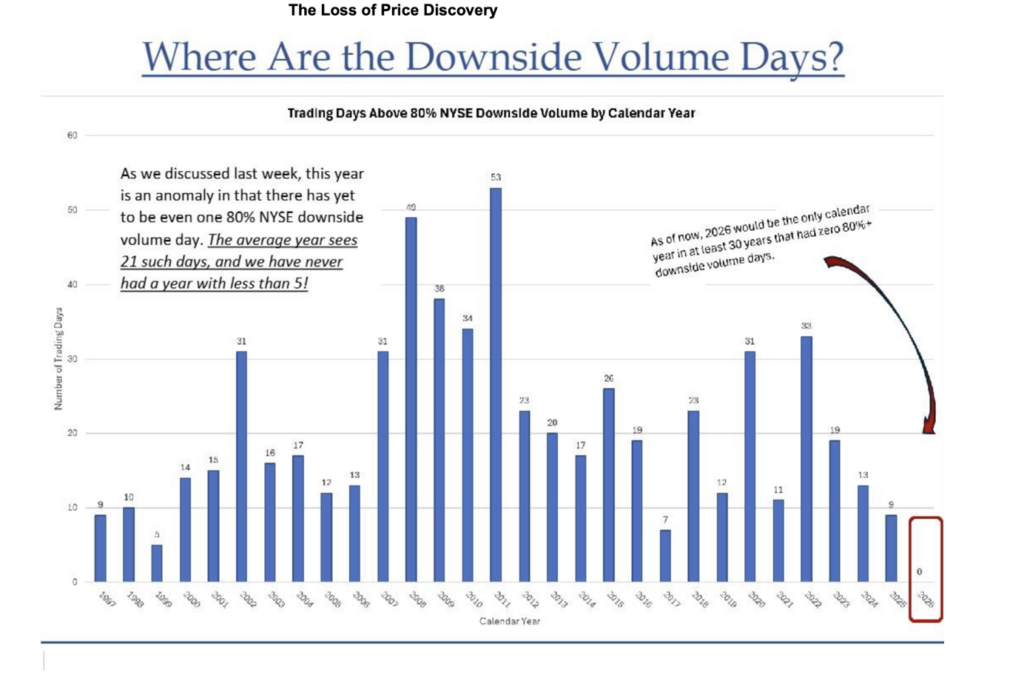
In the good old days, the core purpose and foundation of our markets was for capital to be allocated based on the calculus of fundamental values.
Companies were evaluated by fundamental research, which included (but not restricted to) the relationship to tangible and intrinsic values, an assessment of balance sheets and present value was based on valuation models. Interest rates were at the core of this calculus, using a risk-free rate of return in model building.
Portfolio selection was also based on the quaint notion that managements should be visited and assessed, competition reviewed so investors could determine whether secular earnings expectations would exceed of disappoint relative to consensus expectations.
The analytical process was plodding — slow money vs. fast money, if you will!
This process no longer exists.
Instead (as I recently noted in “An Adverse Market (Structure) Event is Growing More Likely”), traditional and fundamental analysis has been replaced by what can only be described as an algorithmic battleground and hyper-financialized casino (all engineered to extract premium), as active investment management is now dominated by passive investment management (that worships at the altar of price, knowing little about value and everything about momentum).
This helps to explain why rising interest rates (a 4.73% 10-year Treasury note yield) and oil prices, persistent inflation, improvisational and undisciplined foreign and fiscal policy and an equity risk DISCOUNT are increasingly being ignored.
Let’s examine and understand the cold, automated mechanics driving the contemporary market matrix (H/T
1. The High-Frequency Mirage and the Passive ETF Loop
The primary engine behind today’s erratic, valuation-defying price action is the symbiotic relationship between High-Frequency Trading (HFT) algorithms and Passive Basket ETFs.
When a major macroeconomic data point crosses the terminal wires—such as a contractionary labor report or an inflation print—human traders attempt to digest the long-term systemic implications. HFT bots, however, operate on tunnel vision. They are pre-programmed to scrape headlines for specific trigger words and instantly execute massive buy or sell scripts within milliseconds based on a rigid, binary logic (e.g., “Soft data equals guaranteed central bank liquidity injections”).
This initial algorithmic impulse triggers the passive basket ETF loop. Trillions of dollars are parked in automated index funds that must maintain strict, weight-adjusted allocations. When the HFT bots jam index futures higher, these passive ETFs are structurally forced to blindly market-buy every single underlying stock in their basket.
Valuation metrics, credit default risks, and balance-sheet cracks are completely ignored. The result is a vertical rocket ship move built on “phantom liquidity”—a superficial pump that creates an optical illusion of market strength while the underlying economic foundation is actively skyrocketing or fracturing underneath the surface.
2. The Options Casino: Gamma Squeezes and Dealer Hedges
Once the HFT machines set the momentum in motion, the modern market’s most manipulative force takes over: The Options Market Maker Hedging Loop.
Retail trading platforms have effectively gamified options trading, turning complex derivative instruments into cheap casino chips. When a wave of momentum buyers floods an asset, aggressively purchasing out-of-the-money call options, they unwittingly trigger a violent, mechanical feedback loop known as a Gamma Squeeze.
Options market makers (the massive institutional desks writing these contracts) are risk-neutral operators. They do not want to bet on whether a stock goes up or down; they simply want to collect premium cash. However, when an asset begins rising toward a heavily crowded options strike, the Delta (the probability of that option expiring in-the-money) violently explodes toward 1.00.
To maintain delta neutrality and protect their balance sheets from astronomical upside risk, the market makers’ automated software is legally and structurally forced to blindly and aggressively market-buy millions of shares of the underlying equity.
The computers don’t care that the stock is fundamentally overvalued. This forced institutional buying hits a thin after-hours or early-morning order book, creating a supply vacuum that vacuums the price upward in a series of long, violent green candles. It is an option-fueled illusion designed to optimize dealer delta profiles and trap late-day breakout chasers right beneath a major institutional ceiling.
3. The Institutional Pushback: Breaking the Machine
The natural frustration for traditional investors is watching bad economic data twisted into a “liquidity party,” while asset prices flatline or surge on completely hollow structures. But the smart money—sophisticated macro hedge funds and risk officers—does not fight the HFT bots head-on. They exploit the structural blind spots of the machine to systematically extract wealth from the crowd.
The institutional pushback occurs through a calculated, two-stage operational playbook:
The Midday Premium Bleed
During the high-volume environment of the morning session, market makers keep their bid-depth dense to absorb the order flow. But as the session marches into the midday lunch hour, aggregate volume naturally thins out.
Rather than chasing the HFT momentum, institutional desks utilize this quiet block to completely flatline the asset. They construct a tight horizontal trading band, letting the clock do the heavy lifting. This allows Theta (time decay) to ruthlessly strip the remaining cash value out of the expiring, overvalued options, turning the retail crowd’s leverage into dust by the minute.
The Power Hour Trapdoor
The true structural reversal triggers when the market crosses into the late-afternoon clearing window heading toward a weekly expiration. By this point, the out-of-the-money options have seen their premium values completely decimated.
The market makers’ automated risk parameters run their end-of-day calculations and realize the probability of those options expiring in-the-money is near zero. Suddenly, the regulatory and capital mandate to hold those millions of shares of underlying stock hedges completely vanishes.
The computers turn off their artificial buy programs and instantly unleash a cascading wave of automated, de-hedging market-sell orders to dump their excess share inventory back into the public float simultaneously. Because the broader economy is facing structural cracks, there is no organic institutional cash buying resting on the floor to absorb that sudden supply shock. The bids are stripped from the Level 2 ladder, the trapdoor slams shut, and the asset suffers a severe, vertical mean-reversion flush to catch up with macroeconomic reality.
The New Market Paradigm
The modern stock market is no longer a pristine measurement of corporate health or a passive vehicle for long-term capital compounding. It is a highly sophisticated, electronic wealth-extraction matrix dominated by algorithmic delta-hedging, passive index inelasticity, and behavioral manipulation.
To survive in this ecosystem, an investor must look past the flashy, empty marketing headlines and the short-term algorithmic wiggles. Success requires standing shoulder-to-shoulder with the structural mechanics of the tape—understanding that when the technical and options springs are stretched to their absolute physical limits against an institutional ceiling, fundamental gravity and options expiration math will always look to claim their due.
This commentary was originally posted in Doug Kass’ Daily Daily on TheStreet Pro.
At the time of publication, Kass was short SPY (S), QQQ (S).