Income Investors Find a Sweet Spot Right in the Middle
Retirement savers are locking in yield before the Fed cuts. Here are three ways to play the game.
You've reached your free article limit
You've read 0 of 1 free Pro articles.

Investors, in particular retireees who like getting income, have enjoyed an unusually profitable place to hide.
For the past three years, since the Federal Reserve began a series of rate increases, investors could park cash in Treasury bills and money-market funds, collect pretty good yields and avoid the stock-and-bond market rollercoaster rides.
Not a bad deal.
No, bonds don’t have the same return as stocks. But investors don’t hold bonds expecting the iShares Core U.S. Aggregate Bond ETF (AGG) to act like Sandisk (SNDK) or Micron (MU). Bonds are there to provide balance against stocks’ volatility and to create income that allows retirees to withdraw less from their equity holdings.
But this cushy arrangement won’t last forever. For the past four years, bond investors have been paid reasonably well for taking very little risk.
There’s a shift happening, though; according to a July report from iShares, investors are tilting away from short- and longer-term bonds and toward the middle.
Fixed-income ETFs attracted $292 billion in inflows during the first half of this year, up almost 65% over 2025. Of that amount, intermediate-term bond ETFs accounted for about $60 billion.
The big inflows into intermediate-term funds suggest investors are seeing an advantage to moving a little further out on the yield curve from the safer category of short-term, but aren’t ready to commit to the riskiest end of the curve.
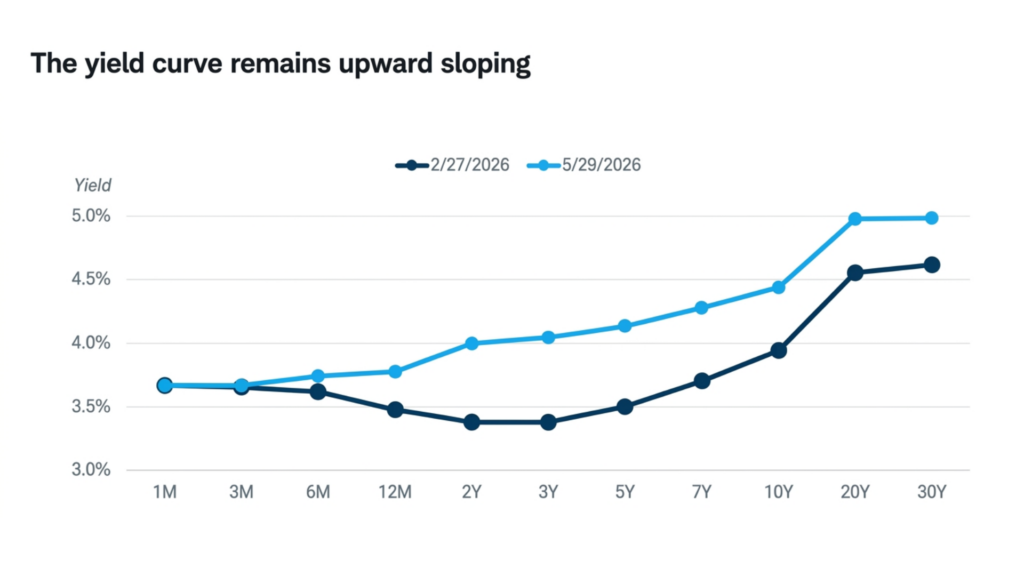
As the above chart illustrates, Treasury yields generally increase as bond maturities lengthen, with longer bonds also carrying greater interest-rate risk.
The intermediate corner of the bond world tends to get overlooked, kind of like mid-cap stocks also get lost in the shuffle.
But these funds offer a chance to lock in today’s yields for longer than you could with shorter bonds, while also avoiding the volatility of longer-term issues.
Putting Cash to Work
Now, like anything else when it comes to investing, the trade isn’t risk-free. But as the saying goes, “risk and return are related.”
For retirees sitting on mountains of cash, perhaps worried about a teeny tiny bit of global uncertainty, the middle of the bond market may be a new sweet spot. They offer something that cash doesn’t: The ability to maintain today’s yields for the next few years, while potentially rising in value if interest rates fall.
But the tradeoff is more price volatility if rates rise. Unlike a money-market fund, these ETFs aren’t cash equivalents.
Retirees who decide the middle is the right spot for part of their portfolios don’t need anything too esoteric.
Here are some examples of ETFs with exposure to intermediate bonds.
- Vanguard Intermediate-Term Bond ETF (BIV): This one holds intermediate-term government bonds and investment-grade corporate bonds. It offers more diversification than a Treasury-only or corporate-only fund and in keeping with Vanguard’s low expense ratios, charges only 0.03%.
- Schwab Intermediate-Term U.S. Treasury ETF (SCHR): This is an ETF for investors who value safety above all else. It holds Treasury bonds with remaining maturities of three to 10 years. It has about $13.3 billion in assets and also charges a low fee of just 0.03%.
- SPDR Portfolio Intermediate Term Corporate Bond ETF (SPIB): A higher-income choice, this ETF holds investment-grade corporate bonds, most maturing within one to 10 years. It has about $11.7 billion in assets under management and a low expense ratio of 0.04%.
Why Take More Interest-Rate Risk?
With cash still paying pretty well, what’s behind investors’ increased willingness to take on more risk?
Investors aren’t exactly stampeding for the exits, but greater inflows into intermediate-term bonds suggest something’s afoot. Investors are realizing they can collect more income by moving from cash and short-term bonds into those with intermediate maturities, while avoiding the bigger price swings of long-term bonds.
Cash still pays well, but its advantage evaporates fast once the Fed starts cutting. Money market and Treasury bill rates reset almost immediately in that case.
Bonds, though, don’t work like that. A bond bought today continues paying its stated yield until maturity, no matter what the Fed does next.
That’s the calculation behind the shift into intermediate bonds.
In a June report, “2026 Mid-Year Outlook: Taxable Fixed Income,” Schwab noted that some of this year’s biggest yield increases were in the two- to five-year portion of the Treasury curve, while investment-grade corporate bonds were yielding more than 5% on average.
Investors moving into that part of the curve aren’t chasing performance; they’re locking in income before that opportunity is gone, without taking on the price volatility of 20- and 30-year longer-term debt.
Long-term Treasury yields also reflect a rising term premium, which is the additional compensation investors demand for holding those riskier instruments.
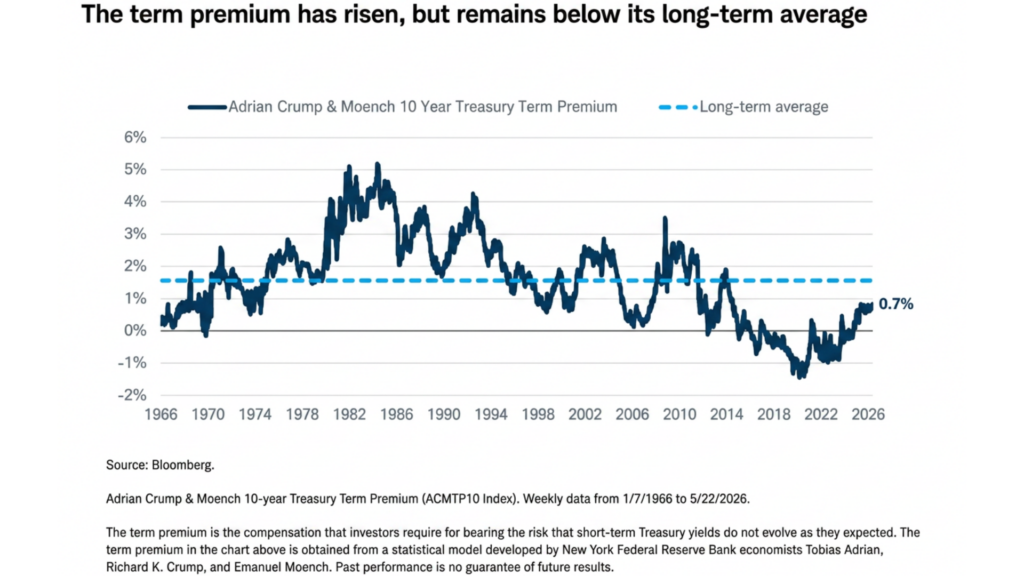
It’s a modest move, not a big bet or a swing for the fences (which you really wouldn’t do with bonds in any event).
Retirees shifting away from cash into the middle of the curve are trading a small amount of price risk for a longer runway on today’s yields, not reaching for the riskiest end of the bond market.