How to De-Risk if One Stock Dominates Your Portfolio
How I helped a client diversify a portfolio with $300,000 held in one position.
You've reached your free article limit
You've read 0 of 1 free Pro articles.

My client Billy had a lot of MetLife (MET) stock. And I mean a lot. In addition to his and his wife’s IRAs (which needed some tweaking themselves), he held about $300,000 in that one stock.
How did it happen? Billy’s dad had worked at MetLife many years ago and Billy inherited the shares. His father was long since deceased, but Billy held onto the shares. There wasn’t really any good reason. He didn’t think they would go gangbusters (they didn’t), nor did he have any sentimental attachment to them. It just never occurred to him to sell.
So there they sat, in a taxable account. Sure, he had a stepped-up basis, which helped, but after a 2017 stock split, he had even more shares than before, with even more gains. And by that time, he didn’t care if he had the stock or not. He was focused on regular retirement income.
What to Do When There’s Too Much
When you find yourself with a concentrated stock position, whether from employer shares or for any other reason, the way you handle it depends largely on the account where it’s held.
It may surprise you to know there are no caps on employer stock from piling up in a 401(k). There’s a 10% limit in traditional pensions, and we know how many people in corporate jobs have those now. It’s about six. It was a little higher last year, but one guy with a pension died.
401(k)s work differently. After the Enron debacle in the early 2000s, Congress didn’t limit how much company stock could pile up in a 401(k), it just said that after you’ve worked somewhere three years, you can ask to move that stock into something else. Your employer has to remind you that the option exists at least a month before you’re allowed to use it.
But nobody moves it for you. It’s not automated. You have to actively log in and make the change yourself or be sure the asset manager makes the trade.
So, if you never get around to it, or don’t even realize you can, the company stock just keeps piling up with every paycheck, until it’s a bigger chunk of your retirement nest egg than you may have intended.
No One-Size-Fits-All Solution

When you realize you have a concentrated stock position, you may not want to keep buying more. You may at least want to hit the brakes temporarily while you evaluate.
But the decision usually isn’t so simple as sell or hold.
A large single stock position can create several risks, namely company-specific volatility, overlapping career and portfolio risk (which is a built-in lack of diversification), tax exposure, liquidity constraints and the possibility that one stock becomes too important to your retirement or estate plan.
Rather than immediately selling the entire position, you or your financial advisor can evaluate how the stock fits into your broader financial picture. One frequent goal is to create a plan to reduce concentration risk over time while balancing diversification, taxes, liquidity and your long-term goals.
That usually doesn’t mean start unloading all the shares right away, although in a 401(k) or IRA, you may be able to, since there would be no immediate tax consequences.
There Is a 401(k) Trap
However, be aware that selling company stock inside a 401(k) eliminates the net unrealized appreciation (NUA) strategy, which some people specifically want to preserve.
Typically, when you leave a job, you’ll want to roll your 401(k) into an IRA as soon as you can. But if you’re holding company stock inside that 401(k) wrapper, you can instead move that stock out as an in-kind transfer, straight to a regular taxable account.
Do that, and the growth on those shares gets taxed at lower long-term capital-gains rates instead of ordinary income rates when you eventually sell.
But that plan only works if the shares come out of the 401(k) whole. Sell them inside the 401(k) first, and that nice tax treatment goes away.
What Actually Counts as ‘Concentrated’?
The problem of too much of one stock isn’t limited to employee shares, as we saw with my client Billy who inherited Metlife. I had another client, Ron, who just liked Apple (AAPL). He used pretty much every Apple product that was made, and after he retired from his job as a hospital administrator, he took a part-time job in an Apple store just for fun.
His Apple fan-boying didn’t end there. You guessed it: Ron’s portfolio was loaded up with Apple shares. But in his case, it didn’t matter. Ron’s 403(b) was allocated in a more traditional way, so he had plenty of built-in risk management. He also had (wait for it) a hospital pension and another small pension from a long-ago job that generated monthly income in addition to portfolio withdrawals.
Essentially, I adjusted some 403(b) holdings (now rolled into an IRA) to account for the extra risk in the Apple stock, and everything was hunky dory.
Why the Answer Is ‘it Depends’
There’s no universal formula handling a high stock concentration. It’s situation dependent, but I’m telling you all this so you’re aware that you could run into a problem.
The approach to a big old chunk of one stock in your account depends on factors such as your net worth, age, tax situation, liquidity needs, asset location (if the stock is in your 401(k) or taxable account) and how much of your paycheck already depends on the same company.
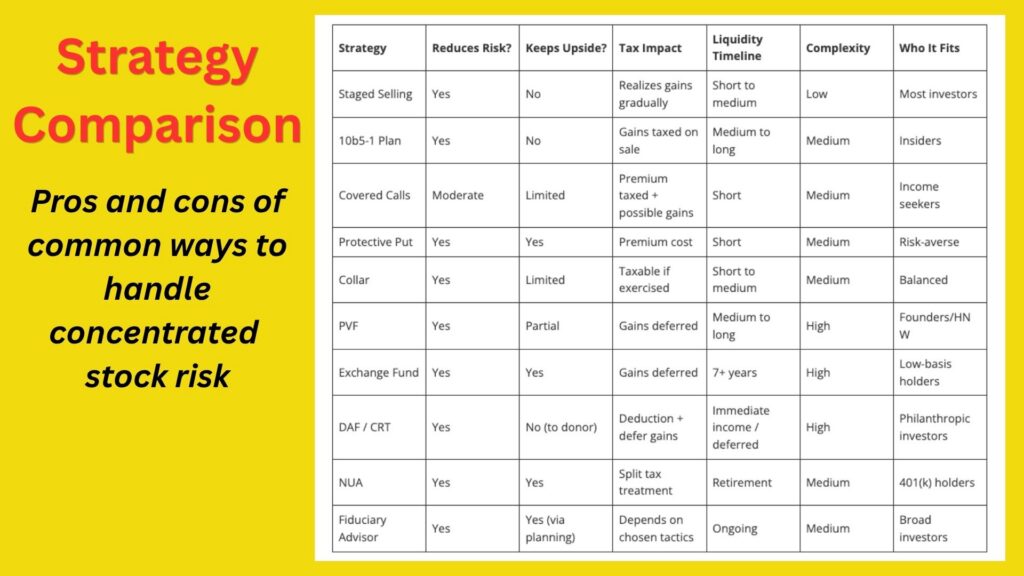
But here are some approaches you can take to de-risk your portfolio if one stock has come to be a hulking mass, overshadowing everything else:
- Rebalance around it, don’t sell it. New money and dividends go everywhere else. The position shrinks on its own, over years, without you ever pulling the trigger on a sale. This is what I did for my client Ron.
- Sell in pieces. Offload a few shares this tax year, a few next. Smaller bill each time, and you’re not staring down one big all-or-nothing call.
- Use your losers to pay for it. If something else in the portfolio’s underwater, sell that too. This is basic tax loss harvesting in a taxable account. The loss offsets the gain from the stock you’re saying goodbye to.
- Long/short overlay, if you’re not ready to sell yet. Keep the concentrated stock, but build a separate long/short book around it that throws off losses on purpose. Those losses fund the eventual sale. It’s a lot of moving parts, and this isn’t a strategy for everyone, but for experienced traders, it offers more control over the situation.
- Just give some away. Donate appreciated shares to a charity you actually care about. You’ll have no capital gains on what you donate, and you get the deduction. Check the IRS rules before you do it, not after. I steered another client toward this, and she ended up making donations over a few years. It worked well for her, and she was happy that her church got the shares.
- If you’re an executive, a 10b5-1 plan does the selling for you. Set it up ahead of time; follow the rules and blackout periods stop being your problem. Get legal and compliance involved from day one, as this is part of an SEC rule. You don’t want to mess this up, but it can be a great solution.
- Exchange funds work, but read the fine print. Notice I didn’t say “exchange traded funds.” Exchange funds are a different animal. Pool your shares with strangers in the same boat, walk away with a diversified basket, and no tax bill up front. Downsides? There’s a minimum check size and you’re locked in for years, so understand the fine print. This isn’t for everyone.
- Company stock sitting in a 401(k)? Ask about NUA before you touch it. If you make a mistake and roll it over or sell it inside the plan, that option’s gone for good. Talk to a tax person first.
- Covered calls, collars, prepaid forwards. Again, this is something for seasoned traders, not someone with little experience in the market. Tread carefully here! These can help, but they can also cap your upside and blow up if you don’t fully understand what you signed. Get tax or financial planning help if you need it.
Not One Solution, But Three!
So what happened to Metlife Billy?
Ultimately, my firm used a few different methods to remove some of the single-stock risk.
We sold down a portion of Billy’s MetLife each year to stay inside the 15% capital-gains bracket. We also redirected another slice straight into a donor-advised fund at Schwab to wipe out the gain on those shares entirely.
We also used tax losses harvested elsewhere in his and his wife’s taxable account to absorb some of the MetLife gains that were left. Nothing fancy (Billy wasn’t a fancy guy), but those three moves, stacked, over time, took care of the problem and he went about his retirement never worried about those shares.