Economic Pain Planned for Iran, Sandisk Slips, Charting a Bit of Bearishness
Let’s take a deep dive into the U.S.’ latest strategy for the war on Iran, check the semiconductor action and chart the market.
You've reached your free article limit
You've read 0 of 1 free Pro articles.

D-Day? OK. Not exactly D-Day. On June 6, 1944. 73,000 U.S. troops stormed the beaches of, or were dropped behind enemy lines at, Normandy, France. They were part of an allied force of 156,000 soldiers. They were all infantry. They were supported by 195,000 naval personnel representing eight countries. Allied pilots flew 14,674 sorties that day. So, understand me when I say that D-Day was probably a much bigger deal militarily than most people realize in 2026. U.S. forces suffered 6,603 casualties (2,519 killed in action) that day alone. To put that in perspective, U.S. military forces suffered 1,922 killed in action in Afghanistan from 2001 through 2021.
On Monday, U.S. Treasury Sec. Scott Bessent publicly announced, “Operation Economic Outcast,” or as he nicknamed the program over the weekend in his op-ed at the Financial Times, an “Economic D-Day.” I am not here to nitpick the secretary’s choice of words. Given that Mr. Bessent is a serious man and that he is probably the most capable individual in this Trump administration, he probably does “get” the hugeness implied in that moniker and he probably used that description with some intention.
Background
The U.S. air and naval war on Iran has raged on and off for roughly six months now. The U.S. military has rendered the Iranian military close to defenseless without the use of ground forces. The decision to forego the use of U.S. “boots on the ground” has kept numbers of U.S. casualties extremely low but has also permitted the brutally oppressive regime in Iran to remain in power, despite the elimination of several layers of leadership.
Clearly, it is not easy to fight or win a war when one side is unwilling to intentionally expose its own forces or enemy civilians to the risks associated with combat. The fact is that independent estimates count the total of accidental Iranian civilian deaths caused by this war at between 1,030 and 2,100. Yes, that includes the strikes in February at that girls’ school in Minab, which while some have disputed what led to it, caused deaths that are indeed a tragedy. By contrast, the Iranian government is estimated to have murdered between 7,007 and roughly 36,500 of its own civilians year to date for speaking out against the regime.
The regime in Iran, in the meantime, without the U.S. forcing the issue through increased military participation, has refused to surrender and has continued to harass civilian cargo ships trying to traverse the Strait of Hormuz. Perhaps, most dangerously, it is believed that the Islamic Revolutionary Guard, which is composed of hardliners, has continued to work on the development of nuclear weapons, even with far less incoming support coming from the sale of crude oil or trade in general.
Economic Pressure
It’s no secret that perhaps the most effective weapon against the regime in Iran throughout this war has been the U.S. naval blockade of Iranian ports. This past Thursday, Mohammad Bagher Ghalibaf, who is speaker of Iran’s parliament, said, “No matter how much military power we have, if people are hungry and we don’t have financial circulation, economic growth and domestic production, we will not endure.” The next day, Iran’s Pres. Masoud Pezeshkian stated, “The war must come to an end at some point.” In doing so, he acknowledged that the Iranian people are facing shortages across that economy.
As of this past weekend, one U.S. dollar could purchase a rough 2,045,000 Iranian rials. That number was as low as 750,000 as recently as 2024 and as low as 70,000 when U.S. Pres. Donald Trump had the U.S. terminate the failed Iranian nuclear deal during his first term, in 2018. Inflation clearly has hit runaway speed inside Iran. It is believed that the regime in Iran will soon be forced to reduce domestic fuel subsidies, which will likely turn even more suffering Iranians against their own government despite its known brutality against its own people.
“Operation Economic Outcast” will try to further isolate Iran economically by bringing those nations that have continued to trade with Iran overland or via air cargo throughout the conflict, ignoring U.S. and global sanctions against that government. The U.S. president is said to be working allies and “acquaintances” alike in an attempt to gain broader support for the program. Bessent states that “Every country has a defined timeline to shut down activities we have identified. If they do not take action, we will do so unilaterally.”
Getting Tough…
Bessent added that “a major announcement of a financial institution being sanctioned by the end of the week” is coming. A very likely outcome for those not getting in line would be exclusion from the US dollar system, which serves as the primary global financial network for trade and is the very reason why many central banks have been hoarding gold and the BRICS nations are believed to have been working on a fiat alternative to the US dollar as planet earth’s leading reserve currency.
It is believed, through Bessent’s appearance, that a number of nations have already been identified as Iranian enablers. First and foremost, of course, would be mainland China. We know that Chinese “teapot” refineries would be willing to purchase black market Iranian oil. We believe that the US naval blockade has done a solid job of depriving these refineries of access. That said, as onlookers, we don’t know, but the U.S. government might know just how involved financially, Chinese state-owned banks might be.
Beijing has already stated that U.S. sanctions concerning trade with Iran undermine the rights of other nations. When asked about China on Monday, Bessent said, “If they facilitate transactions and are part of the ecosystem that turns Iranian oil into money into repression, they will be targets.”
It is also believed that businesses or even government agencies out of the U.A.E., Iraq, Turkey, Malaysia, Qatar, and Pakistan among others have continued to trade with or enable Iran throughout the conflict. In an attempt to beat the Trump administration to the punch, the U.A.E. has already publicly committed to cutting all trade with Iran. While this is a clear positive, it is believed that a network runs out of Dubai whose intention is to disguise trade with Iran in order to evade sanctions.
On The Treasury Department’s Recent Moves…
I suggest reading Stanley Druckenmiller’s op-ed at the Wall Street Journal this morning.
Marketplace
Equity markets gave up some ground on Monday, but not significant ground. That is of course, unless one is heavily invested in semiconductors. While treasury yields relaxed a little as did market prices for crude oil, the S&P 500 gave up 0.28%, while the Nasdaq Composite lost 0.76%. The latter was weighed down by a Philadelphia Semiconductor Index that surrendered 2.7% for the session, which itself was weighed down by losses suffered by the “memory” trade. SanDisk (SNDK) was hit on Monday for 6.45%, while Micron (MU) was sacked for a loss of 5.83%.
Breadth was not at all awful on Monday. Eight of the 11 S&P sector SPDR ETFs closed out the Monday session in the green. The winners were paced by the staples (XLP), the financials (XLF) and the utilities (XLU). Yes, this does mean that defensive sectors led the cyclicals, but this was in no way, a “rout.”
Losers did beat winners by a three-to-two margin at the Nasdaq, but winners actually beat winners (by a smidgen) at the NYSE. Advancing volume took a respectable 49.2% share of composite NYSE-listed trade on Monday and a 46.8% share of composite Nasdaq-listed activity. Aggregate trade was lower across NYSE-listings, across Nasdaq-listings and across the membership of the S&P 500 as well. This makes Monday’s price discovery outcomes somewhat less significant than they might have been otherwise.
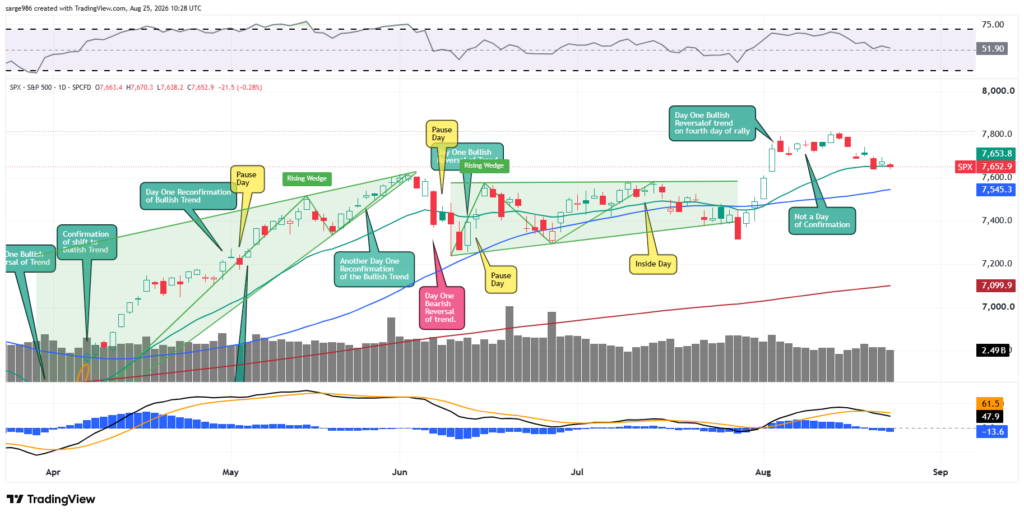
The bulls can look for some support at the 21-day exponential moving average this morning if the swing crowd steps to the plate en masse. Otherwise, a visit with the 50-day simple moving average could be in order. Note that the daily moving average convergence disvergence (below the chart) is currently postured short-term bearish. On the bright side, one might note that five of the past seven trading days have resulted in red candles for the S&P 500, but that the two “busiest” trading days over that span were the “up” days.
Economics (All Times Eastern)
08:15 – ADP Employment Change (Weekly): Last 9.5K.
08:55 – Redbook (Weekly): Last 7.6% y/y.
09:00 – Case-Shiller HPI (June): Expecting 1.8% y/y, Last 1.6% y/y.
09:00 – FHFA HPI (June): Expecting 0.2% m/m, Last 0.3% m/m.
10:00 – CB Consumer Confidence (Aug): Expecting 90.9, Last 90.8.
10:00 – New Home Sales (July): Expecting 620K, Last 628K SAAR.
10:00 – Richmond Fed Manufacturing Index (Aug): Expecting 7, Last 5.
4:30 p.m. – API Oil Inventories (Weekly): Last -3.28M.
The Fed (All Times Eastern)
08:00 – Speaker: Richmond Fed Pres. Tom Barkin.
4:00 p..m. – Speaker: Richmond Fed Pres. Tom Barkin.
Today’s Earnings Highlights (Consensus EPS Expectations)
Before the Open: DKS (3.79)
After the Close: BOX (.40), INTU (3.59), ZM (1.48)
At the time of publication, Guilfoyle was long SNDK, MU equity.