A Chill Down Wall St. as Confidence Cools
We felt a cool breeze on the market as the Consumer Confidence survey hit with an ugly headline number … but bad data inputs can produce counterintuitive market outputs…
You've reached your free article limit
You've read 0 of 1 free Pro articles.

Summer Breeze
See the curtains hangin’ in the window
In the evening on a Friday night
A little light a-shinin’ through the window
Lets me know everything’s all right
Summer breeze makes me feel fine
Blowin’ through the jasmine in my mind
Summer breeze makes me feel fine
Blowin’ through the jasmine in my mind
– Dash Crofts, Jim Seals (Seals and Crofts) 1972
A Cool Breeze
Feel that? That’s a cool, crisp, refreshing breeze. Maybe not a summer breeze. Smells kind of like autumn. The Halloween decorations are visible up and down my block. Football season is in full swing. Now that D1 football players are actually professionals and no longer even pretend to be student athletes, I really don’t care. The hockey season has started as well. At least that still holds my interest. The Major League Baseball playoffs have begun. Having grown up in Queens, I am a Mets fan. So much for that. At least the Rays are still alive. That said, my allegiance to the National League, despite the fact that there really is only one league nowadays, had me pick the Marlins as my adopted team. So much for that.
Still, I feel refreshed. What is it? The time? Oh, it’s very early on Wednesday morning. Zero dark-thirty as we used to say in the military. U.S. Treasury debt securities are finally catching a bid. The U.S. Ten-Year Note pays a rough 5.22% this morning after that yield peaked at 5.29% on Tuesday. The long bond (U.S. 30-year) yields 5.555% this morning after paying more than 5.61% at its lows on Tuesday. That was a post-2002 high, or low for 30-year U.S. paper, depending on whether one is talking about yield or price. WTI Crude oil is poised to give the public a break as well. Front-month WTI is trading with an $89 handle this morning, after trading with a $94 handle early Tuesday and a $96 handle on Monday.
Of course, these values could all be the stuff of fantasy by the time investors and traders read this column. Come 8:30 a.m. ET, you, the public and the algorithms that represent most of you these days, will be hit with personal consumption expenditure inflation data for August, which we know is something the Fed pays close attention to. At that time, we’ll also see the final revision to the Bureau of Economic Analysis’ estimate for second-quarter gross domestic product growth and August data for both personal income and consumer spending. That will all come after the ADP Employment Report for September allows us a glimpse into private sector demand for labor for the past month. So, what gives?
Confidence Wanes…
The Conference Board on Tuesday released the results of that group’s Consumer Confidence survey for September and those results were awful. The headline number hit the tape at 81.9, down sharply from 88.6 in August and well below the 89+ print that had been the general consensus headed into the event. The numbers within the numbers are just as ugly.
That headline number was the worst seen since 2014 as both the present situation and expectations components showed alarming weakness. One item really stuck out because we spoke about this at length in the column just yesterday. Respondents claiming that “jobs are hard to get” reached a post 2016 high, ex-Covid.
In summary, Dana M. Peterson, who is chief economist at The Conference Board, wrote, “The Consumer Confidence Index deteriorated notably in September, following two prior months of softening. The Present Situation Index fell sharply, while the Expectations Index slipped further into negative territory. Consumer appraisals of current business conditions became negative for the first time since September 2024. Perceptions of the current labor market also worsened, though remained within positive territory. Over the next six months, consumers expected both business conditions and the labor market to weaken. Consumers still anticipated their household incomes to rise, but less so compared to previous months.”
What Now?
As often is the case, economic data inputs can produce counterintuitive market outputs. Yes, equity markets sold off on Tuesday morning but rallied sharply into the afternoon. At the index level, stocks closed on Tuesday, down slightly from Monday’s closing levels. Of course, that’s if one only looks at the S&P 500, Nasdaq Composite and Russell 2000. With Pres. Trump meeting with tech CEOs on AI on Tuesday afternoon, those stocks led the comeback. The Philly Semiconductors ran 1.32% on Tuesday, led by Applied Materials (AMAT) and Marvell Technology (MRVL). This forced the Nasdaq 100 (+0.21%) into the green for the session.
Well, maybe it wasn’t just some optimism that a group of tech CEOs can self-regulate the further development of AI. Self-regulation works, sort of, for the financial services industry. See FINRA. That said, the financial services industry has never faced disruption at scale like this. That could be about to change.
It was also a change in the winds of projected monetary policy that helped push markets along. How refreshing. As the public expects to suffer, it may be tougher for the powers that be, to raise short-term interest rates. I have already explained why this is not the time for further hikes. Markets may be starting to accept that perhaps I am correct on this, and that the Fed is incorrect (What, again?).
This morning, in response to a notably weaker US consumer, and possibly a slowdown in demand for labor (duh). Fed Funds futures markets trading in Chicago are pricing in a 57% probability for no short-term rate hike to be made at the culmination of the FOMC’s next policy meeting on October 28th. That’s a huge change from a 66% probability for a 25-basis point rate hike to be made on that date less than 48 hours ago. Futures markets, at least for now, have pushed that rate hike out to Dec. 9.
On The Docket…
I have four Fed speakers on my radar for Wednesday. Among the four, there are two who hold policy voting rights for 2026. Fed Gov. Lisa Cook, as a member of the board, holds permanent rights while Minneapolis holds temporary voting rights this year, making Neel Kashkari’s words more important. Both Richmond’s Tom Barkin and Chicago’s Austan Goolsbee will rotate into policy voting roles in 2027 as Kashkari rotates out.
The S&P 500
Readers will see that the S&P 500 relied upon support at its 50-day simple moving average on Tuesday, which comes awfully close to relying upon the lower trendline of a large pennant formation that goes back to July. This is a razor thin margin here as the bull market gasps for life. The progress made in mid-September has been all but given back. Real progress has not been made since early August.
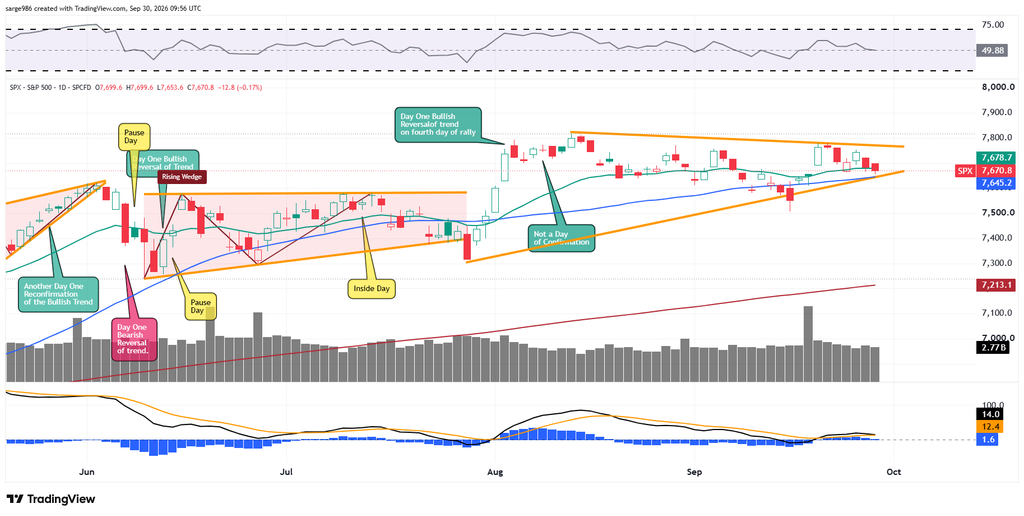
Big surprise? Not really. September has a reputation for a reason. The S&P 500 is down 0.2% month to date with one session to go. The Nasdaq Composite has done better and is up 1.6% this month. Thank the Philadelphia Semiconductor Index for this. That index is up 9.5% for the month with “pond the table” Sarge-folio names Advanced Micro Devices (AMD) and Intel (INTC) up 29% apiece in September. Rock on.
Yes, it’s been a very, very good month, overall if you read these columns. Other high-exposure Sarge-folio names Taiwan Semiconductor (TSM), Micron (MU) and CrowdStrike (CRWD) are all up 10%, 11% and 14% month to date, respectively. In fact, the only high-exposure name that gave us any trouble this month was IBM (IBM), which was down 6%.
In fact, the Sarge-folio is up 20.6% since mid-March when the divorce was final, and I had to start over again. The S&P 500 is up 14.5% over that same timeframe, so we’ll take it. The Sarge-folio is 9-1 versus the S&P 500 since 2016. We’d like to see that trend to continue. Then again, I have been tech-heavy for about ten years, so this makes sense.
Economics (All Times Eastern)
07:00 – MBA 30 Year Mortgage Rate (Weekly): Last 7.12%.
07:00 – MBA Mortgage Applications (Weekly): Last -1.5% w/w.
08:15 – ADP Employment Report (Sep): Expecting 70K, Last 38K.
08:30 – GDP Growth (Q2-F): Flashed 1.5% q/q SAAR.
08:30 – Personal Income (Aug): Expecting 0.4% m/m, Last 0.4% m/m.
08:30 – Consumer Spending (Aug): Expecting 0.9% m/m, Last 0.2% m/m.
08:30 – PCE Price Index (Aug): Expecting 0.4% m/m, Last 0.2% m/m.
08:30 – Core PCE Price Index (Aug): Expecting 0.3% m/m, Last 0.2% m/m.
08:30 – PCE Price Index (Aug): Expecting 3.8% y/y, Last 3.7% y/y.
08:30 – Core PCE Price Index (Aug): Expecting 3.4% y/y, Last 3.3% y/y.
08:30 – Wholesale Inventories (Aug-adv): Expecting 1.1% m/m, Last 1.3% m/m.
09:45 – Chicago PMI (Sep): Expecting 51.3, Last 47.1.
10:30 – Oil Inventories (Weekly): Last +2.969M.
10:30 – Gasoline Stocks (Weekly): Last -1.686M.
The Fed (All Times Eastern)
1:30 p.m. – Speaker: Richmond Fed Pres. Tom Barkin.
3:25 – Speaker: Reserve Board Gov. Lisa Cook.
5:10 – Speaker: Chicago Fed Pres. Austan Goolsbee.
6:00 – Speaker: Minneapolis Fed Pres. Neel Kashkari.
Today’s Earnings Highlights (Consensus EPS Expectations)
Before the Open: CAG (.28), FDS (4.35), JBL (4.07)
After the Close: MU (31.59), PRGS (1.52)
At the time of publication, Guilfoyle was long MU, AMD, INTC, TSM. CRWD, IBM equity.