Fun Facts That Help Investors Make Money
Asymmetric rewards come to those who buy severely depressed stocks and give them adequate time to rebound. Here are seven current candidates for excellent rebounds.
You've reached your free article limit
You've read 0 of 1 free Pro articles.
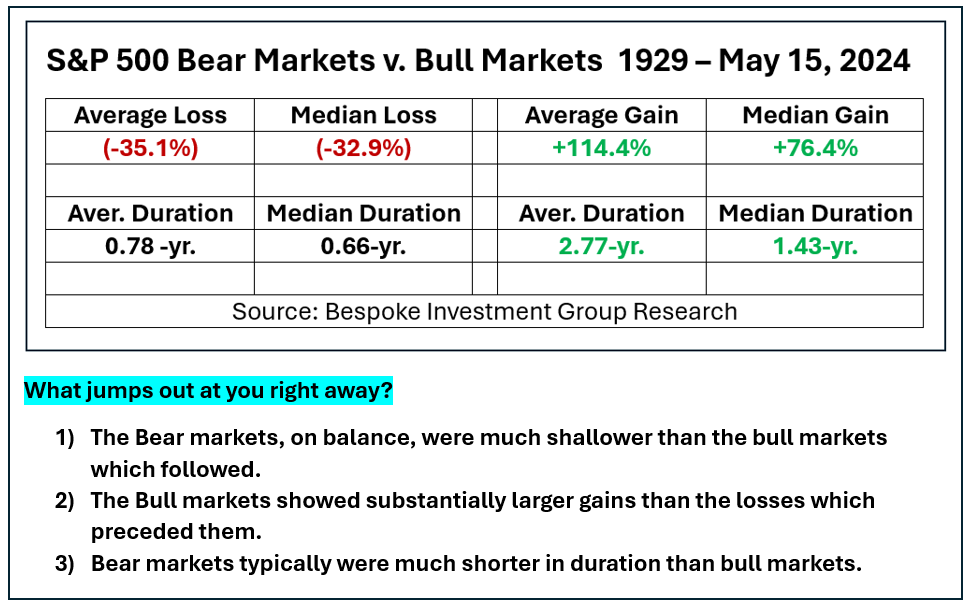
Since 1929 there have been 27 bear markets (defined as 20% minimum declines following 20% minimum gains) in the S&P 500 or its equivalent.
The average percentage selloff totaled (-35.1%) and ran about 0.78-year. The median decline was (-32.9%) incurred over about 0.66-year.
The 27 bull markets which followed, including the current one through May 15, 2024, saw average gains of +114.4% earned over about 2.77 years. The median advance was +76.4% achieved over 1.43 years.
Here is an easy-to-fathom table of those 54 result periods.
Here is the raw data for those who desire full details.
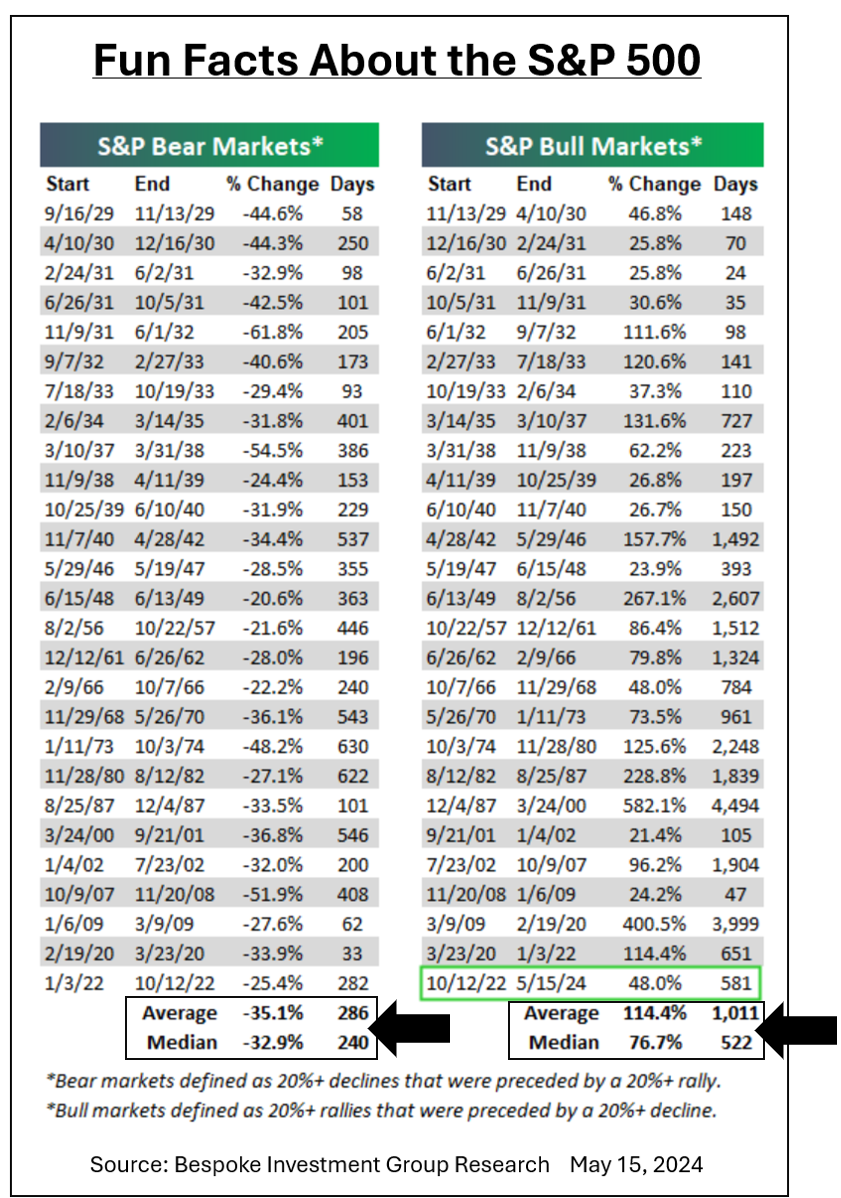
This simply proves again what I have been illustrating over many years here on TheStreet Pro.
Asymmetric rewards come to those who buy severely depressed stocks and give them adequate time to rebound.
The math is compelling. A stock which falls from $100 to $25 is down 75%. Buyers at that low will see 300% gains, though, if that stock then merely rebounds to its starting price.
Other, somewhat less severe drops and their subsequent gains to the original price point are detailed below.
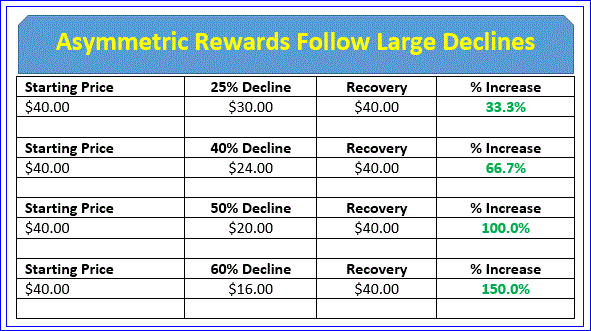
Do decent quality stocks really make those kind of recoveries? You bet they do.
Mega-cap names such as Nvidia NVDA, Netflix NFLX, Meta META, Booking Holdings BKNG, Intuitive Surgical ISRG, and Chipotle Mexican Grill CMG all suffered major declines followed by enormous rebounds. Most of those saw it happen on multiple occasions.
Note, too, that the gains shown were only through the dates listed. Many far exceeded those levels before settling back again.
So did two of my top 10-holdings list, Caleres CAL and American Woodmark AMWD.
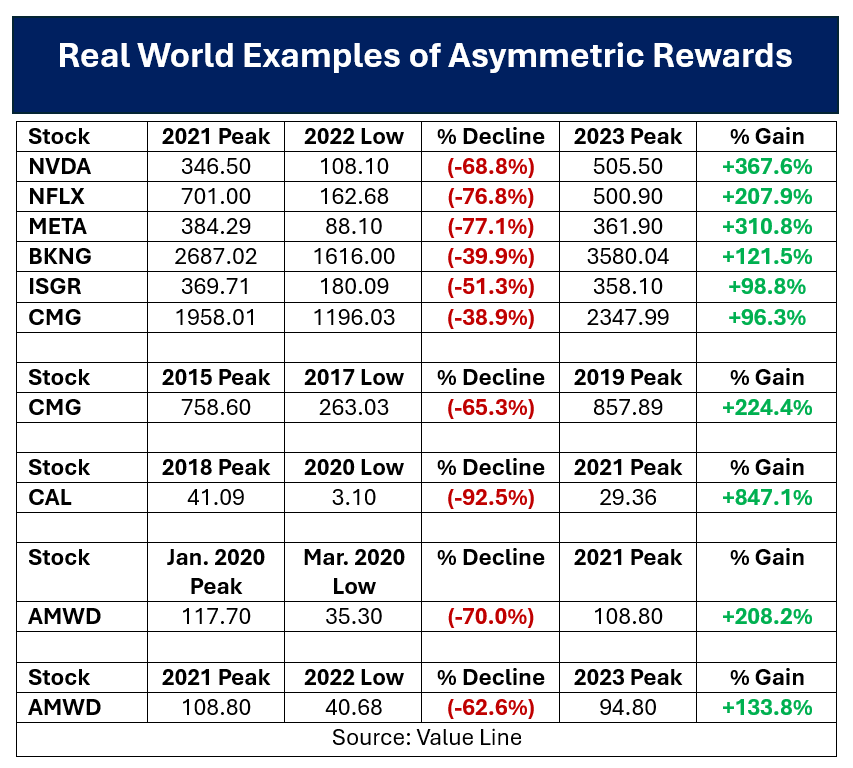
In every case buying “falling knives” was indeed a great thing to do. You did not need to catch exact tops and bottoms to pocket extremely big rewards.
Investment legends like Peter Lynch and Sir John Tempelton knew intuitively that a stock can only lose up to 100% of its value while upside potential always remains theoretically unlimited.
Buying a diversified mix of ultra-depressed but viable companies is a fine way to garner life-changing wealth. It is especially effective when executed in Roth IRAs or Roth 401(k)s where even enormous profits remain tax free forever, even after withdrawal from those plans.
All three major indexes established new all-time highs on May 15, 2024.
Despite that, there are still some prime candidates available to buy right now which are still well below their 52-week tops.
My list of candidates for excellent rebounds is shown below.
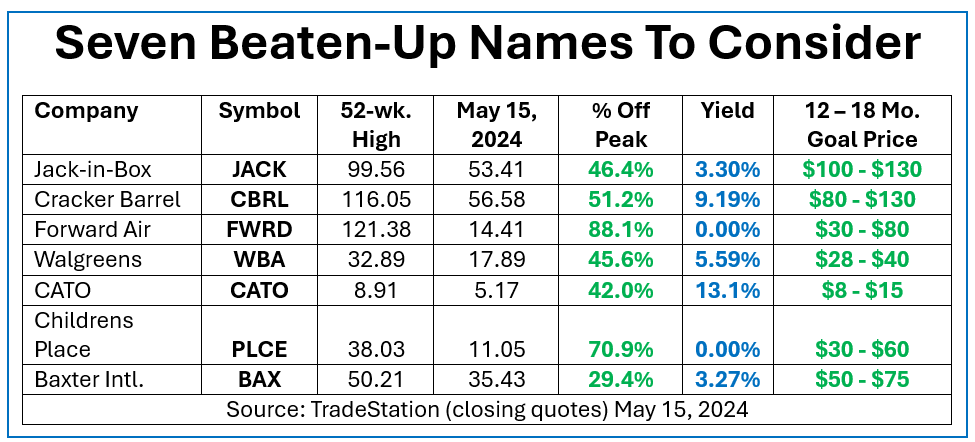
All but Forward Air FWRD are down much more from their all-time peaks. Five of the seven stocks listed pay dividends, making waiting for rebounds a bit easier. FWRD suspended dividends this year to firm up its balance sheet. It is a fine company going through a tough year. Insiders bought about $2 million of its shares last August at average prices in the mid-$60s.
Walgreens WBA already cut its payout, yet still pays better than the best bank CDs. WBA is now offered at about 5.6-times trailing earnings. Recent insider buys took place at higher than today’s quote. I look at WBA in depth here.
Jack in the Box's JACK decline in price took its well-covered yield to more than double its historically average level. Its multiple is now less than half its historically normalized level.
JACK has now moved to the very top of my personal largest holdings list. I have not felt so confident in any stock’s year-ahead prospects since I wrote up American Woodmark that way in 2022. A 3.3% yield while I wait sounds great as well.
I own shares in all those stocks except for Baxter International BAX. I am short in-the-money LEAP puts on BAX as a proxy for stock ownership. BAX peaked at over $95 during 2020. It hit $89.70 as recently as February 2022.
Cracker Barrel CBRL topped out from $118 to $185 during each of the 11 calendar years from 2013 through 2023. It is likely to be there again within a year or two.
Children's Place PLCE has received a large cash infusion from its new management team which removed any near-term balance sheet risk. The shares hit $113 back in 2021.
Cato Corp. CATO is debt-free and cash rich. They own North Carolina real estate, valued on the books at cost, from decades earlier. Its 13+% yield might or might not be reduced but the stock is a buy regardless.
More Paul Price:
- Forget Meme Players… What Is GameStop Really Worth?
- Is Value Investing Dead? You Make the Call
- Buying Income Is Hazardous to Your Wealth
It always seems scary buying stocks which have recently taken a beating. The charts look terrible and almost nobody will have a kind word to say about them. Ironically, unless terrible and unexpected news occurs, that is exactly when long-term risk is lowest and upside potential is highest.
Regular readers of my columns know that I reaped huge profits back in the spring of 2020 on Michaels MIK, the arts and crafts retailer. After three straight years of greater than $2 per share earnings the stock had dropped from a previous peak of $31.40 to $1 even.
Panicky traders dumped the stock, sure it would be going out of business. They were convinced that the ultra-cheap share price was a sign of corporate distress. Instead, kids quarantined at home were prime consumers of what Michaels had to sell. Final 2020 EPS set a record at over $3.00.
I wrote the stock up favorably at $2.17 during April 2020. I bought many thousands of shares at an average cost of just under $2. The same $31,400 that bought 1,000 MIK shares in 2016 could have bought 31,400 shares for those lucky enough to have caught the exact low.
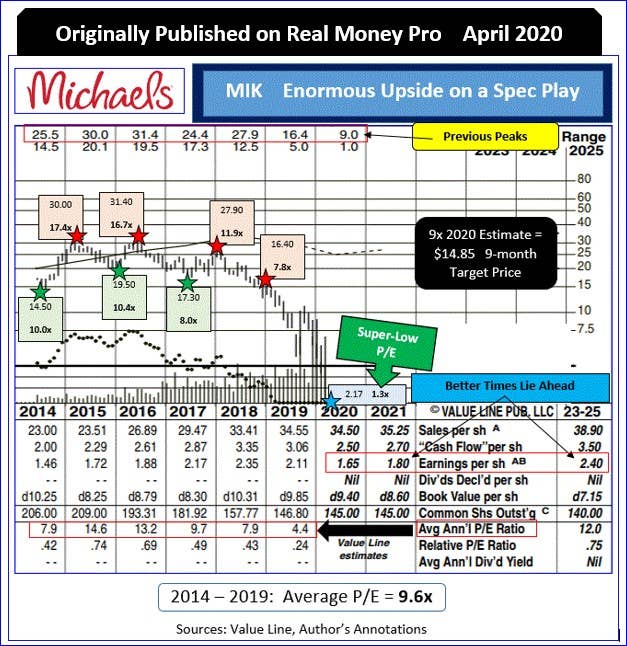
Less than one year later the stock went private at a $22 buyout price.
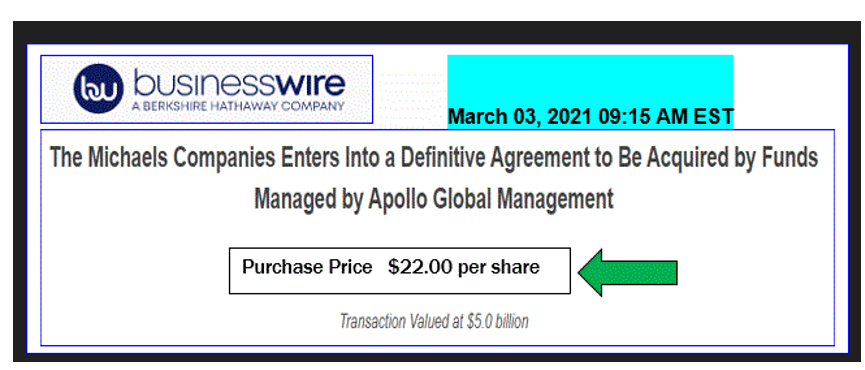
Gains like that can be truly life-altering for those brave enough to buy when others are scared to tread.
A portfolio of stocks like these could easily catch some major winners. That should more than make up for any that fail to prosper as hoped for. In the end your full portfolio result is all that matters.
At the time of publication, Price was long shares and short options on all stocks shown in the "Seven to Consider" list except BAX. He is short LEAP puts on BAX. He's also long shares and short options on CAL and AMWD. He has no positions in any other stocks or index ETFs or Funds mentioned.