What Traits Make a Great Stock Investor?
Virtually all Peter Lynch's character traits for good investing were necessary to weather the highs and lows with this stock since 2020.
You've reached your free article limit
You've read 0 of 1 free Pro articles.
The American Association of Individual Investors (AAII) sent out an informative email on Valentines Day rehashing wisdom from Peter Lynch from his book "One Up on Wall Street" originally published in February of 1989.
Though the advice is now 35 years old, it remains valuable and accurate.
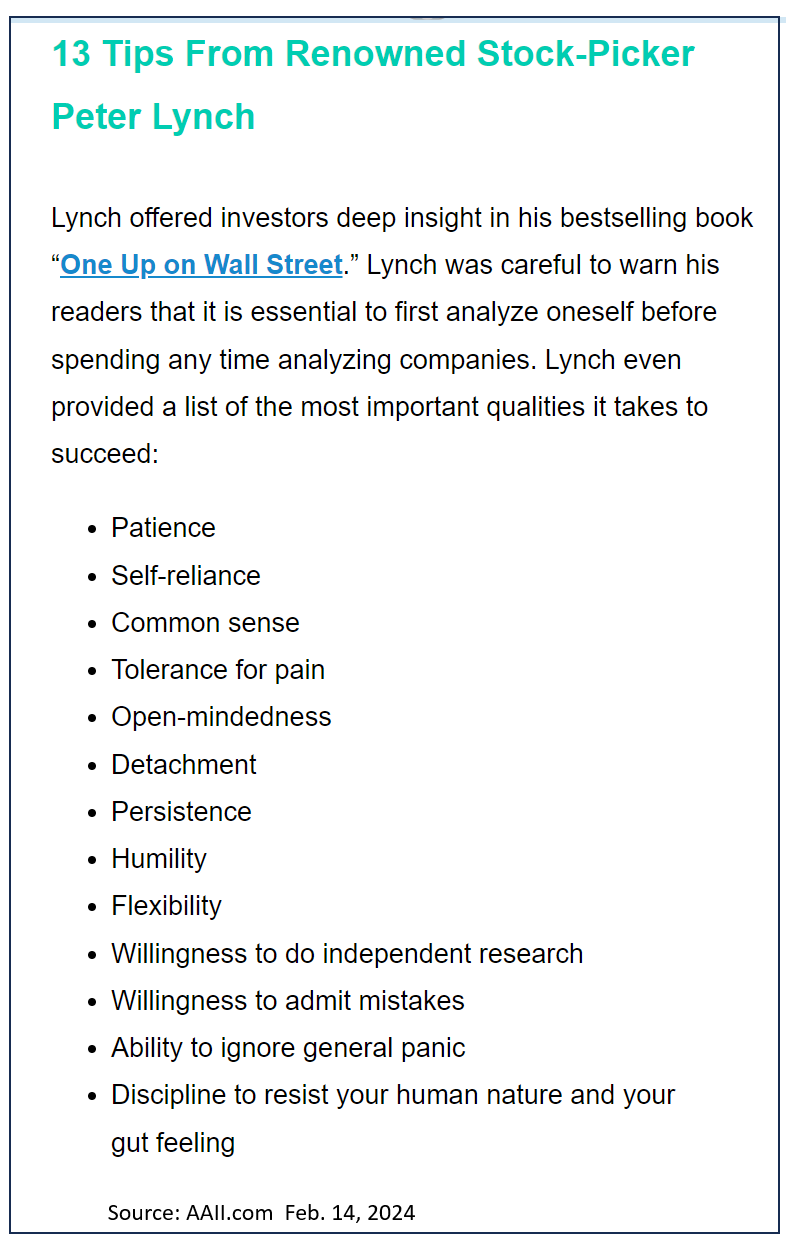
The traits he listed are absolutely what make for terrific long-term investors.
Patience: Most people today are extremely short-term oriented. Computer technology, commission-free trading and the internet have conspired to turn most of us into "traders" rather than investors.
Many years ago the average holding period of a stock was about 7.4 years. At present that number has plunged to under seven months.
Contrarians can turn that trend into an advantage by buying cheap stocks and giving them the time they need to make massive percentage gains not typically possible over short periods.
Self-Reliance: Putting your decision making into the hands of fund managers, mechanically created index funds or ETFs etcetera, is the lazy man's way of doing things. If you simply own "the market" you can never outperform it.
It is better to learn how to value stocks properly and then follow your own indicators for buy/hold/sell decisions.
Common Sense: This is now rare to find in the investment world. The old "buy low/sell high" advice made perfect sense. In today's world many people worship "momentum" and try to buy high to sell higher.
Tolerance for pain: This is required. Owning stocks will occasionally inflict brutal pain. You need to prepare yourself for those periods and stay on course regardless. If you cannot bear to see temporary plunges, investing is not going to end well.
Detachment: I am presuming Mr. Lynch was saying to detach your ego from your present-day results. Smart people do not become idiots just because stocks they selected behaved badly.
Persistence: Once you have developed a solid plan you need to stick with it rather than flitting from one "hot idea" to the next big thing.
Humility: Euphoric stock markets can make you feel like a genius. Fight the urge to get overconfident as bad markets will inevitably return. Keeping your head when things are going great will prevent disasters which occur when you no longer think you can make mistakes.
Flexibility: Times change, industries go into ascension and decline. Be alert to changing fundamentals and adapt accordingly.
Willingness to do independent research: Most media talking heads love to tout what has already done well, rather than beaten-up stocks which are primed to rebound. Doing your own research will often outperform ideas from "professionals."
Willingness to admit mistakes: Everybody who picks stocks has ones that do not work out as planned. Moving on from bad ideas is like cutting out a cancerous tumor. You will free up capital for better investments and rid yourself of seeing those dogs on your statements each month. In taxable accounts you will save money each April.
Ability to ignore general panics: This is another key trait. Periods like March 2020, the financial crisis of 2008-09 and days like last Tuesday, when the DJIA dropped almost 800 points intraday, present great buying opportunities to pick up bargains while others are fearfully selling.
Warren Buffett's largest career mistake was probably being a net seller during the Covid crisis when Berkshire Hathaway BRK.ABRK.B sat on over $132 billion in cash.
Discipline to resist human nature and "gut feelings": This might be the most importantof all the traits listed. When markets crash or individual stocks are getting killed every ounce of your natural response is to do what is stress relieving rather than goal achieving.
When you are feeling so bad about your portfolio that you do not want to look at your account balances... so does everybody else. That is exactly when superb values are most available.
Legendary money manager Marty Sweig said it best: "It is okay to feel like everybody else. It is not okay to act like them."
In pre-computer days when I was a Merrill Lynch stock broker back in the 1980s I told clients, "When your hands shakes when you pick up the phone to buy... you are making the right move."
If the Shoe Fits...
Now, I am going to show one on my long-term investments as an example of how all these things applied.
Shoe manufacturer, designer, and retailer Caleres CAL got knocked down from north of $41 in 2018 to just $3.12 during the Covid panic of 2020. If that was not terrifying for previous holders they must have been fast asleep.
Pre-Covid the firm had run off five straight years of $2.00 to $2.21 in earnings per share. Caleres lost money in 2020 as the stores were closed by government edict.
When others panic sold I was snatching up thousands of shares at under $4 on the belief that Caleres would go back to earning its proven $2 plus per share whenever the crisis ended.
On July 20, 2020 CAL had rebounded to $7.42. I wrote up the shares that day saying CAL could easily triple from there. Value Line had penciled in an EPS rebound to $1.70 for fiscal 2021.
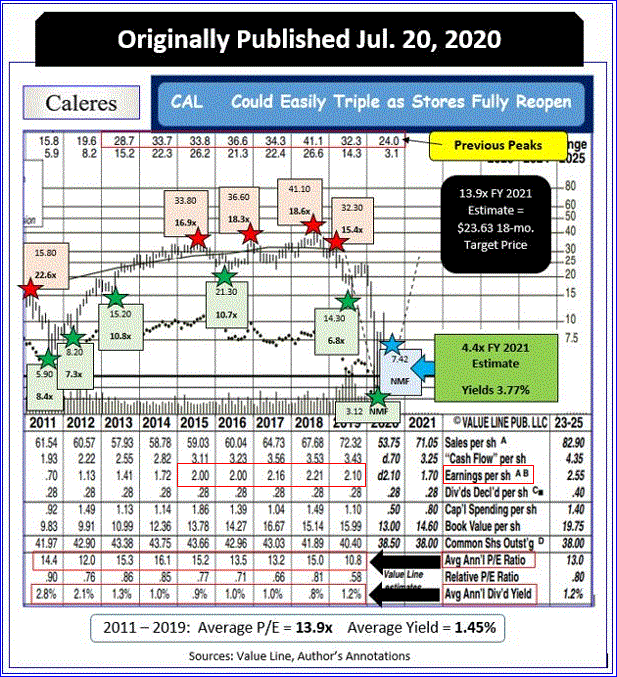
As things turned out that estimate proved much too conservative. Caleres went on to earn $4.29 in 2021. The shares surged to $29.36 just 10 months after being left for dead at $3.12.
At $29.36 CAL still appeared bargain-priced at less than 6.9 times that year's profits. I did not sell outright but did write many covered calls bringing in tons of premium dollars. Oops. By March 2022 CAL had regressed to south of $18.
That occurred even though Caleres earned $4.92 per share that year. At the $17.82 low price Caleres was offered at less than 3.7 times current year's profits.
It felt horrible to have ridden CAL down by over 39% when the news could not have been better. After getting over the shock of having missed my chance to exit and rebuy, I got busy adding more shares and selling tons of naked puts to take advantage of the market's craziness.
CAL became my largest single dollar holding of all time. Five months later I was vindicated. CAL hit $31.13, a gain of 74.7% from the recent low. Regular readers know I did not sell then either, except for more covered calls.
The company continued earning over $4 yet the stock again inexplicably plunged, to $16.85 in June 2023. My tolerance for pain was severely tested. When I least felt like it, I forced myself to add even more shares to my position.
Why was I so willing to bulk up on a stock that had just reamed me? My own research said CAL could be $40-$60 if it merely reverted to 10-15 times earnings.
I am happy to say that CAL is still an enormous dollar position, one of my largest personal holdings in 45 years of investing.
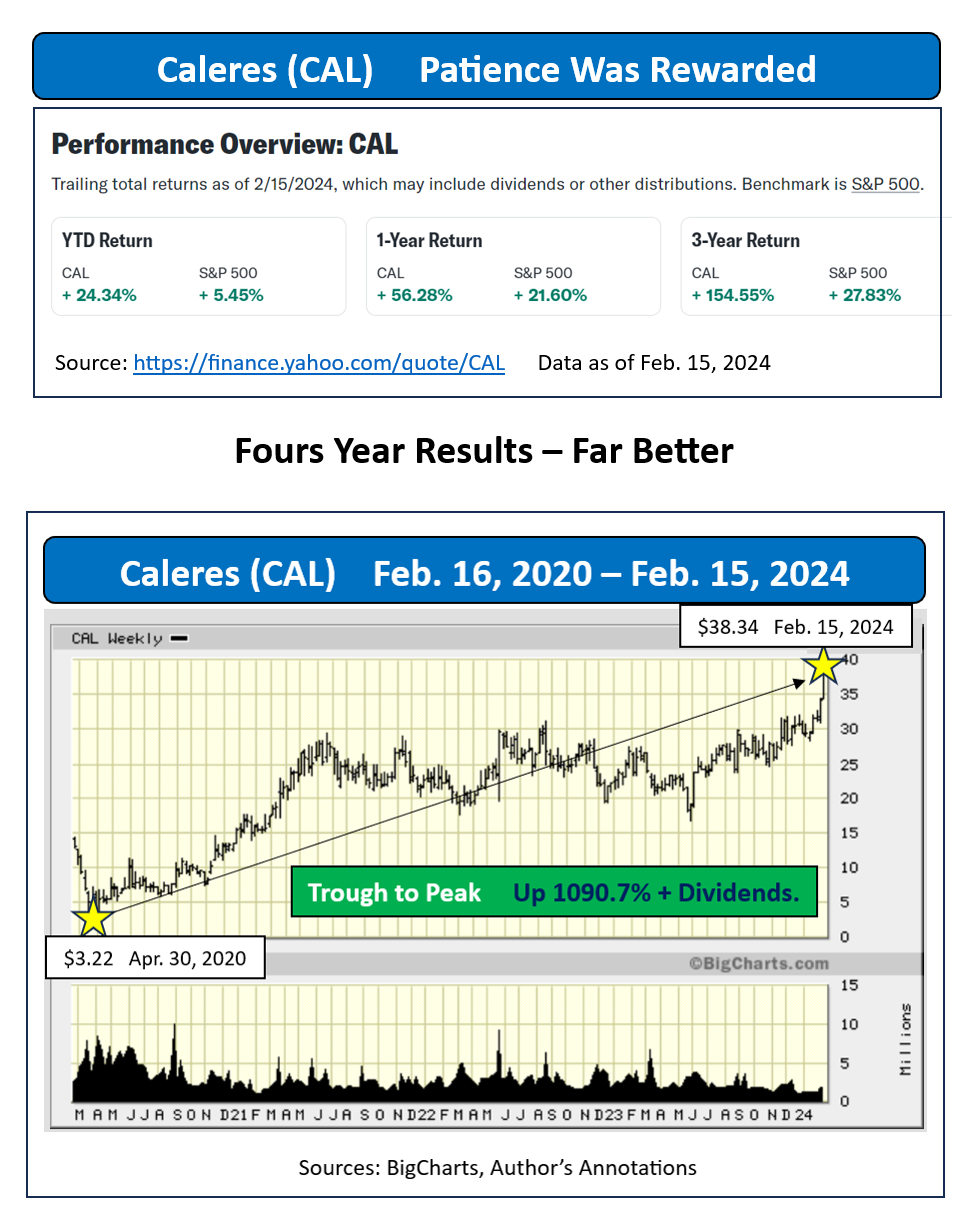
On Feb. 15, 2024 CAL hit a post-2018 high of $38.35. I am sitting on huge unrealized gains plus short greater than $178,000 in put option premiums collected on now 100% out-of-the-money puts expiring next January.
The shares now trade at about 8.3 times projected earnings for FY 2024. The stock rallied over 15% in the past week or so. I am guessing that an LBO, an outside takeover or simply a better-than-expected Q4 report will be reported soon.
CAL has significantly bested the S&P 500 year to date and over the past one, three and four years.
Patience, his first listed trait, was certainly rewarded. So was my independent research and fortitude in buying more when momentum was dismal, but fundamentals were strong.
100% of my shares are now sporting covered calls at strike prices ranging from $35.00-$42.50.
I am leaving my naked puts alone for the moment but might consider buying to close if the buyback quotes get cheap enough.
When CAL was under $5, back in the spring of 2020, I transferred thousands of shares into my Roth IRA and paid taxes at the value transferred when the stock was unusually depressed. I have enormous gains in that account now that will be tax-free forever. So will all the income from covered calls which have already expired and many others that may go on to expire over the coming months,
Stocks like CAL, which is now up over 1,000% since its Covid-panic nadir, can be life changing. Peter Lynch called them "ten-baggers."
Think of all the traders who probably purchased CAL at $4 and then sold quickly for a double at $8, rather than hanging around for the big payoff.
It is true that you will never go broke taking a profit. It is also true that you will almost never be around for truly magnificent gains which come over time if you simply trade out quickly and move on to the next idea.
At the time of publication, Price was long CAL shares, short CAL naked puts; and short CAL covered calls.