Asian Stocks Make History After 'Full-On Crazy' Trump Decision
What should investors do when faced by levels of selling not seen since the Asian financial crisis?
You've reached your free article limit
You've read 0 of 1 free Pro articles.
It’s a bloodbath in Asia. Carnage.
Some market pundits are a little glib when they use such terms, overhyping a slight drop.
While there’s been no literal shedding of blood, there’s no overhyping the declines today. The red ink is flowing freely.
I’m writing my normal Tuesday column on Monday, because the losses on Asian equity markets are at historic levels.
Taiwan is posting its biggest-ever one day loss.
The Hong Kong market has had its worst day since the 1997 to 1998 Asian financial crisis.
And the Tokyo market is down 7.8%, taking its three-day loss since markets turned south on Thursday to 18.7%.
All as the insanity sinks in of U.S. President Donald Trump’s “reciprocal” tariffs.
Nonsense
I’ll be blunt. These tariffs are nonsense. I agree with Germany’s economy minister, Robert Habeck, who delivered that assessment today. I agree with economist Paul Krugman, too, that Trump has gone “full-on crazy.”
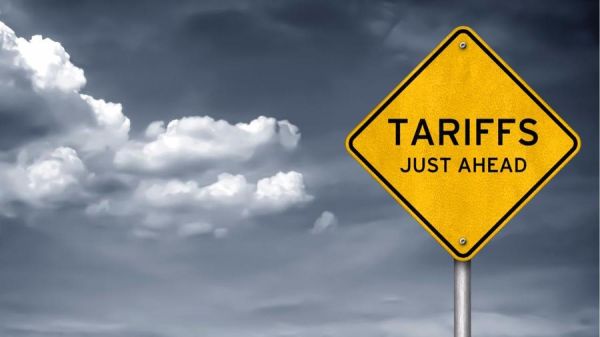
Yet Trump, like mad Nero, is fiddling around while markets burn, mumbling about swallowing unpleasant medicine, perhaps the bleach he at one point suggested drinking so you could give your insides a good clean.
But what do investors do in response? That’s the question.
Both Taiwan and Hong Kong were closed on Friday for a public holiday. So on Monday, you’re seeing them catch up with the selling that took place on Wall Street and in Asia on Friday.
The Taipei market heavyweight Taiwan Semiconductor Manufacturing Co. TSM (TW:2330) descended the daily 10.0% limit for Taiwanese stocks. That dragged the Taiex down a similar amount, 9.7% on the day. The whole market down the daily limit!
Cut Back on Margin
Monday is surely not the day to be liquidating positions, if you haven’t already. I’m happy that, prior to the Rose Garden event, I decided to sell down around 25% of my positions in Nvidia NVDA and TSMC, just in case trade took a hit.
I’ve also traded out on Friday of a position in Microsoft MSFT, mainly so that I can make sure I have plenty of wiggle room of cash on hand to avoid any kind of margin call. It’s a time to get cash in order if you have it on hand in your portfolio, and cut back on margin and borrowing.
And to hunker down. There’s likely to be more selling this week, with export-heavy Asia particularly at risk. This isn’t yet the time to buy back in, with the sniff of recession in the wind. But this historic selling will at some stage also present a historic point to buy back in.
Multinational Finance Hit
Hong Kong’s Hang Seng index is down 13.2% on Monday alone, effectively erasing the gains for what had been the world’s best showing among major markets. It is up, but barely, for 2025, netting a 1.0% gain after today’s descent.
Unlike Taiwan, there’s no one-day limit on moves in Hong Kong. All Hang Seng components sank into the red, but they were led by Chinese biotech Wuxi Biologics WXXWY (down 26.4%) and computer maker Lenovo Group LNVGY (HK:0992) (down 22.9%), best-known internationally for the ThinkPad brand it bought from IBM IBM.
Banking giant HSBC HSBC (HK:0005) fell 14.8% today in Hong Kong, its chief profit center, while rival Standard Chartered SCBFY (HK:2888), with a focus on Asian emerging markets, lost 16.1%. They finance many Asia-based or Asia-focused multinationals, companies that are sure to suffer heavy disruption.
Some Tech Titans Protected
Tech stocks reacted worst on Monday if, like Lenovo, they depend on global parts sourcing and shipments. Some of China’s “Seven Titans” fared better if they have a domestic focus.
For instance, software provider Kingsoft KGFTY (HK:3888), the “Microsoft of China,” was the best performer among components of the Hang Seng Tech Index, which fell 17.2% as a whole. Kingsoft posted a contained 5.6% loss. But its cloud-computing subsidiary Kingsoft Cloud Holdings KC (HK:3896) was pummeled, down 23.9% today in Hong Kong, and has a Wall Street listing that will surely see heavy selling.
WeChat super app operator Tencent Holdings TCEHY (HK:0700), another “titan,” was next-best on the tech index, although still down 12.5% on Monday.
But beyond Tencent and Kingsoft, the other titans also fell hard. Alibaba Group Holding BABA (HK:9988) dropped 18.0%, with its rival e-commerce shipper and platform JD.com JD (HK:9618) down 15.5%. Video game maker NetEase NTES (HK:9999) fell 17.9%. All demonstrate concern about consumer confidence.
Smartphone maker Xiaomi XIACY (HK:1810) was off 20.6% on Monday. It’s been a star so far this year given its successful diversification into electric vehicles. It is still up 7.2% for 2025, quite something given today’s hit.
Rival EV maker BYD BYDDY (HK:1211) posted losses more or less in line with the broad Hong Kong market, down 15.9% today. While it is the world’s largest EV seller due to its hefty domestic focus, it is also engaged in a costly price war at home. Its expansion into Europe was delivering higher margins, until these pressures on global trade.
China Faces Heaviest Tariffs
China faces the heaviest tariffs under Trump’s new system, the 34% in additional tariffs on the Rose Garden chart coming on top of existing higher tariffs of 20% on the country.
In mainland China, the CSI index fell 7.1% on Monday, investors in Shanghai and Shenzhen somewhat isolated from Hong Kong’s selloff. Beijing officials have already responded with 34% tariffs on U.S. imports, and have been discussing how to support stocks. Central Huijin Investment, a unit of the Chinese sovereign wealth fund China Investment Corp., says in a statement today that it is buying China-listed stocks via exchange-traded funds to “safeguard the smooth operation of the capital market.”
If there’s any saving grace for China, it’s that other countries are also faced with hefty additional U.S. trade duties. Manufacturers such as Apple AAPL have been expanding production away from China, into markets such as India, but India is now also subject to an extra 27% tariff.
Numbers Make No Sense
The tariffs make no sense. Trump pledged “reciprocal” tariffs based on what other countries charge the United States on its exports. But we now know that the chart he waved around contained figures that are nothing of the sort.
Instead of actually calculating what tariffs other countries are charging the United States, the Trump administration has instead just looked at the degree of trade surplus or deficit that a country has with the United States.
That’s not a tariff. It’s an expression of the balance of trade.
For some reason, the calculations look only at goods, and exclude services altogether. The United States is a major exporter of software services, for instance, but apparently that doesn’t count at all.
Author James Surowiecki, who wrote "The Wisdom of Crowds" and used to pen the financial page for The New Yorker,
Let’s be clear. The United States is the world’s largest economy, with a per-capita income that is very nearly the highest in the world. It is very hard for me to fathom how the impoverished nation of Lesotho, landlocked within surrounding South Africa, has been taking advantage of American citizens. Yet Lesotho, which besides sheep and goat farming makes some basic clothing like jeans, is slapped with a 50% tariff.
The new tariffs also crunch a 10% tariff on the uninhabited Heard Island and McDonald Islands, which is home only to penguins, islands that were likely last visited by people 10 years ago. These tariffs are the result of clerical errors, with the Australian territory of Norfolk Island also leveled with a 29% tariff on goods. It has no shipments to the United States. But a shipment of boots to Timberland, which is headquartered in New Hampshire, was mislabeled as Norfolk Island, The Guardian reports, since "NI" is next in the drop-down menu from "NH."
Those errors are glaring. But none of the math makes sense.
If these tariffs stay in place, they’ll force U.S. trade to grind to a crawl. The ultimate upshot would be to see all sweat shops and cheap manufacturing relocating back to the United States.
But we also don’t know what kind of concessions the Trump administration may make with U.S. trading partners. Apparently, some 50 leaders have already put in calls attempting to strike some kind of deal.
Markets will surely see more selling but be highly unpredictable as they recalibrate. China and the European Union have the sort of scale to push back on these tariffs. Meanwhile companies that rely on global trade, or that finance it, will suffer.
Investors should cut back on margin, make sure they are nowhere near margin-call limits, and prepare any cash they have in their portfolio, looking for the opportunity to buy back in. For Asian equities, we expect choppy trade and further moves lower, until we get more clarity on any trade concessions.
At the time of publication, Alex Frew McMillan had long positions in NVDA, AAPL, BYDDY and KTEC.