Why I’m Buying IBM After 115-Year Record Plunge
The Big Tech giant had its worst losses in more than a century but the bottom might be in.
You've reached your free article limit
You've read 0 of 1 free Pro articles.

Last week, the news landed like a lead balloon (not a Led Zeppelin, though that would have been more fun). The share price of (IBM) fell out of bed on Tuesday, July 14, giving up 25.2% for the day. The share price has continued to drop since. I have added twice during this period and expect to add further.
The firm, which is scheduled to release its second quarter financial results this Wednesday, released preliminary results that morning that fell well short of expectations. IBM reported an adjusted EPS of $2.93 on revenue of $17.2 billion. Wall Street consensus view, prior to last Tuesday, had been for an adjusted earnings per share of $3.02 on revenue of almost $17.9 billion.
Readers may recall that CEO Arvind Krishna, who is a business leader that I am admittedly a fan of, wrote a letter to shareholders. Krishna tried to explain.
“In the last few weeks of June, we saw clients shift their quarterly capex spend toward servers, storage and memory purchases to secure supply-constrained infrastructure ahead of expected price increases. While we anticipated some supply chain related impact in our expectations, we did not anticipate the magnitude of the capex reprioritization.”
Krishna went on:
“These conditions require our teams to execute perfectly, and this quarter we faltered. We did not adapt and move quickly enough, and numerous large deals failed to close on the timelines we expected, driving the majority of our shortfall. These are not excuses, but they are realities. Our job is to help our clients through uncertainty, to find paths forward to grow their businesses no matter what is happening in the external environment.”
News Rattled Tech
In response, in addition to uncertain news regarding the war in Iran, public confidence in the tech sector had been rattled. The Nasdaq 100 gave up ground on Wednesday, Thursday and Friday, while surrendering 4.13% for the week. Investors showed concern that the AI boom was diverting budgets away from traditional spending patterns and that capex-related expenses had blown past free cash flows across the group.
Software stocks and semiconductors took the sell-off on the chin. The Philadelphia Semiconductor Index gave back almost 10% forthe five-day period. That’s because said AI boom is causing a shortage of memory and storage hardware, which slowed those stocks as well as infrastructure names. These fears were exacerbated separately, by news that Starbucks (SBUX) was planning to use artificial intelligence to build its own tools that could replace inventory and maintenance software from outside vendors.
IBM is one of those vendors that sells this possibly soon to be obsolete software. This fed into a broad 2026 trend that has software investors worried that artificial coding agents could replace humans and subsequently turn what had been high-margin businesses into almost low margin utilities.
As the downside catalyst for this whole sector-wide beatdown, IBM stock had suffered its worst day in percentage terms in 115 years, even worse than October 19, 1987 (Black Monday). I was long. I didn’t go into the red on my position, but I did give back almost all of my profit. Oh joy. Remember, I am not in IBM for all of their legacy businesses. I am in IBM as I see this firm as the eventual winner in the quantum computing sweepstakes. Now, it’s not like I don’t need IBM to keep producing the free cash flow that funds the quantum program, but those businesses are not what I think differentiates IBM.
Could There Be a Positive Surprise?
When IBM officially reports this Wednesday? Probably not. The headline numbers are pretty much known. That said, software sales will still show growth. Red Hat will show nice enough sales growth. A lot will depend on how optimistic Krishna sounds when he addresses investors. It is my opinion that, if Krishna does not sound like his dog died, that the worst-case pain, at least for now, is very possibly priced in.
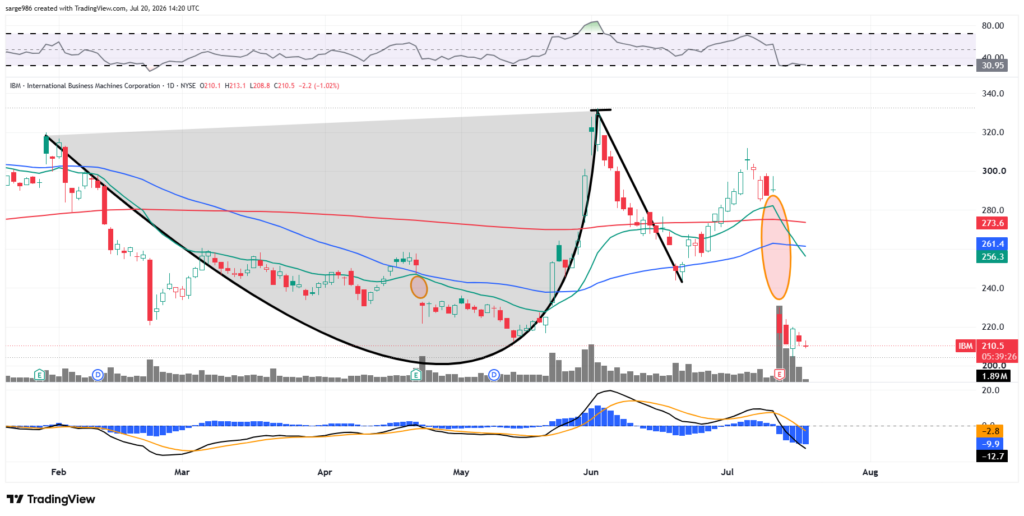
Readers will see the same cup-with-handle pattern that I showed you last week that had produced the mid-June rally. That rally failed. Relative strength is now scraping along close to technically oversold territory without kicking that door in. The daily MACD is now overtly bearish with all three components singing the blues.
I added to my stake twice last week. I have added to that position again overnight. On Friday, the stock suffered a mini or swing-traders’ death cross, which is when the 21-day EMA crosses below the 50-day SMA. I believe that is where Monday morning’s weakness came from. The low from last week was down at $204 and buyers did show up there, with some aggression.
It does look like the stock is trying to bottom ahead of Wednesday. This may be a trading opportunity in addition to or outside of a core investment. We’ll know soon enough. For now, I have returned IBM to “top five” status going into that event. After earnings, I will return the name to number six or seven. I’m thinking profitably.
At the time of publication, Guilfoyle was long IBM equity.