New SpaceX Trade Idea After Charter Communications Report
Elon Musk’s aerospace firm is now headed to a prestigious index.
You've reached your free article limit
You've read 0 of 1 free Pro articles.

No, I did not try to get in on the IPO. After having been involved in the investment banking side of the business back in my glory days, I try not to play the game from the outset.
That said, this name has repeatedly found support, despite enough early volatility to shake a stock at, well above its IPO price of $135. There has now been some mandated passive investment after the stock had been added to the Russell 1000. There will be more as SpaceX (SPCX) is now headed to the highly prestigious Nasdaq 100 index as well. Jeffries has estimated that in aggregate, this passive demand could come to $3 billion worth of the shares.
No, SpaceX is not yet profitable. What does that mean? I don’t really know. Clearly, there is demand across a number of fronts for what SpaceX offers.
I mean, look at how great of a stock Elon Musk’s Tesla (TSLA) was long before that business was truly viable. Musk is bold and not afraid to be aggressive. Incredibly, SpaceX raised $25 billion in senior unsecured notes across five tranches, less than two weeks after going public, with a range of maturities spanning from 2031 to 2056. Interest rates on those notes ran from 5.35% for the shorter-term stuff out to 6.65% at the long end. These notes, despite some “iffy” performances since, did not lack for bond market demand. The firm reportedly used or will use the funds to pay off a $20 billion bridge loan facility.
Trade SpaceX on This News?
I’m not so sure. According to INDmoney, Nasdaq’s own economists did the work and calculated an average market-adjusted return of barely more than 1% from five days pre-announcement through post-index inclusion, when it comes to the Nasdaq 100. The reason behind this “less than one might expect” effect is structural. If a Nasdaq-listed company qualifies as one of the 100 largest non-financial companies domiciled there, it is added. As the newest member, it is often added, as is the case here, at a smallish weighting.
How About This News?
On Sunday, Bloomberg News reported that SpaceX and Charter Communications (CHTR) had discussed partnering on a consumer mobile phone offering. Charter, potentially, might run some of SpaceX’s phone traffic through its ground-based internet infrastructure, if so. Does such a partnership make sense? Remember, there is no deal here yet, so this is still hypothetical.
I think a deal could make strategic sense for both firms, particularly for mobile/consumer connectivity. SpaceX’s Starlink excels in satellite-to-phone communications for remote coverage where traditional cell towers just do not exist. Charter has a large terrestrial network and already partners with Verizon (VZ) for wireless. The two could create a more well-rounded, more complete service for consumers and business clientele at scale.
Starlink is already preparing to launch direct consumer mobile service in the U.S. This would compete directly with what Verizon, AT&T (T) and T-Mobile (TMUS) already do. By pairing off with Charte, Starlink could accelerate existing plans by leveraging existing infrastructure, and accessing an existing customer base without having to build out everything themselves.
So, my answer is maybe. As a trade. Not yet as an investment.
The Chart
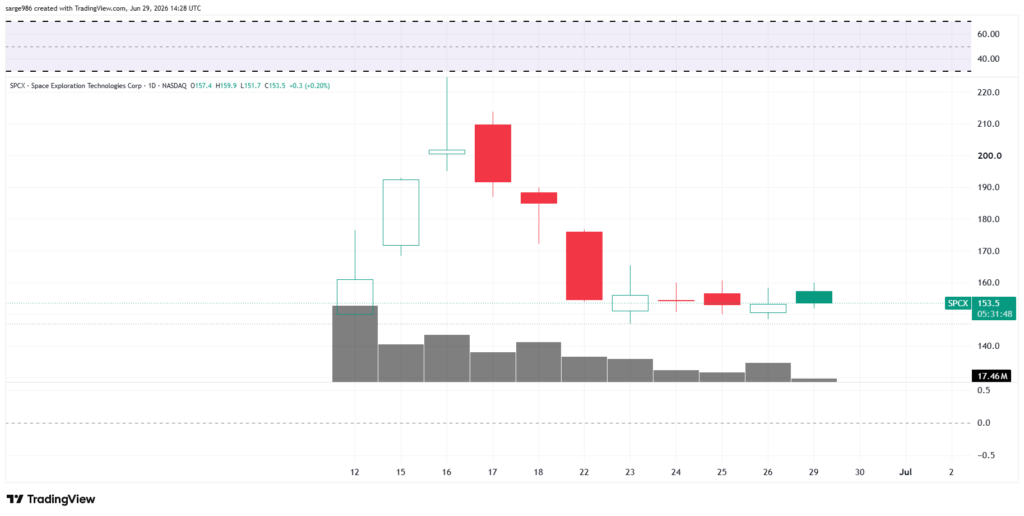
Unfortunately, SPCX has just not been around long enough to do any credible technical analysis. There are no moving averages, therefore there can be no daily MACD. There is also no such thing as relative strength.
We can see, though, that SPCX has found support twice in the high $140s and, for a number of days now, has hit resistance in the high $150s. Personally, rather than purchase the shares outright, I would be more comfortable selling a bull put spread with a short duration to try to generate a few bucks and maybe, under the right conditions, end up with a long position.
I’m thinking about selling July 17 $145 puts for about $5.60 and purchasing a like amount of July 17 $135 puts for roughly $2.80. That would create a net credit of $2.80 that could potentially leave the trader with a long position at a net basis of $142.20. However, this also opens up the potential for a net loss of up to $7.20 should the shares trade below $135 at expiration.
At the time of publication, Guilfoyle had no positions in any securities mentioned.