New Microsoft Price Target After a Quarter With ‘a Lot to Like’
Here’s why we’re gladly back in this Mag 7 name.
You've reached your free article limit
You've read 0 of 1 free Pro articles.

On Wednesday evening, struggling tech mega-cap, hyperscaling name and Sarge-folio hoarding Microsoft (MSFT) went to the tape with its fiscal fourth-quarter financial results. For the period ended June 30, Microsoft posted adjusted EPS of $4.74 (GAAP EPS: $4.81) on revenue of $90.007 billion. These top and bottom-line results both easily crushed Wall Street’s expectations while the sales print was good for year-over-year growth of 17.8%.
The big news for investors in and fans of the stock was probably the 43% year-over-year growth (vs. expectations for 40% growth) in sales for the Azure cloud-computing platform and the fact that Azure surpassed $100 billion in sales for the full year. CEO Satya Nadella commented in the press release: “We are advancing the frontier on the cost-to-outcome curve, ensuring every customer can turn tokens into business results. This year, Azure revenue surpassed $100 billion for the first time, and Microsoft 365 Copilot reached over 30 million paid seats, reflecting the confidence customers are placing in us to power their AI transformation.”
Operations
While sales increased 17.8%, gross income grew 15.4% to $60.482 billion. That took gross margin down to 67.2% from 68.6%, but still easily beat expectations. Operating expenses were up 9.8% to $19.879 billion. This left a GAAP operating income of $40.603 billion (+18.3%) on an operating margin of 45.1% (up from 44.9% and much better than expected).
After accounting for interest, other income & expenses as well as taxes, GAAP net income printed at $35.766 billion (+31.3%). That worked out to $4.81 per fully diluted share, up from $3.65 for the year-ago period. Once adjusted for the company’s investment in OpenAI, that EPS print lands at $4.74, up from $3.86.
Segment Performance
– Productivity and Business Processes generated revenue of $37.847 billion (+14.3%), producing an operating income of $21.9 billion (+15.3%).
– Intelligent Cloud generated revenue of $39.306 billion (+31.6%), producing an operating income of $16 billion (+31.4%).
– More Personal Computing generated revenue of $12.854 billion (-4.4%), producing an operating income of $2.748 billion (-13.9%).
Guidance
For the current quarter, Microsoft sees total revenue in a range spanning from $89.85 billion to $90.95 billion. This would imply growth of between 16% and 17% and beats the $89.7 billion that Wall Street was looking for. Operating expenses are seen landing in between $16.8 billion to $16.9 billion. That’s below the $17.3 billion that the Street had feared. Capex spending is still expected to be over $50 billion for the quarter.
In addition, CFO Amy Hood projected that the Azure business is expected to continue to accelerate, with revenue growth expected to hit 45% for this quarter. Consensus had been for growth of 42%.
Fundamentals
For the period reported, Microsoft generated operating cash flow of $55.441 billion (+30%). Out of that came capex spending of $41 billion, leaving free cash flow of $19.639 billion (-23.2%). Though free cash generation was down year over year, some of the other hypersalers are posting hefty outright cash burns. This number crushed free cash flow expectations for roughly $2.5 billion. Out of that FCF print, Microsoft repurchased $4.579 billion worth of common stock and paid out $6.758 billion in cash dividends to shareholders.
Turning to the balance sheet, Microsoft ended the period with a “current” cash position of $76.843 billion. The company also has $36.348 billion in equity investments not listed as current. That gives it a total cash position of $113.191 billion. That makes figuring Microsoft’s current ratio a little wonky, but the balance sheet is in fine shape, in my opinion.
Microsoft has shorter-term debt on the books of $9.227 billion and long-term debt of $31.067 billion. This debt load is covered several times over by the cash position. In addition, the company has $72.965 billion in unearned revenue listed under current liabilities. In other words, 43% of its current liabilities are not true financial obligations at all.
Opinion
This was a very solid quarter. Guidance was good, actually very strong. Cash flows are still quite robust. In fact, they are excellent relative to Microsoft’s peers. There’s a lot to like here.
I’m very glad Thursday morning that I did go and get the Sarge-folio back in this name. This rally coupled with sales in Micron (MU) and that stock’s recent struggles have moved MSFT up to my eighth largest holding.
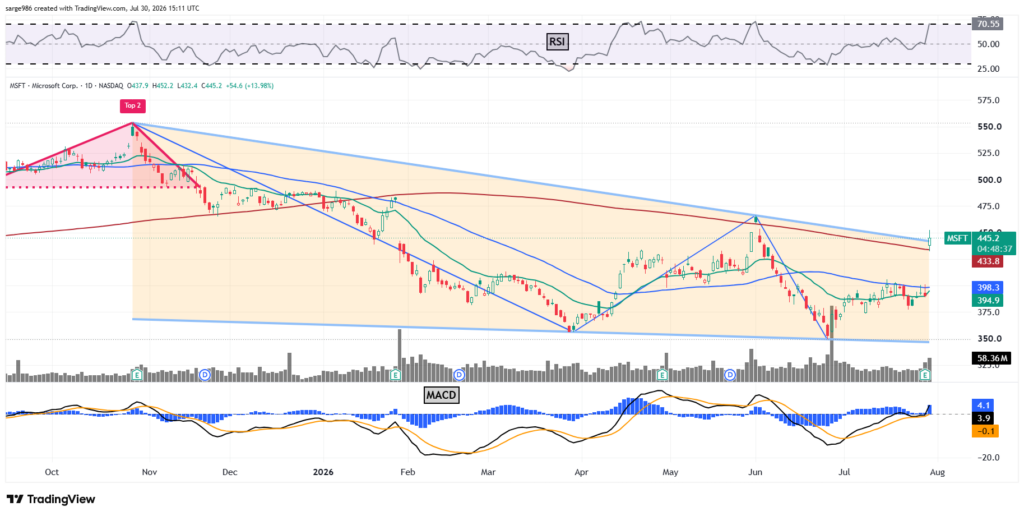
Readers will see that MSFT is trying to break out of the falling wedge pattern of bullish reversal that we discussed this past Monday. In reaching for that level, the stock has retaken its 200-day simple moving average (SMA). That becomes our new pivot and forces us to increase our price target as now professional managers will feel like they have to increase long-side exposure.
Both Relative Strength and the daily moving average convergence divergence (MACD) are suddenly much more bullish looking for obvious reasons.
Price Target: $532 (up from $488)
Pivot: 200-day SMA (currently $434)
Add: Down to 50-day SMA (currently $398).
Panic: Loss of the wedge
At the time of publication, Guilfoyle was long MSFT, MU equity.