Hold To Maturity? Take a Closer Look at Your Bond ETF
These bond ETFs may be suitable for many investors, but they aren’t entirely risk-free.
You've reached your free article limit
You've read 0 of 1 free Pro articles.
Wall Street has spent a decade dressing up equity index funds as something safer than they are. Now it’s bond ladders’ turn for a makeover.
Northern Trust just added eight new maturities to its Distributing Ladder ETF suite, letting investors buy a “maturity date” the way they’d buy an individual bond. These ETFs come in 5-, 10-, 20- and 30-year maturities, with holdings split across Treasury Inflation-Protected Securities (TIPS) and municipal bonds.
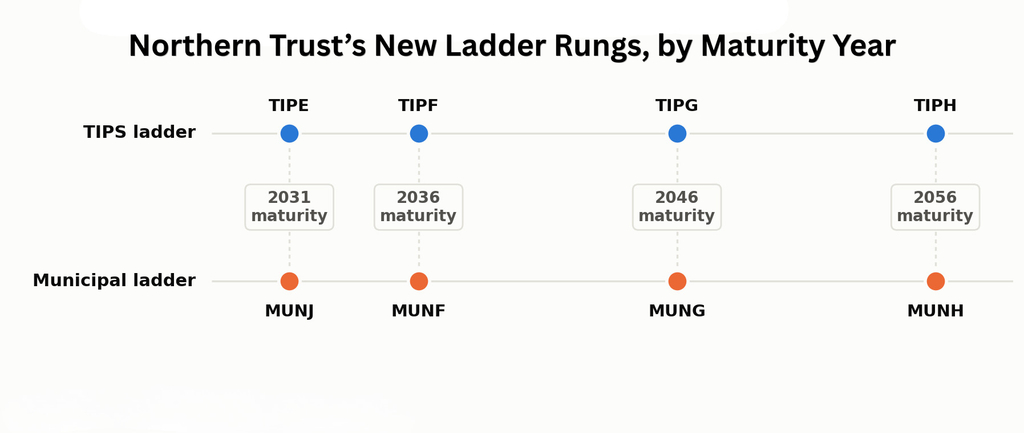
The pitch behind these new products is matching a fund to a future date when you’ll need income, then collect the interest until the fund winds down and returns your principal.
Having a predictable retirement income stream isn’t a bad thing, and these funds may be suitable for some savers, and they certainly sound simple and convenient
But what downsides should investors understand when putting money into one of these ETFs?
An ETF Is Not a Bond
For starters, it’s important to separate the two types of investments. Investors understand that the Vanguard S&P 500 ETF (VOO) is not a stock, but a fund that measures performance of a basket of stocks.
Similarly, a fixed-income ETF is a wrapper around bond holdings. It isn’t a bond, but the promise of interest income paid out at specific intervals could lead some to believe their ETF will behave like a single bond held to maturity.
“There’s still a meaningful distinction between owning an individual bond to maturity and owning a fund that holds bonds with defined maturities,” said Trent Von Ahsen, CFP and managing partner at Cedar Point Capital Partners in Cedar Rapids, Iowa.
The Wrapper Changes the Rules
“The danger is confusing a maturity schedule with a principal guarantee,” Von Ahsen added. “They’re not the same.”
The reason comes down to structure: Unlike a single bond, an ETF has to keep moving money in and out.
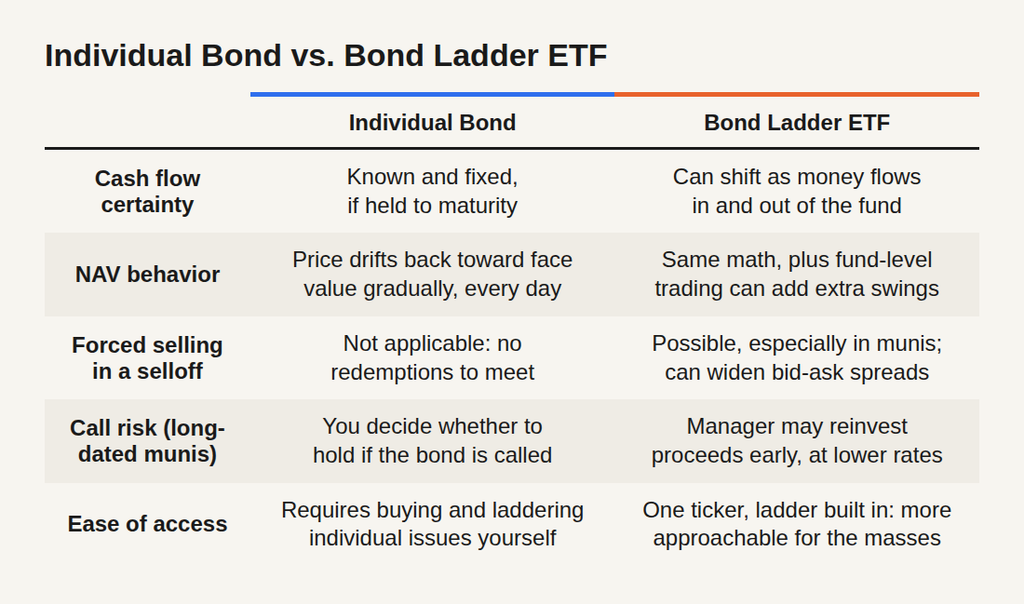
“When an investor buys an individual bond and holds to maturity, their cash flows are known,” said Ken Bellinger, fixed income analyst at Johnson Financial Group, headquartered in Racine, Wisconsin.
“An ETF structure doesn’t necessarily provide that comfort,” he added. “As cash flows enter and exit the fund, there’s buying and selling of the underlying securities, which can impact performance and expected cash flows over time.”
An ETF’s holdings make a difference, too, when it comes to redemptions.
“That concern is probably more significant with municipal bonds than highly liquid treasury securities like TIPS,” Von Ahsen said.
How the Mechanism Works
When investors put money into the ETF, the manager has to go buy more bonds to match those deposits. When investors pull money out, the manager has to sell bonds to raise the cash, whether or not it’s a good time to sell.
So, the actual bonds backing your shares aren’t fixed in place the way they would be if you bought one bond yourself and held it in a drawer (OK, really it would be in your Schwab or Fidelity account).
The ETF basket keeps getting resized by everyone else’s buying and selling, not just your own decision to hold. If a wave of redemptions hits during a selloff, the manager may be forced to sell into a weak, illiquid market. That could drag the fund’s per-share value, called Net Asset Value (NAV), down for everyone holding it. In turn, that can shift your expected income, even though you personally never sold a single share.
Maturity Day Isn’t Magic
Tom Graff, chief investment officer at Facet Wealth, pointed out that the supposed ease and comfort of “hold to maturity” is a myth even for a single bond, let alone a fund.
His reasoning has nothing to do with the calendar. When a bond loses value because rates rise, he said, that loss doesn’t sit there waiting for maturity day to fix it. It gets recovered gradually, in even amounts, over the life of the bond. As Graff put it: “The day of maturity has no special properties.”
You still get paid at maturity; that part is real. But Graff’s point is just that maturity doesn’t magically undo any losses along the way: A bond’s price drifts back toward face value gradually, a little each day, so by maturity there’s nothing left to “fix.” The pricing has already fixed itself.
“In fact, the last year of a bond is usually its worst yielding year,” he added.
This is because shorter-term bonds generally yield less than longer-term bonds.
“So as a bond ages naturally, its yield is declining. That actually results in small price appreciation as the bond goes from five years to four years to three years to maturity,” he said. “By the time you get to the last year, there’s no appreciation left to be had.”
In other words, holding a bond to maturity, regardless of whether you own it outright or in a fund, is likely to harm your return.
“The supposed safety is entirely psychological,” Graff added.
Understand What You’re Buying
These ETFs may be sound additions to a portfolio, but investors should weigh all the pros, cons and possible downsides. That’s actually the case with every investment, not just the Northern Trust ETFs.
“Bond ladders have an illustrious history in financial planning, and they can be very useful in retirement because you’re matching assets with future spending needs,” Von Ahsen said. “Packaging that into an ETF can make implementation a lot more approachable for the masses.”